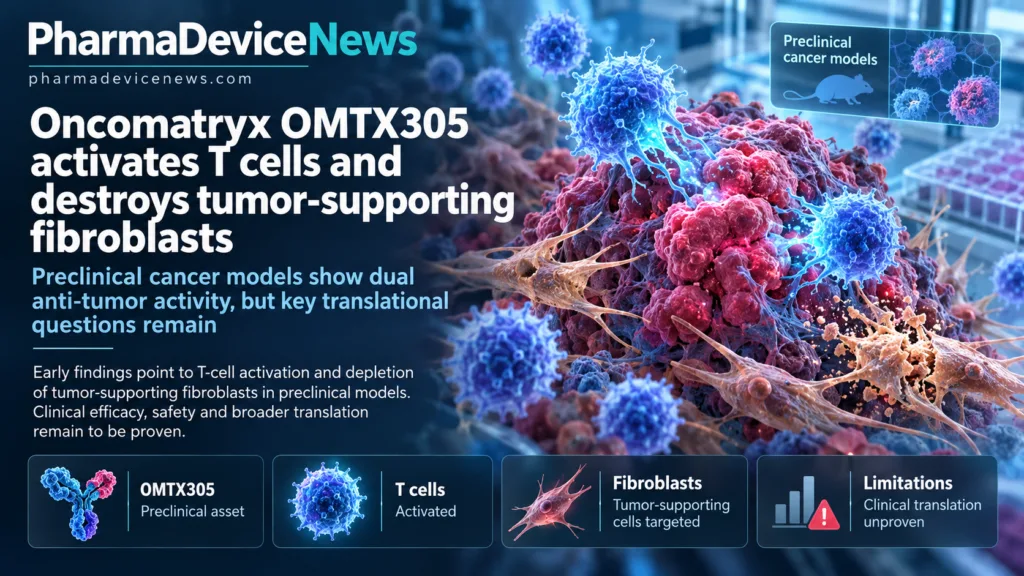
Spanish biotechnology company Oncomatryx has highlighted peer-reviewed preclinical findings showing that its investigational bispecific antibody OMTX305 can activate immune cells against cancer-associated fibroblasts and induce death in neighbouring tumor cells in selected patient-derived cancer models. The research, published in Science Advances on September 11, 2026, and highlighted by the company on October 9, examined tumor tissue from 15 patients with lung or ovarian cancer, providing evidence for a treatment strategy that targets the tumor microenvironment rather than directly recognising malignant cells.
The central finding was a reduction in the proportion of tissue occupied by fibroblast activation protein-positive regions from 38.2% to 24.2% following three days of experimental treatment. Researchers also observed activation of tumor-associated T cells, changes in the surrounding stromal environment and increased tumor cell apoptosis in a subset of samples. These findings strengthen the biological rationale for fibroblast-directed immunotherapy, although they do not demonstrate that OMTX305 can shrink tumors or improve outcomes in living patients.
The distinction is important because the experiments involved surgically removed tumor tissue maintained under laboratory conditions, not patients receiving OMTX305 as a treatment. The study offers a more biologically complex assessment than conventional cancer cell cultures by preserving important features of the original tumor architecture and immune environment. However, its short observation period, small patient sample and variable responses leave substantial questions about safety, treatment durability and the ability to reproduce the findings in clinical trials.
What did the OMTX305 study reveal about killing cancer-associated fibroblasts in lung and ovarian tumors?
The research was conducted through a collaboration involving Oncomatryx, the Dr. Margarete Fischer-Bosch Institute of Clinical Pharmacology and the University of Tübingen, alongside other German research institutions. Led by Meng Dong, with Julia Thiel as first author, the study investigated OMTX305 using cell cultures, three-dimensional tumor models and precision-cut slices obtained from patients undergoing cancer surgery. The patient-derived tissue experiments included five non-small cell lung cancer samples and ten high-grade serous ovarian cancer samples.
The precision-cut tumor slices were particularly important because they preserved aspects of the cellular organisation and stromal architecture that are often lost in conventional laboratory cultures. Researchers exposed the samples to OMTX305, with or without immune cells isolated from the same patients, and assessed the resulting changes over a period of up to three days. Measurements included cell viability, T-cell activation, fibroblast depletion, molecular signalling and the location of dying cells relative to fibroblast-rich tumor regions.
In the tissue experiments, the proportion of the sampled area expressing fibroblast activation protein, known as FAP, declined from 38.2% to 24.2%. This represents a reduction of 14 percentage points in the measured FAP-positive area, rather than a 14% reduction in total tumor size. A separate viability assessment involving seven patient samples found that adenosine triphosphate levels fell to 69.6% of the control level, providing additional evidence of treatment-associated changes in cellular viability within the experimental system.
The findings also showed that treatment could affect malignant cells despite OMTX305 primarily targeting surrounding fibroblasts. Researchers identified increased apoptosis among cancer cells in some samples, with dying tumor cells located significantly closer to FAP-positive regions than surviving cells. The spatial relationship supports a possible secondary killing mechanism, although the experimental observations do not establish the degree to which this effect would contribute to tumor regression in patients.
How does the OMTX305 FAP CD3 bispecific antibody activate immune cells against the tumor microenvironment?
OMTX305 is a bispecific T-cell-engaging antibody designed to recognise two different molecular targets. One binding component recognises FAP, a protein associated with certain cancer-supporting fibroblasts, while the other interacts with CD3 on T cells. This configuration brings immune effector cells into proximity with targeted fibroblasts, creating an opportunity for local T-cell activation and the destruction of those stromal cells.
The antibody uses a trivalent molecular architecture incorporating two FAP-binding components and one CD3-binding component. This design is intended to support target recognition and immune-cell engagement without relying on the cancer cell itself to express the antigen recognised by the treatment. The approach is particularly relevant to solid tumors where malignant cells are surrounded by dense supporting tissues that can interfere with immune-cell movement and therapeutic activity.
Cancer-associated fibroblasts are involved in multiple biological processes that influence tumor behaviour, including extracellular matrix production, inflammatory signalling and interactions with immune cells. Some fibroblast populations contribute to an environment that protects malignant cells or limits the effectiveness of existing therapies. By targeting selected fibroblast populations, OMTX305 seeks to interfere with these supporting mechanisms while redirecting the immune system toward cells within the tumor’s surrounding structure.
Laboratory experiments demonstrated that OMTX305-mediated cytotoxicity depended on both FAP expression and the presence of immune cells. FAP-negative cancer cells did not show comparable direct sensitivity to the antibody in simplified culture systems, supporting the intended target-dependent mechanism. In more complex models containing both fibroblasts and cancer cells, however, treatment was associated with increased apoptosis among neighbouring malignant cells, suggesting that immune activation against the stromal compartment can extend its effects beyond the original target.
Why could bystander killing offer a different route to treating difficult solid tumors?
The observation of neighbouring cancer cell death is among the most scientifically interesting aspects of the study because it suggests a route to antitumor activity that does not depend exclusively on recognising antigens expressed by malignant cells. Many targeted therapies require cancer cells to carry a particular molecular feature, and variation in target expression can complicate treatment. A stromal-targeting approach could potentially affect tumor regions where the cancer cells themselves lack the antibody’s primary binding target.
The researchers detected increased production of molecules associated with cytotoxic immune activity, including granzyme B, perforin and interferon gamma. They also observed changes involving Fas ligand, another component of immune-mediated cell death signalling. These findings support a biological explanation in which activated T cells and locally released inflammatory mediators contribute to apoptosis among cells near the targeted fibroblasts.
The spatial analysis found that apoptotic tumor cells were typically located approximately 10 to 100 micrometres from FAP-positive regions. This proximity is consistent with a locally mediated effect, but it does not independently prove that any single immune mediator caused the observed cancer cell death. The findings are therefore best understood as mechanistic evidence supporting potential bystander activity rather than confirmation of a defined clinical antitumor mechanism.
The study also detected changes in gene expression associated with extracellular matrix remodelling. In selected fibroblast populations, treatment was associated with reduced expression of certain collagen-related genes and increased expression of matrix metalloproteinases. These changes could influence the structure of the tumor microenvironment over time, although the three-day experimental period was too short to establish lasting tissue remodelling or improved penetration of subsequent therapies.
Could immune infiltration and PD-L1 expression help identify tumors most likely to respond to OMTX305?
The investigation found considerable variability in treatment responses between patient-derived samples, indicating that the presence of FAP-positive fibroblasts may not be sufficient to predict the magnitude of antitumor activity. The functional state and distribution of T cells appeared to influence how effectively OMTX305 activated local immune responses. This observation is important for a therapeutic strategy that depends on recruiting existing immune cells rather than delivering a conventional cytotoxic payload.
Among the ten ovarian cancer samples, researchers identified tumors with different patterns of immune infiltration, including immune-desert, immune-excluded and immune-inflamed characteristics. Samples with pre-existing T-cell infiltration generally demonstrated more pronounced immune activation, although downstream cell death varied. One immune-desert ovarian tumor lacked detectable T-cell infiltration and did not produce a meaningful response in the assessed activation and apoptosis measurements.
The five lung cancer samples were classified as immune-inflamed, but their responses were not uniform. Researchers explored whether programmed death-ligand 1, or PD-L1, expression might help explain differences in sensitivity, observing that one sample with very high PD-L1 expression did not demonstrate the expected activation and apoptosis response. Another sample with little detectable PD-L1 expression showed a relatively strong apoptotic response, although interpretation was complicated by the small FAP-positive area.
These observations generate hypotheses about future biomarker development, but the sample sizes were insufficient to validate PD-L1 expression or immune phenotype as predictors of treatment success. PD-L1 status cannot currently be used to select patients for OMTX305 on the basis of this research. Larger studies would be required to establish whether combinations of FAP expression, T-cell distribution and immune signalling markers can reliably identify responsive tumor populations.
What are the safety and clinical limitations of targeting FAP-positive fibroblasts?
The laboratory findings provide early evidence of target selectivity, but they do not establish the safety of OMTX305 in humans. Tissue cross-reactivity experiments involving the antibody’s FAP-binding sequence did not identify specific staining in the healthy human tissues examined. This is relevant to the potential for unwanted binding outside tumors, although the absence of detectable staining in a laboratory assessment cannot rule out toxicity under conditions of systemic drug exposure.
FAP expression is also biologically more complex than a simple distinction between healthy and malignant tissue. Fibroblasts participate in normal tissue maintenance, repair and remodelling, and different cancer-associated fibroblast populations can have distinct functions. Some fibroblast subsets may restrain aspects of tumor progression, making selective targeting important when developing therapies intended to alter the supporting tissue rather than attack malignant cells directly.
The study’s immune activation findings introduce additional questions concerning cytokine-related toxicity and unintended immune effects. Bispecific antibodies that engage T cells can produce clinically significant immune activation, although the severity and characteristics of such effects depend on the individual molecule, its targets, dose and treatment setting. OMTX305 has not yet established a human safety profile, so adverse-event rates or tolerability cannot be inferred from its activity in cultured tumor slices.
Another limitation involves the behaviour of T cells during the experiments. Although treatment increased markers of immune activation, the researchers observed a reduction in T-cell density after three days in the precision-cut tumor slices. They considered several possible explanations, including effects associated with sustained immune activation, but the experimental design did not establish the longer-term consequences for T-cell function.
These findings illustrate why laboratory destruction of tumor-supporting cells is not equivalent to demonstrated therapeutic benefit. A living tumor interacts continuously with circulating immune cells, surrounding organs, blood vessels and systemic inflammatory processes that cannot be fully reproduced in short-term tissue culture. Before any clinical conclusions can be drawn, OMTX305 would require appropriate pharmacology, toxicology, dose-selection and human studies.
How does OMTX305 differ from Oncomatryx’s clinical-stage antibody-drug conjugate OMTX705?
An important distinction within the Oncomatryx portfolio is that OMTX305 and OMTX705 use different therapeutic mechanisms, despite sharing the broader strategy of targeting the tumor microenvironment. OMTX305 is a research-stage bispecific antibody designed to recruit T cells against FAP-expressing fibroblasts. OMTX705 is an investigational antibody-drug conjugate that targets FAP-positive stromal cells to deliver a cytotoxic drug payload.
OMTX705 has progressed into human clinical development, with programmes evaluating the product in advanced solid tumors and combination treatment strategies. Oncomatryx identifies the candidate as being in Phase 1b/2 development, including work involving pancreatic cancer, colorectal cancer, lung cancer and sarcomas. Its clinical progress should not be confused with the preclinical status of OMTX305, and the latest bispecific antibody study does not provide new patient efficacy or safety results for OMTX705.
The distinction also affects how the two mechanisms might perform in different biological settings. OMTX705 relies on targeted delivery of a cytotoxic compound, while OMTX305 requires functional T cells capable of responding to CD3 engagement. Tumors with limited immune infiltration or severely impaired T-cell activity may therefore present particular challenges for the bispecific antibody strategy, whereas antibody-drug conjugates face their own requirements involving target expression, cellular uptake, payload activity and drug distribution.
Oncomatryx has also pursued external development relationships around OMTX705. In July 2026, the company disclosed that the product had been selected for preclinical combination research involving InxMed and HanchorBio, examining its potential alongside other investigational oncology approaches. InxMed holds licensing rights to OMTX705 across specified Asian territories, providing an example of how Oncomatryx is seeking to extend the commercial reach of its FAP-targeting technology.
The new OMTX305 findings contribute to that broader scientific strategy by demonstrating a different way of exploiting the same stromal target. However, the published experiments do not establish that the two candidates have interchangeable activity, comparable safety or equivalent development prospects. Each programme will require its own evidence package, and positive mechanistic findings for one cannot substitute for clinical validation of the other.
What development steps would be necessary before OMTX305 could enter clinical trials?
OMTX305 remains at a preclinical research stage, and the latest publication does not announce the initiation of a human trial or the receipt of regulatory permission for clinical testing. The study provides a mechanistic foundation for further development, but it does not specify a clinical starting dose, treatment schedule, proposed indication or formal regulatory submission timetable. Any move toward first-in-human testing would require a development package appropriate to the molecule and its intended patient population.
Further research would need to establish how the antibody behaves following administration, including its distribution, duration of exposure and ability to reach relevant stromal targets. Investigators would also need to assess potential effects on normal tissues, systemic immune activation and the consequences of repeated treatment. These requirements are especially important for a drug designed to engage T cells against a target associated with tissue remodelling and certain nonmalignant biological processes.
Patient selection represents another critical development challenge. The current findings suggest that tumors with FAP-positive fibroblasts and a functional local immune population may be more responsive, but neither characteristic has been validated as a clinical selection criterion. Expanding the research to larger collections of patient-derived samples could help establish whether particular tumor types, stromal features or immune signatures consistently influence treatment activity.
The researchers also identified a rationale for investigating combination strategies involving immune checkpoint inhibition or additional T-cell stimulation. Such combinations might address situations in which pre-existing immune exhaustion or inadequate T-cell recruitment restricts the effectiveness of OMTX305. However, any potential improvement in antitumor activity would need to be balanced against the possibility of greater immune-related toxicity, making carefully designed preclinical studies essential before combination treatment could be evaluated in patients.
Why does the Oncomatryx research matter for the wider cancer immunotherapy pipeline?
The significance of the study extends beyond an individual investigational antibody because it contributes to a wider effort to understand how the tumor microenvironment influences treatment resistance. Many immunotherapy strategies have focused on activating immune cells against malignant cells, while stromal-targeting approaches seek to address the surrounding biological structures that influence whether those immune cells can function effectively. The Oncomatryx research provides experimental evidence that targeting one component of that environment can generate secondary effects on adjacent cancer cells.
The work also demonstrates the potential value of patient-derived tissue models for investigating immunotherapy mechanisms before clinical trials. By preserving aspects of the original tumor structure and combining tissue analysis with immune profiling, researchers were able to observe differences that might be less apparent in simplified cell cultures. Such models could contribute to early drug selection and biomarker research, although their ability to predict actual patient treatment outcomes remains to be established.
For biotechnology developers, targeting the tumor microenvironment offers several possible therapeutic directions, including antibody-drug conjugates, bispecific immune engagers and other forms of targeted delivery. The challenge is to identify which cellular populations can be modified without compromising useful immune or tissue functions. A therapy that is active in fibroblast-rich laboratory models may still face substantial barriers involving patient heterogeneity, systemic exposure and the complexity of human tumor biology.
The peer-reviewed OMTX305 findings establish a meaningful preclinical advance by connecting FAP-targeted immune activation with fibroblast destruction and nearby tumor cell apoptosis in selected human tumor tissue samples. They do not yet establish tumor shrinkage, improved survival or acceptable safety in treated patients, and the observed variation between samples makes patient selection a central question for future development. For Oncomatryx, the next scientific milestone will be demonstrating that the mechanism is sufficiently reproducible, selective and tolerable to support clinical investigation, while identifying the tumor environments in which this approach is most likely to produce a sustained therapeutic effect.