Nihon Kohden Corporation has introduced three capabilities for its United States-manufactured NKV-550 Series Ventilator System: estimated non-invasive muscle-pressure monitoring, Adaptive Ventilation Mode and adjustable AdaptiveSync technology. Announced through Nihon Kohden America on July 15, 2026, the upgrade is intended to give intensive-care teams a more integrated view of patient effort, lung mechanics and patient-ventilator synchrony.
The clinical proposition is significant because mechanical ventilation involves two competing risks. Too much assistance can expose the lungs to injurious pressure and energy while allowing the diaphragm to weaken. Too little support can force a patient to generate excessive respiratory effort, potentially aggravating lung stress and delaying successful liberation from the ventilator.
Nihon Kohden is attempting to bring those considerations together on one platform. However, the announcement establishes commercial availability, not proof that the combined features improve survival, shorten ventilation or accelerate discharge. No NKV-550-specific comparative clinical trial or patient-outcome dataset accompanied the disclosure, making real-world validation the next important test.
What is genuinely new about combining Pmus, AVM and adjustable synchrony on one ventilator?
The three capabilities address different parts of the same respiratory-support problem. Muscle pressure, commonly expressed as Pmus, estimates the pressure generated by a patient’s inspiratory muscles. Adaptive Ventilation Mode adjusts ventilation parameters in response to measured respiratory mechanics. AdaptiveSync manages when supported breaths begin and end so that ventilator assistance better follows the patient’s spontaneous effort.
These functions are potentially more useful together than as isolated measurements. A ventilator could theoretically deliver technically acceptable tidal volumes and airway pressures while missing the fact that the patient is generating excessive muscular effort. Conversely, reducing patient effort too aggressively could produce over-assistance, diaphragm inactivity and prolonged dependence on mechanical support.
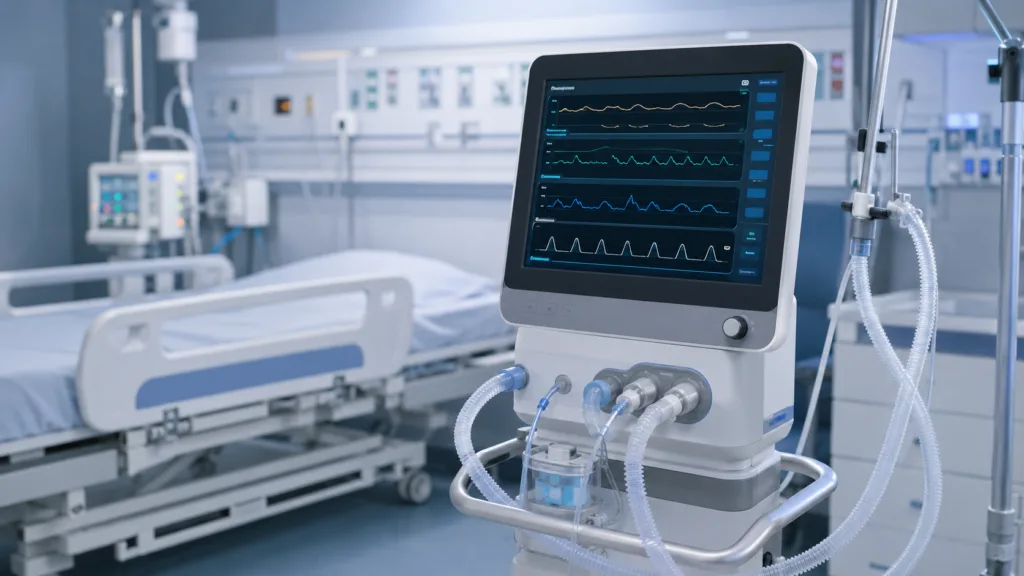
The NKV-550 displays estimated Pmus as a breath-by-breath waveform and numerical value, according to Nihon Kohden. The system does not require an oesophageal balloon catheter, electrical catheter or separate bedside device for this estimate. That reduces an important practical barrier because invasive respiratory-effort measurements require placement expertise, additional equipment and continued attention to signal quality.
Nihon Kohden describes the upgraded system as the first ventilator to combine non-invasive Pmus monitoring, Adaptive Ventilation Mode and adjustable synchronisation. That remains a company positioning claim rather than an independently established market comparison. Adaptive modes, respiratory-effort indicators and synchronisation tools exist elsewhere in critical-care ventilation, so the differentiating question is whether this particular integration produces better visibility and more actionable bedside decisions.
Why could estimated muscle pressure matter during assisted ventilation and weaning?
Clinicians routinely assess respiratory rate, tidal volume, airway pressure, blood gases, oxygenation, accessory-muscle use and chest movement when judging whether a patient is receiving appropriate support. Those indicators remain important, but they may not reveal the full amount of muscular pressure that the patient generates during each breath.
A patient can appear synchronised with the ventilator while still working harder than desirable. Visual assessment can also be complicated by obesity, weakness, altered chest-wall mechanics, sedation or subtle respiratory movement. Continuous effort estimation could therefore add information between intermittent clinical assessments and more invasive physiological monitoring.
Nihon Kohden presents 5 to 10 centimetres of water as a target Pmus range associated with productive respiratory activity. Values below that zone may suggest excessive unloading and limited diaphragm activation, while higher values may indicate excessive effort. The range should not be treated as a universal treatment threshold for every patient, diagnosis or stage of ventilation. Respiratory mechanics, sedation, lung injury, chest-wall characteristics and the mode of support can all influence interpretation.
The crucial technical detail is that the NKV-550 estimates Pmus. It does not directly measure pleural pressure or muscular pressure through an oesophageal catheter. An estimate may still be clinically useful, particularly for continuous trend monitoring, but clinicians will need to understand how the algorithm performs across different patient groups, ventilation modes and respiratory patterns.
The announcement did not disclose performance characteristics such as bias, limits of agreement, sensitivity for excessive effort, false-alert rates or comparison against oesophageal manometry. Those data would help hospitals determine whether the feature is most appropriate for screening, trending, titration support or more definitive physiological assessment.
How does Adaptive Ventilation Mode respond to changing lung mechanics and patient support needs?
Adaptive Ventilation Mode continuously calculates and adjusts respiratory rate, tidal volume and pressure support based on the patient’s measured lung mechanics. Nihon Kohden says the mode can follow a patient from fuller ventilatory assistance through weaning without repeated mode changes and constant manual retitration.
The potential operational benefit is less about eliminating clinical intervention and more about reducing repetitive adjustments between formal assessments. Respiratory mechanics can change with disease progression, treatment, body position, secretion management, sedation and spontaneous effort. A responsive mode may adapt more quickly than a fixed set of parameters left unchanged between bedside reviews.
Nihon Kohden has incorporated driving pressure and mechanical power into the mode’s lung-protection framework. Driving pressure reflects the pressure associated with delivering a breath, while mechanical power considers the energy transferred to the respiratory system over time. These metrics can provide a broader view of mechanical exposure than tidal volume alone.
The ventilator calculates mechanical power automatically for each breath, potentially removing manual calculation from routine workflow. Yet automated calculation does not establish that a specific displayed value should trigger the same intervention in every patient. The clinical significance still depends on diagnosis, lung recruitability, respiratory-system compliance and other bedside findings.
Adaptive ventilation also creates an oversight requirement. Clinicians must understand what parameter the system is changing, which limits are configurable and how the mode responds when respiratory mechanics become unstable. Automation can reduce routine workload, but unclear automation can create a different workload centred on interpreting why a system changed support.
Can adjustable AdaptiveSync reduce patient-ventilator dyssynchrony without encouraging over-assistance?
Patient-ventilator dyssynchrony occurs when mechanical assistance does not align properly with the patient’s neural respiratory timing. A ventilator may trigger too late, fail to detect an effort, terminate support prematurely or continue delivering pressure after the patient has begun to exhale.
Nihon Kohden says AdaptiveSync uses multiple detection methods and adjusts continuously to respiratory mechanics. Its sensitivity can be tuned instead of being limited to a binary setting. This could be useful because a configuration that responds well for one patient may be too sensitive or insufficiently responsive for another.
Better synchronisation could reduce uncomfortable or ineffective breaths and may help clinicians avoid escalating sedation solely to make a patient conform to the ventilator. However, the broader evidence linking dyssynchrony with longer ventilation, sedation exposure and lung injury does not independently prove that AdaptiveSync changes those outcomes.
The feature must demonstrate that it detects clinically relevant dyssynchrony reliably without creating inappropriate triggering, cycling or support. Performance may vary in the presence of leaks, irregular respiratory drive, weak effort, secretions, cardiac oscillations and non-invasive ventilation interfaces.
The most valuable use may therefore be the combination of synchronisation with effort monitoring. A breath can be well timed but still involve excessive muscular work. Conversely, a lower Pmus estimate does not necessarily mean that timing is appropriate. Displaying both dimensions may offer a more complete assessment than either measurement alone.
What does the United States regulatory record establish for the upgraded NKV-550?
The NKV-550 is a prescription Class II continuous ventilator intended to provide invasive or non-invasive respiratory support for adult, paediatric and neonatal patients in hospitals, hospital-type facilities and during in-hospital transportation.
The United States Food and Drug Administration’s 2024 510(k) record specifically describes the addition of Adaptive Ventilation Mode, Adaptive Trigger and Adaptive Cycle as software functions. The regulator determined the modified system to be substantially equivalent to legally marketed predicate devices on March 1, 2024.
The clearance retained the NKV-550’s existing intended use. It did not represent an authorisation for a new disease indication or proof that the adaptive functions improve clinical outcomes. The regulatory summary states that software verification, bench comparison, device-function testing, risk management, usability testing and regression testing supported the submission. Clinical performance data were not required to demonstrate substantial equivalence.
The commercial AdaptiveSync description focuses on adaptive triggering and cycling, although hospitals should rely on the current labelling and instructions for use when determining the exact relationship between the regulatory terminology and the marketed feature.
The July 2026 announcement did not identify a separate 510(k) number for non-invasive Pmus monitoring. That absence does not automatically mean another premarket submission was required, since manufacturers may implement some device changes under documented design-control processes without filing a new 510(k). It does mean that the precise regulatory basis, labelled function and validated operating conditions for the Pmus estimate should be confirmed from the current product documentation rather than inferred from the announcement.
Will non-invasive Pmus estimation require independent clinical validation before broader adoption?
Regulatory clearance and technical availability are only the beginning of the hospital-adoption process. Respiratory therapists, intensivists and procurement committees will want to know whether the estimate remains reliable across the patients most likely to present interpretation difficulties.
Useful validation would compare NKV-550 estimates against an accepted reference method across a sufficiently varied intensive-care population. Studies would ideally examine adults with different causes of respiratory failure, altered chest-wall mechanics, weak respiratory drive and high spontaneous effort. Separate evaluation may be needed for paediatric and neonatal patients because the device’s cleared population spans all three age groups.
Prospective studies could also assess whether displaying continuous Pmus changes clinician behaviour. A technically accurate waveform has limited value if it does not influence support adjustments, recognition of excessive effort or weaning decisions. The more demanding question is whether those changes improve clinically meaningful outcomes without increasing alarms, unnecessary intervention or time spent interpreting new data.
A randomised outcomes trial may not be necessary before the feature can provide practical bedside value. Nevertheless, the strength of commercial claims should remain proportionate to the evidence. Until comparative data are available, the upgrade is best understood as a decision-support and workflow development rather than demonstrated proof of safer ventilation.
How could United States manufacturing influence hospital procurement and commercial execution?
Nihon Kohden manufactures the NKV-550 in the United States through Nihon Kohden OrangeMed. Domestic production could support customer confidence around servicing, replacement components, technical support and supply continuity, particularly as hospitals reassess dependence on geographically concentrated medical-device supply chains.
Manufacturing location alone does not guarantee availability or shorter lead times. Nihon Kohden has not disclosed the production capacity attached to the upgrade, the size of the installed base eligible for it or whether all existing NKV-550 units can receive the capabilities through software installation.
The platform already uses an application-based architecture that allows additional functions to be installed, and its broader configuration supports invasive ventilation, non-invasive ventilation and high-flow oxygen therapy. That creates a potentially attractive upgrade model because a hospital may be able to add clinical functions without replacing an entire ventilator fleet.
Commercial adoption will still depend on pricing, licence terms, upgrade compatibility, training, service coverage and integration with each institution’s ventilation protocols. Procurement teams will also consider how the new values are captured in clinical documentation and whether information can move reliably into patient-monitoring or hospital information systems.
Training will be particularly important. Introducing another respiratory-effort value without a shared interpretation protocol could produce inconsistent responses between clinicians. Nihon Kohden will need to support not only operation of the feature but also institution-level agreement on acceptable ranges, alarm settings, intervention pathways and circumstances in which a direct measurement remains appropriate.
What measurable developments will determine whether the NKV-550 upgrade changes ICU practice?
The NKV-550 upgrade addresses a genuine clinical blind spot: the difficulty of continuously assessing how much muscular pressure a patient generates while receiving assisted ventilation. Its integrated design is commercially credible because it combines observation, automated adjustment and synchronisation within an existing critical-care platform.
The next evidence should move beyond descriptions of what the software calculates. Hospitals need validation against reference measurements, subgroup performance, clinician-response studies and transparent information about failure conditions. Data showing fewer manual adjustments or more consistent recognition of excessive effort would support the workflow argument, even before harder patient outcomes are established.
Nihon Kohden must also clarify the Pmus feature’s regulatory documentation, software-upgrade pathway and availability across the installed NKV-550 base. If the company can demonstrate that the estimate is dependable, interpretable and operationally useful, the upgrade could strengthen the NKV-550’s position in competitive ventilator procurement.
Until then, the development represents a technically ambitious expansion of bedside respiratory monitoring. Its ultimate value will depend on whether clinicians can trust the estimate, understand the automation and translate both into safer, more consistent ventilation decisions.