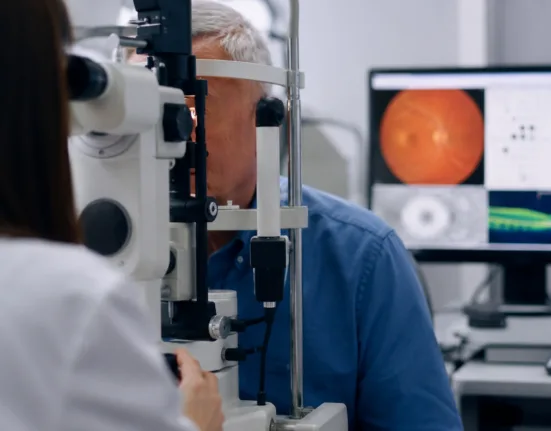
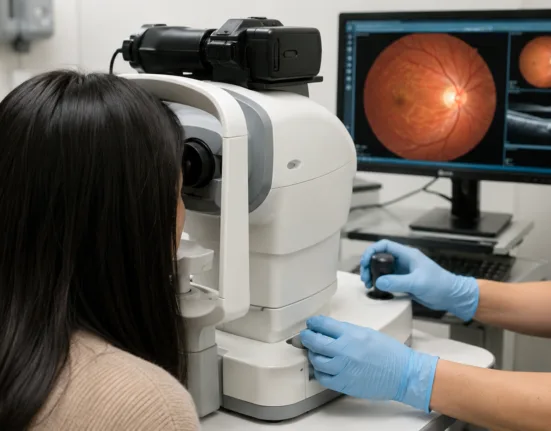
PerZeption Inc. has announced a research collaboration with Alcon Research focused on AIM+ CSF modeling, a vision assessment technology designed to detect clinically meaningful differences in contrast sensitivity more efficiently. The U.S.-based ophthalmology technology startup is presenting validation data at the Association for Research in Vision and Ophthalmology annual meeting, positioning the platform within the broader shift toward faster, adaptive and lower-burden visual performance evaluation.
Why faster contrast sensitivity testing could matter beyond standard visual acuity scores
The core significance of the PerZeption and Alcon Research collaboration is not that another digital vision test is being shown at a scientific meeting. The more important point is that contrast sensitivity is gaining greater attention as ophthalmology research looks beyond conventional high-contrast visual acuity to understand how patients actually perform in real-world visual environments.
Visual acuity remains the best-known clinical measure because it is familiar, standardized and relatively easy to interpret. However, it does not always capture problems such as poor vision in low contrast, glare, dim lighting, fog, night driving conditions or subtle optical quality differences after vision correction procedures. This is especially relevant in intraocular lenses, refractive technologies and other vision correction products where two patients may read similar letters on a chart but report different quality-of-vision experiences.
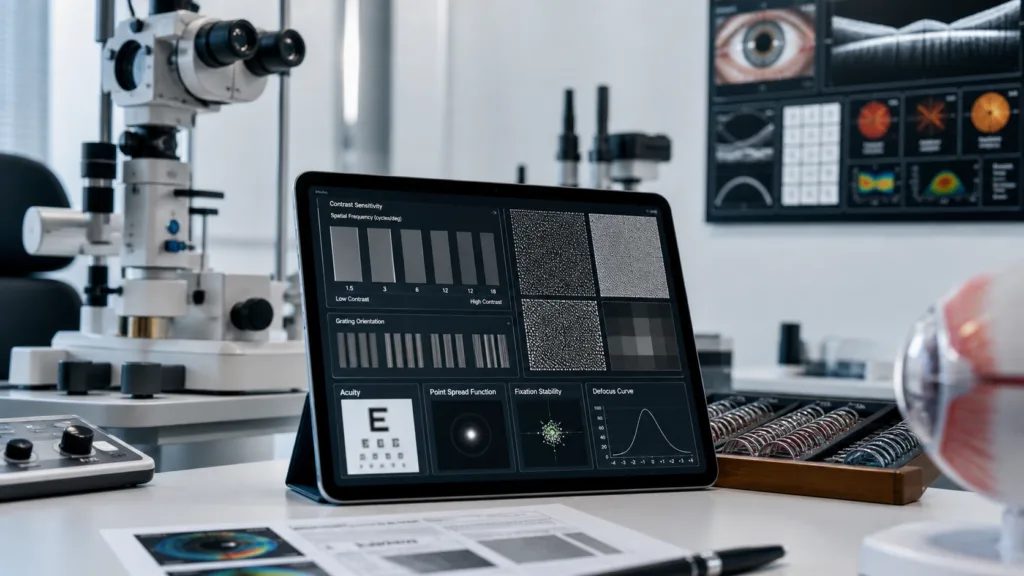
PerZeption’s AIM+ CSF approach enters this gap by targeting the contrast sensitivity function, which maps how well a person detects contrast across visual conditions. For researchers and device developers, that matters because smaller but clinically meaningful differences can be difficult to detect if testing is slow, inconsistent or too burdensome for trial participants. The unresolved question is whether adaptive digital testing can deliver enough precision and reproducibility across broader study settings to influence trial design, regulatory evidence packages and commercial product differentiation.
What PerZeption’s AIM+ CSF model changes in visual performance evaluation
PerZeption’s disclosed data suggest that AIM+ CSF modeling may support rapid, repeatable assessment of contrast vision, with testing reportedly completed in less than three minutes and with a low number of adaptive displays and repeats. The claim that roughly 20 subjects could provide 90% power to detect a 1 just noticeable difference change in area under the log contrast sensitivity function is particularly relevant for early-stage research because sample size efficiency can affect study feasibility, cost and iteration speed.
That does not mean AIM+ CSF automatically replaces established contrast sensitivity methods or broader clinical endpoints. It does, however, point to a potential workflow advantage. If a platform can produce stable results quickly on standard tablets or all-in-one computers, it may lower operational barriers for research sites, reduce chair time, and make functional vision testing easier to incorporate into studies that already carry substantial assessment loads.
The limitation is that ophthalmology research is conservative for good reason. A faster tool must prove not only repeatability in controlled settings but also robustness across demographics, ocular conditions, lighting environments, device types, operator variability and study geographies. A three-minute test is attractive, but adoption will depend on whether the data remain consistent when the platform moves from selected validation environments to multicenter, commercially relevant clinical research.
Why the Alcon connection gives the PerZeption data added industry relevance
Alcon Research’s involvement gives the PerZeption announcement strategic weight because Alcon is deeply embedded in ophthalmic surgical devices, contact lenses, intraocular lenses and vision correction research. For a startup developing functional vision testing tools, collaboration with a major ophthalmology player can help signal that the technology is being assessed against practical industry needs rather than only academic curiosity.
The relationship is especially interesting because companies developing premium vision correction technologies increasingly need evidence that goes beyond standard acuity. In a market where product differences can be subtle, contrast sensitivity, visual quality and patient-relevant performance measures can help distinguish one platform from another. A rapid CSF tool could therefore become useful not only in clinical development but also in comparative studies, post-market research and clinician education.
However, the collaboration should not be overread as proof of commercial adoption. Large ophthalmology companies routinely evaluate emerging measurement methods, and only a fraction become embedded in pivotal trials, regulatory submissions or routine commercial research. The next real signal will be whether AIM+ CSF appears in larger datasets, peer-reviewed publications, multicenter studies or product-specific evidence programs where outcomes influence development decisions.
How tablet-based and cloud-delivered testing fits the future of ophthalmology workflows
PerZeption’s broader pitch rests on a familiar but important trend in medical devices and diagnostics: moving specialized assessments from bulky, single-use equipment toward software-enabled, scalable platforms. Its Angular Indication Measurement platform is positioned as a rapid, self-administered and adaptive psychophysical system that can assess multiple visual functions using standard tablets or all-in-one computers.
For clinical research organizations, pharmaceutical companies and ophthalmology device developers, the appeal is obvious. Standardized software delivery can make testing easier to deploy across sites, reduce training burden and improve consistency in data capture. Cloud-based infrastructure can also support remote or hybrid testing models, although clinical-grade validation remains a higher bar than consumer-style convenience.
The risk is that digital vision testing sits at the intersection of software usability, psychophysics, clinical reliability, cybersecurity and regulatory expectations. Any platform used to support trial evidence must show that changes in measured performance reflect real visual differences rather than screen calibration issues, user learning effects, environmental variation or inconsistent administration. That is why the PerZeption data will likely be judged less on novelty alone and more on repeatability, bias control and performance under practical study conditions.
Why contrast sensitivity is becoming more important in vision correction research
The growing interest in contrast sensitivity reflects a wider recognition that vision quality is multidimensional. Cataract surgery, presbyopia correction, refractive procedures and advanced intraocular lenses are all judged increasingly by how patients function across distances and conditions, not only whether they can identify high-contrast letters in a clinic.
This is where CSF-based testing can add value. Area under the log contrast sensitivity function can summarize broader contrast performance, helping researchers quantify visual differences that may be meaningful but not captured by visual acuity alone. In premium ophthalmology markets, that distinction can matter commercially because patients and clinicians often care about night driving, halos, glare, near-to-intermediate performance and daily visual confidence.
Still, contrast sensitivity endpoints can be difficult to standardize across studies. Different tests, luminance conditions, spatial frequencies and reporting methods can make cross-trial comparisons messy. PerZeption’s opportunity is to show that AIM+ CSF can make such testing faster and more repeatable without flattening the nuance that makes contrast sensitivity clinically useful in the first place.
What clinicians and industry observers are likely to watch after ARVO
The next phase for PerZeption will depend on whether the ARVO presentation is followed by broader validation evidence. Clinicians and research teams will likely look for performance across diseased and healthy eyes, repeatability across multiple visits, sensitivity to known visual changes, and comparisons against established testing methods. For a platform aimed at researchers and pharmaceutical companies, evidence of multicenter reliability could be more valuable than a single efficient testing result.
Regulatory relevance will also matter. If AIM+ CSF is used only as an exploratory research tool, the commercial path may be relatively flexible. If it is positioned as a clinical outcome assessment or a tool supporting product claims, the evidentiary burden rises. That distinction will shape how quickly the technology can move from conference visibility to routine use in ophthalmology development programs.
The commercial opportunity is real but not frictionless. Ophthalmology is full of measurement tools that perform well scientifically but struggle to become daily workflow standards. PerZeption’s strongest argument is that reducing test time and burden can unlock more frequent, more scalable functional vision measurement. Its biggest challenge is proving that convenience does not come at the cost of clinical confidence.
Why the PerZeption and Alcon collaboration is incremental today but strategically useful
The PerZeption announcement should be viewed as a validation step rather than a market-changing event. AIM+ CSF is not being presented as a new therapy, a cleared device expansion or a definitive replacement for existing assessment systems. It is a research-facing technology being tested for its ability to detect meaningful visual differences with speed and repeatability.
That makes the development incremental in regulatory terms but potentially important in research infrastructure terms. Better measurement tools can change how therapies and devices are evaluated, especially in fields where traditional endpoints miss patient-relevant differences. In ophthalmology, that could influence how developers assess premium lenses, visual performance technologies, neuro-ophthalmic interventions or disease-modifying retinal therapies where subtle functional outcomes matter.
For PerZeption, the collaboration with Alcon Research gives AIM+ CSF a stronger platform at ARVO and places the startup in front of the right scientific and industry audience. For Alcon Research, the collaboration reflects continued interest in measurement systems that can sharpen how visual performance is quantified. For the broader ophthalmology sector, the real question is whether rapid adaptive testing can become trusted enough to move from poster sessions into decision-grade evidence.