PVP Labs is preparing to present clinical research on Taphalgin, also known as lumekefamide, at the 2026 Military Health System Research Symposium as the biotechnology company seeks to position the investigational peptide analgesic for military surgical, trauma and prolonged field-care settings. The presentation will place Taphalgin before an influential military medicine audience, but it will not change the product’s regulatory status or independently establish that results from elective surgery can be transferred directly to battlefield casualties.
The scheduled presentation is built around a Phase 3 study in 250 adults undergoing abdominal or pelvic surgery. According to the conference abstract, subcutaneous Taphalgin produced greater total pain relief than placebo over the first six hours and met the study’s non-inferiority comparison against promedol, an opioid analgesic related to meperidine. Analgesic activity was reported from about 30 minutes after administration, while adverse events were described as infrequent and mild during the 48-hour treatment period.
Those findings give PVP Labs a substantive clinical dataset to discuss at MHSRS, rather than a purely preclinical military medicine concept. However, the study was conducted in controlled surgical environments, not at the point of injury, during evacuation or under the temperature, supply and monitoring limitations that define combat casualty care. The central question is therefore no longer whether Taphalgin can produce analgesia, but whether its clinical and pharmaceutical profile can be translated into a dependable field-ready treatment.
Why does the 250-patient Taphalgin trial matter for battlefield pain management?
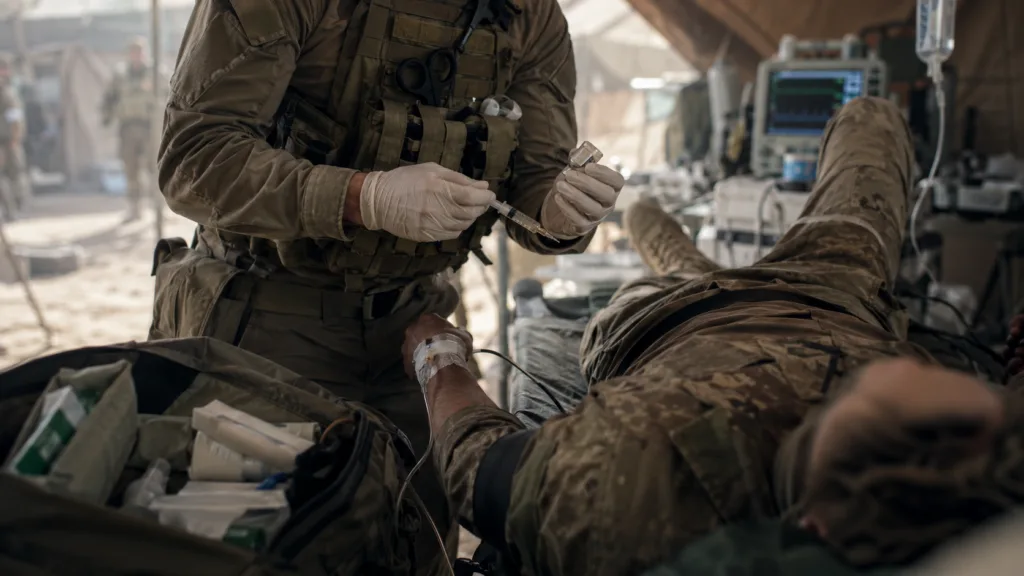
Acute pain treatment in military medicine is not determined by analgesic potency alone. Medical personnel must balance speed of action, respiratory stability, mental alertness, cardiovascular effects, ease of administration, transportability and the ability to continue monitoring a casualty during evacuation.
Taphalgin is a four-amino-acid peptide administered by subcutaneous injection. PVP Labs describes the drug as a selective μ1-opioid receptor agonist that also modulates calcium-dependent pain signalling. The company believes this pharmacological profile could maintain meaningful analgesia while reducing the respiratory, cognitive and abuse-related liabilities associated with conventional opioids.
The Phase 3 postoperative study offers an initial basis for that argument. Patients received 4 milligrams of Taphalgin three times daily for two days, with total pain relief during the first six hours used as the primary endpoint. The drug was compared with placebo followed by dexketoprofen and with subcutaneous promedol.
Taphalgin was reported to be superior to placebo and non-inferior to the opioid comparator for the primary endpoint. Fewer patients receiving Taphalgin required rescue analgesia than patients assigned to the placebo and dexketoprofen sequence. No serious adverse events or clinically significant abnormalities in laboratory measurements or vital signs were reported in the conference abstract.
For military clinicians, those results are relevant because they suggest the product may be capable of providing opioid-level postoperative analgesia through a relatively simple injectable route. The data may be particularly pertinent to Role 2 and Role 3 facilities, where surgical teams manage casualties after initial stabilisation and need analgesia that does not add excessive respiratory-monitoring demands.
The results are less directly applicable to the earliest point-of-injury setting. An onset of approximately 30 minutes could be clinically useful, but battlefield pain may require treatment during the first minutes following penetrating trauma, blast injury, burns or fracture. Whether Taphalgin can deliver sufficiently rapid and predictable relief in those situations has not been established by the disclosed study.
How strong is the clinical evidence behind PVP Labs’ battlefield positioning?
The 250-patient trial has several useful features. It was randomized, multicentre and included both placebo and active-comparator groups. The study evaluated pain at rest and during movement, time to rescue analgesia, rescue-medication use, adverse events, serious adverse events, laboratory results and vital signs.
At the same time, the study was single-blind rather than double-blind. The available conference abstract does not disclose the non-inferiority margin, confidence intervals, detailed adverse-event counts or the full statistical analysis needed to evaluate the robustness of the comparison with promedol.
Promedol is also not the comparator most U.S. military or civilian clinicians would ordinarily use to determine how a new product performs against contemporary American pain-management practices. Future U.S. development may therefore require studies against more locally relevant treatment regimens, potentially within a multimodal protocol rather than as a stand-alone analgesic comparison.
The population also matters. Participants underwent elective abdominal or pelvic procedures associated with moderate surgical trauma. These patients were treated within controlled medical facilities and could be screened before surgery. Combat casualties may have haemorrhage, shock, traumatic brain injury, respiratory compromise, burns, polytrauma or exposure to several emergency medicines before receiving an analgesic.
A trial in planned surgery can demonstrate analgesic activity, but it cannot independently establish performance in haemodynamically unstable casualties or patients being moved through prolonged evacuation chains. A battlefield-development programme would need to assess those clinical differences rather than treating the postoperative trial as a complete proxy.
Additional published evidence offers supporting, although still limited, context. A 2026 prospective observational study evaluated a single Taphalgin injection in 37 patients with severe pain from mixed causes, including cancer, vertebral fractures, joint injuries and radicular pain. Average pain scores fell substantially, with the greatest reported reduction occurring after 30 to 45 minutes.
Adverse events were reported in 19 of the 37 patients in that study, equivalent to 51.3%, although most were non-serious, required no treatment and resolved spontaneously. The small sample, uncontrolled design and varied pain conditions limit interpretation, but the findings illustrate why broad descriptions such as “free from opioid side effects” require more qualification than a company presentation may provide.
A separate observational programme involving hundreds of surgical patients has also been reported in the medical literature. Such real-world experience can help identify patterns of use and uncommon tolerability issues, but observational data cannot replace randomized evidence when determining comparative respiratory safety, cognitive effects, abuse potential or superiority over established treatments.
Why is Taphalgin’s non-scheduled status important but not equivalent to FDA approval?
PVP Labs has placed considerable emphasis on a March 2026 determination from the Drug Enforcement Administration that lumekefamide was not a controlled substance or listed chemical under the Controlled Substances Act while in development. That conclusion could become commercially and operationally important.
Scheduled drugs may require additional security, inventory controls, record keeping, prescribing restrictions and handling procedures. In a military supply system, reducing those administrative and logistical requirements could simplify storage, distribution and deployment.
A non-scheduled classification does not, however, establish that a drug is non-addictive, clinically safe or effective. The Drug Enforcement Administration addresses controlled-substance status, while the United States Food and Drug Administration evaluates whether evidence supports marketing authorisation for a defined indication, dose, formulation and patient population.
Taphalgin remains investigational in the United States and has not been approved by the United States Food and Drug Administration. The disclosed Drug Enforcement Administration decision therefore removes one potential regulatory complication without answering the central questions surrounding efficacy, respiratory safety, manufacturing quality, dosage, drug interactions and benefit-risk balance.
PVP Labs has said Taphalgin has been evaluated in six clinical trials and is supported by more than 100,000 documented human exposures without recorded evidence of euphoria, addiction or respiratory-depression events. Those are company-reported figures, and the announcement does not provide a complete breakdown of the exposure database, patient characteristics, monitoring methods or duration of follow-up.
Absence of recorded events is not necessarily proof that a risk does not exist, particularly when exposure occurs across different healthcare systems or when monitoring standards vary. U.S. regulators may seek dedicated abuse-liability, respiratory-safety and pharmacokinetic studies before accepting claims that distinguish Taphalgin from other medicines acting through opioid receptors.
Where could Taphalgin fit within military Roles of Care?
The most plausible near-term military position appears to be within surgical facilities and prolonged field-care environments rather than as an immediate replacement for every point-of-injury analgesic. The MHSRS abstract itself identifies potential use at Role 2 and Role 3 facilities, where casualties receive resuscitation, damage-control surgery, postoperative care and preparation for onward evacuation.
A subcutaneous injection can be easier to administer than an intravenous infusion when vascular access is difficult. It may also avoid some equipment requirements associated with infusion pumps. However, the disclosed three-times-daily regimen suggests that repeated dosing, dose tracking and continuing clinical assessment would still be necessary.
Field adoption would also depend on pharmaceutical factors that have not yet been detailed publicly. Military procurement teams would need data on shelf life, temperature stability, freeze-thaw tolerance, packaging durability, dose presentation and whether the product is supplied in a ready-to-use syringe, vial or formulation requiring preparation.
These details can determine whether an otherwise effective medicine is practical in a hot vehicle, cold-weather deployment, aircraft evacuation or remote surgical unit. A peptide medicine may also create different manufacturing and stability requirements from a conventional small-molecule analgesic.
Cognitive performance will be another major test. PVP Labs argues that Taphalgin could provide pain relief without the impairment associated with established opioids. That could be operationally valuable for injured service members who remain conscious, need to communicate or may still be involved in self-extraction and evacuation.
The available Phase 3 abstract does not provide detailed neurocognitive testing. Future military-relevant studies may need to measure reaction time, alertness, decision-making, balance and ability to perform essential tasks rather than relying only on general adverse-event reporting.
What must happen before Taphalgin can become a credible U.S. military medicine programme?
The MHSRS presentation can raise the product’s visibility among military clinicians, researchers, government agencies and potential development partners. It could also help PVP Labs define the studies that government stakeholders would consider most useful.
Conference acceptance should not be interpreted as procurement interest, military endorsement or regulatory validation. The announcement itself acknowledges that participation does not imply support from the Military Health System, Defense Health Agency or U.S. Government.
The next meaningful milestone would be a clearly disclosed U.S. regulatory programme. That could include confirmation of an active Investigational New Drug application, agreement with the United States Food and Drug Administration on the required clinical package and initiation of trials designed to bridge existing international evidence to U.S. regulatory standards.
A military development pathway may also require trauma-specific studies, interaction testing with other medicines used during resuscitation, pharmacokinetic evaluation in shock or blood loss and evidence from realistic prolonged field-care scenarios. Human-factors testing would be necessary if the company develops a specialised battlefield delivery device.
Manufacturing will become equally important. A peptide analgesic intended for military stockpiles must be produced consistently at scale and remain stable through storage and transport. PVP Labs has not disclosed commercial manufacturing capacity, U.S. production plans or the financing required to complete development.
Because the company is privately held, the MHSRS selection is not a conventional public-market catalyst. Its immediate value lies in scientific exposure, possible government engagement and the opportunity to attract development capital or a pharmaceutical partner capable of funding U.S. trials, manufacturing and regulatory work.
Could Taphalgin become both a military and civilian acute-pain treatment?
The commercial opportunity extends beyond battlefield medicine. Hospitals continue to seek acute-pain treatments that can reduce conventional opioid exposure without sacrificing analgesic effectiveness. Surgical centres, emergency departments, oncology services and palliative-care providers could all become relevant markets if Taphalgin eventually demonstrates an acceptable U.S. benefit-risk profile.
Its injectable formulation may initially favour supervised clinical settings rather than routine outpatient prescribing. That could narrow the launch market, but it may also allow the company to focus development on hospital-controlled use where dosing and monitoring are more consistent.
The challenge is that pain medicine has produced many candidates promising opioid-like efficacy with fewer opioid-related complications. Regulators and clinicians will expect strong comparative evidence, particularly when a drug still activates an opioid receptor.
PVP Labs therefore needs to establish more than receptor selectivity and non-scheduled status. It must show that Taphalgin’s pharmacology produces measurable clinical advantages, such as lower respiratory-depression risk, less cognitive impairment, fewer serious adverse events or simpler monitoring requirements.
The MHSRS presentation is an important opportunity to introduce that argument to a military audience. It is not the endpoint. Taphalgin’s prospects will depend on whether PVP Labs can move from overseas postoperative evidence and company-reported exposure figures to transparent U.S. studies that replicate analgesic efficacy, characterise safety and demonstrate that the product can survive the practical demands of combat casualty care.
Until those milestones are reached, Taphalgin should be viewed as an investigational analgesic with a credible military-use hypothesis and a meaningful clinical foundation, but not yet as an established battlefield alternative to conventional opioids.