Redox Inc. and Lapsi Health Holding B.V. have announced a collaboration to connect the Keikku Clinical Platform with electronic health record infrastructure used by healthcare organizations. The arrangement positions Redox as Lapsi Health’s interoperability partner, providing a route for Keikku’s clinical documentation, reference and diagnostic-support capabilities to operate within existing healthcare workflows rather than remaining in a separate application.
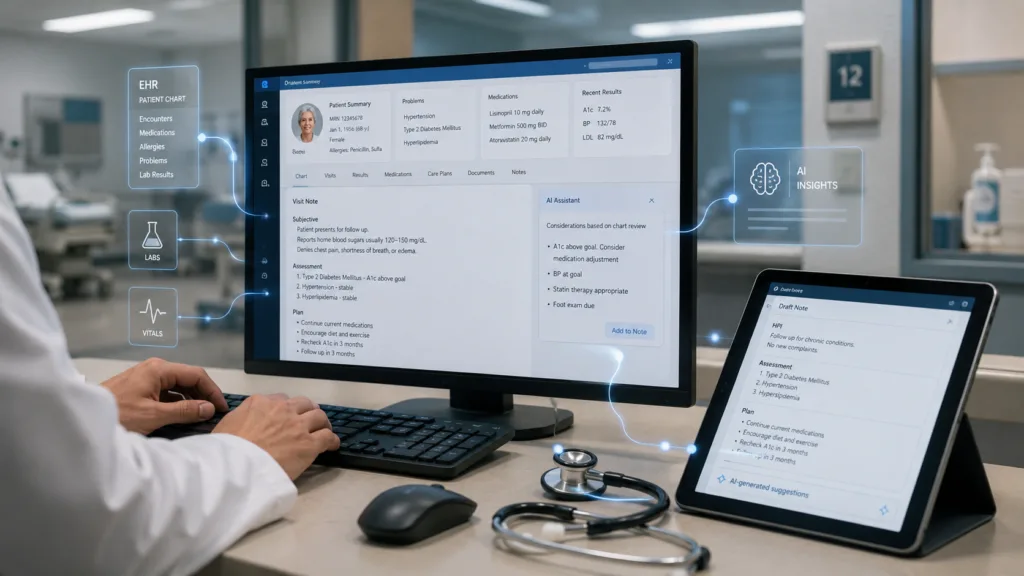
The commercial importance of the agreement lies less in the addition of another artificial intelligence feature and more in the attempt to remove one of the barriers that repeatedly slows healthcare AI adoption. Clinicians may be interested in ambient documentation, medical-reference systems and digitally captured examination data, but enthusiasm can fade when each tool requires a separate login, patient search, workflow and transfer of information back into the patient record.
Keikku combines AI-assisted clinical documentation, contextual medical reference, coding support and an electronic stethoscope ecosystem. Lapsi Health said healthcare organizations will be able to deploy the platform as a software-only product or add hardware-enabled ambient audio capture and auscultation capabilities. Redox, meanwhile, supplies the interoperability layer intended to exchange data between Keikku and the healthcare organization’s existing systems.
This is an integration and commercialisation development, not evidence that Keikku improves clinical outcomes or that broad hospital adoption has already occurred. The announcement did not identify a participating health system, disclose financial terms, provide an implementation timetable or report performance data from a completed enterprise deployment. Those omissions do not diminish the potential usefulness of the collaboration, but they define what the market will need to see next.
Why is EHR interoperability becoming the decisive commercial test for clinical AI platforms?
Healthcare AI companies increasingly face a frustrating reality. Building a capable application may be easier than embedding it reliably into clinical operations across hospitals, outpatient practices and specialist settings.
Patient demographics, appointments, encounter information, clinical notes, orders and results may be stored or transmitted differently across healthcare organizations. Even institutions using the same EHR vendor can have customised fields, local terminology, access rules and workflow configurations. A technically impressive AI product can therefore become another administrative burden when clinicians must open it separately and manually transfer its output into the chart.
Redox is intended to reduce that integration burden. The company says its network spans more than 12,000 healthcare organizations and supports connections with more than 100 EHR systems, alongside health information exchanges, revenue-cycle platforms and other healthcare applications. Its model allows customers to develop against a standardised Redox interface while Redox handles variations among connected systems.
For Lapsi Health, that infrastructure could shorten the distance between demonstrating Keikku and deploying it. Instead of treating every new health-system customer as an entirely new integration project, the company may be able to reuse established Redox connections and workflow components.
That does not make installations automatic. Each healthcare organization must still approve the product, determine what information Keikku can access, decide where generated documentation will appear, configure identity management and test whether data is written to the correct patient and encounter. Redox can reduce the engineering burden, but it cannot remove the governance and implementation responsibilities of the customer.
Which Keikku functions are covered by FDA clearance and which require separate evaluation?
Regulatory precision is particularly important because Keikku combines a cleared medical device with software capabilities that may serve different clinical and administrative purposes.
The United States Food and Drug Administration granted 510(k) clearance to the Keikku Electronic Stethoscope in April 2024 as a Class II electronic stethoscope. Its cleared indication covers the amplification, filtering and transmission of auscultation data from the heart, lungs, bowel, arteries and veins. The device may be used with pediatric and adult patients by professional users in clinical environments or by lay users in nonclinical environments, although it is not intended for self-diagnosis.
The clearance therefore establishes the regulatory status of the electronic stethoscope for its stated sound-capture and transmission functions. It should not automatically be interpreted as clearance of every AI-generated note, reference answer, coding suggestion or diagnostic-support function included within the wider Keikku Clinical Platform.
Lapsi Health markets Keikku as a connected platform incorporating ambient documentation, referenced clinical information and auscultation-related capabilities. Its website states that the scribe can structure clinical conversations into notes and coding information, while its reference tool is designed to provide answers linked to medical literature and institutional guidance.
Healthcare organizations evaluating the platform will need a clear function-by-function account of what is administrative software, what constitutes clinical decision support, what relies on separately cleared third-party technology and what may fall within regulated medical-device software requirements. That distinction affects procurement, validation, labelling, clinician training and the controls required when software is updated.
Can one connected workflow reduce the hidden operational cost of fragmented clinical AI?
The strategic logic behind Keikku is that a clinical encounter generates several related forms of information. A clinician listens to the patient, records the history, performs an examination, checks medical evidence, considers possible diagnoses and documents the visit.
When those tasks are distributed across multiple systems, the same clinical context must be reconstructed repeatedly. The clinician may search for the patient in one application, activate a scribe in another, consult reference material elsewhere and then return to the EHR to review or paste the result.
Keikku is attempting to retain that context across documentation, reference and examination workflows. A note generated from the consultation could potentially provide context for a subsequent clinical question, while auscultation data captured during the same encounter could remain associated with the relevant patient record.
Connecting that workflow to the EHR is commercially meaningful because the EHR remains the authoritative record for most healthcare organizations. An AI platform that cannot read relevant patient context or return reviewed information to the chart may remain useful to individual clinicians but struggle to become enterprise infrastructure.
However, the partnership announcement did not provide comparative evidence showing that the integrated workflow reduces documentation time, lowers error rates or improves clinician satisfaction against existing alternatives. It also did not report how accurately Keikku matches patients and encounters, how often generated notes require correction or whether coding suggestions improve revenue-cycle performance.
These questions matter because reducing clicks is not the same as improving care. A streamlined workflow can still create risk when incorrect information is written into the record quickly and at scale. Clinical review therefore remains essential, particularly when generative AI is used to summarise conversations or suggest structured documentation.
Why will implementation governance still matter after Redox removes integration complexity?
Healthcare organizations evaluating the combined offering will look beyond whether the systems can exchange data. They will need to understand what data is accessed, where it is processed, how long it is retained, whether it is used for model training and how administrators can audit access and output.
Redox states that its platform operates under controls including HIPAA compliance, HITRUST certification and a SOC 2 Type 2 framework. The company also describes healthcare data security as a shared responsibility, with Redox securing the interoperability platform while customers remain responsible for user access and their use of protected health information.
That shared-responsibility model is important for Keikku deployments. Redox may secure the movement of data, but Lapsi Health and the healthcare organization must still govern the clinical application, user permissions, patient consent, documentation review and downstream use of AI-generated information.
Health-system teams will also need to decide whether Keikku receives only encounter-specific information or a broader longitudinal record. Giving the platform additional patient context may improve the relevance of documentation and clinical-reference responses, but it also expands the amount of sensitive information passing through the workflow.
Writeback requires similar caution. Sending a draft note into a review queue presents a different risk from placing structured information directly into a signed clinical record. Enterprise customers will need configurable approval steps, reliable audit trails, clear identification of AI-generated content and mechanisms for correcting information after it reaches the EHR.
How could the Redox relationship strengthen Lapsi Health’s enterprise business model?
Lapsi Health currently presents Keikku as a product that can be purchased in software-only and software-plus-device configurations, with a separate enterprise offering for practices and health systems. Its enterprise proposition includes native EHR integration, identity-management capabilities, business associate agreements, fleet administration and dedicated support.
The Redox collaboration strengthens the enterprise side of that strategy. Individual clinicians may tolerate copying a completed note into an EHR, especially when testing a low-cost tool. A hospital or multi-site medical group is less likely to accept manual transfer as its standard workflow across hundreds or thousands of users.
Native integration can therefore become a dividing line between clinician-level adoption and organization-wide procurement. It also gives Lapsi Health a better opportunity to sell the broader platform rather than competing only as an electronic stethoscope manufacturer or standalone AI scribe.
Keikku’s potential differentiation lies in combining physical examination hardware with software-based documentation and clinical information tools. Many clinical AI companies begin with ambient documentation because it is relatively easy to introduce and has an obvious administrative use case. Lapsi Health is attempting to extend beyond the note by connecting conversational data with auscultation and contextual reference capabilities.
The challenge will be proving that customers value the combined platform enough to adopt it instead of selecting separate products from established documentation, diagnostic-device and EHR vendors. Integration improves the proposition, but commercial differentiation will ultimately depend on performance, usability, pricing and evidence.
What evidence will healthcare organizations need before scaling Keikku across clinical settings?
The next stage should move the collaboration from infrastructure potential to measurable implementation.
Healthcare organizations will want deployment data showing how long an integration takes, which EHR workflows are supported and whether the same configuration can be repeated across locations. They will also need to know whether Keikku can reliably retrieve the correct patient context, return notes to the intended chart and preserve clinician edits.
Documentation performance should be assessed across specialties, accents, encounter types and noisy clinical environments. Useful measures could include omission rates, clinically meaningful errors, correction time and the proportion of generated notes accepted after review. Coding features will require separate evaluation because a plausible code suggestion can still be incomplete, unsupported or inconsistent with payer rules.
Reference and diagnostic-support functions require their own evidence. Cited medical information may be easier to verify than an uncited response, but citations do not guarantee that a conclusion is appropriate for the patient in question. Auscultation-related algorithms should be evaluated according to their specific regulatory status, intended users, target findings and validation populations.
The most persuasive milestone would be a named health-system deployment accompanied by transparent workflow and performance results. Until then, the Redox collaboration should be understood as an enabling infrastructure agreement that may improve Keikku’s route to enterprise customers rather than proof of scaled clinical adoption.
Redox gives Lapsi Health access to an interoperability network that would be difficult and expensive for a smaller healthcare technology company to recreate independently. Lapsi Health, in turn, gives Redox another clinical AI platform whose value depends on reliable EHR connectivity. Whether that combination becomes commercially important will be determined by the first live implementations, the quality of EHR writeback and the evidence that Keikku reduces administrative work without introducing new clinical or data-governance problems.