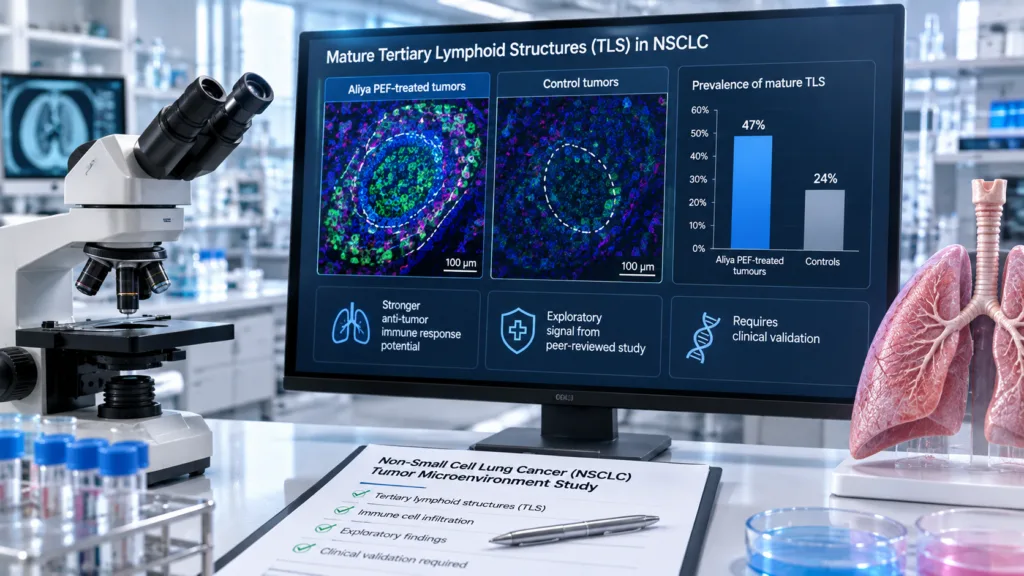
Galvanize Therapeutics has reported new peer-reviewed evidence suggesting that its Aliya pulsed electric field technology may alter the immune environment of non-small cell lung cancer tumors after ablation, potentially extending the biological effects of the medical device beyond local tissue destruction. The finding is scientifically intriguing because tumors treated with Aliya PEF showed mature tertiary lymphoid structures with germinal centers more frequently than non-ablated controls, but it remains an exploratory immunology signal rather than evidence that the device improves cancer survival or enhances the effectiveness of immunotherapy.
The distinction is particularly important because Galvanize is simultaneously commercializing the next-generation Aliya EX System in the United States. The US Food and Drug Administration cleared Aliya EX through the 510(k) pathway in May 2026 for surgical ablation of soft tissue, not for treatment of a particular cancer and not for induction of an antitumor immune response. FDA records identify the Class II device under K253826 and state that it delivers high-frequency, short-duration electrical pulses through compatible needles to ablate soft tissue.
That creates an unusual intersection between commercial medtech and early translational oncology. Galvanize already has a cleared surgical ablation platform entering clinical use, while investigators are studying whether the biological aftermath of that ablation could eventually become therapeutically relevant in its own right.
What did the INCITE-ES lung cancer study find after Aliya PEF ablation?
The new Clinical Cancer Research publication comes from INCITE-ES, a prospective, multicenter, open-label treat-and-resect study in patients with early-stage non-small cell lung cancer. Participants receiving Aliya PEF underwent ablation after diagnostic biopsy and before planned surgical resection, allowing investigators to examine treated tumor tissue directly. A concurrent control group underwent biopsy without PEF treatment.
ClinicalTrials.gov describes the programme as evaluating the safety and feasibility of PEF ablation before surgery, with treatment delivered either bronchoscopically or percutaneously. Earlier reporting on the study identified 36 treated patients and eight controls with evaluable clinical participation, while the original protocol allowed enrollment of as many as 40 participants.
The newly published analysis focused on exploratory immune endpoints rather than proving an oncologic treatment effect. Investigators examined tumor histology, cytokines, single-cell RNA sequencing and circulating immune markers to determine how tissue and blood changed after ablation.
The most eye-catching result involved tertiary lymphoid structures, or TLS, which are organized clusters of immune cells that can form within or around tumors. Mature TLS containing germinal centers are of considerable interest because they can support local B-cell and T-cell organization and have been associated in multiple cancers with more active antitumor immune environments.
In the study, tumors from the Aliya PEF group contained TLS with germinal centers in 47% of cases compared with 24% of tumors in the non-ablated control group. Investigators also reported increased expression of immune-organizing signals including CXCL13, increases in class-switched memory B cells and plasma cells, and changes in circulating immune markers including cytotoxic T cells.
Those findings support the hypothesis that PEF treatment may produce a more immunologically active tumor microenvironment after ablation. They do not show that the immune changes subsequently shrink untreated tumors, extend progression-free survival or improve overall survival.
Why are tertiary lymphoid structures attracting so much interest in cancer immunotherapy?
Tumors often create an immune-suppressive environment that prevents immune cells from mounting an organized response. Tertiary lymphoid structures are interesting because they resemble miniature lymphoid organs developing locally within diseased tissue, bringing together B cells, T cells and antigen-presenting cells in structures capable of supporting adaptive immune responses.
The presence of mature TLS has been associated with favorable prognosis or improved responses to immunotherapy in several tumor types, although the relationship varies according to cancer biology, treatment and the maturity and location of the structures. The Nature Cancer review highlighted by Galvanize describes TLS not only as potential biomarkers but also as possible therapeutic targets if researchers can learn how to induce or mature them reliably.
That explains why the 47% versus 24% result is more interesting than simply detecting inflammatory cells after ablation. Tissue destruction would be expected to provoke some biological response. Formation of organized germinal-center-containing structures suggests a more complex process in which local immune architecture may be changing.
Even so, association is not equivalent to therapeutic causation. A patient developing mature TLS after PEF ablation has not thereby been shown to experience better cancer control. The current study was not designed or powered to establish that clinical outcome.
The next scientifically important question is whether the immunological changes can be connected to measurable patient benefit, particularly when Aliya PEF is combined with checkpoint inhibitors or other immunotherapies. That would require prospective studies designed specifically around those hypotheses.
How does Aliya PEF differ from conventional thermal tumor ablation?
Ablation technologies typically destroy tumor tissue by exposing cells to damaging energy, but the mechanism and resulting tissue environment can differ substantially between modalities. Radiofrequency and microwave systems rely primarily on heat, while cryoablation damages tissue through freezing.
Aliya uses high-voltage, microsecond-range electrical pulses. Galvanize describes the approach as producing regulated cell death without relying predominantly on thermal injury, while attempting to preserve important elements of stromal architecture. The FDA-cleared Aliya EX system can operate at two energy settings intended to create different lesion dimensions.
Preservation of structural elements is part of the biological hypothesis around immune activation. If ablated cells release tumor antigens while the surrounding tissue environment remains capable of supporting immune organization, investigators theorize that PEF could potentially create conditions more favorable to antigen presentation and local immune activity than some destructive methods.
The INCITE-ES findings are consistent with that hypothesis but cannot yet establish that Aliya is immunologically superior to thermal ablation, cryoablation or other PEF technologies because the published study did not randomize patients between those competing modalities.
That comparative question could eventually become important commercially. The oncology-ablation market contains multiple technologies capable of destroying tissue. Demonstrating a clinically meaningful systemic or immune advantage could differentiate one platform in a way that lesion size alone cannot.
What has FDA actually cleared for the Aliya EX System?
FDA cleared the Aliya EX System on May 7, 2026 through a traditional 510(k) submission after determining it substantially equivalent to predicate devices including the earlier Aliya System. Its authorized indication is surgical ablation of soft tissue. The regulatory record does not provide a specific lung cancer indication, an immune-activation indication or a claim that the device improves outcomes when combined with immunotherapy.
That regulatory boundary is essential when interpreting Galvanize’s latest research announcement. The company itself states that the effectiveness of Aliya for inducing an immune response resulting in patient benefit has not been established and that the system is not intended under its current labeling to treat, cure, prevent or mitigate any specific disease or condition.
Aliya EX nevertheless represents a meaningful technology upgrade. Compared with the previous generator, Galvanize says it can create up to twice the ablation diameter and as much as seven times the ablation volume, potentially widening the range of lesion sizes that physicians can address. FDA documentation confirms the new generator and associated delivery components were cleared as modifications to the existing platform.
The company completed its first commercial Aliya EX procedures in August using both percutaneous and endoscopic approaches, meaning the platform is already transitioning from regulatory clearance into actual US adoption.
Could immune activation eventually become the more valuable part of the Aliya platform?
That possibility is precisely what makes the new study strategically interesting, but the evidence remains too early to assume it will happen.
If future controlled studies demonstrate that PEF-induced biological changes improve responses to checkpoint blockade or produce meaningful effects outside the treated lesion, Aliya could potentially evolve from a local ablation tool into part of a multimodal cancer-treatment strategy. That would substantially change both its clinical positioning and the type of evidence Galvanize would need to generate.
The company would then face a regulatory challenge very different from obtaining a 510(k) clearance for soft-tissue ablation. Claims involving improved cancer outcomes or potentiation of immunotherapy would require evidence directly supporting those clinical benefits, rather than extrapolation from histology or immune biomarkers.
For now, the strongest conclusion from INCITE-ES is narrower but still noteworthy. Aliya PEF treatment was associated with biological changes consistent with a more organized immune response, including a near-doubling in the proportion of tumors showing mature TLS with germinal centers compared with controls.
That makes the study more than a routine device-performance update. It raises a testable hypothesis about what tumor ablation might accomplish after the lesion itself has been destroyed.
The next stage must establish whether the immune architecture visible under the microscope produces anything patients can actually feel or clinicians can measure in disease control. Until then, Galvanize has an intriguing mechanistic signal alongside an FDA-cleared commercial ablation system, not an immune-oncology indication.