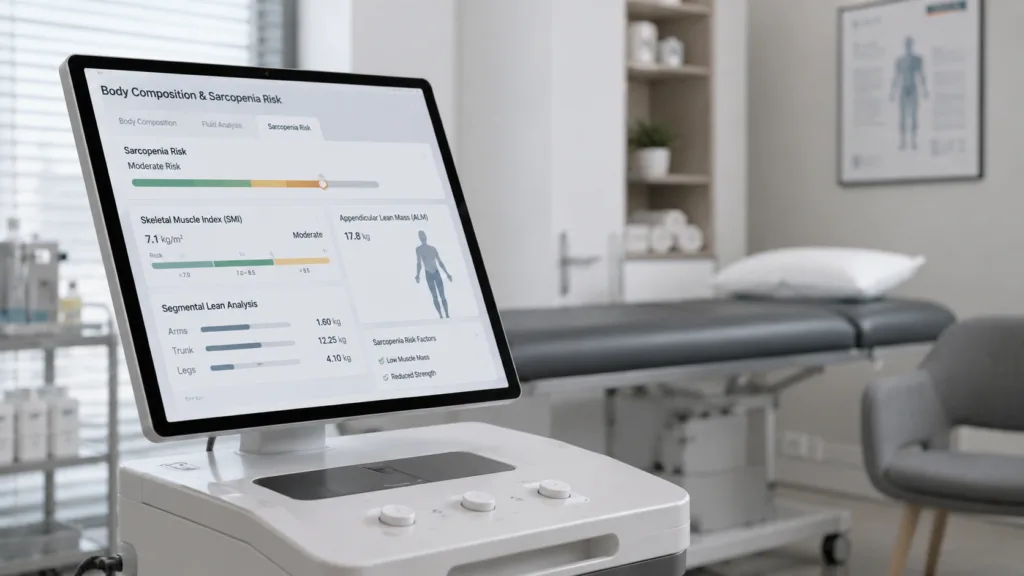
ImpediMed Limited has received US Food and Drug Administration 510(k) clearance to add sarcopenia risk assessment to its SOZO Digital Health Platform, expanding a bioimpedance spectroscopy system already used for body-composition and lymphedema-related monitoring into another clinically relevant problem in oncology: identifying patients developing abnormally low muscle mass or muscle loss. The new capability is scheduled to arrive with SOZO software version 6.3 in fall 2026.
The clearance is strategically important because it adds another clinical application without requiring a fundamentally different patient examination. SOZO uses bioimpedance spectroscopy to measure how low-level electrical signals pass through body tissues, generating information related to fluid distribution and body composition. ImpediMed’s proposition is that clinicians already using the platform can obtain a sarcopenia risk assessment during the same rapid scanning workflow rather than directing patients to a separate imaging procedure solely to examine muscle status.
FDA databases show that SOZO has accumulated a long regulatory history encompassing extracellular-fluid monitoring, body-fluid analysis and nutritional or body-composition-related applications. Earlier iterations were cleared as Class II devices through the 510(k) substantial-equivalence framework, including SOZO Pro and software updates supporting the platform.
The new indication should nevertheless be understood carefully. SOZO is cleared to help assess sarcopenia risk; the device does not independently establish every component of a complete sarcopenia diagnosis, and muscle quantity is only one part of a condition also associated with impaired muscle strength or physical performance.
Why does sarcopenia matter during cancer treatment?
Cancer-associated muscle loss can result from several overlapping mechanisms, including reduced nutritional intake, systemic inflammation, decreased physical activity, tumor-related metabolic changes and treatment toxicity. Chemotherapy can further alter appetite, activity, fluid status and body composition, meaning significant loss of lean tissue may occur even when conventional body weight does not fall dramatically.
Recent prospective evidence illustrates the problem. A 2026 study following 51 women receiving chemotherapy for breast cancer found significant loss of lean tissue alongside increasing extracellular fluid. After six months, investigators observed a median fluid-volume increase of approximately 1.1 liters together with a 1.4-kilogram decline in muscle mass, producing a pattern in which fluid accumulation could partially conceal clinically relevant tissue loss.
That is one reason body weight alone can be a poor sarcopenia-monitoring tool. A patient can maintain or even gain weight while losing skeletal muscle if fat mass or fluid increases simultaneously.
The implications can extend beyond physical appearance. Sarcopenia has been associated across oncology studies with poorer functional status, treatment intolerance, surgical complications and adverse outcomes, although the strength of individual associations varies by cancer type, disease stage, treatment and how sarcopenia is defined.
A 2025 systematic review and meta-analysis examining metastatic breast cancer estimated sarcopenia prevalence at 41.6% in the pooled population, while also noting heterogeneity in associations with survival and treatment outcomes and calling for additional work on dynamic body-composition change.
The clinical case for monitoring is therefore less about treating a numerical body-composition measurement and more about identifying deterioration early enough for nutrition, exercise, rehabilitation or treatment-management decisions to be considered within the wider cancer-care plan.
How does bioimpedance spectroscopy detect body-composition change?
Bioimpedance analysis introduces a small electrical current through the body and measures opposition to that current. Different tissues and fluid compartments have different electrical characteristics, allowing mathematical models to estimate parameters such as total body water, extracellular water, intracellular water and components of body composition.
ImpediMed’s technology uses spectroscopy across multiple frequencies rather than relying on a single-frequency measurement. Different frequencies penetrate biological tissues differently, allowing the system to model extracellular and intracellular compartments with greater granularity.
That has already supported SOZO’s established role in lymphedema monitoring, where subtle extracellular-fluid change can be clinically important. The sarcopenia indication applies the broader body-composition capabilities of the platform to muscle-loss risk.
The potential oncology advantage is the ability to distinguish fluid change from tissue change more effectively than weight or body-mass index. The recent breast-cancer chemotherapy study using multifrequency bioimpedance spectroscopy demonstrated why that distinction can matter: extracellular fluid increased while intracellular fluid and lean tissue declined, meaning overall weight-based assessment could miss the direction of underlying muscle change.
Bioimpedance is not the only method available. Computed tomography images acquired during routine cancer staging can be used to quantify skeletal muscle at predefined anatomical levels, while dual-energy X-ray absorptiometry can estimate body composition. Hand-grip strength, gait speed and functional tests may contribute other dimensions of sarcopenia assessment.
SOZO’s opportunity is therefore not that it uniquely measures something impossible to assess otherwise, but that a rapid non-invasive test could be repeated frequently without radiation and potentially integrated into routine oncology visits.
Why could combining sarcopenia and lymphedema monitoring matter in breast cancer care?
ImpediMed has built much of SOZO’s US clinical positioning around breast-cancer-related lymphedema surveillance. Patients undergoing breast surgery, lymph-node procedures or radiation can develop abnormal lymphatic fluid accumulation, and bioimpedance spectroscopy can detect changes before swelling becomes clinically obvious.
Adding sarcopenia risk creates the possibility of monitoring two very different treatment-related complications through one device. One concerns abnormal extracellular-fluid accumulation, while the other concerns loss of skeletal muscle and physical reserve.
The overlap could be particularly relevant during chemotherapy. A patient may simultaneously experience fluid redistribution and declining lean mass, and separating those processes can be difficult using weight, appearance or routine physical examination alone.
Operationally, this could strengthen SOZO’s economics within cancer centers. Medical devices that perform one narrow measurement can be difficult to justify if patient volume is modest, whereas expanding the number of clinically relevant measurements available from an installed system can increase utilization.
That does not mean every SOZO lymphedema user will automatically adopt sarcopenia assessment. Oncology programs will need protocols determining which patients to test, how often measurements should be repeated, what thresholds trigger action and which clinician owns the response to an abnormal result.
The value of screening also depends on having an intervention pathway. Identifying muscle loss becomes more useful when patients can be referred quickly for nutritional assessment, resistance exercise, physical therapy or other supportive-care measures appropriate to their clinical status.
Does FDA clearance establish that SOZO monitoring improves cancer outcomes?
No. The regulatory clearance supports marketing of the device for sarcopenia risk assessment within the cleared indication, but it should not be interpreted as evidence that using SOZO itself improves survival, prevents chemotherapy toxicity or reduces cancer recurrence.
Those questions require different evidence. A diagnostic or monitoring device may measure a clinically important variable accurately without proving that routine measurement changes hard outcomes.
ImpediMed’s next evidence challenge is therefore likely to involve clinical utility. Cancer centers will want to know whether repeated SOZO assessment identifies meaningful muscle deterioration earlier than existing practice, whether clinicians act on the information and whether intervention improves treatment tolerance, function, quality of life or other outcomes.
There is also a standardization challenge around sarcopenia itself. Definitions have evolved and may incorporate muscle quantity, strength and performance rather than relying exclusively on estimated lean mass. Different oncology studies also use different imaging thresholds and anatomical measurements.
A bioimpedance-derived risk assessment consequently needs to fit into an established clinical framework rather than becoming a stand-alone label detached from functional evaluation.
How much can another indication expand SOZO’s commercial role?
The broader strategic logic is straightforward. ImpediMed already has an FDA-cleared connected hardware and software platform deployed around fluid and body-composition measurements. Adding new clinical indications can increase the utility of each installed system while reducing the need to build a separate commercial infrastructure for every application.
The company said sarcopenia assessment will be incorporated through SOZO version 6.3, which is expected during fall 2026. That software-driven deployment illustrates how medical-device companies can expand clinical functionality around a stable measurement platform while still passing each new claim through regulatory review.
Oncology is a particularly logical environment for that strategy because longitudinal care creates repeated opportunities to measure change. Patients move through surgery, systemic therapy, radiation, survivorship and recurrence monitoring, while body composition and fluid status can evolve throughout that journey.
The commercial upside will depend on whether clinicians see sarcopenia as an actionable monitoring target rather than another metric on a dashboard. The scientific literature increasingly supports the relevance of muscle loss, but definitions, intervention strategies and evidence linking surveillance to outcomes remain areas of active development.
For ImpediMed, FDA clearance nevertheless turns an existing research and body-composition capability into a regulated sarcopenia-risk application. More importantly, it pushes SOZO closer to becoming a multipurpose oncology monitoring platform rather than a device associated predominantly with one complication of breast-cancer treatment.