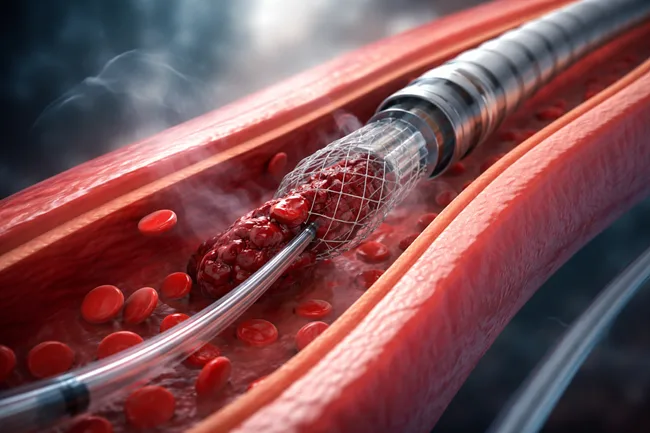
Imperative Care has disclosed a post-hoc analysis of the SYMPHONY-PE Trial suggesting that use of the Symphony Thrombectomy System within 12 hours of diagnostic imaging may produce larger early improvements in pulmonary artery pressure and right-heart strain than later intervention in patients with intermediate-risk pulmonary embolism. The analysis, published in Circulation: Cardiovascular Interventions, follows the device’s 2025 U.S. clearance for pulmonary embolism and arrives as Imperative Care reports more than 500 U.S. patients treated since commercial launch.
Why the 12-hour treatment signal matters in the intermediate-risk pulmonary embolism debate
Intermediate-risk pulmonary embolism remains one of the most difficult areas of acute cardiovascular decision-making because patients can appear hemodynamically stable while still carrying substantial right ventricular strain and a risk of sudden deterioration. Anticoagulation remains the primary treatment for confirmed acute pulmonary embolism, but it does not immediately remove the obstructing clot. That creates a clinical tension between observing a stable patient on medication and intervening before right-heart pressure overload progresses.
The genuinely new element in the SYMPHONY-PE analysis is therefore not another demonstration that mechanical thrombectomy can reduce clot burden or improve imaging measurements. The more consequential proposition is that the clinical value of thrombectomy may partly depend on how quickly it is performed after diagnosis. That shifts the debate from whether a catheter-based procedure works to whether delays within the treatment pathway diminish the physiological benefit that could otherwise be achieved.
The biological rationale is plausible. A pulmonary embolism raises resistance within the pulmonary arteries, forcing the right ventricle to pump against an abrupt increase in pressure. Earlier clot extraction could reduce this load before prolonged strain impairs right ventricular function. However, anticoagulation, endogenous clot breakdown and supportive care also influence recovery, while the age of the clot may not match the time at which diagnostic imaging occurred. The 12-hour finding should consequently be treated as a clinically important hypothesis rather than a definitive treatment threshold.
How strong are the SYMPHONY-PE timing findings and what do the measured endpoints prove?
The analysis divided 109 patients by the interval between diagnostic computed tomography pulmonary angiography and mechanical thrombectomy. Forty-eight patients underwent treatment in less than 12 hours, while the remaining patients were treated after the 12-hour point. Those treated earlier experienced a mean pulmonary artery pressure reduction of 8.6 mm Hg, compared with 5.8 mm Hg among patients treated later.
That difference reached nominal statistical significance, with a reported p-value of 0.006. The mean reduction in the right ventricle-to-left ventricle ratio was also larger in the early-treatment group, at 0.52 compared with 0.37, although the p-value of 0.071 did not cross the conventional threshold for statistical significance. The analysis further indicated that differences were more pronounced among patients with higher Composite Pulmonary Embolism Shock scores, raising the possibility that timing may matter most in individuals closer to clinical deterioration.

These endpoints are clinically relevant because pulmonary artery pressure reflects the immediate hemodynamic burden placed on the right side of the heart, while the right ventricle-to-left ventricle ratio is widely used to assess right ventricular strain. Improvements in both measures can indicate that the heart is recovering from the acute obstruction. They are also surrogate measures, however, and cannot independently establish that earlier thrombectomy prevents death, reduces recurrent embolism, avoids clinical collapse or produces better long-term functional recovery.
The safety findings also require careful interpretation. One major adverse event occurred in the early group and none occurred in the later group, while no device-related serious adverse events or deaths were reported in either group. These low event numbers are encouraging but too small to demonstrate that early and delayed thrombectomy carry equivalent safety. A study designed to compare safety between timing strategies would require a substantially larger population and longer follow-up.
Why the post-hoc design prevents a 12-hour window from becoming a clinical treatment rule
The central limitation is that patients were not randomly assigned to early or late thrombectomy. The analysis examined timing differences after the original trial had been completed, which means the reasons for treatment delay may also have influenced the observed outcomes. Patients treated earlier may have been managed at hospitals with faster pulmonary embolism response systems, more experienced interventional teams or different thresholds for escalation.
Clinical selection may have worked in either direction. Physicians could have expedited thrombectomy for patients who appeared more vulnerable, or delayed intervention in patients who were more stable and showed signs of responding to anticoagulation. Transfer status, overnight presentation, catheter laboratory availability, staffing, consent, additional testing and comorbid conditions may also have affected the interval between imaging and treatment. Without randomized timing allocation, these influences cannot be fully separated from the effect of earlier clot removal.
The measurement clock creates another uncertainty. The study defined timing from diagnostic imaging rather than from symptom onset, initial hospital arrival or the beginning of physiological deterioration. One patient could undergo imaging shortly after symptoms began, while another could have experienced several days of symptoms before receiving the same diagnosis. A 12-hour imaging-to-procedure interval therefore does not necessarily represent a consistent biological stage of disease.
The threshold itself should not yet be interpreted as a validated golden hour. Dividing patients at 12 hours is useful for identifying a signal, but it does not prove that clinical benefit suddenly declines after that point. A continuous analysis could ultimately reveal that each additional hour carries a gradual effect, that the relationship is concentrated in the highest-risk patients, or that the apparent timing advantage disappears after adjustment for baseline differences.
How the new timing analysis fits with randomized evidence for pulmonary embolism intervention
The wider evidence base for pulmonary embolism intervention is expanding, but it remains less mature than the evidence supporting thrombectomy in acute ischemic stroke or percutaneous intervention in myocardial infarction. Many mechanical thrombectomy devices initially reached the market through prospective single-arm studies that compared safety and imaging outcomes with predefined performance targets rather than with anticoagulation or another active treatment.
The original SYMPHONY-PE Trial followed that model. It enrolled 109 patients at 17 U.S. centers and demonstrated a mean right ventricle-to-left ventricle ratio reduction of 0.44 at 48 hours. Mean pulmonary artery pressure declined by approximately 24%, and clot burden fell by approximately 38%. The trial recorded a 0.9% major adverse event rate within 48 hours and no mortality through 30 days. Those findings supported the safety and effectiveness of the Symphony Thrombectomy System, but the absence of a randomized control group limited conclusions about its superiority over standard care.
The PEERLESS randomized trial subsequently compared large-bore mechanical thrombectomy with catheter-directed thrombolysis in 550 patients with intermediate-risk pulmonary embolism. Mechanical thrombectomy produced a more favorable hierarchical outcome, largely through lower rates of clinical deterioration, reduced intensive care utilization and fewer readmissions. Mortality and major bleeding did not differ significantly. Importantly, PEERLESS addressed which catheter-based strategy may be preferable after a decision to intervene, not whether intervention is superior to anticoagulation for every intermediate-risk patient.
The smaller STORM-PE randomized trial moved closer to that unanswered question by comparing mechanical thrombectomy plus anticoagulation with anticoagulation alone. It showed a greater improvement in the right ventricle-to-left ventricle ratio with thrombectomy and did not identify a statistically significant increase in major adverse events. Its limited size still prevented firm conclusions about mortality or uncommon procedural complications.
The 2026 U.S. acute pulmonary embolism guideline reflects this evolving evidence. Anticoagulation remains the primary treatment, while catheter-based clot removal is included among advanced options for patients in more severe clinical categories. The SYMPHONY-PE timing analysis should therefore be interpreted within patients already being considered for thrombectomy. It does not establish that every intermediate-risk patient should undergo a procedure within 12 hours of imaging.
What earlier thrombectomy would require from hospitals and pulmonary embolism response teams
A clinically meaningful early-treatment pathway would depend on much more than the availability of a thrombectomy catheter. Hospitals would need rapid diagnostic imaging, standardized risk classification, immediate review of right ventricular strain and cardiac biomarkers, and a clear process for activating interventional cardiology, vascular medicine, interventional radiology, critical care and cardiothoracic surgery teams.
Pulmonary embolism response teams could become particularly important if timing is confirmed as a determinant of recovery. These multidisciplinary teams are designed to reduce fragmented decision-making and accelerate treatment selection. A 12-hour target, however, would place pressure on hospitals to maintain round-the-clock procedural capability or create faster transfer arrangements with regional centers.
This could expose differences between high-volume academic hospitals and facilities with fewer specialist resources. A patient diagnosed at a center with an established pulmonary embolism pathway may receive treatment quickly, while a clinically similar patient requiring interhospital transfer may cross the proposed 12-hour boundary before reaching an equipped catheter laboratory. Any future timing recommendation would need to consider whether it can be implemented without widening geographic and socioeconomic disparities in access to advanced care.
Faster intervention must also be balanced against adequate patient selection. Mechanical thrombectomy requires vascular access and the advancement of relatively large catheters through the right side of the heart into the pulmonary arteries. Potential risks include access-site bleeding, blood loss, arrhythmia, cardiac injury and pulmonary vascular injury. Low event rates in experienced trial centers cannot automatically be extrapolated to every hospital or operator.
What the Symphony commercial milestone reveals about adoption and what it still cannot prove
Treatment of more than 500 U.S. patients since the Symphony Thrombectomy System entered the pulmonary embolism market in September 2025 signals meaningful early physician interest. It suggests that Imperative Care has moved beyond a limited launch and secured initial use across a growing clinical network. Commercial uptake can also create the real-world volume needed to evaluate procedural consistency, operator learning curves and performance outside research centers.
Patient volume is not a substitute for comparative evidence. The number treated does not reveal how patients were selected, how outcomes compared with anticoagulation or competing thrombectomy systems, or whether use reduced hospital stays and total care costs. Those questions will determine whether Symphony becomes a broadly adopted platform or remains one of several devices used selectively by specialist centers.
The regulatory distinction is equally important. The U.S. Food and Drug Administration clearance allows the Symphony Thrombectomy System to be marketed for pulmonary embolism treatment. It does not create a regulatory recommendation that the device be used within 12 hours, nor does the post-hoc analysis alter the cleared indication. Any attempt to position the 12-hour finding as a treatment standard would move ahead of the evidence.
Commercial expansion will depend on training, catheter laboratory availability, procedural efficiency, reimbursement and the ability to generate outcomes that matter to hospital administrators. A higher-cost intervention becomes easier to justify when it prevents deterioration, reduces intensive care use, shortens hospitalization or lowers readmissions. Surrogate improvements alone may not provide a sufficient economic argument in hospitals operating under fixed or bundled payment structures.
What clinicians, regulators and medical device competitors are likely to watch next
The most important next step would be a prospective study that treats procedural timing as a primary research question. Random assignment to deliberately delayed thrombectomy may be difficult in patients showing deterioration, but a trial could compare early intervention with protocol-driven standard care in carefully selected intermediate-high-risk patients. Timing could also be examined as a continuous variable rather than divided at a single cutoff.
Future studies should include outcomes beyond 48-hour imaging and hemodynamics. Mortality, escalation to rescue treatment, recurrent pulmonary embolism, bleeding, hospital and intensive care length of stay, readmission, exercise capacity, quality of life and persistent post-embolism symptoms would provide a more complete view of clinical value. Longer follow-up is also needed to determine whether earlier pressure relief reduces chronic thromboembolic pulmonary disease or persistent right ventricular dysfunction.
Risk stratification will be another major focus. The stronger signal observed among patients with higher Composite Pulmonary Embolism Shock scores suggests that timing may interact with baseline severity. A broad recommendation covering all intermediate-risk patients could lead to unnecessary intervention, while a targeted approach based on validated clinical, biomarker and imaging characteristics may produce a more favorable risk-benefit balance.
Real-world data from the expanding commercial population will be useful but must be collected systematically. Independent event adjudication, standardized definitions and complete follow-up will be necessary to distinguish reliable evidence from selective case reporting. Comparative registries could also clarify how Symphony performs against other aspiration thrombectomy systems and catheter-directed thrombolysis in routine practice.
Why the real value of SYMPHONY-PE may be a workflow hypothesis rather than a golden hour
The most credible interpretation of the new analysis is that it identifies treatment delay as a potentially modifiable variable in pulmonary embolism care. It does not prove that 12 hours is a universal deadline, but it challenges the assumption that a stable blood pressure gives clinicians unlimited time to consider intervention while right ventricular strain persists.
For Imperative Care, the analysis strengthens the clinical narrative around Symphony by connecting procedural performance with treatment-system efficiency. The longer-term opportunity is not merely to market a powerful aspiration platform, but to demonstrate that rapid diagnosis, risk stratification and clot removal can form a reproducible pathway that improves outcomes and uses hospital resources more efficiently.
The evidence still needs to progress from post-hoc association to prospective confirmation. Until then, the 12-hour finding should influence research priorities and pathway design rather than function as a stand-alone clinical mandate. The signal is important because it asks the right next question. The answer will require randomized evidence, harder endpoints and proof that faster intervention remains beneficial across different hospitals, operators and patient populations.