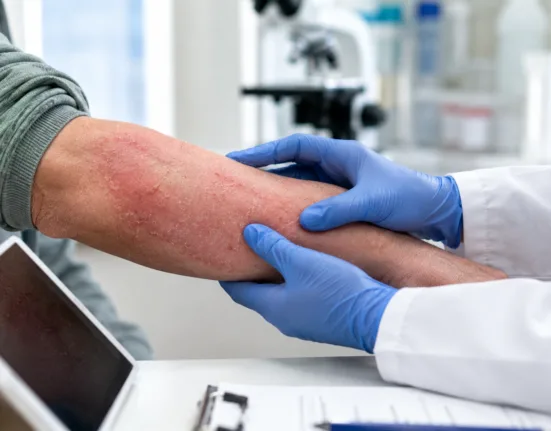
Castle Biosciences, Inc. (Nasdaq: CSTL) said on July 14, 2026, that the New York State Department of Health has granted assay approval for AdvanceAD-Tx, its laboratory-developed gene expression profile test intended to guide systemic therapy selection for patients aged 12 years and older with moderate-to-severe atopic dermatitis. The decision allows the test to be offered to eligible patients in New York, removing an important state-level access barrier for Castle Biosciences’ emerging precision dermatology product.
The approval does not represent United States Food and Drug Administration approval, national reimbursement or an endorsement of any particular atopic dermatitis medicine. AdvanceAD-Tx remains a clinician-support tool that classifies a patient’s molecular profile to help inform the choice between Janus kinase inhibitor therapy and treatments targeting the T helper type 2 inflammatory pathway.
Castle Biosciences launched AdvanceAD-Tx through a limited-access programme in November 2025 and has been expanding availability during 2026. The central commercial question is now shifting from whether the company can make the test available to whether dermatologists, payers and patients will view molecular treatment guidance as sufficiently useful to change established prescribing pathways.
What does New York State approval actually change for the AdvanceAD-Tx test?
New York operates one of the most demanding state-level oversight systems for laboratory-developed tests in the United States. Laboratories accepting specimens from New York patients generally require the relevant permits and assay approvals through the New York State Department of Health’s Clinical Laboratory Evaluation Program before testing can be offered within the state.
The AdvanceAD-Tx decision therefore has a practical consequence. Castle Biosciences can now expand access to New York patients with moderate-to-severe atopic dermatitis who meet the test’s intended age and treatment criteria. The company also said the decision means that all tests across its dermatology and ophthalmology portfolios, along with the TissueCypher gastroenterology test, now have New York approval.
That portfolio-wide status may simplify commercial discussions with large dermatology practices and health systems that treat patients across several Castle Biosciences indications. New York is also a clinically influential market, with major academic dermatology centres and a sizeable population of patients potentially eligible for systemic treatment.
The terminology remains important. The New York decision is an assay approval within the state’s clinical laboratory framework. It is not equivalent to Food and Drug Administration premarket approval or 510(k) clearance, and it does not automatically apply to treatment decisions, coverage policies or clinical practices elsewhere.
Regulatory access solves only the first part of the commercial equation. A dermatology practice may legally order AdvanceAD-Tx for a New York patient, but the decision to use the test will still depend on evidence, workflow, cost, turnaround time and confidence that the result could materially improve therapy selection.
How does AdvanceAD-Tx translate a skin scraping into systemic therapy guidance?
AdvanceAD-Tx uses RNA expression data obtained from a non-invasive scraping of an affected skin lesion, avoiding the need for a surgical biopsy. The test evaluates the expression of 487 genes across 12 inflammatory, immune and cutaneous biology pathways before applying a neural network algorithm to classify the sample.
The report produces one of two molecular profiles. A JAK Inhibitor Responder Profile indicates that the patient’s gene expression pattern is associated with a stronger response to Janus kinase inhibitor therapy than to a T helper type 2-targeted therapy. A Th2 Molecular Profile indicates that the available validation data did not show a statistically meaningful difference in response between the two treatment classes.
This distinction is more nuanced than a simple recommendation that one class is good and the other is ineffective. The test’s most obvious clinical value lies in identifying the approximately 30% of patients in the validation cohort who had the JAK Inhibitor Responder Profile. For the larger Th2 Molecular Profile group, clinicians retain greater flexibility because outcomes were not statistically different between the evaluated therapy classes.
The non-invasive collection process could help implementation. Dermatologists do not need to schedule a separate biopsy, and Castle Biosciences can use laboratory and commercial infrastructure developed through its existing dermatology testing portfolio. However, practices will still require collection training, reliable specimen handling, clear report interpretation and a process for incorporating results into prior-authorisation and prescribing workflows.
A technically convenient test can reduce adoption friction, but convenience cannot compensate for weak clinical utility or uncertain payment. AdvanceAD-Tx will ultimately be judged on whether its report changes treatment decisions and produces better outcomes than conventional selection based on disease severity, previous treatment, comorbidities and clinician judgement.

How strong is the prospective evidence behind AdvanceAD-Tx treatment guidance?
The principal supporting evidence comes from a prospective, multicentre study published in the Journal of the American Academy of Dermatology. Researchers used data from 192 patients to develop the 487-gene expression profile algorithm and independently validated it in 110 patients aged 12 years or older with atopic dermatitis.
Approximately 30.4% of patients in the validation cohort were classified as having a JAK Inhibitor Responder Profile. Within that molecular group, patients treated with a Janus kinase inhibitor achieved a 90% improvement in the Eczema Area and Severity Index at three months at a rate of 45.5%, compared with 8.3% among those receiving a T helper type 2-targeted therapy.
The study also reported that patients with the JAK Inhibitor Responder Profile reached that skin-clearance threshold 3.8 times faster when treated with a Janus kinase inhibitor. The corresponding rates for reporting no itch were 45.5% and 8.3%, while flare-free rates were 54.5% and 16.7%. These findings were statistically significant in the disclosed analysis.
Among patients classified with a Th2 Molecular Profile, Eczema Area and Severity Index 90 response rates were 26.5% with a T helper type 2-targeted therapy and 33.3% with a Janus kinase inhibitor. That difference was not statistically significant, supporting the interpretation that the test’s principal differentiating power resides in the JAK Inhibitor Responder Profile.
The prospective, multicentre design and independent validation cohort give the evidence more weight than a retrospective, single-centre dataset. Publication in a peer-reviewed journal is another positive step. Nevertheless, this was a company-funded, observational study rather than a randomised trial in which therapy was assigned according to the test result.
The validation cohort was also relatively modest, especially after patients were divided by molecular profile and treatment class. Follow-up focused on outcomes within three months, leaving questions about longer-term disease control, treatment persistence and whether test-guided care reduces switching over a year or more.
Validation was restricted to patients aged 12 years and older. The assay offers therapy-class guidance rather than predicting response to an individual medicine, dose or formulation. The rapid evolution of the atopic dermatitis market also means emerging biologics and other systemic treatments will need to be considered as the evidence package expands.
Why can molecular profiling not replace safety-led clinical decision-making?
The AdvanceAD-Tx result addresses expected treatment response, not whether a specific drug is appropriate or safe for an individual patient. That separation is especially important when the report identifies a JAK Inhibitor Responder Profile.
Systemic Janus kinase inhibitors can provide rapid and substantial symptom improvement, but their prescribing information includes significant warnings and monitoring requirements. Relevant considerations can include serious infection risk, malignancy, major cardiovascular events, thrombosis, laboratory abnormalities, age, smoking history and other patient-specific risk factors.
Targeted biologics have different safety profiles, administration routes, monitoring requirements and treatment burdens. Clinicians must also consider pregnancy, other immune-mediated conditions, previous infections, vaccination status, concurrent medicines, patient preference and the practical difference between an oral medicine and an injectable therapy.
AdvanceAD-Tx should therefore be interpreted as one component of shared clinical decision-making. A JAK Inhibitor Responder Profile does not mean that a Janus kinase inhibitor is automatically the correct choice, while a Th2 Molecular Profile does not establish that a targeted biologic will work for every patient.
This limitation does not make the test clinically irrelevant. It defines its proper role. The assay may help answer which broad treatment mechanism is more likely to deliver a strong response, while clinicians determine whether that treatment is medically appropriate and compatible with payer requirements.
Will reimbursement determine whether New York approval produces meaningful adoption?
Reimbursement is likely to be the decisive commercial issue. New York assay approval does not establish a billing rate, compel an insurer to cover AdvanceAD-Tx or guarantee that a submitted claim will be paid.
Castle Biosciences has said it is pursuing multiple reimbursement pathways, but broad coverage, pricing and patient cost-sharing details have not yet been established publicly. Payers may require additional evidence showing that the test changes prescribing behaviour, shortens the time to disease control, reduces unsuccessful treatment sequences or produces measurable health-economic benefits.
The hurdle is not merely whether the molecular classification predicts response. Insurers will ask whether paying for the test lowers total treatment costs or improves outcomes sufficiently to justify another diagnostic expense. That calculation could be complicated by existing formulary rules and step-therapy requirements that direct patients toward preferred drugs before alternatives are authorised.
Castle Biosciences estimated that approximately 10 million people aged 12 years and older in the United States have moderate-to-severe atopic dermatitis, creating a theoretical addressable market of around $33 billion based on its assumptions. That figure should not be interpreted as an attainable revenue forecast. The clinically tested population, patients actively considering systemic therapy, physician ordering behaviour and reimbursed test volume will define a much smaller commercial opportunity.
The company reported approximately 650 AdvanceAD-Tx orders during the first quarter of 2026 while the test remained in limited access. That early demand indicates clinician curiosity, but order volume alone does not establish repeat utilisation, paid claims or durable adoption.
What does Castle Biosciences’ recent financial and stock performance signal?
Castle Biosciences reported first-quarter 2026 revenue of $83.7 million, down from $88 million a year earlier, although combined test volumes for its core DecisionDx-Melanoma and TissueCypher products increased 36%. Management raised full-year revenue guidance to between $345 million and $355 million.
The company recorded a quarterly net loss of $14.5 million and adjusted EBITDA of negative $5.1 million. It ended March with $261.7 million in cash, cash equivalents and marketable investment securities, providing financial capacity to support evidence development and commercial expansion.
Castle Biosciences shares closed at $23.12 on July 14, up 0.61% during the session. The AdvanceAD-Tx announcement was released after regular market trading, meaning that closing movement cannot be treated as a direct reaction to the approval.
The stock was down approximately 2.2% over five trading days but remained about 14.2% higher over one month. It was still down roughly 40.6% in 2026 and traded within a 52-week range of $14.59 to $44.28. The company’s market capitalisation was approximately $697 million.
That pattern suggests mixed investor sentiment. The recent monthly recovery reflects renewed interest, but the large year-to-date decline indicates that the market remains cautious about profitability, reimbursement exposure and the conversion of new tests into dependable revenue.
Castle Biosciences is scheduled to report second-quarter results on July 30. Investors will be looking for updated AdvanceAD-Tx order volume, progress on reimbursement and evidence that the company can expand newer products without placing excessive pressure on operating margins.
The New York approval removes a genuine regulatory obstacle and gives AdvanceAD-Tx access to an important market. The larger test now begins: whether Castle Biosciences can turn a promising molecular classifier, prospective clinical evidence and early physician interest into reimbursed, repeatable use across everyday atopic dermatitis care.