Nutromics Pty Ltd has moved closer to testing whether continuous molecular monitoring can extend beyond glucose after the United States Food and Drug Administration granted Breakthrough Device Designation to its investigational wearable vancomycin therapeutic drug monitoring patch. The designation does not authorize commercial use, but it gives Nutromics closer interaction with the agency as the Australian-founded company develops its pivotal study and regulatory submission. Nutromics is targeting a possible United States launch in 2027, subject to obtaining marketing authorization.
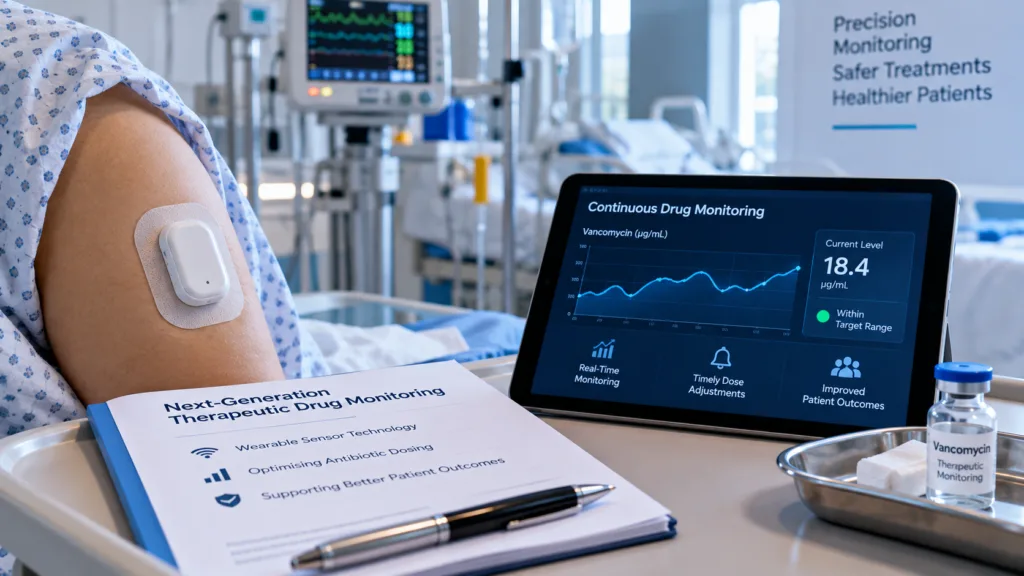
The concept is simple to describe but technically ambitious. Instead of repeatedly drawing blood, transporting samples to a laboratory and waiting for a result, Nutromics uses minimally invasive microneedles and electrochemical aptamer-based sensors to monitor vancomycin concentrations in dermal interstitial fluid. Its first-in-human study demonstrated measurement every five minutes over a 24-hour period in six healthy volunteers, although sensor degradation meant the researchers focused much of their detailed analysis on the first 12 hours.
Why is vancomycin an attractive first target for continuous monitoring?
Vancomycin is widely used against serious Gram-positive bacterial infections, including infections involving methicillin-resistant Staphylococcus aureus, yet effective dosing can be difficult because pharmacokinetics vary substantially between patients. Insufficient exposure can undermine efficacy, while excessive exposure can increase toxicity risk.
Modern therapeutic drug monitoring therefore seeks to keep exposure within an appropriate range rather than relying on fixed dosing alone. Updated vancomycin guidance has increasingly favoured area-under-the-curve approaches over simple trough concentration monitoring because total exposure can better connect drug concentration with efficacy and toxicity. Nutromics says approximately 2.9 million United States patients receive vancomycin each year.
The limitation is that conventional monitoring still depends on discrete blood samples. Even a well-timed measurement provides only a snapshot, leaving clinicians or software to infer what happens between samples. Continuous measurements could theoretically reveal drug distribution, peak and elimination behaviour with far greater temporal detail.
What did Nutromics actually demonstrate in humans?
The February 2026 Nature Biotechnology publication is important because it moves the technology beyond benchtop claims. Six healthy participants wore patches containing electrochemical aptamer-based sensors capable of measuring vancomycin in dermal interstitial fluid every five minutes. The patches were described as safe and nearly pain-free during the pilot study.
Researchers were able to model distribution and clearance dynamics that sparse plasma sampling did not capture. Patches placed at different body sites showed broadly consistent concentration trends within and between participants, supporting the idea that interstitial-fluid measurement could provide clinically interpretable pharmacokinetic information.
Yet the experiment also exposed a central engineering challenge. Sensor performance degraded with time, and although measurements were collected for 24 hours, the publication emphasized the first 12 hours because of that deterioration. A commercially useful hospital monitor must maintain accurate performance for a clinically meaningful period without frequent replacement or recalibration.
Why is Breakthrough Device Designation useful but not the same as clearance?
The FDA Breakthrough Devices Program is designed to facilitate development of technologies that could provide more effective treatment or diagnosis for serious conditions. It can increase interaction between the sponsor and agency and potentially accelerate aspects of review, but it is not evidence that the FDA has determined a product to be safe and effective for routine clinical use.
Nutromics explicitly states that its patch remains investigational and is not authorized for commercial distribution. In granting the designation, the FDA considered potential workflow improvements, accessibility, faster actionable results and the possibility that more timely concentration information could support earlier modification of vancomycin dosing.
That distinction is important for evaluating early medical-device announcements. Breakthrough designation materially improves the regulatory development pathway, but pivotal clinical evidence must still establish analytical accuracy, clinical performance, safety, usability and reliability under intended real-world conditions.
Will healthy-volunteer data translate to intensive-care patients?
That may be the most important technical question facing Nutromics. Healthy volunteers provide a controlled environment for demonstrating that a wearable sensor can detect vancomycin pharmacokinetics. Critically ill patients present a much harsher biological test.
Sepsis, shock, vasopressor use, oedema, altered tissue perfusion, renal dysfunction and rapid changes in fluid balance can all affect drug distribution. Interstitial-fluid concentrations also need to remain reliably interpretable against clinically validated plasma exposure targets.
Nutromics says it has subsequently conducted intensive-care clinical studies in Australia and is preparing additional United States studies. Those datasets should reveal whether continuous interstitial sensing remains accurate when patient physiology is precisely the kind of unstable environment in which improved monitoring would be most valuable.
Would five-minute data actually change how clinicians dose vancomycin?
Producing more measurements does not automatically produce better care. Hospitals would need algorithms, clinical decision rules or pharmacokinetic models capable of translating a stream of concentration readings into dosing recommendations that clinicians can trust.
The value proposition is strongest if the system shortens the time patients spend outside the desired exposure window. Continuous data could potentially alert teams earlier when clearance changes, identify unexpected accumulation and improve estimation of drug exposure without waiting for another scheduled blood draw.
However, alarm fatigue and overreaction are genuine risks in continuous-monitoring systems. Clinicians do not necessarily need a new decision every five minutes. The product therefore needs to convert high-frequency raw data into useful information without creating unnecessary interventions.
Could continuous therapeutic drug monitoring become a platform rather than a single product?
Nutromics is explicitly building for that possibility. Its sensing architecture uses DNA-based aptamers, molecules engineered to bind specific targets, integrated with electrochemical readout and microneedles. The company has identified future sensor targets related to sepsis and cardiovascular disease and ultimately envisages simultaneous multi-analyte monitoring.
This is where the commercial opportunity becomes larger than vancomycin. Continuous glucose monitors created a huge market because one analyte has enormous relevance across millions of people with diabetes. Hospital medicine involves many biomarkers and drugs, but most remain measured intermittently through centralized laboratories.
A reliable multi-analyte patch could theoretically track drugs, proteins, metabolites or hormones from one wearable platform. That would transform Nutromics from a therapeutic drug monitoring company into something closer to a continuous laboratory infrastructure provider.
The difficulty is that each new molecule creates its own sensor chemistry, validation requirements, clinical-use case and regulatory pathway. Platform potential is therefore valuable strategically, but investors and hospital customers will judge the first product on whether it can solve vancomycin monitoring reliably before giving much credit to broader ambitions.
What would hospitals need before adopting the patch?
Hospitals will want evidence that the patch agrees sufficiently with validated laboratory assays and meaningfully improves clinical workflow. They will also examine whether continuous monitoring reduces blood draws, laboratory turnaround delays, pharmacist workload, nephrotoxicity, length of stay or time outside the therapeutic range.
Economics will matter because centralized laboratory testing is already deeply embedded into hospital operations. A wearable device introduces a new consumable, digital infrastructure and potentially subscription or data costs. Nutromics will need to show that those expenses are offset by clinical or operational gains.
Integration into electronic medical records and pharmacy systems could become another competitive advantage or barrier. A continuous drug concentration signal that remains isolated in a proprietary dashboard creates more work; a system capable of feeding pharmacokinetic models and existing clinical workflows could be much easier to adopt.
Why could vancomycin be only the beginning?
The broader problem Nutromics is attacking is that modern medicine often makes decisions using intermittent biochemical snapshots despite patients changing continuously. Continuous glucose monitoring proved that converting a laboratory measurement into a real-time data stream can alter clinical behaviour, patient engagement and commercial markets.
Extending that principle to drugs is far more difficult because concentrations may be lower, targets are chemically diverse and hospital patients are physiologically complex. The company’s six-person feasibility study therefore represents proof of measurement, not proof of a clinical revolution.
Breakthrough Device Designation brings Nutromics closer to the decisive experiment. If pivotal studies demonstrate reliable sensing in real patients and show that continuous information changes dosing quickly enough to improve outcomes or workflow, vancomycin could become the first practical example of a much larger category. If accuracy or sensor stability deteriorates under real clinical conditions, the gulf between an elegant biosensor and a dependable medical device will become equally clear.