CoreTissue BioEngineering Inc. has initiated the randomized controlled cohort of its Japanese clinical trial evaluating CT-ACL001, a Tissue Regenerative Ligament device for anterior cruciate ligament reconstruction. The move follows completion of the safety evaluation cohort and shifts the Yokohama-based medtech startup from early safety assessment toward a comparative test against standard ACL reconstruction using a patient’s own hamstring tendon.
Why CT-ACL001 is now entering the more meaningful test in ACL reconstruction
The important change is not simply that CoreTissue BioEngineering has progressed another clinical trial stage. The more meaningful development is that CT-ACL001 is now being tested in a randomized controlled cohort, the type of trial structure that can begin to answer whether a regenerative ligament scaffold can compete with an established surgical standard rather than merely appear feasible in early use.
That distinction matters because anterior cruciate ligament reconstruction is not an empty treatment field waiting for a device to fill a gap. Orthopedic surgeons already have familiar graft strategies, including autologous hamstring tendon reconstruction, bone-patellar tendon-bone grafts and other graft options depending on patient profile, surgical preference and local practice. CT-ACL001 therefore has to prove more than novelty. It has to show that a tissue-regenerative ligament can deliver clinically relevant outcomes while reducing some of the trade-offs that accompany tendon harvesting.
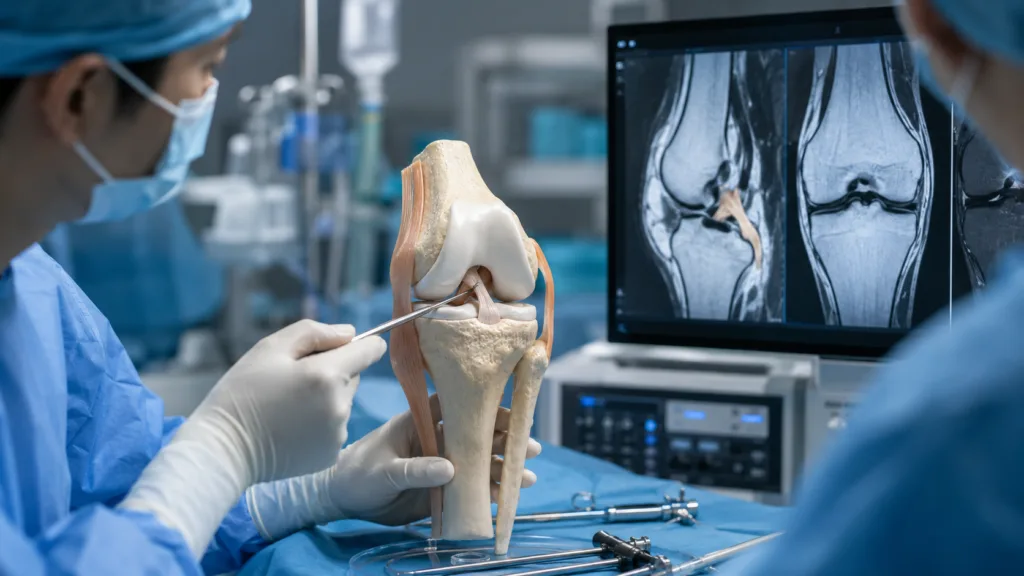
The central promise of CoreTissue BioEngineering’s approach is that CT-ACL001 acts as a scaffold for ligament regeneration using the patient’s own cells. In practical terms, the device is being positioned around a biological repair logic rather than a purely mechanical replacement logic. That is attractive in a field where surgeons care not only about initial fixation and stability, but also graft integration, remodeling, functional recovery, revision risk and donor-site morbidity.
The unresolved question is whether the regenerative mechanism can translate into measurable patient and surgeon value in a controlled study. A scaffold can look elegant as a concept, but orthopedic adoption is shaped by harder realities: operative handling, tunnel integration, mechanical strength over time, inflammatory response, rehabilitation outcomes, imaging evidence and long-term graft durability. The randomized cohort is where those questions begin to move from concept to evidence.
How the randomized design raises the evidence bar for a regenerative ligament device
CoreTissue BioEngineering’s randomized cohort is expected to include 38 cases in the CT-ACL001 reconstruction arm and 19 cases in the autologous tendon reconstruction arm. The control group is clinically important because it places the investigational device against a common real-world benchmark rather than against historical expectations or a weak comparator.
For clinicians and regulators, the use of autologous hamstring tendon reconstruction as the control group makes the trial more interpretable. Hamstring autograft reconstruction is widely used because it offers a known balance of strength, biological compatibility and surgical familiarity. However, harvesting the patient’s own tendon can involve donor-site concerns, including potential weakness, pain or morbidity at the harvest location. A device that avoids or reduces that burden would have a clear conceptual advantage, but only if the reconstructed ligament performs reliably.
The cohort size also deserves a sober reading. A 57-patient randomized cohort can be highly useful for generating controlled safety and efficacy evidence in a medical device development pathway, especially in a surgical indication where trials are complex and resource-intensive. However, it is not the same as a large international pivotal program capable of resolving every question around subgroups, surgeon learning curves and long-term durability. The findings may help support a Japanese approval filing after the primary endpoint is reached, but broader clinical confidence would likely depend on the quality of endpoints, follow-up duration and consistency across the six participating hospitals.
The multicenter structure adds strength because the study is being conducted across Tokyo Women’s Medical University Hospital, Hirosaki University Hospital, Hiroshima University Hospital, Hokkaido University Hospital, Juntendo University Hospital and Kobe University Hospital. A multicenter design can reduce the risk that results are driven by one surgical team or one institutional protocol. However, it also introduces execution risk, especially in a device-enabled surgical procedure where technique standardization and rehabilitation consistency can influence outcomes.
Why regenerative ligament technology could matter beyond a single Japanese ACL trial
The CT-ACL001 study sits at the intersection of sports medicine, regenerative medicine and surgical implant innovation. That positioning is commercially relevant because ACL injuries are common among athletes and active adults, and reconstruction remains one of the most important procedures in orthopedic sports medicine. Even incremental improvements in graft selection, surgical efficiency or patient recovery could matter in a high-volume procedure category.
CoreTissue BioEngineering is not merely testing a new orthopedic implant shape. The Japanese medtech startup is attempting to validate a regenerative scaffold model in which biological tissue is used to support the patient’s own ligament regeneration. If the trial produces convincing evidence, the approach could strengthen industry interest in tissue-derived devices that aim to combine structural support with biological remodeling.
That said, regenerative medicine has often faced a credibility gap between biological promise and clinical standardization. In orthopedics, the bar is especially unforgiving because surgeons need predictable mechanical performance. A ligament graft or scaffold cannot simply be biologically interesting. It must tolerate real forces, integrate with bone tunnels, maintain stability through rehabilitation and avoid complications that could compromise knee function.
This is why the CT-ACL001 program will likely be watched not only for headline safety and efficacy outcomes, but also for granular signals. Clinicians will want to know whether the device affects knee stability measures, graft maturation, failure rates, revision rates, pain, return-to-activity timelines and patient-reported function. Regulators will look for a coherent risk-benefit profile. Industry observers will look for whether the trial provides enough evidence to support manufacturing scale-up and physician training beyond a tightly managed study environment.
What the trial says about Japan’s medtech pathway for orthopedic innovation
The study also highlights Japan’s role as a serious medtech development environment for regenerative and tissue-based devices. CoreTissue BioEngineering’s research and development, including the trial, is supported by a grant from the Japan Agency for Medical Research and Development. That support matters because orthopedic regenerative devices often require long development timelines, specialized manufacturing systems and a regulatory strategy that can bridge laboratory biology with surgical workflow.
Japan has a strong clinical and research base in orthopedics, but medtech startups still face a difficult path from hospital-based validation to commercial adoption. A device such as CT-ACL001 has to satisfy multiple stakeholders at once. Surgeons need confidence in handling and outcomes. Hospitals need workable procurement and procedure economics. Regulators need safety and performance evidence. Payers and health systems need a reason to support adoption if the device is priced above conventional graft approaches.
The trial’s next phase will therefore test more than the device itself. It will test whether CoreTissue BioEngineering can build an evidence package strong enough to support a manufacturing and marketing approval application in Japan after the primary endpoint is completed. The Japanese approval strategy appears clear in broad terms, but the eventual commercial pathway will depend on how compelling the comparative data are and whether the device can be produced consistently at scale.
Manufacturing could become a defining issue. Tissue-derived regenerative devices carry different industrial challenges from standard metal, polymer or purely synthetic orthopedic implants. Batch consistency, sterilization, decellularization, mechanical properties, storage, supply chain reliability and surgeon usability all become part of the value proposition. A positive trial without a scalable manufacturing model would still leave commercialization exposed.
Why the safety cohort presentation at ESSKA may influence early specialist perception
CoreTissue BioEngineering has also said that initial results from the safety evaluation cohort will be presented at the 22nd Congress of the European Society of Sports Traumatology, Knee Surgery and Arthroscopy. That presentation may help the device gain visibility among sports medicine specialists beyond Japan, although early safety data should not be confused with definitive comparative evidence.
Conference presentations can be valuable in orthopedic device development because surgeon perception forms early and often spreads through specialist networks. If the safety cohort data show acceptable perioperative safety, early graft behavior and manageable clinical workflow, CT-ACL001 could attract attention from clinicians interested in reducing autograft-related trade-offs. However, early specialist interest will remain conditional until randomized outcomes show whether the regenerative ligament can match or outperform standard reconstruction on clinically meaningful measures.
The European sports medicine audience is also a useful test of the device’s global relevance. ACL reconstruction practice patterns vary by region, surgeon training, patient activity level and available graft choices. If CoreTissue BioEngineering eventually pursues markets outside Japan, the company will have to show that CT-ACL001 is not only viable in Japanese trial settings, but adaptable to broader surgical ecosystems.
The near-term value of the ESSKA presentation is therefore reputational rather than regulatory. It can introduce the mechanism, build scientific familiarity and invite clinical scrutiny. But the randomized cohort remains the decisive evidence step.
What clinicians, regulators and industry observers will watch next in CT-ACL001
The next phase of CT-ACL001 development will be judged by how cleanly the trial connects biological regeneration to functional clinical benefit. For surgeons, the question will be whether the device can deliver stable knees without creating new procedural complexity or new safety concerns. For regulators, the question will be whether the safety and efficacy data are strong enough to justify approval as a medical device for ACL reconstruction. For industry observers, the question will be whether CoreTissue BioEngineering can turn a scientifically appealing platform into a manufacturable and commercially adoptable product.
The control arm makes the study more credible, but it also raises the bar. Autologous hamstring tendon reconstruction is familiar, available and supported by years of clinical practice. CT-ACL001 must compete against that embedded standard, not against an abstract unmet need. If the regenerative ligament shows comparable outcomes while reducing donor-site concerns, the device could create a meaningful clinical opening. If the outcomes are merely similar without a clear practical advantage, adoption may be slower.
The biggest strategic opportunity is that CT-ACL001 could broaden graft choice in ACL reconstruction. The biggest risk is that regenerative claims often take longer to prove than investors and developers expect. Ligament remodeling is not a short marketing cycle. It is a biological process that has to be validated through follow-up, imaging, mechanical stability and patient function.
CoreTissue BioEngineering has now moved into the stage where the device’s clinical story becomes harder and more useful. The randomized cohort will not answer every question about global adoption, reimbursement or long-term durability. However, it will begin to show whether CT-ACL001 can move from a promising regenerative concept into the evidence-driven world of orthopedic reconstruction.

CoreTissue BioEngineering pushes ACL device strategy beyond early safety testing added by Pallavi Madhiraju on
View all posts by Pallavi Madhiraju →