Cortechs.ai has received US Food and Drug Administration 510(k) clearance for NeuroQuant PET, an automated software platform designed to quantify molecular brain imaging and support physician interpretation of positron-emission tomography examinations used in cognitive impairment and other neurological conditions. The August 18 clearance, identified by the company as K261916, extends the established NeuroQuant imaging portfolio into PET at a time when Alzheimer’s disease diagnosis is becoming increasingly dependent on quantifiable biological markers rather than clinical phenotype alone.
NeuroQuant PET does not acquire the PET scan and does not independently diagnose Alzheimer’s disease. Instead, it processes existing molecular-imaging data, segments anatomical regions and produces standardized quantitative measurements that clinicians can consider alongside visual image interpretation and the wider patient assessment.
Its commercial relevance has increased as amyloid PET moves closer to treatment-selection and disease-management workflows. Anti-amyloid therapies require confirmation of underlying amyloid pathology, while growing use of blood biomarkers is creating a diagnostic environment in which clinicians may need to reconcile results from laboratory testing, PET and other clinical information.
Cortechs.ai is positioning automated quantification as a way to make one of those evidence streams more reproducible.
What does NeuroQuant PET measure from an amyloid brain scan?
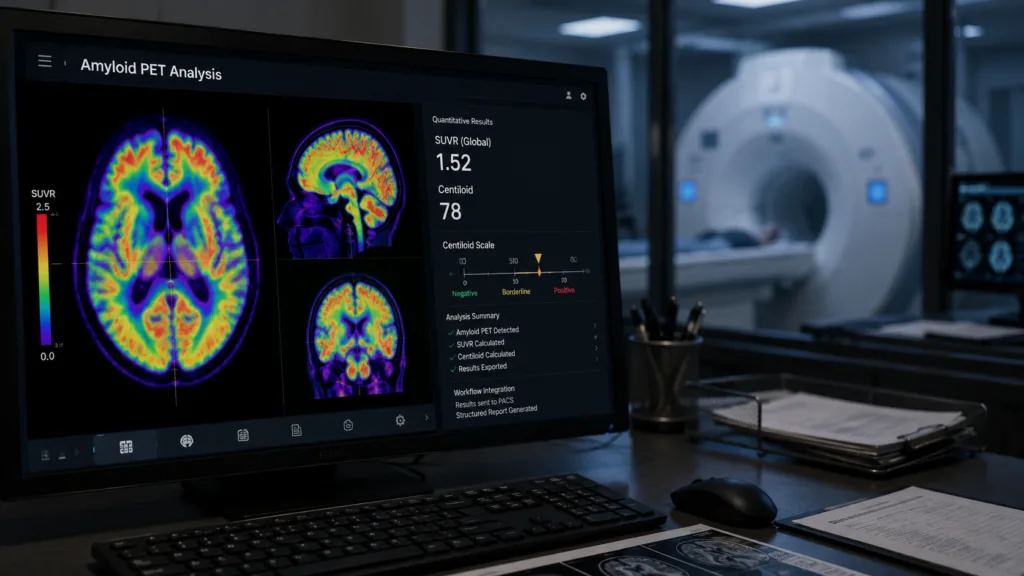
The software provides atlas-based analysis of PET images and automatically identifies anatomical regions of interest. It then calculates regional tracer uptake and generates standardized uptake value ratios, or SUVRs, which compare uptake in selected brain regions against a reference region.
For amyloid PET, NeuroQuant PET also generates Centiloid values for commonly used tracers including flutemetamol, florbetaben and florbetapir. The platform is compatible with PET-CT, PET-MR and PET-only workflows and can generate PACS-ready outputs intended for integration with existing radiology infrastructure.
The Centiloid scale was developed to address a longstanding problem in amyloid imaging: different PET tracers, analysis methods and imaging sites can generate values that are difficult to compare directly.
By converting amyloid burden to a standardized scale, Centiloid analysis aims to make results more comparable between patients, tracers and longitudinal examinations. Zero approximately represents the level expected in young amyloid-negative individuals, while higher values indicate increasing amyloid burden.
That standardization becomes increasingly valuable when a patient undergoes repeated imaging or when health systems use different approved amyloid tracers according to availability.
Automated regional analysis can also reduce dependence on manual placement of regions of interest, potentially improving consistency across readers and sites. It does not eliminate the need for physician interpretation because image artifacts, unusual anatomy and clinical context can still affect how quantitative findings should be understood.
Why is quantitative PET becoming more important in Alzheimer’s disease care?
Historically, Alzheimer’s disease diagnosis relied heavily on history, cognitive testing and exclusion of other causes of impairment. Biomarker-based diagnosis has increasingly shifted the field toward direct evidence of pathological processes such as amyloid and tau accumulation.
PET is one of the most established methods for visualizing those pathologies in vivo. Approved radiotracers allow amyloid burden to be assessed, while tau PET can provide additional information about neurofibrillary pathology.
The emergence of disease-modifying treatments has increased the practical stakes. When a therapy specifically targets amyloid, confirming that the patient actually has amyloid pathology becomes essential rather than academically interesting.
Visual interpretation of PET remains important, but quantitative measures can add information around borderline scans, longitudinal change and consistency. Standardized numerical values may also make it easier to communicate disease burden across specialists or compare scans performed at different institutions.
Cortechs.ai says NeuroQuant PET is intended to provide that quantitative layer automatically rather than require time-consuming manual processing.
The broader NeuroQuant brand already has a substantial history in structural MRI analysis, where automated brain volumetry can compare regional volumes with normative reference populations. Extending the architecture to molecular PET allows the company to combine structural and pathological information within a wider neuroimaging portfolio.
Does FDA clearance mean NeuroQuant PET diagnoses Alzheimer’s disease automatically?
No. That would substantially overstate both the regulatory status and the role of the software.
Cortechs.ai states that NeuroQuant PET aids physicians in evaluating pathology and interpreting PET examinations used in cognitive impairment and other neurological conditions. The clinician remains responsible for integrating imaging with symptoms, cognitive testing, medical history and other diagnostic evidence.
A positive amyloid PET scan also does not by itself explain every case of cognitive impairment. Amyloid pathology can be present in people with mixed neurodegenerative disease and can accumulate before dementia becomes clinically evident.
Conversely, a patient with cognitive decline can have a non-Alzheimer’s cause that requires an entirely different diagnostic pathway.
Quantification therefore works best as a decision-support tool rather than an autonomous diagnosis engine. The potential advantage is consistency: an algorithm can apply the same segmentation and calculation framework to each study rather than depending entirely on subjective visual estimation.
That consistency could become particularly important as more treatments and trials use quantitative biomarker thresholds.
How does NeuroQuant PET fit with the rise of Alzheimer’s blood tests?
The simultaneous expansion of blood and imaging biomarkers creates both competition and complementarity.
FDA-cleared blood tests can provide a less invasive and potentially less expensive way to assess the likelihood of Alzheimer’s-associated pathology. C2N Diagnostics’ PrecivityAD2, for example, was cleared this week for symptomatic adults aged 40 and older, while other plasma tests have entered regulated clinical use. Blood testing may consequently reduce the number of patients who require PET solely to answer whether amyloid pathology is likely present.
PET retains advantages in directly localizing pathology and generating an image of regional distribution. It may remain particularly valuable when blood results are inconclusive, discordant with the clinical picture or when a more definitive biomarker assessment is needed.
Quantitative PET software therefore does not necessarily depend on every cognitively impaired patient undergoing a scan. Its value can increase even if scans become more selectively targeted, because the patients who do reach PET may require increasingly precise interpretation.
The introduction of disease-modifying therapies also creates a longitudinal question. Clinicians and researchers may want to understand how biological markers change over time, and standardized quantitative reporting could make repeated measurements more useful.
Cortechs.ai’s support for commonly used amyloid tracers is commercially relevant in that context because health systems are not locked to a single tracer for Centiloid reporting.
Could automated PET quantification become part of routine radiology rather than a specialist research tool?
That is the larger commercial test created by FDA clearance.
Quantitative PET analysis has been used extensively in research, but routine clinical workflow imposes different requirements. Processing must be fast, reports must integrate into PACS, radiologists must understand the output and the additional numbers must change interpretation enough to justify their use.
Cortechs.ai emphasizes fully automated cloud processing and PACS-ready reporting, an architecture designed to reduce the operational barrier to using quantitative information in routine care.
The company’s own product page had previously described NeuroQuant PET as research use only and not FDA cleared, illustrating the regulatory transition represented by K261916. The new clearance converts the platform from a research-oriented offering into software that can be marketed for its authorized US clinical use.
Competition is likely to increase quickly. Imaging vendors, artificial-intelligence companies and specialist neuroimaging software developers are all pursuing tools that quantify amyloid, tau, metabolism and structural brain change.
Differentiation may therefore depend on interoperability, normative databases, processing speed, reproducibility and integration with multiple modalities rather than on the existence of one measurement alone.
Cortechs.ai has an advantage in being able to build PET analysis around an established NeuroQuant ecosystem, but customers will ultimately judge whether the software improves confidence and efficiency enough to become part of standard reading workflow.
The FDA clearance represents a meaningful step in that direction. Molecular imaging is increasingly producing not only pictures but standardized biological measurements, and NeuroQuant PET now has a regulated US pathway for helping clinicians turn those scans into structured quantitative information.