Velmeni, Inc. has announced United States Food and Drug Administration 510(k) clearance for Velmeni for Dentists V4D 3D, software intended to assist qualified dental professionals in reviewing and analysing three-dimensional cone-beam computed tomography scans. The product uses artificial intelligence to support anatomical segmentation, image reconstruction, measurements and multidimensional visualization while leaving final interpretation, diagnosis and treatment planning with the clinician.
The July 23, 2026 clearance pushes Velmeni beyond the two-dimensional radiograph analysis that shaped its earlier regulatory progress and into a more technically complex part of dental imaging. The company is positioning V4D 3D as a component of Velmeni One, a connected platform combining two-dimensional imaging analysis, three-dimensional CBCT review, voice-based clinical documentation, structured reporting, insurance workflow automation and practice-management integrations.
That platform strategy may be more commercially important than any individual visualization feature. Dental artificial intelligence vendors are increasingly competing not merely on whether an algorithm can identify or segment anatomy, but on whether the software can reduce workflow fragmentation across imaging, documentation, patient communication, specialist referrals and administrative processes.
However, FDA clearance removes only one barrier. Velmeni must still demonstrate that its three-dimensional software performs consistently across scanners, practices, patient populations and clinical workflows while giving dentists enough efficiency or decision-support value to justify implementation costs.
What does the FDA clearance allow Velmeni for Dentists V4D 3D to do?
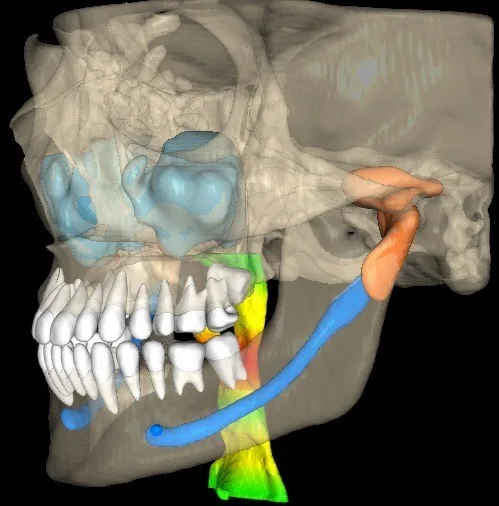
Velmeni for Dentists V4D 3D is designed to help dental professionals navigate CBCT datasets by identifying, labelling and segmenting anatomical structures. The company said these structures may include the maxilla, mandible, teeth, mandibular canal, maxillary sinuses, temporomandibular joints and airway anatomy.
The software can also identify the dental arch and generate reconstructed panoramic and cross-sectional views from volumetric CBCT data. It provides measurements and multiplanar or three-dimensional visualizations that may be used during anatomical assessment, case review, treatment planning and communication with other dental professionals.
Velmeni has additionally included the ability to export stereolithography files, commonly known as STL files, which can support three-dimensional modelling, case presentation, laboratory collaboration and patient education. Structured reporting and documentation functions are intended to connect the imaging output with the broader clinical workflow rather than leaving the information inside a standalone viewer.
The regulatory distinction is important. V4D 3D is an assistive tool, not an autonomous diagnostic system. The clearance does not mean that the software independently determines a diagnosis, replaces a complete clinical examination or produces a treatment plan without professional review.
Velmeni itself states that qualified dental professionals remain responsible for final diagnoses, recommendations and patient treatment plans. The practical value of the software will therefore depend on whether it helps clinicians interpret and communicate complex imaging information more efficiently without encouraging overreliance on automated segmentation.
Why does moving from two-dimensional radiographs into CBCT materially broaden Velmeni’s dental AI position?
Two-dimensional dental radiographs remain fundamental to routine practice, but they compress three-dimensional anatomy into a flat image. Structures can overlap, anatomical relationships may be difficult to assess and certain treatment-planning questions require more detailed spatial information.
Dental CBCT systems rotate around the patient using a cone-shaped X-ray beam and reconstruct volumetric images of the teeth, jaws, oral and maxillofacial regions and surrounding structures. The technology is used across implant planning, evaluation of abnormal teeth, endodontics, dental trauma, jaw assessment and other clinical applications where conventional radiographs may not provide sufficient information.
This creates a substantially larger computational challenge for artificial intelligence developers. A CBCT scan may contain hundreds of slices, multiple anatomical planes, variable fields of view, metal artefacts and scanner-dependent differences in image quality. Interpreting that dataset is more demanding than highlighting a suspected finding on a single bitewing or periapical image.
Automated segmentation can potentially reduce the time required to isolate structures such as the mandibular canal, teeth, sinuses or jawbone. Reconstruction tools can also make it easier to move between axial, coronal, sagittal, panoramic and cross-sectional views.
For Velmeni, the expansion creates opportunities across general dentistry, oral and maxillofacial radiology, oral surgery, orthodontics, prosthodontics, endodontics, imaging centres and dental service organisations. It also broadens the company’s relevance from radiographic finding detection toward treatment-planning support, structured imaging review and interdisciplinary case collaboration.
How mature is the evidence supporting Velmeni’s AI-assisted CBCT capabilities?
The FDA’s 510(k) pathway generally evaluates whether a device is substantially equivalent to a legally marketed predicate device. Clearance is a meaningful regulatory milestone, but it should not be interpreted as a finding that the product is superior to existing software or that it improves clinical outcomes.
Velmeni’s announcement described the software’s capabilities but did not publish detailed technical performance results, validation-cohort characteristics or the 510(k) submission number associated with V4D 3D. It did not disclose segmentation accuracy by anatomical structure, error distributions for automated measurements, scanner-specific performance or the frequency with which clinicians needed to correct automated output.
Those details will matter to specialist users. An apparently small segmentation error may have limited relevance in a general visualization task but could become more consequential when software-generated boundaries are used near a mandibular canal, tooth root, sinus floor or other structure involved in treatment planning.
Dental practices and imaging centres will also need to know how the system behaves when scans contain motion artefacts, metallic restorations, implants, missing teeth, unusual anatomy or incomplete fields of view. Performance across different CBCT manufacturers, acquisition protocols, voxel sizes and patient populations will influence whether the product can be deployed broadly or requires tightly controlled configurations.
Prospective workflow studies would strengthen the commercial evidence package. Useful endpoints could include review time, reporting turnaround, clinician correction rates, inter-reader consistency and whether structured output reduces documentation burden. Clinical utility cannot be assumed solely because an algorithm can segment anatomy or create visually appealing three-dimensional models.
Can Velmeni’s connected platform strategy create a stronger commercial advantage?
Velmeni is not presenting V4D 3D as an isolated imaging product. The company is incorporating it into Velmeni One, which is intended to connect two-dimensional radiographic analysis, three-dimensional CBCT review, voice-enabled periodontal charting, clinical documentation, reporting support, insurance claims automation and practice integrations.
That approach reflects an important change in healthcare artificial intelligence purchasing. Providers increasingly face too many disconnected applications, each solving a narrow problem while adding another login, interface, data transfer and vendor relationship.
A unified system may be more attractive to dental service organisations overseeing multiple practices. Centralised groups can potentially standardise imaging review, reporting templates and documentation workflows while monitoring how software is used across locations.
The platform could also create commercial cross-selling opportunities for Velmeni. A practice initially adopting two-dimensional X-ray assistance might later add CBCT tools, voice documentation or administrative automation without replacing the broader software environment.
Yet platform breadth can become a weakness when integration is incomplete. Combining several capabilities under one product family does not automatically create a seamless workflow. Each function must exchange data reliably with imaging systems, electronic dental records, practice-management software and specialist referral networks.
Velmeni will therefore be judged on implementation rather than the number of modules listed in the platform. Dental teams are unlikely to value connected artificial intelligence if staff still need to copy findings manually, upload scans repeatedly or reconcile inconsistent patient records across systems.
Why will interoperability and data governance influence adoption of V4D 3D?
Dental imaging remains fragmented across proprietary systems and inconsistent implementations of Digital Imaging and Communications in Medicine standards. The American Dental Association has warned that imaging data may be stored separately from electronic dental records, making exchange between providers difficult and increasing dependence on manual transfer methods.
The association has also argued that poor interoperability can result in lost metadata, reduced image quality, additional administrative work and unnecessary repeat imaging. It has called for open export specifications, interoperable application programming interfaces and stronger dental-specific implementation of imaging standards.
These issues are directly relevant to Velmeni. The value of automated segmentation and structured reporting decreases when the resulting information cannot move cleanly into the dentist’s main record, referral workflow or laboratory system.
Cybersecurity and privacy will also require attention because CBCT scans and linked clinical records contain identifiable health information. Dental groups evaluating V4D 3D will want clarity on cloud architecture, encryption, user permissions, data retention, audit trails, incident response and whether customer data are used to train or update algorithms.
Software updates present another operational question. Dental practices need to know how model changes are validated, documented and introduced without disrupting performance. A platform spanning clinical and administrative workflows may require more complex release management than a standalone image viewer.
How does Velmeni enter an increasingly competitive dental CBCT artificial intelligence market?
Velmeni is entering a market that already includes specialist artificial intelligence companies and established dental technology manufacturers.
Pearl received FDA 510(k) clearance for Second Opinion 3D in May 2025. The product was classified as automated radiological image-processing software, establishing Pearl as an early regulated competitor in three-dimensional dental artificial intelligence.
Overjet subsequently received FDA clearance for CBCT Assist in December 2025, while Dentsply Sirona obtained clearance for DS Core CBCT Anatomy in April 2026. The arrival of products from both artificial intelligence specialists and established dental equipment companies suggests that CBCT software is becoming an important competitive layer within digital dentistry rather than a niche add-on.
Velmeni’s differentiation may come from connecting CBCT analysis with its existing two-dimensional imaging and workflow automation capabilities. Its earlier FDA records include Velmeni for Dentists clearance in August 2024, an additional V4D clearance in September 2025 and clearance for Velmeni for Dentists Endo-Perio in May 2026.
A growing regulatory portfolio can support credibility with procurement teams, but the competitive contest will move quickly from clearance counts to practical deployment. Buyers will compare image compatibility, processing speed, correction burden, reporting functions, integration depth, pricing and responsiveness of technical support.
Established dental technology companies may benefit from existing installed bases and sales relationships. Independent artificial intelligence vendors may counter with faster product development, broader software compatibility and greater willingness to integrate across competing hardware ecosystems.
What adoption barriers remain for dental practices, specialists and DSOs?
Regulatory clearance allows commercialisation for the cleared intended use, but it does not guarantee rapid adoption. Dental practices vary widely in size, technology maturity, imaging volume and willingness to introduce new software into clinical decision-making.
Specialist centres processing large numbers of CBCT scans may see a clearer efficiency case than small general practices that order three-dimensional imaging infrequently. For lower-volume users, subscription costs, onboarding time and integration work may outweigh the immediate productivity benefit.
Training will also matter. Although the company describes the system as intuitive, clinicians must understand the limits of automated segmentation, recognize inaccurate output and know when conventional interpretation or specialist consultation remains necessary.
Dental service organisations could provide Velmeni with larger deployments, but these customers generally conduct more extensive technology reviews. They may require evidence of measurable time savings, consistency across locations, compatibility with existing systems and controls governing how artificial intelligence output is documented.
Reimbursement is unlikely to operate like payment for a separately billable therapeutic device. The commercial argument may instead depend on operational value, including faster review, improved documentation, more consistent case presentation or greater throughput. Velmeni will need to show that those benefits are large enough to support software expenditure.
Why does appropriate CBCT use remain important as artificial intelligence lowers interpretation friction?
Artificial intelligence may make CBCT datasets easier to navigate, but it should not encourage unnecessary imaging. The FDA states that dental CBCT generally delivers more radiation than conventional dental X-rays, even though exposure is typically lower than with many other computed tomography examinations.
The regulator recommends that CBCT be performed only when necessary to obtain clinical information that cannot be provided by another imaging modality. It also advises dental professionals to justify the examination, consider lower-exposure alternatives and use settings that achieve adequate diagnostic quality with the lowest reasonably achievable radiation dose.
The American Dental Association’s 2026 patient-selection recommendations similarly emphasise that both two-dimensional and three-dimensional dental imaging should be ordered only when clinically necessary and after considering the patient’s history, previous imaging and current examination findings.
This creates an important boundary for V4D 3D. The software can support analysis of an acquired CBCT scan, but its availability should not become a reason to obtain more scans. Responsible adoption will depend on keeping image-acquisition decisions separate from enthusiasm for downstream artificial intelligence capabilities.
What should the dental imaging industry watch next from Velmeni?
Velmeni’s immediate commercial test will be whether it can convert FDA clearance into reproducible deployment across dental practices, specialist groups, imaging centres and dental service organisations.
Product availability, pricing and compatible CBCT systems will be important early details. The company will also need to demonstrate how quickly scans are processed, how often automated segmentations require correction and whether structured reporting materially reduces clinical or administrative workload.
Independent or peer-reviewed validation would help potential customers assess performance beyond the regulatory threshold. Studies involving multiple imaging systems, external sites and diverse patient populations would be particularly valuable because real-world dental imaging conditions can differ substantially from controlled development datasets.
Integration announcements may be equally important. Partnerships with imaging-system manufacturers, practice-management providers, laboratories or large dental organisations could reveal whether Velmeni One is becoming a genuine workflow platform or remains a collection of related software functions.
The FDA clearance gives Velmeni a credible entry into three-dimensional dental artificial intelligence and extends a regulatory portfolio built through successive imaging products. The next stage will be less about generating impressive anatomical models and more about proving that the software can operate reliably inside busy dental environments, exchange data cleanly and deliver enough measurable value for clinicians to keep using it after the novelty wears off.