UCP Merchant Medicine has highlighted a study using 140,894 de-identified urgent care encounters collected through its Intellivisit clinical support platform to examine when tympanometry may be useful and whether the technology can be financially viable for urgent care operators. The retrospective modeling study found that 18.2% of a representative sample of urgent care encounters may have justified tympanometry, while its financial assumptions indicated that an average center could recover the cost of a portable device after approximately 214 examinations.
The research addresses a familiar but commercially underexamined problem in frontline medicine. Ear pain is common in urgent care, yet clinicians frequently depend on conventional otoscopy, a visual examination that can be affected by technique, experience, patient movement, earwax and interpretation of subtle findings.
Tympanometry adds an objective measurement of eardrum mobility and middle ear pressure. Modern handheld systems can produce results in seconds and may be operated by trained clinical support staff, potentially making the technology compatible with the high-throughput model used by urgent care centers.
However, the study should not be interpreted as proof that routine tympanometry has already improved diagnostic accuracy, patient outcomes or antibiotic prescribing across urgent care networks. It modeled which patients might benefit from testing and estimated the associated economics, making it an adoption hypothesis supported by real-world encounter data rather than a completed prospective implementation trial.
Why does the Intellivisit study matter for urgent care ear infection diagnosis?
The immediate importance of the study lies in its attempt to quantify a diagnostic opportunity that urgent care operators may know exists but rarely measure. Tympanometry has long been used by audiologists and ear, nose and throat specialists, yet it remains less common in general urgent care environments where ear pain, suspected acute otitis media and sudden hearing changes frequently present.
The technology assesses how the tympanic membrane responds when air pressure is varied within the ear canal. This produces a tympanogram that can help determine whether the eardrum is moving normally, whether middle ear fluid may be present or whether negative pressure is affecting the middle ear.
That objective information matters because the clinical appearance of an eardrum is not always straightforward. Redness may result from crying, fever or irritation rather than a bacterial middle ear infection. Fluid can also be missed when clinicians rely only on a brief visual examination, particularly in children who are distressed or unable to remain still.
The study therefore tackles both underdiagnosis and overdiagnosis. Missing middle ear fluid may delay appropriate follow-up, while incorrectly diagnosing acute otitis media can lead to unnecessary antibiotic treatment. In adults, ear pain may also originate from conditions outside the ear, including temporomandibular disorders, making an objective finding potentially useful when ruling against a middle ear process.
The commercial relevance comes from the scale of urgent care rather than from tympanometry being a technically novel test. The device category is established. What is new is the use of a large urgent care dataset and a machine learning model to estimate how frequently the test could be clinically justified in that particular care setting.
What do the prediction model results reveal about real-world clinical usefulness?
The model was trained using 140,894 encounters recorded through Intellivisit between May 2024 and March 2025. It was designed to identify presentations and diagnoses associated with circumstances in which tympanometry would be considered appropriate.
Two board-certified otolaryngologists independently reviewed a set of model-selected cases. Agreement between the reviewers was high, with a kappa value of 0.9, suggesting that the clinical criteria used to label potential cases were interpreted consistently by the specialists.
The model produced a median F1 score of 0.80 and specificity of 1.00. High specificity is commercially and operationally encouraging because it indicates that cases classified as appropriate for testing were unlikely to be obvious false positives within the reviewed sample.
Sensitivity was considerably lower at 0.55. That means the model may have missed a meaningful share of encounters that specialists believed could benefit from tympanometry. For a clinical support system, that limitation matters because the value of the technology would depend not only on avoiding unnecessary tests but also on consistently identifying patients who should receive them.
The wide confidence intervals around the reported performance measures add further uncertainty. Only 100 cases were manually reviewed for model validation, which is small compared with the full training dataset. The enormous encounter count creates a strong foundation for pattern identification, but it does not remove the need for broader clinical validation.
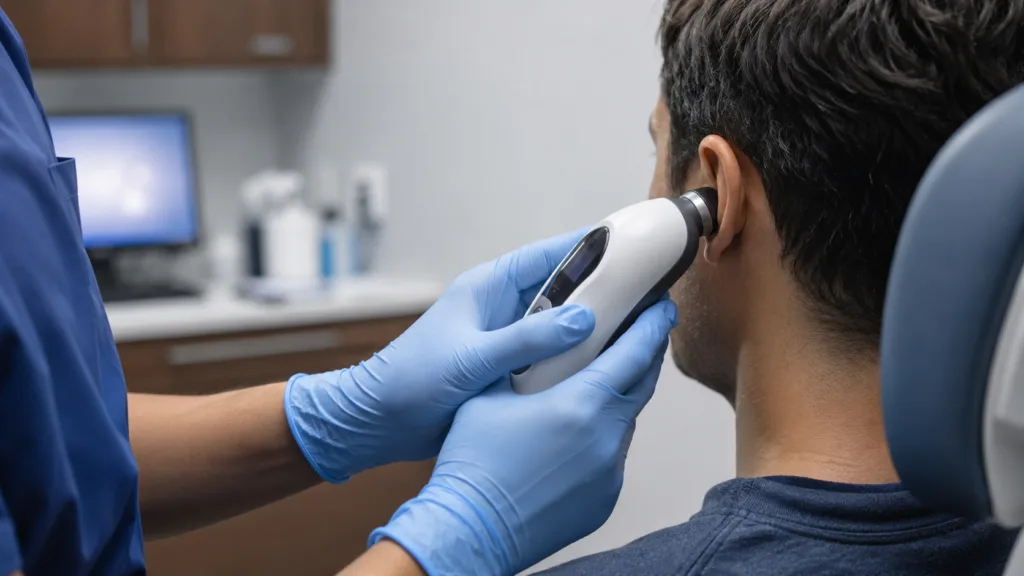
The model was subsequently applied to a separate random sample of 10,000 encounters. It predicted that 1,819 encounters, or 18.2%, had an indication for tympanometry. Ear pain was the most common chief complaint among these patients, while acute otitis media was the most common associated diagnosis.
This finding should be understood as predicted eligibility, not demonstrated use. The model did not confirm that every identified patient would have completed the test, produced an abnormal result or received a different diagnosis because of it.
Could tympanometry support antibiotic stewardship without slowing urgent care workflows?
Ear infections remain closely connected to outpatient antibiotic prescribing, particularly among children. One reason for unnecessary treatment is the difficulty of distinguishing acute otitis media from other causes of ear discomfort during a short consultation.
Tympanometry may help narrow that uncertainty by showing whether middle ear fluid is present. A normal result may prompt the clinician to consider other explanations for pain, while an abnormal result can support further assessment of a possible middle ear disorder.
The potential antibiotic stewardship benefit is therefore plausible, but it was not measured in the published analysis. The researchers did not compare prescription rates between patients assessed with conventional otoscopy and patients assessed using tympanometry. They also did not measure whether treatment decisions changed after clinicians received tympanometry results.
This distinction is important because better diagnostic information does not automatically produce better prescribing. Clinician habits, patient expectations, time pressure and concern about follow-up can continue to influence antibiotic decisions even when an objective test is available.
The workflow case may be more immediately persuasive. Portable tympanometers can return results within seconds, and testing may be delegated to trained nurses or medical assistants where permitted. A clinic could potentially perform the examination during intake or before the clinician enters the room, reducing the risk that the additional diagnostic step becomes a bottleneck.
Intellivisit could add value by identifying relevant presentations and prompting staff to perform the test through a standardized protocol. That combination of software guidance and compact diagnostics may be more scalable than relying on every urgent care clinician to remember detailed testing indications.
Yet implementation will still require training in probe placement, result quality, tympanogram interpretation and escalation protocols. A 30-second test can become a 10-minute delay when staff repeatedly obtain poor seals, encounter excessive earwax or are unsure how to interpret an unexpected tracing.
How persuasive is the one-month financial break-even case for urgent care operators?
The financial model assumed a device cost of approximately $4,700 and reimbursement of $22 for each examination billed under the relevant tympanometry procedure code. On those assumptions, a center would recover the acquisition cost after 214 completed and reimbursed tests.
Using an estimated annual volume of 14,750 visits and the model’s 18.2% testing rate, the researchers calculated that an average clinic could perform approximately 2,657 tympanometry examinations each year. That would equal roughly 221 tests per month and place the theoretical break-even point at 29.4 days.
After recovering the device cost, the center could generate about $4,862 in monthly gross revenue from tympanometry billing under the model. For multi-site urgent care operators, that figure makes the adoption proposition more attractive because a relatively inexpensive diagnostic device could create a repeatable ancillary revenue stream.
The simplicity of the calculation is also its weakness. It assumes that every clinically eligible test is performed, properly documented, successfully billed and reimbursed at the expected rate. Real-world collections can be affected by payer contracts, patient cost sharing, coding requirements, claim denials and differences between commercial insurance and government reimbursement.
The estimate also represents gross revenue rather than operating profit. It does not fully account for staff time, disposable probe tips, infection-control procedures, device downtime, administrative work, training refreshers or the cost of integrating testing prompts into an electronic health record.
Utilization is another significant variable. A center that performs only a fraction of the predicted tests may require several months to recover the equipment cost. Conversely, pediatric-heavy locations or clinics with high volumes of ear and hearing complaints might achieve break-even more quickly.
The study nevertheless gives procurement teams a practical starting point. Tympanometry does not require the capital approval associated with advanced imaging equipment, and the estimated test volume suggests that adoption may be defensible even before broader clinical savings are demonstrated.
What operational barriers could prevent routine tympanometry adoption in urgent care?
The largest barrier may be behavioral rather than technological. Conventional otoscopy is deeply embedded in urgent care practice, and many clinicians may believe that their existing examination is sufficient for uncomplicated ear complaints.
Introducing tympanometry requires a change in clinical workflow and in the perceived standard of evidence for diagnosing middle ear disease. Operators would need to define when testing is mandatory, recommended or unnecessary, rather than allowing use to depend entirely on individual clinician preference.
Training must also cover the limits of the test. Tympanometry does not independently diagnose every ear condition, and abnormal results need to be interpreted alongside symptoms, medical history and examination findings. It cannot replace clinical judgment or specialist referral when sudden sensorineural hearing loss, perforation or another urgent condition is suspected.
Pediatric testing can present additional challenges. Small ear canals, movement, crying and poor probe seals may affect test completion. Clinics serving large numbers of young children would need reliable protocols for repeating unsuccessful tests without undermining throughput.
Software integration could determine whether adoption succeeds. A stand-alone device sitting in a storage cabinet is unlikely to transform practice. A system that identifies appropriate patients during intake, generates an order, guides staff, records the result and supports documentation has a better chance of producing consistent utilization.
This is where the Intellivisit strategy extends beyond the device itself. The platform is positioned as an urgent care clinical intelligence system that gathers structured patient information, proposes diagnoses, supports ordering and integrates with electronic health record platforms. Tympanometry prompts could become another component of a wider effort to standardize urgent care decisions.
The commercial opportunity therefore may benefit both diagnostic device manufacturers and workflow technology providers. Device makers gain access to a broader point-of-care market, while software companies can strengthen their value proposition by connecting recommendations to billable diagnostic actions.
Why does the study remain a proof-of-concept rather than definitive clinical evidence?
The retrospective design is the most important limitation. Researchers analyzed previously collected encounter information and predicted when tympanometry would have been useful. They did not observe clinicians using the device during those visits.
The model could not compare its predictions with actual otoscopic findings or tympanometry results. It therefore remains unclear how many patients identified by the model had middle ear fluid, how many received an incorrect initial diagnosis or how often testing would have changed care.
Expert review was used as the reference standard instead of patient outcomes. Although the two specialists demonstrated strong agreement, their assessment was based on encounter data rather than direct examinations. That approach can validate whether the model follows specialist reasoning, but not whether it improves diagnostic accuracy in practice.
The reported sensitivity of 0.55 also argues against presenting the current model as a finished clinical deployment tool. Missing nearly half of potentially appropriate cases could limit its usefulness if the platform is expected to serve as the primary trigger for testing.
Financial relationships require careful interpretation as well. Study authors disclosed affiliations involving UCP Merchant Medicine, Intellivisit and MAICO Diagnostics. The paper stated that there was no outside funding and that the relevant relationships had been reviewed and mitigated, but independent replication would still strengthen confidence among hospital systems and procurement committees.
A prospective study should compare usual care with a tympanometry-supported pathway across multiple urgent care organizations. Useful endpoints would include diagnostic changes, antibiotic prescribing, referral rates, return visits, patient throughput, claim acceptance and total cost per episode.
Until those data are available, the current paper supports investment discussions and pilot programs more strongly than system-wide clinical mandates.
What should urgent care operators and medical device companies watch next?
The next stage will be determined by whether predicted utility converts into measurable clinical behavior. Operators will want to know whether staff perform the test when prompted, whether clinicians trust the results and whether tympanometry changes diagnosis or treatment often enough to justify permanent workflow redesign.
Antibiotic prescribing will be a particularly important endpoint. A demonstrated reduction in inappropriate prescriptions could elevate the business case beyond procedure revenue by linking tympanometry to quality improvement, antimicrobial stewardship and lower downstream healthcare utilization.
Payer response will also matter. The current model depends on fee-for-service reimbursement. As healthcare organizations move toward value-based arrangements, the argument may shift from generating revenue per test to reducing misdiagnosis, unnecessary medication and repeat visits.
For device manufacturers, urgent care represents a potentially attractive expansion market because portable tympanometers are compact, relatively inexpensive and compatible with distributed care networks. Winning that market will require more than supplying hardware. Vendors will need to simplify training, result interpretation, connectivity and documentation.
For UCP Merchant Medicine, the study demonstrates how Intellivisit encounter data can be used to identify underused diagnostic services and build an economic case around them. That approach could be extended to other point-of-care technologies, creating a model in which clinical software recommends not only what diagnosis to consider but also which diagnostic capabilities a clinic should deploy.
The present findings do not establish tympanometry as the next universal urgent care standard. They do show that a familiar diagnostic technology may have been overlooked in a care setting where it appears clinically relevant, operationally feasible and potentially self-financing. The decisive evidence will come when prospective deployment reveals whether those three advantages survive contact with real patients, real workflows and real reimbursement systems.