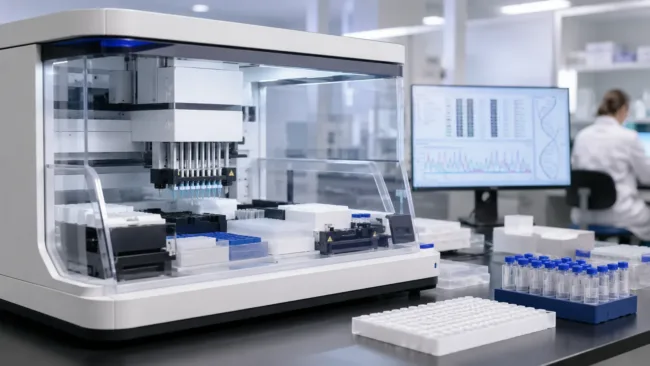
n6 Tec, Inc. announced on November 13, 2026, that the Molecular Biology Core Facilities at Dana-Farber Cancer Institute have integrated its icon96 adaptive polymerase chain reaction system into a targeted cell-free DNA sequencing service used for liquid biopsy research. The workflow combines dual unique molecular identifier library preparation, sample-specific amplification, hybrid capture and duplex sequencing, with reported improvements in library yield consistency and detection of low-frequency variants in reference-standard samples.
The integration addresses a technical challenge in oncology genomics, where circulating cell-free DNA samples may contain limited amounts of genetic material and highly variable quantities of tumour-derived DNA. Dana-Farber’s evaluation found that the coefficient of variation in library yield among samples containing 10 nanograms of input DNA declined from 54% with conventional fixed-cycle amplification to 8% using n6’s AutoNorm approach. The workflow also detected reference-standard variants at 0.5% allele frequency using as little as one nanogram of cell-free DNA.
These findings indicate that adaptive amplification can improve selected laboratory performance measures under defined conditions. However, the results concern an integrated research sequencing workflow and do not establish that icon96 improves cancer diagnosis, clinical sensitivity or patient outcomes. The system remains designated for research use only, making its immediate significance relevant to sequencing laboratories and translational oncology research rather than routine diagnostic decision-making.
Why is low-input cell-free DNA sequencing technically difficult for cancer researchers?
Cell-free DNA consists of short DNA fragments released into circulation through biological processes including cell death and turnover. In patients with cancer, some fragments may originate from tumour cells, providing a potential source of molecular information without requiring a conventional tissue biopsy. However, the proportion of circulating tumour-derived DNA can be extremely low, particularly in settings where tumour burden is limited.
This creates a challenge for laboratories attempting to identify mutations present at low variant allele frequencies. A sample may contain ample background DNA from non-malignant cells but relatively few molecules carrying the variant of interest. The ability to identify those variants depends on obtaining and preserving enough original DNA molecules for reliable sequencing analysis.
Library preparation is a critical stage because DNA fragments must be converted into molecules compatible with the sequencing instrument and analytical workflow. Amplification is often required to generate enough library material for downstream processing. Yet amplification cannot create genuinely independent original DNA molecules, meaning poor initial molecular representation cannot be fully corrected by producing more copies.
The problem becomes more complicated when samples with substantially different DNA inputs are processed together. A fixed number of PCR cycles may provide sufficient yield for one sample while leaving another under-amplified. Samples with greater input may produce excessive amplification products, potentially increasing duplicates and complicating subsequent library normalisation.
The practical consequence is that laboratories often need additional quantification, dilution and balancing procedures before libraries can be combined for sequencing. These steps consume reagents and operator time while creating opportunities for handling variation. A system capable of adjusting amplification individually may therefore improve workflow consistency.
Dana-Farber’s integration is intended to address this upstream variability. Its value lies in making challenging research samples more consistently suitable for downstream sequencing, not in changing the fundamental biological limits imposed by the amount of DNA originally collected.
How does n6 icon96 use adaptive PCR to control library amplification?
The icon96 system uses independent thermal control and real-time amplification monitoring across 96 reaction wells. Unlike a conventional approach that subjects every sample in a batch to the same predetermined amplification programme, the system can adjust the endpoint for individual reactions. This allows samples with different input quantities or amplification behaviour to be processed within the same run.
n6’s AutoNorm software is designed to stop each reaction when it reaches a defined sample-specific amplification endpoint. The objective is to generate libraries with more consistent yields while avoiding unnecessary amplification in samples that have already reached the target. The system combines amplification monitoring with quantification and normalisation functions.
This architecture is particularly relevant when a laboratory receives samples from different research projects or collection conditions. Cell-free DNA yields may vary because of collection volume, extraction efficiency, sample handling and biological differences. Processing every sample according to one amplification schedule can therefore create avoidable inconsistencies.
Adaptive control offers a different way of managing those variations. Rather than adjusting every library after amplification, the workflow seeks to regulate the process while amplification is occurring. If successful, this can reduce the need for additional manual balancing before samples proceed to hybrid capture.
However, real-time amplification control is not equivalent to measuring every original molecule or confirming that all relevant genetic variants have been preserved. The system monitors amplification behaviour and applies predefined endpoints, while the quality of the final sequencing library still depends on the original DNA, library preparation chemistry and subsequent processing.
The technology also requires appropriate calibration and quality controls. A poorly defined amplification endpoint could produce insufficient material or excessive amplification despite the presence of automated monitoring. Laboratories must therefore establish that the selected operating conditions are suitable for their intended assays and sample types.
Dana-Farber’s reported results provide evidence that the approach can improve library consistency in the evaluated workflow. The broader test will be whether equivalent performance can be achieved across different target panels, sequencing applications and sources of low-input DNA.
What does the reduction in library yield variability from 54% to 8% demonstrate?
Dana-Farber compared conventional fixed-cycle amplification with AutoNorm using cell-free DNA inputs of 10 nanograms. The coefficient of variation in library yield was 54% under the fixed-cycle approach and 8% with adaptive amplification. This represents a substantial reduction in the relative dispersion of library yields within the evaluated sample group.
The coefficient of variation measures variability relative to the average value. It is useful for comparing how consistently a process produces results, but it does not establish whether those results meet every downstream quality requirement. A workflow can generate highly consistent libraries that still require further assessment for sequence complexity, coverage and analytical performance.
The evaluation also examined one-nanogram inputs, where AutoNorm produced a reported coefficient of variation of 30%. This is higher than the 8% observed at 10 nanograms, illustrating that sample-input limitations remain relevant even with adaptive amplification. Lower DNA quantities can create greater stochastic variation because relatively few starting molecules are available.
Both one-nanogram and 10-nanogram samples were processed in the same run, demonstrating that the workflow can accommodate heterogeneous inputs under the tested conditions. This mixed-input capability is operationally relevant because laboratories may otherwise need to divide samples into different batches or perform additional preparation steps.
The results should not be interpreted as showing that AutoNorm reduces every type of sequencing error by the same proportion. Library yield variability is one performance measure, while sequencing error, molecular coverage and false-positive variant detection involve different analytical processes.
Nor does the reduction establish that 8% variability will be achieved consistently across every future sample group. The result comes from a defined evaluation and depends on the characteristics of the material, assay conditions and measurement process. Independent replication would help determine its reproducibility.
Nevertheless, the magnitude of the reported improvement supports the argument that controlling amplification at the individual reaction level can address an important source of laboratory variability. For core facilities processing samples from multiple investigators, greater consistency may simplify downstream workflows and reduce the number of libraries requiring additional adjustment.
How meaningful is detecting variants at 0.5% allele frequency from one nanogram of cfDNA?
Dana-Farber’s evaluation used Twist Bioscience reference standards containing predefined variants to assess the workflow’s low-frequency detection capability. According to n6, all spiked variants included in the evaluated reference-standard dataset were reliably detected down to 0.5% variant allele frequency using both one-nanogram and 10-nanogram inputs. Mean target coverage exceeded 200-fold at the one-nanogram input level.
These findings provide evidence of analytical performance under controlled conditions, particularly when the starting material is limited. A variant allele frequency of 0.5% means that the variant represents a small fraction of the alleles measured at a particular genomic position. Detecting such variants requires sufficient molecular representation and an analytical process capable of distinguishing true variants from sequencing or amplification errors.
However, one nanogram of human DNA contains only a limited number of genome equivalents. At very low allele frequencies, some aliquots may contain few or no copies of a particular variant simply because of molecular sampling. No amplification technology can recover a mutation that was absent from the starting sample.
This creates an important boundary around the reported detection result. Successful identification of spiked variants in a particular reference-standard experiment does not establish that the workflow will detect every variant present at 0.5% in every clinical or research sample. A validated limit of detection requires an appropriately designed study involving relevant sample numbers, concentrations and reproducibility assessments.
The use of dual unique molecular identifiers and duplex sequencing provides additional methods for controlling analytical error. Molecular identifiers can help distinguish reads derived from the same original DNA molecule, while duplex approaches can support more reliable variant identification when the necessary information from complementary strands is available. These methods improve analytical interpretation but cannot eliminate limitations caused by low input.
Coverage depth also requires careful interpretation. A mean target coverage above 200-fold describes sequencing depth under the reported conditions, but raw read depth is not equivalent to the number of independent original DNA molecules represented. Unique molecular coverage and the distribution of reads across targets remain important when evaluating sensitivity.
The results are therefore encouraging for low-input research applications, but they should not be converted into clinical sensitivity or specificity claims. The next level of validation would require comprehensive analytical assessment across relevant variant classes, concentrations and sample conditions.
Why does the integrated Dana-Farber sequencing workflow matter beyond PCR amplification?
The Molecular Biology Core Facilities service combines several technologies that contribute to overall sequencing performance. Library preparation uses the Integrated DNA Technologies xGen cell-free DNA and formalin-fixed paraffin-embedded DNA kit with dual unique molecular identifiers. Adaptive amplification is performed on icon96, followed by hybrid capture and sequencing using an Illumina NovaSeq X Plus instrument.
This combination illustrates why the reported performance cannot be attributed exclusively to one instrument. Variant detection depends on the quality of the starting material, adapter ligation, molecular tagging, amplification, capture chemistry, sequencing and bioinformatics. Each stage can influence the quantity and reliability of information available for analysis.
The workflow reported on-target capture rates exceeding 90% across four evaluated sample sets containing one-nanogram and 10-nanogram inputs. High on-target rates indicate that a substantial proportion of sequencing reads mapped to intended genomic regions in the evaluated assay. However, they do not independently establish uniform coverage or an absence of bias across every target.
Dana-Farber also processed patient-derived cell-free DNA samples containing approximately two to 25 nanograms of input material within a single run. According to the reported evaluation, all generated sufficient library material to proceed to hybrid capture. This provides a practical demonstration involving biological samples with variable input quantities, although the announcement does not establish clinical variant detection performance in those specimens.
The ability to combine different DNA inputs may be valuable for shared research facilities. Such laboratories receive material from investigators studying different cancers, disease stages and sample collection protocols. A workflow that accommodates variability without repeated manual adjustment could improve scheduling and sample throughput.
Nevertheless, integrating several established technologies requires careful control of the interfaces between them. Changes in extraction methods, library preparation kits or sequencing parameters may alter performance. A laboratory adopting the workflow must therefore qualify the complete process rather than assuming that individual component specifications guarantee end-to-end results.
The Dana-Farber implementation demonstrates that n6’s platform can be incorporated into a sophisticated research sequencing service. Its broader commercial significance will depend on whether other laboratories can replicate the operational and analytical advantages under their own conditions.
Could adaptive PCR improve liquid biopsy research without establishing clinical diagnostic utility?
Liquid biopsy research is increasingly important in oncology because circulating DNA can provide information about tumour-associated genetic alterations. Investigators use these techniques to study molecular heterogeneity, treatment resistance and potentially residual disease. However, the level of analytical performance required depends on the intended research question and the abundance of relevant DNA molecules.
Low-input sequencing technology may improve the ability to analyse precious or difficult samples, particularly when obtaining more material is impractical. Reducing library preparation variability can also support more consistent experimental comparisons. These advantages may help research programmes generate higher-quality datasets.
However, laboratory performance is not equivalent to clinical utility. A technique may detect low-frequency variants accurately under defined conditions without demonstrating that using those results changes treatment decisions or improves patient outcomes. Clinical applications require additional evidence concerning the intended population, specimen handling, reference methods and the consequences of testing errors.
False-positive and false-negative findings can be especially important in cancer-related molecular testing. A false-positive variant could create misleading biological conclusions, while a false-negative result may conceal relevant information. Research workflows therefore need appropriate error control and validation even when their results are not used directly for patient care.
n6 identifies iconPCR and icon96 as research-use-only products, not devices intended for diagnostic procedures. The Dana-Farber integration does not alter that status. It should therefore be described as a research service enhancement rather than a newly authorised clinical liquid biopsy test.
The commercial opportunity for n6 lies in supplying sequencing preparation systems to research institutions, biotechnology companies and genomic service providers. A successful implementation at a prominent cancer research institution may provide useful operational evidence for prospective customers, but it does not guarantee adoption or establish quantified financial returns.
What must n6 demonstrate before adaptive PCR becomes a broader laboratory standard?
The next challenge is reproducing the reported benefits across laboratories with different instruments, personnel and research requirements. Variability in sample extraction, DNA fragment characteristics and downstream sequencing protocols can affect library preparation performance. A technology intended for broad adoption must demonstrate robustness under these conditions.
Laboratories will also evaluate workflow economics. Reduced manual normalisation may save staff time and limit repeated sample handling, but the benefits must be weighed against instrument acquisition costs, consumables, maintenance and training. The optimal economic case will depend on sample volumes and the frequency of low-input or heterogeneous batches.
Throughput is another consideration. The icon96 architecture supports individual reaction control across 96 wells, but effective laboratory productivity depends on total cycle time, sample preparation requirements and downstream processing capacity. The number of wells alone does not establish the number of complete sequencing samples a laboratory can deliver within a specified period.
From an analytical perspective, larger validation studies would help clarify repeatability, unique molecular coverage, variant detection performance and the handling of challenging samples. Comparisons against conventional amplification should use consistent library preparation and sequencing conditions wherever possible. This would help isolate the contribution of adaptive amplification from other workflow differences.
Dana-Farber’s results establish a meaningful laboratory performance milestone for n6. The reported reduction in library yield variability and successful low-frequency reference-standard detection suggest that sample-specific amplification can improve selected aspects of low-input sequencing. Its long-term value will depend on demonstrating that those gains remain reproducible, economically useful and analytically reliable across a wider range of genomics research applications.