
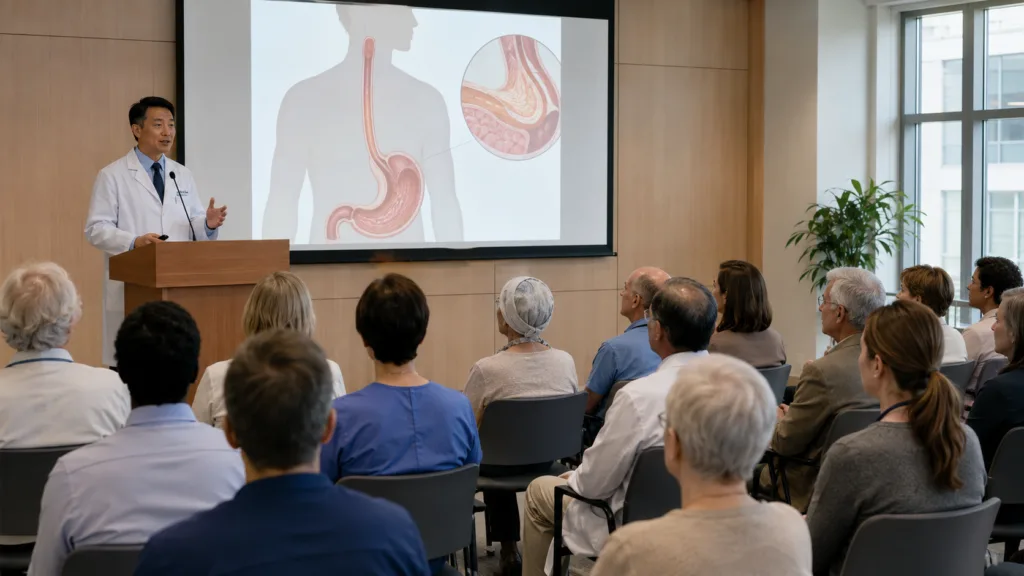
Debbie’s Dream Foundation: Curing Stomach Cancer is collaborating with Yale Cancer Center and Smilow Cancer Hospital to hold a free patient and community symposium focused on gastroesophageal cancer. Scheduled for September 9, 2026, the hybrid event will examine early detection, diagnosis, treatment, clinical trials, nutrition, wellness and supportive care at a time when therapeutic decisions are becoming increasingly dependent on disease stage, tumor biology and biomarker results.
Understanding Gastroesophageal Cancer: A Patient and Community Symposium will run from 4:30 p.m. to 7:30 p.m. Eastern Time at the Smilow Cancer Hospital Auditorium in New Haven, Connecticut. Virtual participation will also be available, extending access beyond the local community, while in-person attendance will be free with advance registration requested.
The announced program is aimed at people diagnosed with stomach, esophageal or gastroesophageal junction cancer, as well as caregivers, healthcare professionals and community members. It will include patient perspectives and conclude with an interactive Ask the Experts session involving a multidisciplinary group of specialists.
The importance of the event lies less in the conference format than in the problem it is attempting to solve. Gastroesophageal cancer care is moving away from a relatively linear treatment model toward a more segmented pathway in which anatomical location, histology, resectability, molecular characteristics, general health and prior treatment can all affect the available options. For patients and caregivers, simply understanding why two apparently similar diagnoses may lead to different treatment plans has become a substantial educational challenge.
Why is gastroesophageal cancer education becoming more important as treatment pathways fragment?
Gastroesophageal cancer is not a single clinical entity. The term can encompass gastric adenocarcinoma, gastroesophageal junction adenocarcinoma, esophageal adenocarcinoma and esophageal squamous cell carcinoma. These diseases can differ in risk factors, geographic distribution, biological behavior, staging considerations and treatment approach.
The clinical pathway also changes considerably according to whether a cancer is detected while potentially resectable or after it has become locally advanced, unresectable or metastatic. Surgery, chemotherapy, radiation therapy, immunotherapy, targeted therapy and supportive interventions may all play a role, but the combination and sequence depend on the specific clinical setting.
That complexity gives patient education a practical function. A well-designed symposium cannot replace an oncology consultation or produce an individualized treatment recommendation, but it can help participants understand the terminology used during consultations, the purpose of diagnostic tests and the questions that may be relevant when reviewing a treatment plan.
Raghav Sundar, associate professor of internal medicine and leader of Yale’s Gastroesophageal Cancer Program in medical oncology, will chair the symposium. His work includes research into biomarkers, therapeutic targets, tumor heterogeneity, treatment resistance and the tumor microenvironment in gastroesophageal malignancies.
Yale’s event calendar also names Pamela Kunz, Anil Nagar, Kiran Turaga, Scott Capozza and Vinay Rao among the participants. The range of speakers reflects the reality that gastroesophageal cancer care frequently involves medical oncology, surgery, gastroenterology, rehabilitation, nutrition and other supportive disciplines rather than a single specialist operating in isolation.
What does the United States cancer burden reveal about the need for earlier diagnosis?
The symposium is being organised against a substantial disease burden. The American Cancer Society estimates that approximately 31,510 people in the United States will be diagnosed with stomach cancer in 2026 and that about 10,740 will die from the disease. The organisation estimates that esophageal cancer will account for approximately 22,530 new diagnoses and 16,290 deaths during the year.
National Cancer Institute surveillance data place the five-year relative survival rate at 39.8% for stomach cancer and 22.2% for esophageal cancer, based on the most recent reporting periods. These population-level figures cannot predict an individual patient’s outcome, but they illustrate why disease stage at diagnosis and access to specialist care remain central concerns.
Symptoms can be vague, overlap with common gastrointestinal conditions or become more noticeable only as disease progresses. At the same time, the United States does not operate a universal population screening program for gastric cancer comparable to programs used in some higher-incidence countries.
The American Gastroenterological Association has advised that identifiable high-risk groups should be considered for gastric cancer screening. These include first-generation immigrants from high-incidence regions, people with a first-degree family history of gastric cancer and individuals with certain hereditary cancer syndromes. The association identifies endoscopy as the preferred screening and surveillance test for people considered to be at increased risk.
That distinction is important for public education. Awareness campaigns need to encourage informed risk assessment without implying that every person requires the same screening procedure. A symposium involving clinicians who can explain risk stratification may therefore be more useful than broad messaging that reduces early detection to a single universal recommendation.
How are biomarkers changing conversations about gastroesophageal cancer treatment?
Biomarker testing has become one of the most important sources of both progress and confusion in advanced gastric and gastroesophageal junction cancer. Depending on the disease setting, clinicians may examine markers such as human epidermal growth factor receptor 2, programmed death-ligand 1, microsatellite instability, mismatch repair status and claudin 18.2.
These markers do not operate as interchangeable switches, and a positive result does not automatically establish that one treatment is appropriate. Eligibility may depend on the exact cancer type, stage, treatment line, accompanying therapy, testing method and authorised indication.
The expansion of biomarker-directed treatment is nevertheless changing the field. In October 2024, the United States Food and Drug Administration approved zolbetuximab-clzb with fluoropyrimidine-containing and platinum-containing chemotherapy for previously untreated, locally advanced unresectable or metastatic, human epidermal growth factor receptor 2-negative gastric or gastroesophageal junction adenocarcinoma that tests positive for claudin 18.2. The regulator simultaneously approved a companion diagnostic to identify eligible patients.
Immunotherapy has also entered multiple gastroesophageal cancer settings. Pembrolizumab-based and nivolumab-based regimens have approved uses across defined gastric, gastroesophageal junction and esophageal cancer populations. The details vary by histology, biomarker status, disease stage and treatment context, making accurate explanation particularly important.
The treatment landscape continued to evolve in November 2025 when the Food and Drug Administration approved durvalumab with perioperative FLOT chemotherapy, followed by durvalumab alone, for adults with resectable gastric or gastroesophageal junction adenocarcinoma. The approval was based on the randomised Phase 3 MATTERHORN trial, which enrolled 948 patients with previously untreated, resectable Stage II to Stage IVA disease.
Companion diagnostic labelling has continued to change as well. During 2026, the regulator expanded certain programmed death-ligand 1 assay indications associated with nivolumab and pembrolizumab treatment in defined gastroesophageal cancer populations. These developments underline why patients may hear several test names, scoring systems and treatment combinations during a relatively short period.
A community symposium can add value by translating those developments without presenting biomarker testing as a simple menu of therapies. The key educational task is to explain why adequate tissue collection, pathology review, test selection and interpretation can influence treatment planning, while recognising that the final decision must account for the complete clinical picture.
Why do nutrition, rehabilitation and supportive care deserve equal space alongside new therapies?
The inclusion of nutrition, wellness and supportive care prevents the Yale program from becoming a narrow discussion of drug development. Gastroesophageal cancers and their treatments can affect swallowing, appetite, weight, digestion, energy, mobility and the ability to maintain normal daily routines.
Surgery involving the stomach or esophagus may result in substantial anatomical and nutritional adjustments. Chemotherapy, radiation therapy, immunotherapy and targeted treatments can introduce different toxicity profiles and monitoring requirements. Advanced disease may also require symptom management that is coordinated with anticancer treatment.
For healthcare systems, supportive care is not merely an optional addition after the principal oncology decision has been made. Nutrition services, rehabilitation, psychosocial support, symptom management and caregiver education can influence whether patients are able to tolerate planned treatment and recover from complex procedures.
The announced involvement of specialists from different disciplines suggests that the symposium will attempt to connect treatment advances with the day-to-day experience of receiving care. Its patient-perspective component may be particularly useful because clinical explanations often focus on what a treatment is designed to do, while patients and caregivers also need to understand how care can affect routines, employment, food intake, transportation and family responsibilities.
Can community education improve awareness and participation in clinical trials?
Clinical trials are another area in which access to reliable information matters. Gastroesophageal cancer studies are increasingly designed around biomarker-defined populations, specific disease stages or previous treatment histories. This may make trial eligibility more scientifically precise, but it can also make the process harder for patients to interpret.
A trial may test a new drug, a new combination, a different treatment sequence, a perioperative strategy, an earlier use of an existing therapy or an intervention for a less common molecular subgroup. Participation does not guarantee clinical benefit, and not every study is appropriate for every patient. However, understanding how trials are structured can help patients hold more informed discussions with their care teams.
Virtual participation may extend the educational reach of the Yale symposium to people who cannot travel to New Haven. It does not remove the geographic and logistical limitations surrounding actual trial participation, but it can reduce the initial information barrier and help community clinicians, patients and caregivers recognise when a specialist referral or trial discussion may be relevant.
The Ask the Experts format could be especially valuable if it distinguishes established standard care from investigational strategies. That separation is essential in oncology communication because early research findings, promising mechanisms and conference presentations should not be interpreted as equivalent to regulatory approval or proven patient benefit.
How does the Yale collaboration fit Debbie’s Dream Foundation’s wider strategy?
The Yale initiative reflects Debbie’s Dream Foundation’s attempt to operate across patient education, advocacy, community support and research funding. In June 2026, the foundation announced an Innovation and Discovery Grant with the American Association for Cancer Research to support research aimed at improving the detection, treatment and outcomes of gastric cancer.
The combination of research support and public education is strategically relevant. Scientific advances cannot improve outcomes if patients are not diagnosed, referred, tested or evaluated for appropriate treatments. Conversely, education programs need a credible research foundation so that discussions remain connected to the changing evidence base.
Amanda Pullinger, chief executive officer of Debbie’s Dream Foundation, said the collaboration was intended to connect patients, caregivers, families and healthcare professionals with trusted experts and current evidence-based information. Sundar similarly indicated that the symposium would create a forum for clinicians, researchers, patients and caregivers to share knowledge and discuss progress in the field.
The practical impact of the collaboration will depend on more than attendance. The strongest measure of success will be whether the program communicates complex information clearly, gives participants useful follow-up resources and accommodates the differing needs of newly diagnosed patients, long-term survivors, caregivers and people considering clinical trials.
What will determine whether the gastroesophageal cancer symposium delivers lasting value?
The September event will not resolve the structural challenges facing gastroesophageal cancer care. Screening remains targeted rather than universal in the United States, many patients are still diagnosed with advanced disease, and access to specialised pathology, molecular testing, clinical trials and multidisciplinary centres is uneven.
What the symposium can do is reduce one part of that gap by making specialist knowledge more accessible. The hybrid format broadens its potential audience, while the multidisciplinary agenda recognises that treatment decisions cannot be separated from nutrition, recovery, symptoms and the patient’s wider circumstances.
The timing is appropriate. Therapeutic progress is producing additional treatment options, but those advances also create more complicated decisions. As biomarker testing and stage-specific treatment strategies become increasingly important, clear patient and community education is becoming part of the infrastructure required to translate oncology research into meaningful care.
For Debbie’s Dream Foundation, Yale Cancer Center and Smilow Cancer Hospital, the immediate test will be whether the symposium can convert a rapidly changing scientific landscape into information that patients and caregivers can understand without oversimplifying it. That is a less glamorous challenge than announcing a new drug approval, but it may determine whether medical progress reaches the people it is intended to help.