Pictor Holdings Inc. has introduced its next-generation PictImager at ADLM 2026, positioning the high-resolution imaging instrument as the centrepiece of an integrated workflow for targeted protein analysis in research laboratories. The system combines the company’s PictArray assay format, PictImager instrument and Pictorial analysis software, with beta-site engagement beginning ahead of a planned full commercial launch later in 2026.
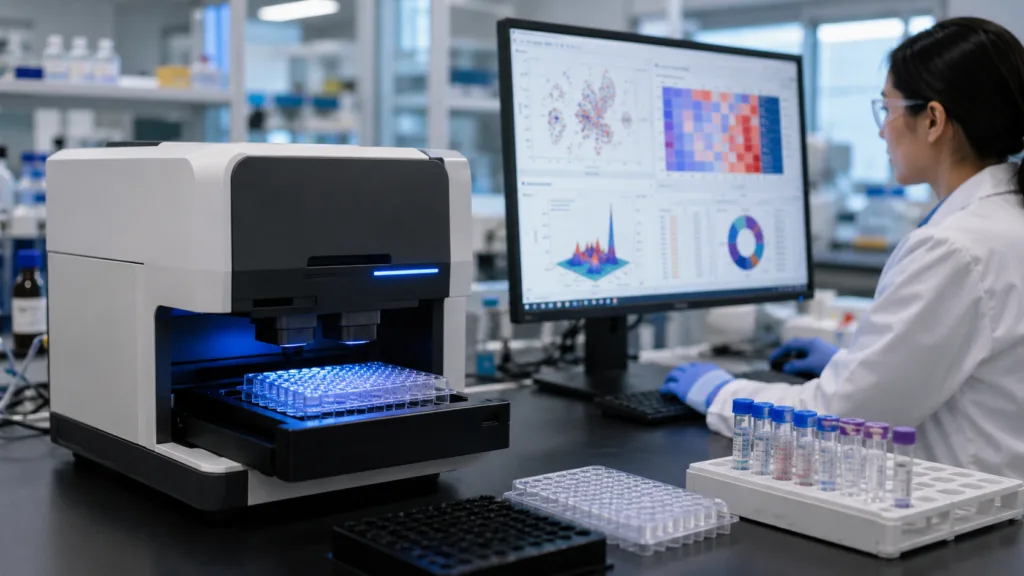
The platform is designed around standard 96-well laboratory plates and can process 96 samples per run, according to Pictor. The company says researchers can measure as many as 20 analytes in each well, read a completed plate in under one minute and finish the broader assay workflow in less than two hours. Supported research sample types include serum, plasma, saliva, cerebrospinal fluid, nasal swabs and milk.
The launch is therefore less about inventing a new category of protein measurement and more about packaging targeted multiplex analysis into a workflow that smaller or less specialised laboratories may realistically operate. That distinction matters. Proteomics platforms can deliver extensive biological information, but adoption often depends on instrument cost, assay preparation, software complexity, staff training, sample throughput and whether a system can fit existing laboratory processes without turning every run into a small research expedition.
What is genuinely new about Pictor’s next-generation PictImager platform?
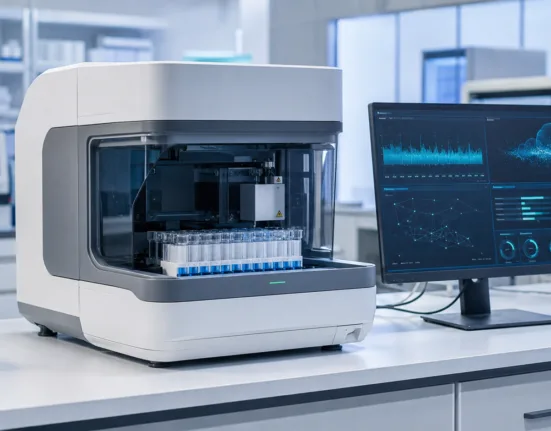
The new PictImager builds on earlier imaging systems that Pictor developed mainly for research and technology-development work. Pictor said the redesigned instrument provides improved imaging capability, greater usability and a more robust architecture intended to support external beta testing and eventual commercial deployment.
The instrument is only one part of the commercial proposition. PictArray provides the physical multiplex assay format, with arrays printed inside the wells of a conventional 96-well plate. PictImager captures the resulting signals, while Pictorial software performs automated image processing, signal extraction and reporting. Pictor also says the software can integrate reporting with customer laboratory information management systems.
This integration may prove more important than an isolated improvement in imaging resolution. Laboratories generally evaluate diagnostic and research platforms as complete operating systems rather than collections of attractive specifications. A fast reader has limited value when sample preparation is cumbersome, quality-control failures are frequent or results require substantial manual processing before they can enter a laboratory database.
Pictor’s product strategy attempts to address that problem by linking assay, imaging and analysis within a single workflow. The commercial test will be whether beta laboratories experience the same degree of simplicity under routine conditions that Pictor has demonstrated internally.
Why could the familiar 96-well format help laboratories adopt targeted proteomics?
The 96-well plate remains a familiar format across pharmaceutical research, academic laboratories, contract research organisations and many clinical laboratory environments. Equipment, liquid-handling systems, plate-management processes and staff experience are already widely organised around it.
Pictor’s decision to place its multiplex arrays inside individual wells could therefore reduce the amount of workflow redesign required for adoption. Laboratories may be able to introduce multi-analyte protein testing without investing in mass spectrometry infrastructure, sequencing equipment or an entirely unfamiliar sample-handling system. Pictor says the platform does not require specialised training and is designed to produce results in under two hours.
The stated capacity of 20 analytes per well also defines Pictor’s intended position in the proteomics market. The system is not being presented as a substitute for every high-plex discovery platform capable of surveying hundreds or thousands of proteins. Instead, it is aimed at targeted panels in which researchers already have a defined group of proteins that they want to measure consistently across larger numbers of samples.
That positioning could suit translational studies, immune profiling, vaccine-response research, oncology programmes and longitudinal biomarker monitoring. These applications may not always require the maximum possible number of analytes. They often require repeatable measurement of a carefully selected panel across many samples, time points or study sites. Pictor lists each of these areas among the intended research applications for the integrated platform.
However, headline throughput does not provide a complete measure of laboratory efficiency. Prospective users will examine hands-on preparation time, incubation requirements, plate-failure rates, calibration frequency, repeat testing, sample-volume requirements and the proportion of wells reserved for controls. A claimed two-hour workflow can look rather different once staff time, quality controls and reruns join the party.
Why does the PictImager’s research-use-only status remain a critical limitation?
The new PictImager is being introduced as a research-use-only product. It has not been cleared or approved for clinical diagnostic use, and Pictor is not presenting the beta launch as a regulatory authorisation.
United States Food and Drug Administration guidance distinguishes research-use-only products from in vitro diagnostic devices intended for patient diagnosis or management. Research-use-only products are considered to be in the laboratory research phase and should not be represented as approved or cleared clinical diagnostic systems. Their labelling must remain consistent with that research purpose.
This means PictImager’s immediate market is research laboratories, biopharmaceutical companies and development partners evaluating targeted protein panels. A laboratory cannot treat the ADLM debut or the planned commercial release as evidence that the system has been authorised to diagnose disease, guide treatment or independently inform patient care.
Research adoption can still create meaningful commercial value. Instruments, assay kits, custom-panel development, software, service arrangements and collaborative studies can generate revenue without an initial clinical indication. Research customers can also provide performance data that support later product refinement.
Clinical translation would nevertheless require a more demanding evidence and regulatory programme. Pictor would need to define the intended use, targeted patient population, specimen type, analytical performance, clinical performance and result-interpretation framework for a specific diagnostic application. A broad research platform does not automatically become one broadly authorised clinical test.
Does Pictor’s autoimmune assay publication validate the new imaging system?
Pictor linked the PictImager debut to a recently published study of its PictHealth Immunoscreen extractable nuclear antigen assay. The Journal of Immunological Methods paper compared the assay with the Euroimmun ENA Line immunoassay and the Bio-Rad BioPlex 2200 platform using clinical serum samples from people with autoimmune diseases.
The study reported three-way agreement ranging from 67.3% for the TRIM21/Ro52 marker to 100% for Jo-1. Agreement for Sm and CENP-B was reported at 95%, while positive and negative percentage agreement exceeded 85% for most of the autoantibodies assessed. The authors concluded that the Pictor assay showed performance broadly comparable with the established platforms evaluated in the study.
The publication is relevant because it provides peer-reviewed evidence that Pictor’s underlying multiplex assay approach can be applied to a recognised laboratory-testing problem. It also illustrates the potential appeal of an ELISA-like format for laboratories that may find larger multiplex instruments financially or operationally difficult to implement.
The evidence should not, however, be stretched beyond what the study examined. The paper assessed a specific extractable nuclear antigen assay and compared its agreement with two commercial methods. It did not independently establish the performance of every future PictArray panel, every supported sample type or every application proposed for the new PictImager.
Method agreement is also different from demonstrating improved clinical outcomes. High concordance can support analytical and diagnostic development, but it does not show that using the platform changes treatment decisions, reduces diagnostic delays or improves patient health. The current PictImager launch remains a research-platform commercialisation story rather than a newly validated clinical diagnostic claim.
What will beta laboratories need to demonstrate before the commercial launch?
Beta-site engagement gives Pictor an opportunity to test whether the platform performs consistently outside its own development environment. The most valuable beta programme would move beyond collecting favourable user impressions and generate structured information on reliability, reproducibility and workflow performance.
Laboratories will need to examine within-run and between-run precision, agreement across instrument units, lot-to-lot assay consistency, calibration stability, analytical sensitivity, reportable range and potential cross-reactivity. Performance should also be evaluated separately for different sample matrices because serum, saliva, cerebrospinal fluid, nasal material and milk present very different analytical conditions.
Multiplex testing introduces additional validation challenges because reagents that work reliably in isolation can interact when combined. Published evaluations of other multiplex immunoassays have shown that performance may vary between analytes even when the overall platform appears technically successful. Reproducibility, harmonisation and comparison with established reference methods therefore need to be assessed at the individual-analyte level rather than inferred from the panel average.
Pictorial software will require similar scrutiny. Automated signal extraction can reduce manual interpretation, but beta users will want transparency around quality-control flags, image rejection, data traceability, user permissions, audit trails and the handling of software updates. Claimed integration with laboratory information management systems will also need to work across the varied interfaces found in real laboratories.
Service requirements could become another adoption factor. Laboratories buying instruments evaluate installation, preventative maintenance, downtime, technical support, replacement availability and the geographic reach of service teams. Pictor operates from Carlsbad, California, with laboratory and commercial operations in New Zealand, Australia and India, but a wider commercial launch will test whether its support infrastructure can grow alongside instrument placements.
Can Pictor turn lower workflow complexity into a sustainable commercial model?
Pictor is framing affordability as one of the platform’s central differentiators. Its website states that PictArray consumables can cost less than $50 per sample and that the next-generation PictImager can read a 96-well plate in under one minute. These remain company claims and actual customer economics will depend on panel design, testing volume, labour, controls, repeat rates, maintenance and contractual pricing.
The system could create several revenue streams if adoption develops. Pictor may sell or place instruments, supply recurring PictArray consumables, develop customised panels, license applications and provide software or service support. The recurring value of assay consumption may ultimately matter more than the initial number of instruments shipped.
The company recently raised $7.5 million in bridge financing, bringing its reported total capital raised to approximately $30 million. Pictor said the proceeds would support platform development, manufacturing scale-up, translational studies and commercial partnerships. It also reported seven commercial product launches and four strategic partnerships, while indicating that it was evaluating a United States Series A financing for its next growth phase.
Those disclosures show that Pictor has funded an active commercial expansion programme, but they do not establish broad platform adoption or sustainable revenue. A bridge round provides additional execution capacity. It does not remove manufacturing, customer-acquisition or market-development risk.
The planned commercial launch later in 2026 will therefore be judged by more than whether the instrument becomes technically available. Important indicators will include the number and diversity of beta sites, conversion of evaluations into paying customers, repeat consumable orders, custom-panel partnerships, manufacturing readiness and the quality of post-installation support.
Where could PictImager fit between ELISA and high-complexity proteomics systems?
Pictor is trying to occupy the operational space between conventional single-analyte immunoassays and more expensive, infrastructure-intensive proteomics technologies. Traditional ELISA workflows can be accessible and familiar but become inefficient when laboratories need to examine multiple biomarkers from limited sample volumes. Large-scale proteomics systems can provide substantially greater depth, although their instrumentation, technical expertise and data-processing requirements may exceed what some laboratories need.
PictImager’s appeal will depend on whether laboratories value targeted panel flexibility more than maximum analytical breadth. A research team following 10 or 15 established biomarkers across hundreds of samples may prefer a focused, faster workflow over a platform designed for broad protein discovery. Another laboratory searching for previously unknown protein signals may still need mass spectrometry or a much higher-plex system.
This means Pictor does not have to outperform every proteomics technology on every metric. It must show that its combination of multiplex capacity, workflow familiarity, cost and customisation is strong enough for defined research use cases.
The new PictImager gives the company a more commercially developed instrument around which to test that proposition. The decisive evidence will come from beta laboratories demonstrating reproducible performance across users, panels and sample types, followed by customers choosing to keep running the platform after the demonstrations and introductory enthusiasm have ended. That is the point at which Pictor’s promise of practical targeted proteomics will begin to look like a repeatable laboratory business rather than an appealing trade-show specification.