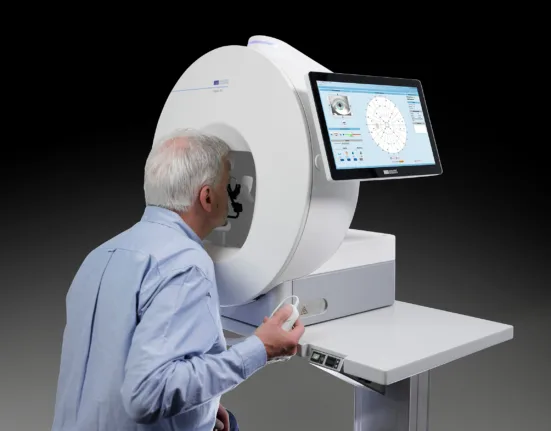
Carl Zeiss Meditec AG has secured US Food and Drug Administration 510(k) clearance for ZEISS CLINIC 360, a browser-based ophthalmic image-management and analysis platform designed to consolidate information from diagnostic devices, medical records and clinical systems into a single patient view. The clearance gives Carl Zeiss Meditec a US commercialization pathway for software that sits between ophthalmic diagnostic hardware and the clinician, reflecting a wider medtech shift in which the value of imaging increasingly depends on how efficiently longitudinal data can be interpreted rather than simply how many images a device can generate.
FDA records identify the system as K260694, a Class II medical image management and processing device under product code NFJ. The agency received the traditional 510(k) submission on March 3, 2026 and made its substantial-equivalence determination on July 17, while Carl Zeiss Meditec publicly announced the clearance on August 19. The company plans to make ZEISS CLINIC 360 available in the United States in early fall 2026.
The regulatory distinction is important. CLINIC 360 was cleared through 510(k); it was not granted Premarket Approval and FDA did not evaluate it as an entirely new high-risk device category. Carl Zeiss Meditec established substantial equivalence primarily against the previously cleared Harmony ophthalmic image-management platform, while also using its CIRRUS HD-OCT and Humphrey Field Analyzer technologies as reference devices for specific analytical functionality.
What does ZEISS CLINIC 360 actually do inside an ophthalmology practice?
FDA’s clearance summary describes CLINIC 360 as software that consolidates, processes, analyzes and displays patient medical and diagnostic information through a browser. Data are stored through the company’s Health Data Platform, which acts as the underlying infrastructure supporting information flow between medical devices, health-record systems and cloud-based applications. Importantly, FDA documentation states that CLINIC 360 does not itself acquire diagnostic data and is not directly connected to computerized diagnostic instruments in the manner of an imaging device performing the examination.
Instead, the system functions as an analytical and visualization layer. It incorporates established algorithms from the ZEISS CIRRUS optical coherence tomography portfolio and Humphrey Field Analyzer, allowing information that might otherwise sit across separate devices or software environments to be reviewed within a more integrated interface.
FDA’s indication allows CLINIC 360 to import, process, measure, analyze and store clinical eye images and videos while managing patient data, diagnostic information and reports produced by ophthalmic diagnostic instruments through computerized networks. The device is intended to aid clinicians in detecting, monitoring and managing ocular diseases rather than independently making treatment decisions.
That wording matters because cloud-based diagnostic software can easily be portrayed as an autonomous intelligence system when its actual authorized function is narrower. CLINIC 360 gives ophthalmologists a consolidated analytical workspace, but the regulatory documentation consistently positions the healthcare professional as the decision-maker.
How does CLINIC 360 extend ZEISS glaucoma monitoring?
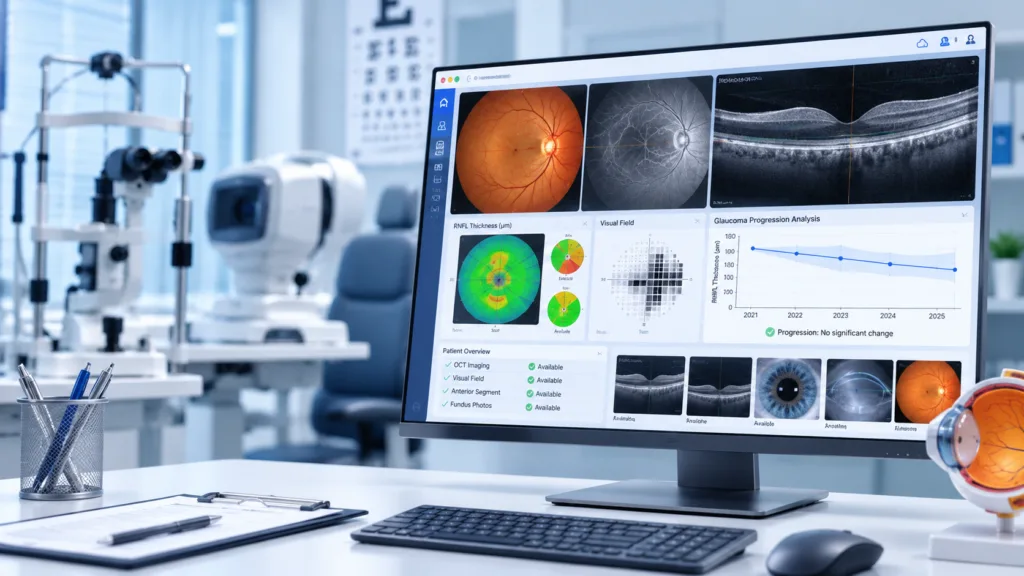
Glaucoma is one of the clearest examples of why longitudinal integration can matter. Clinicians may need to interpret changes in visual fields alongside optical coherence tomography measurements of structures such as the retinal nerve fiber layer, ganglion cell-inner plexiform complex, macula and optic nerve head. Relevant information may be generated at different visits and across different systems.
CLINIC 360 incorporates Visual Field Guided Progression Analysis derived from the Humphrey Field Analyzer environment. FDA documentation says the functionality is designed to help identify and quantify statistically significant progressive visual-field loss and calculate how rapidly visual fields are changing, giving practitioners information that can help assess future visual impairment risk.
The Comprehensive Care configuration includes a glaucoma summary capable of combining this progression information with other patient data, while a Primary Care configuration provides a more basic multimodality connectivity and visualization workflow. That tiered commercial approach suggests Carl Zeiss Meditec intends to address practices with different levels of diagnostic complexity rather than sell one identical software bundle across every eye-care setting.
The distinction also has strategic implications. Ophthalmic equipment manufacturers have traditionally competed heavily on the performance of individual diagnostic systems. Connected software can increase the value of an installed hardware base by making information from repeated examinations easier to use, potentially increasing customer dependence on an integrated workflow rather than any one device.
Can CLINIC 360 work with non-ZEISS diagnostic devices?
Interoperability is one of the most commercially important aspects of the platform, but it comes with boundaries. CLINIC 360 can display DICOM-compliant information from both ZEISS and compatible third-party devices, allowing clinicians to bring multiple image sources into the broader patient record. FDA documentation lists modalities including optical coherence tomography, fundus imaging, perimetry and biometry.
However, some advanced quantitative analysis remains specific to raw data from ZEISS equipment. The 510(k) summary indicates that OCT quantitative analysis is available using raw DICOM data from supported ZEISS CIRRUS devices, while visual-field analysis uses data from supported Humphrey Field Analyzer models. Third-party images can still support visualization functions such as zooming, panning, printing and downloading when the required DICOM conditions are met.
This creates an interesting commercial balance. Carl Zeiss Meditec can market CLINIC 360 as a broader multimodal workspace without requiring that every image originate from ZEISS equipment, but the most sophisticated analytical capabilities still reinforce the value of the company’s own diagnostic ecosystem.
For large ophthalmology groups using equipment from multiple manufacturers, interoperability could reduce one barrier to adoption. At the same time, practices seeking full quantitative functionality may gain more from the platform when a substantial portion of their diagnostic fleet is already based on ZEISS technology.
Why does cloud deployment make cybersecurity part of the clinical proposition?
Moving ophthalmic diagnostic information into connected browser-based workflows introduces operational advantages but also shifts cybersecurity and data-management requirements closer to the center of the device’s value proposition. FDA’s submission summary identifies user-level permissions and encrypted data transfer as cybersecurity characteristics of CLINIC 360, while the platform uses DICOM network integration for interoperability.
For an ophthalmology practice, the benefit of cloud access is straightforward: clinicians can potentially review information without being anchored to a specific diagnostic workstation, while data from multiple devices and encounters can be organized into a longitudinal record. The risk is equally straightforward: greater connectivity can increase the consequences of system outages, access-control weaknesses or integration failures.
FDA’s clearance does not mean every local implementation issue has been solved. Healthcare providers will still need to consider identity management, electronic medical record integration, network resilience, data governance and how workflow continues if cloud connectivity becomes unavailable.
Carl Zeiss Meditec’s Health Data Platform sits underneath CLINIC 360 as a separate, non-medical-device infrastructure layer. That architecture allows the medical-device software to operate within a broader digital ecosystem, including integration with ZEISS Collaborative Care for sharing selected images between healthcare providers through an application programming interface.
Does this clearance signal where ophthalmic-device competition is heading?
CLINIC 360 does not replace the imaging instruments that generate OCT scans, visual fields or fundus images. Its strategic importance comes from making those devices more useful collectively.
Ophthalmology is particularly suited to longitudinal digital workflows because many chronic diseases require repeated imaging and measurement over years. A clinician following glaucoma progression may care less about the existence of one additional scan than about whether meaningful structural or functional deterioration can be identified quickly across a long sequence of examinations.
That changes the competitive unit from individual hardware to integrated workflow. Manufacturers able to combine imaging, analysis, patient records, referral tools and cloud access can potentially build deeper relationships with clinical practices than companies competing around isolated capital-equipment purchases.
CLINIC 360 also arrives after Carl Zeiss Meditec previewed the platform at the American Society of Cataract and Refractive Surgery meeting earlier in 2026 while clearance remained pending. The FDA decision now converts that preview into an actual US commercialization opportunity.
The immediate question will be adoption. Ophthalmology practices already have established image-management and electronic-record workflows, so new software must save enough clinician time or improve enough diagnostic visibility to justify another subscription and integration process.
If CLINIC 360 succeeds, its importance may lie less in any single algorithm and more in turning disparate diagnostic outputs into one longitudinal clinical workspace. FDA clearance has opened that pathway, but customer adoption will determine whether connected ophthalmic software becomes a meaningful growth layer around Carl Zeiss Meditec’s existing diagnostic hardware franchise.