FX Shoulder Solutions, Inc. has announced United States Food and Drug Administration 510(k) clearance for Easytech Reversed, which the company describes as the first fully stemless reverse shoulder arthroplasty system authorised for the US market. Disclosed on 5 November 2026, the clearance follows a US clinical investigation involving 90 patients at seven centres and introduces a humeral fixation design intended to avoid the conventional stem extending into the upper arm bone.
The development represents an important expansion of surgical options in reverse shoulder replacement, where established implants typically rely on stems positioned within the humeral canal. Easytech Reversed instead uses a peripheral fixation approach designed to engage bone within the proximal humerus, potentially preserving more bone and providing an alternative for appropriately selected patients.
The announcement is also significant because stemless shoulder replacement has developed more rapidly in anatomical arthroplasty than in reverse reconstruction. Reverse shoulder implants operate under different mechanical conditions, making fixation reliability, implant stability and long-term performance especially important considerations.
For FX Shoulder Solutions, the regulatory milestone follows years of product development and clinical investigation, together with international commercial experience involving Easytech technology. However, US clearance does not independently establish superiority over conventional stemmed implants, and the company’s November announcement does not disclose detailed outcomes from the 90-patient investigation.
The commercial test will now involve surgeon training, hospital procurement, product availability and the collection of longer-term outcomes. Whether stemless reverse fixation can achieve sustained adoption will depend on its performance in appropriately selected patients and the practical advantages it offers over established implant systems.
How does Easytech Reversed change the mechanics of reverse shoulder replacement?
Reverse shoulder arthroplasty is a surgical procedure in which the normal relationship between the ball and socket components of the shoulder joint is reversed. A spherical component is positioned on the glenoid side, while a corresponding socket component is attached to the humeral side.
This configuration allows the deltoid muscle to play a greater role in elevating the arm when the rotator cuff is severely compromised. Reverse shoulder replacement is used in selected patients with significant shoulder dysfunction, including conditions involving massive irreparable rotator cuff tears and other qualifying structural problems.
Conventional reverse shoulder implants commonly use a humeral stem extending into the upper arm bone to support the replacement joint. Stem length and fixation techniques vary, but intramedullary stems remain an established approach for securing the humeral component.
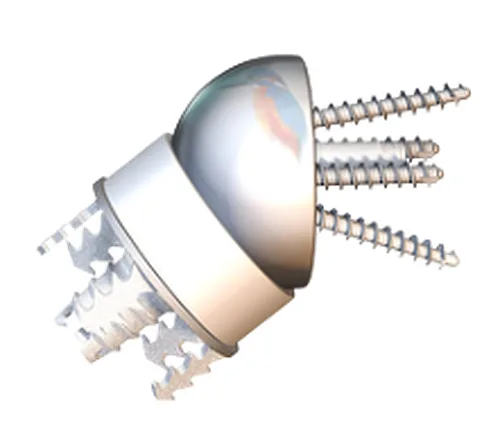
Easytech Reversed takes a different approach. FX Shoulder Solutions has designed the system around a stemless humeral anchor that engages the proximal humerus near the cortical bone boundaries, avoiding the need for a conventional diaphyseal stem.
The intended benefit is to establish fixation while reducing the amount of humeral bone preparation required. Bone preservation can be relevant when considering future revision surgery, although the magnitude of any advantage depends on implant design, surgical technique and the condition of the patient’s bone.
The system’s peripheral fixation concept differs from designs that rely primarily on central metaphyseal support. By engaging bone towards the periphery of the proximal humerus, the company aims to create a stable mechanical foundation without extending a stem down the humeral canal.
However, avoiding a conventional stem changes the distribution of mechanical forces across the implant-bone interface. Surgeons must assess whether the available bone provides sufficient support to withstand the loading conditions associated with reverse shoulder reconstruction.
The success of the design therefore depends not simply on eliminating a stem but on maintaining reliable fixation throughout normal shoulder movement and daily activity. Long-term resistance to loosening, migration and mechanical failure will be central to evaluating its clinical performance.
Why did the FDA clearance follow eight years of clinical investigation?
FX Shoulder Solutions began its US Investigational Device Exemption clinical study of Easytech Reversed in December 2018. The investigation enrolled 90 patients across seven sites, with enrolment completed in 2022 and study follow-up completed in 2023.
The company has described the programme as an important part of the evidence supporting its subsequent regulatory development. Investigators included orthopaedic surgeons experienced in shoulder reconstruction, with Howard W. Harris of Texas Orthopedic Specialists among the clinical leaders involved.
An Investigational Device Exemption permits the clinical investigation of a device under defined regulatory conditions. It does not itself authorise commercial marketing, and the subsequent regulatory decision must be considered separately.
The November announcement describes a 510(k) clearance, which differs from a premarket approval decision. Under the 510(k) pathway, the FDA assesses whether the submitted device is substantially equivalent to an appropriate legally marketed predicate within the applicable regulatory framework.
The clinical investigation provides additional context for the company’s development programme, but the announcement does not specify the full primary endpoint results, complication rates, revision rates or functional outcomes from the 90-patient study. It also does not disclose the complete dataset used in the regulatory assessment.
Those details are important because a lengthy development programme and completed follow-up do not independently establish the magnitude of clinical benefit. A full evaluation would examine functional improvement, pain scores, implant survival, radiographic stability and adverse events over the relevant observation period.
The company’s announcement also does not identify the newly cleared device’s specific 510(k) reference number or reproduce its complete US indications for use. An earlier, separately named FX V135 Easytech Shoulder System received FDA clearance in May 2026, but its reverse configuration required a short humeral stem.
That earlier clearance must not be confused with the fully stemless reverse configuration described in the November announcement. The precise scope of Easytech Reversed’s newly announced authorisation should be understood through its corresponding regulatory documentation and final US labelling.
What does existing research reveal about stemless reverse shoulder arthroplasty outcomes?
The clinical literature on stemless reverse shoulder replacement has expanded as manufacturers and surgeons investigate alternatives to conventional humeral fixation. However, the available evidence remains less mature than the extensive experience accumulated with established stemmed reverse systems.
A systematic review published in 2026 examined 13 studies involving 592 patients and 598 shoulders treated with stemless reverse arthroplasty. The mean follow-up period was approximately 41.8 months, with a mean patient age of 70.6 years.
The review reported improvements in shoulder function and movement following surgery. Weighted mean improvements included approximately 47.8 degrees in forward flexion, 42.5 degrees in abduction and 31.7 points in the Constant shoulder score.
The analysis also documented complications and subsequent surgical interventions. Reported complication and reoperation rates were 14.3% and 7.0%, respectively, while scapular notching occurred in 17.7% and asymptomatic humeral component loosening in 3.3%.
These figures describe the broader published literature rather than outcomes specifically established for Easytech Reversed. They should not be presented as device-specific performance estimates because the review includes different implant designs, surgical populations and follow-up periods.
Among the comparative studies, the authors did not identify clear differences in patient-reported outcomes, functional outcomes or complications between stemless and stemmed reverse arthroplasty systems. They nevertheless highlighted the need for additional long-term comparative and registry-based research.
The review provides useful context for evaluating FX Shoulder Solutions’ commercial proposition. Stemless fixation appears capable of producing functional improvements in selected patients, but the evidence does not establish that removing the humeral stem consistently produces superior outcomes.
Longer-term data will be particularly relevant because implant fixation problems may become apparent years after the original procedure. Clinical assessment should therefore include not only short-term recovery but also implant survival and the frequency of revision surgery.
Which patients could benefit from the Easytech Reversed fixation approach?
FX Shoulder Solutions has identified patients with unusual proximal humeral anatomy or malaligned intramedullary canals as potential candidates for its stemless fixation approach. These anatomical characteristics may complicate the use of conventional humeral stems in some reconstructive procedures.
A stemless design can offer an alternative method of securing the humeral component without requiring alignment with the intramedullary canal. This may provide additional surgical flexibility where bone geometry makes conventional stem placement difficult.
However, the suitability of stemless fixation depends heavily on the quality and quantity of available proximal humeral bone. Patients with substantial bone loss, severe osteoporosis or anatomical conditions that compromise the fixation region may present additional challenges.
The selection process is therefore likely to require careful preoperative assessment of bone stock, shoulder anatomy and soft-tissue function. Intraoperative findings may also influence the surgeon’s choice of implant configuration.
The company has indicated that Easytech Reversed can be considered within traditional reverse shoulder replacement indications where the cleared device is appropriate. However, that statement should not be interpreted as authorisation for every form of shoulder reconstruction, because the final indications and contraindications determine the permitted clinical use.
One potential advantage of a stemless system is preserving humeral bone for possible future procedures. If a revision becomes necessary, avoiding a long intramedullary stem may simplify certain aspects of implant removal.
Nevertheless, this theoretical advantage should be evaluated through actual revision outcomes. The ease of removing a particular stemless component depends on fixation method, bone integration and the condition of surrounding structures.
A stemless implant may also have its own revision challenges if substantial bone damage occurs around the fixation interface. The relevant comparison is therefore not simply stem length but the full mechanical and surgical consequences of each design.
Can peripheral fixation reduce bone loss without compromising long-term implant stability?
The relationship between bone preservation and fixation stability is one of the central design questions in stemless arthroplasty. Conventional humeral stems transfer forces through a combination of proximal and intramedullary fixation, depending on the implant design.
Stemless systems concentrate fixation within the proximal humerus. This can preserve the canal, but it also increases the importance of local bone quality and the mechanical characteristics of the anchor.
Easytech Reversed is designed to engage peripheral proximal humeral bone, where the implant can interact with stronger cortical boundaries. The company considers this approach central to its fixation strategy.
However, the design’s long-term performance must be assessed in the context of reverse shoulder joint mechanics. Reverse arthroplasty changes the loading environment, and repetitive forces may influence implant stability, bone remodelling and the development of radiographic changes.
Potential complications relevant to reverse shoulder replacement include instability, infection, component loosening, fractures and mechanical failure. The risk of these events depends on patient characteristics, implant design and surgical execution.
A design that preserves bone cannot automatically be considered safer than a stemmed alternative. Comparative studies would need to evaluate whether the same patients experience differences in complications, functional recovery or revision outcomes when treated with different fixation strategies.
For FX Shoulder Solutions, documenting radiographic stability over extended follow-up will be important. Changes involving the humeral anchor, surrounding bone or implant position may provide early information about fixation behaviour before clinical failure occurs.
Long-term registry data could offer additional evidence by capturing outcomes across surgeons and healthcare institutions. Such information would complement formal clinical studies and help determine whether performance remains consistent outside selected investigational centres.
How could Easytech Reversed influence hospital procurement and surgical workflows?
The clearance introduces a new commercial option into a medical device category where hospitals often maintain established relationships with shoulder implant manufacturers. Reverse shoulder replacement systems require specialised instrumentation, surgeon familiarity and reliable access to a range of implant sizes.
FX Shoulder Solutions has designed Easytech Reversed around a streamlined instrumentation approach using two surgical trays. The company considers this part of its effort to simplify shoulder arthroplasty workflows.
Reducing the number of instrument trays may offer operational advantages involving equipment handling, preparation and sterilisation. However, the announcement does not provide a comparative economic study demonstrating lower hospital costs or shorter procedure times.
Actual efficiency gains would depend on how the instrumentation integrates into a hospital’s existing surgical procedures. Sterilisation logistics, implant inventory, case complexity and surgeon experience can all influence operating-room resource use.
The commercial introduction will also require surgeon training. Even experienced shoulder arthroplasty specialists may need to become familiar with the preparation techniques, fixation principles and intraoperative assessment requirements associated with a stemless reverse system.
The learning curve is an important consideration because a new fixation design may require different surgical decisions from those used with conventional stems. Training should therefore address implant selection, bone preparation, component positioning and the management of situations where the planned fixation is unsuitable.
Procurement teams will need to assess the complete system rather than the implant alone. Relevant factors include acquisition cost, instrumentation, available component sizes, inventory requirements, service support and the manufacturer’s ability to provide consistent supply.
The company’s international experience with Easytech technology could support its US introduction, particularly through existing surgical expertise and product-development knowledge. However, European clinical use does not automatically establish identical performance in every US patient population or demonstrate that the newly cleared configuration will achieve rapid adoption.
How does the clearance strengthen FX Shoulder Solutions’ competitive position?
FX Shoulder Solutions is a privately held orthopaedic medical device company focused on shoulder reconstruction, with operations in the United States and France. Its portfolio spans anatomical shoulder replacement, reverse arthroplasty, fracture reconstruction and revision procedures.
The company has historically positioned itself around specialised implant designs and surgical flexibility rather than competing solely through the breadth of a general orthopaedic portfolio. Easytech Reversed extends that strategy into a segment where conventional humeral stem designs have remained widely used.
The company describes its system as the first and only FDA-cleared fully stemless reverse shoulder arthroplasty system in the United States. This first-to-market claim may provide an initial commercial distinction, although competing implant manufacturers continue developing alternative fixation technologies.
The shoulder arthroplasty market includes established companies with substantial hospital relationships, surgical training capabilities and distribution networks. New entrants must therefore demonstrate practical value that justifies adoption alongside or instead of familiar systems.
The potential competitive advantages of Easytech Reversed include its peripheral fixation concept, compatibility with the company’s broader shoulder replacement approach and an instrumentation strategy intended to support efficient procedures.
However, these features represent design and commercial propositions rather than independently established superiority. Hospitals may be reluctant to change existing implant systems without reliable evidence that new technology improves clinical outcomes, simplifies difficult procedures or provides meaningful operational benefits.
The company has not disclosed a new sales forecast, launch revenue estimate or financial projection associated with the clearance. Its private ownership also means that the announcement does not create an identifiable publicly traded equity catalyst.
Commercial progress will instead be reflected through the number of adopting centres, surgeon use, repeat purchasing, product availability and the development of real-world outcome evidence.
A successful initial rollout could strengthen the company’s position in specialist shoulder reconstruction. Sustained market share, however, will depend on whether its clinical advantages become measurable and reproducible across a broader range of surgeons and patients.
What evidence will determine whether stemless reverse shoulder replacement becomes a standard option?
The next phase of Easytech Reversed’s development will require more detailed clinical evidence and practical experience within the US healthcare system. The completed investigational programme provides an important starting point, but publicly available results are needed to assess the magnitude and durability of patient benefit.
Key measures include functional improvement, pain reduction, implant survival, radiographic stability, complications and revision rates. Longer follow-up will help determine whether the peripheral fixation design maintains stability under repeated mechanical loading.
Comparative research against established stemmed systems would provide particularly valuable evidence. Such studies could clarify whether stemless fixation improves recovery, reduces operative complexity or preserves bone without increasing the likelihood of loosening and revision.
The quality of patient selection will also influence outcomes. Stemless fixation may be more suitable for certain anatomical and bone-quality characteristics, making the development of clear selection criteria important for consistent clinical practice.
The commercial introduction will depend on training, instrument availability and hospital procurement decisions. Manufacturers must also maintain appropriate quality systems, product traceability and post-market monitoring as utilisation expands.
For FX Shoulder Solutions, the November 2026 announcement represents the culmination of a prolonged US regulatory development effort and an opportunity to introduce a differentiated fixation approach. The company’s international experience and earlier Easytech portfolio provide a foundation for adoption, but the clinical value of the newly cleared configuration must be established through evidence specific to its use.
The meaningful test is whether Easytech Reversed can preserve the potential advantages of stemless fixation while delivering long-term stability and functional outcomes comparable with or better than established alternatives. If subsequent evidence supports those objectives, the system could become an important option for selected patients undergoing reverse shoulder reconstruction. Until then, the clearance should be recognised as an expansion of available surgical technology rather than proof that stemless fixation is universally preferable to conventional humeral stems.