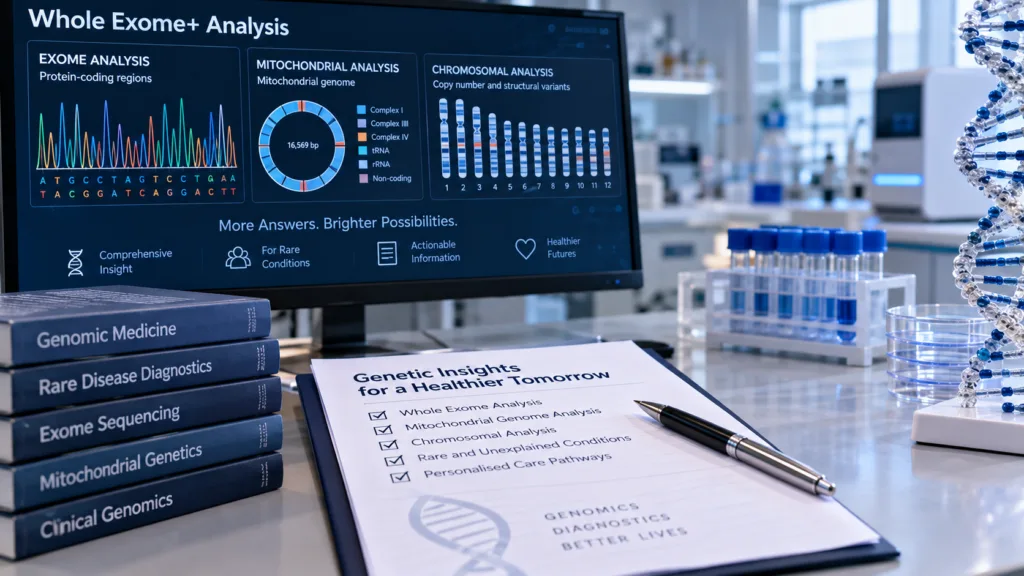
Helix has launched Whole Exome+ Sequencing, a diagnostic test designed to combine broad exome analysis, mitochondrial genome analysis and genome-wide chromosomal copy-number assessment within a single provider order for patients with rare or unexplained conditions. The test is now available to ordering clinicians across the United States and can be requested for an individual patient or in duo and trio configurations that incorporate samples from biological relatives.
The diagnostic proposition is straightforward but potentially consequential. Patients with developmental delay, congenital abnormalities, epilepsy and other unexplained neurological or multisystem conditions can undergo a succession of gene panels, chromosomal testing and specialist evaluations before receiving a molecular diagnosis, while some remain without an answer despite years of testing. Helix is attempting to move more comprehensive genomic analysis earlier in that pathway.
The company says Whole Exome+ covers 99% of clinically relevant exome regions and incorporates mitochondrial sequencing and what it describes as a digital karyotype, using sequencing data to detect genome-wide copy-number changes. Helix says that broader analysis may remove the need for a separate chromosomal microarray in many clinical circumstances, although the company specifically cautions that microarray or additional cytogenetic testing can still be appropriate for individual patients.
Whole Exome+ is therefore not a universal replacement for every genetic diagnostic test. Its significance lies in whether one sequencing workflow can provide enough breadth and analytical quality to reduce sequential testing while retaining the flexibility to revisit the same genomic data as scientific knowledge changes.
Why are clinicians increasingly considering exome or genome sequencing earlier in a diagnostic workup?
Traditional genetic testing frequently begins with a clinical hypothesis. A physician recognizes a collection of symptoms, identifies one or several candidate genes and orders a targeted panel. That strategy can work efficiently when the phenotype strongly points toward a particular disorder, but it becomes more difficult when symptoms overlap with hundreds of possible genetic conditions.
Developmental delay provides a clear example. Intellectual disability, seizures, congenital anomalies, abnormal growth or neurological symptoms can arise from pathogenic variants across a very large number of genes and from chromosomal abnormalities. Choosing one narrow test can therefore miss the responsible variant if the initial clinical assumption is incorrect.
Professional guidance has increasingly moved toward broader sequencing in appropriate pediatric and neurological populations. The American College of Medical Genetics and Genomics has recommended considering exome or genome sequencing as a first-tier or second-tier test for pediatric patients with congenital anomalies or intellectual disability, while subsequent clinical guidance has reinforced genomic testing across several unexplained neurodevelopmental presentations.
This shift changes the economics of the diagnostic pathway. Broad testing is more complex to interpret than a small gene panel, but performing it earlier may reduce the accumulation of multiple inconclusive investigations. The relevant comparison is consequently not simply the laboratory price of whole-exome sequencing versus one targeted test, but the cost and clinical burden of the entire diagnostic sequence that might otherwise occur.
Earlier genomic testing also creates risks. Broader sequencing can identify variants of uncertain significance, unexpected findings or genetic information unrelated to the primary clinical question. The ability to generate more data therefore needs to be matched by careful interpretation and appropriate genetic counseling.
What does Whole Exome+ add beyond a conventional exome sequencing test?
A conventional exome test primarily examines the protein-coding regions of nuclear genes, where a large proportion of currently recognized disease-causing single-nucleotide variants and small insertions or deletions are found. Whole Exome+ extends that model by integrating several analytical layers into the same order.
Helix says the assay covers 99% of clinically relevant exome regions. It also includes analysis of the mitochondrial genome when appropriate, addressing disorders caused by pathogenic variants in mitochondrial DNA that would not necessarily be detected through standard nuclear exome analysis alone.
The digital karyotype component is intended to identify copy-number changes across the genome. These deletions or duplications can involve a single gene, multiple genes or larger chromosomal regions and are an important cause of developmental and congenital disorders. Chromosomal microarray has historically been widely used to detect such abnormalities.
Combining these analyses could reduce the need to order separate tests one after another. A clinician evaluating an unexplained developmental disorder might otherwise order microarray testing, a targeted gene panel, mitochondrial testing and eventually exome sequencing depending on earlier results.
Helix does not claim that the integrated approach eliminates every need for cytogenetics. Structural chromosome rearrangements, repeat expansions, methylation abnormalities and other variant types may require technologies not fully addressed by an exome-based workflow. The company itself states that additional microarray or cytogenetic testing can remain clinically indicated in some cases.
Why do trio and duo sequencing often improve interpretation in rare disease?
Whole Exome+ can be ordered for one patient alone, as a duo involving one relative, or as a trio that typically includes the patient and both biological parents. Family testing is particularly useful in pediatric rare disease because inheritance patterns can help determine whether an observed variant is likely to explain the patient’s condition.
A variant appearing in an affected child but absent from both parents may represent a newly occurring, or de novo, genetic change. Depending on the gene, phenotype and existing evidence, that inheritance pattern can substantially strengthen the case that a variant is disease causing.
Conversely, a variant inherited from an unaffected parent may reduce its apparent significance in disorders expected to have highly penetrant dominant inheritance. Recessive diseases require a different analysis, often involving pathogenic variants inherited from both parents in the same gene.
Parental samples also help laboratories determine whether two variants are located on the same or different copies of a gene, information that can be decisive in recessive disorders. Trio sequencing consequently improves interpretation rather than merely generating additional raw sequence.
The advantage comes with additional logistical and ethical considerations. Biological parents may be unavailable, family relationships may be complex, and sequencing can occasionally reveal unexpected inheritance information. Providers need processes for informed consent and communication before testing rather than treating family sequencing as a purely technical exercise.
Could Helix’s digital karyotype replace chromosomal microarray in routine diagnostic practice?
Helix argues that Whole Exome+ can perform high-resolution genome-wide copy-number analysis from sequencing data, potentially removing the need for a separate chromosomal microarray in many clinical scenarios. If performance is sufficiently robust, this consolidation could reduce sample collection, turnaround time and duplicated laboratory workflows.
The claim requires nuance because chromosomal microarray remains an established technology with well-characterized performance for copy-number abnormalities. Whether sequencing-based copy-number detection can replace it depends on the type and size of abnormality, analytical validation and the clinical question being asked.
Some structural abnormalities may still require cytogenetic technologies such as karyotyping or fluorescence-based testing. Balanced chromosomal rearrangements, for example, can be clinically relevant even when there is no net gain or loss of genetic material, making them difficult to detect through copy-number analysis alone.
Helix explicitly acknowledges these limitations in its launch materials. Whole Exome+ is intended to support clinical judgment rather than dictate a single diagnostic pathway, and clinicians may still order microarray or other testing where the phenotype, family history or initial findings justify it.
The commercial advantage of digital karyotyping will therefore depend less on whether it replaces microarray in every patient and more on whether it allows a substantial proportion of families to avoid an additional test without reducing diagnostic accuracy.
Why is genomic reanalysis becoming an important feature rather than an optional extra?
A negative exome result does not necessarily mean a genetic explanation is absent. The relationship between genes and disease continues to change as new variants are reported, novel disease associations are established and variant-classification frameworks incorporate additional evidence.
A genomic dataset generated in 2026 could consequently contain a disease-causing variant that cannot be interpreted confidently today but becomes clinically meaningful several years later. Reanalysis allows the laboratory to return to existing sequence data rather than obtaining another specimen and sequencing the patient again.
Helix includes one provider-requested complimentary reanalysis each year with Whole Exome+. The company positions this within its Sequence Once, Query Often model, treating genomic information as a reusable clinical asset rather than a test result that becomes obsolete immediately after reporting.
That model has particular relevance in pediatrics. A child’s phenotype can evolve as new symptoms appear with age, allowing a previously ambiguous genetic finding to become more clearly associated with the clinical picture. New gene-disease discoveries can similarly convert a negative case into a diagnosable disorder.
Reanalysis still requires clinical judgment. Constantly reinterpreting every genome without a meaningful change in scientific evidence or patient presentation could create considerable workload, so laboratories and health systems will need policies defining when repeat analysis is most valuable.
What limitations should clinicians remember when broader sequencing returns more information?
The first is that not every genetic variant can be classified as pathogenic or benign. Variants of uncertain significance are common in genomic medicine and should not automatically be treated as explanations for a patient’s disease. Clinical correlation, family testing and emerging scientific evidence may be needed before their significance becomes clearer.
A second limitation is incomplete technology coverage. Exome sequencing focuses primarily on coding regions and may not reliably detect every deep intronic variant, repeat expansion, structural rearrangement, epigenetic abnormality or mosaic change. A negative Whole Exome+ result therefore does not exclude all genetic disease.
Interpretation also depends on phenotype information supplied by the ordering clinician. Helix uses clinical notes to guide phenotype-driven prioritization rather than requiring physicians to nominate a narrow gene panel in advance. Better clinical descriptions can improve analysis because the laboratory can prioritize variants associated with the patient’s actual presentation.
Incidental or secondary findings create a further layer of responsibility. Broad sequencing can reveal medically actionable risks unrelated to the reason testing was ordered, requiring clear consent policies and appropriate follow-up.
This is why genomic testing remains a clinical service rather than simply a sequencing product. Laboratory technology generates variants, but diagnosis requires integration of those results with symptoms, family history and specialist judgment.
How could Whole Exome+ fit into Helix’s wider genomics business?
Helix operates a CAP-accredited and CLIA-certified laboratory and already provides diagnostic testing across hereditary cancer, cardiovascular disease, pharmacogenomics, carrier screening and other areas. Whole Exome+ adds a broader rare-disease offering to that portfolio.
The company has also built relationships with health systems, insurers and life-science organizations, potentially giving it a distribution advantage compared with laboratories operating principally through direct specialist referrals. Whole Exome+ can be ordered through Helix’s provider portal and through selected electronic health record integrations, with additional integrations planned.
EHR connectivity can become important because genomic testing often sits outside routine healthcare information systems. Structured ordering and result return can reduce administrative friction, while longitudinal genomic data become more useful when clinicians can locate them alongside the rest of the medical record.
Reimbursement will remain one of the largest constraints on broader adoption. Helix works with commercial insurers, Medicare and Medicaid and offers financial-assistance programs, but coverage for exome sequencing can vary according to patient age, indication, previous testing and payer policy.
The economic case is strongest when comprehensive testing prevents a prolonged series of lower-yield investigations. Demonstrating that effect in real health-system workflows could become as important commercially as the analytical specifications of the test itself.
Whole Exome+ therefore enters a diagnostics market increasingly focused on moving genomic sequencing earlier in the patient journey. Helix has designed the service to combine several types of genetic analysis, use family data when available and repeatedly interrogate existing sequence as scientific knowledge develops. Its success will ultimately depend on whether that breadth produces faster and more actionable diagnoses rather than simply larger genomic reports.