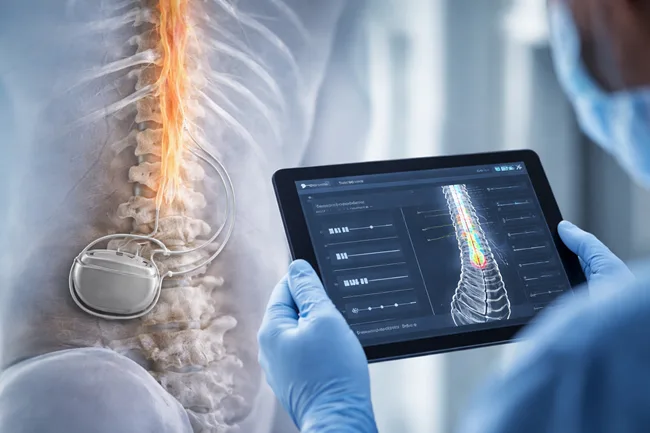
BIOTRONIK Neuro has launched Embrace One Proactive Intelligence, a proprietary artificial intelligence capability designed to identify patients implanted with the Prospera Spinal Cord Stimulation System who may benefit from additional support. The technology analyses more than 200 data points collected from each patient every day through the company’s automatic remote monitoring infrastructure, looking for behavioural patterns that could help the Embrace One Care Team prioritise outreach, therapy support and patient education.
The artificial intelligence does not independently make clinical decisions, diagnose a problem or change a patient’s stimulation settings. Instead, it operates as a human-in-the-loop triage tool, presenting information to trained members of the Embrace One Care Team who determine whether outreach or follow-up support may be appropriate. BIOTRONIK Neuro said the capability uses information already transmitted through the Prospera system and therefore does not require additional data-entry work from patients or healthcare providers.
The launch extends BIOTRONIK Neuro’s remote spinal cord stimulation strategy beyond data collection and into predictive prioritisation. Rather than waiting for a patient to notice declining therapy use, charging difficulties or another change and contact a clinic, the model is intended to help the support team recognise patterns that may warrant attention earlier.
That is a meaningful operational development, but it should not yet be interpreted as evidence that artificial intelligence improves pain relief, reduces explantation or produces better long-term clinical outcomes. The initial evidence comes from a prospective real-world pilot presented orally at the July 2026 American Society of Pain and Neuroscience Annual Meeting, not from a randomised comparison or peer-reviewed clinical outcomes study.
How does Embrace One Proactive Intelligence change post-implant management for Prospera SCS patients?
Spinal cord stimulation management does not end when the neurostimulator is implanted. Patients may require programming changes, help with charging, education about device use or evaluation when therapy utilisation changes. Conventional follow-up models can depend heavily on patients recognising that something is wrong, contacting their healthcare provider and attending another appointment.
Prospera already transmits objective device and therapy information through BIOTRONIK Neuro’s HomeStream infrastructure. The company describes the system as monitoring factors related to therapy compliance, technical proficiency and system integrity, including low device use, charging behaviour, stimulation amplitude and electrode status. Information is transmitted to a secure environment where the Embrace One Care Team and authorised clinicians can review it.
Embrace One Proactive Intelligence introduces an additional prioritisation layer. Instead of relying exclusively on fixed thresholds or manual review, the proprietary model analyses patterns across the data and identifies instances where a patient may benefit from attention. The care team can then contact the patient and, where appropriate, provide education, assist with device use or coordinate remote programming and therapy optimisation.
The distinction between identifying a possible support need and delivering clinical treatment is important. The artificial intelligence does not independently determine why a patient’s behaviour has changed. Reduced device use, for example, could reflect a technical issue, changing symptoms, dissatisfaction with therapy, charging difficulties or an unrelated personal circumstance. Human review therefore remains necessary to understand the context and decide whether any action falls within the support team’s responsibilities or requires clinician involvement.
From an operational perspective, the model could allow BIOTRONIK Neuro to concentrate specialist time on patients with the strongest emerging signals rather than treating every transmitted data point as equally urgent. The commercial and clinical value will depend on whether that prioritisation is sufficiently accurate to identify meaningful needs without producing an unmanageable volume of low-value alerts.
What do the ASPN pilot findings establish, and what remains unproven about the AI model?
BIOTRONIK Neuro reported that the prospective pilot identified 188 behavioural-pattern instances involving 175 patients. These instances were sent to the Embrace One Care Team for review, and patients responded to proactive outreach in 80.9 percent of cases. The company said nearly four out of five reviewed cases ultimately resulted in targeted support, including remote reprogramming, therapy optimisation or additional patient education.
Those figures suggest that the model was not merely generating theoretical alerts that the care team routinely dismissed. A high proportion of flagged cases led to some form of support activity, which is relevant when assessing whether the model can contribute to workflow prioritisation.
However, the disclosed measures primarily describe outreach response and support-team action. They do not establish that the artificial intelligence improved pain scores, functional status, quality of life, therapy durability, healthcare utilisation or device retention. An intervention following an alert can indicate that the outreach was useful, but it does not by itself prove that the patient would otherwise have experienced deteriorating therapy.
The public disclosure also does not provide conventional model-performance measures such as sensitivity, specificity, positive predictive value or false-negative rate. It is therefore unclear how many patients who genuinely required assistance were not identified, how the model performed against existing manual monitoring rules or whether the identified patterns were assessed using an independent validation population.
The reporting unit also deserves attention. The study identified 188 behavioural-pattern instances among 175 patients, indicating that at least some patients generated more than one instance. Future publications will need to clarify whether performance was evaluated at the patient level, alert level or outreach-event level and how repeat alerts were handled.
The study, titled “A Real-World Pilot Integration of Human-In-Loop Artificial Intelligence in Proactive Patient Care,” was presented at the American Society of Pain and Neuroscience meeting between July 16 and July 19, 2026. Until a complete dataset is published, the results are best viewed as an encouraging workflow signal rather than confirmation of clinical benefit.
Why does the regulatory boundary between Prospera therapy and the AI support platform matter?
The United States Food and Drug Administration granted Premarket Approval for the Prospera Spinal Cord Stimulation System on March 31, 2023. The implanted system is indicated as an aid in managing chronic, intractable pain in the trunk or limbs, including pain associated with several specified back, radicular and complex regional pain conditions.
The approval covers the Prospera system, its implanted and external components and its remote-management infrastructure. BIOTRONIK Neuro states that Prospera and Embrace One are currently approved and available only in the United States. The company also characterises Embrace One as a support platform intended to help manage a patient’s spinal cord stimulation experience, rather than a product intended to diagnose disease or provide medical treatment.
BIOTRONIK Neuro’s announcement does not describe Embrace One Proactive Intelligence as an autonomous clinical decision-making product or as software that independently adjusts therapy. That limited role is central to the launch positioning. The model recommends attention to the human care team, which retains responsibility for reviewing the information and determining the appropriate response.
Maintaining that boundary could simplify implementation because healthcare providers are not being asked to surrender treatment decisions to an algorithm. It may also reduce the risk of an unexplained model output directly altering stimulation therapy without clinical context.
Nevertheless, artificial intelligence used within a medical-device support ecosystem still raises questions around software change control, cybersecurity, data integrity, performance monitoring and governance. Providers will need confidence that model updates do not unexpectedly change alert behaviour and that the system remains reliable as its patient population and underlying data expand.
Could AI-assisted support strengthen BIOTRONIK Neuro’s position in spinal cord stimulation?
Competition in spinal cord stimulation has traditionally focused on stimulation waveforms, battery characteristics, lead technology, magnetic resonance imaging compatibility, programming flexibility and evidence of durable pain reduction. BIOTRONIK Neuro is attempting to add another competitive dimension: the quality and continuity of support delivered after implantation.
The strategic asset is not merely the artificial intelligence model. It is the combination of an implanted system, automatic daily data transmission, remote programming infrastructure and a staffed care team capable of acting on the resulting information. A model without reliable longitudinal data would have little to analyse, while remote data without an operational response system could produce information that no one uses.
BIOTRONIK Neuro has previously reported real-world results from 500 consecutive United States patients implanted with Prospera. The retrospective analysis found that 95.1 percent remained implanted after a median implant duration of 364 days, while 96.8 percent of patients who remained implanted were actively using therapy. The study was subsequently published in Neuromodulation, although its observational design does not establish that remote monitoring caused those utilisation or explant results.
Embrace One Proactive Intelligence may deepen this connected-care proposition by converting the expanding dataset into a mechanism for prioritising support. For physicians, the potential attraction is more visibility between scheduled appointments. For BIOTRONIK Neuro, it could create a service-based differentiator that becomes increasingly difficult to replicate as the volume and duration of its longitudinal data grow.
The commercial test will be whether clinics regard the support model as meaningfully reducing their workload or improving patient management. If alerts simply produce additional calls, messages and responsibilities for already stretched practices, the technology could add complexity rather than remove it. BIOTRONIK Neuro’s decision to route the output initially through its own care team appears designed to reduce that risk.
What data governance and implementation questions must be answered as the model expands?
The announcement describes the volume of daily data analysed but provides limited information about the model’s technical development. It does not disclose the size or demographic composition of the training dataset, the features given the greatest weight, the validation methodology or performance across different patient groups.
These details matter because patient behaviour, device usage and communication patterns may differ according to age, health status, digital familiarity, pain history and access to care. A system trained primarily on one type of patient or clinical practice may perform differently when deployed across a broader population.
False positives could result in unnecessary outreach and care-team workload. False negatives could create misplaced confidence that a patient is stable because the algorithm did not generate a flag. The continued use of human review is therefore a strength, but human oversight does not eliminate the need to quantify error rates and monitor performance over time.
Data continuity is another practical dependency. BIOTRONIK Neuro notes that remote information depends on successful transmission and may reflect therapy data from the preceding 24 hours. Connectivity interruptions, device-pairing problems or incomplete transmissions could influence what the model sees and how confidently it interprets behavioural changes.
Healthcare organisations will also want clarity regarding patient consent, data access, retention, cybersecurity controls, clinician visibility and responsibility for escalation. A support-team alert that suggests a patient requires technical education is different from information that could indicate a broader medical problem. Clear protocols will be needed to determine when the Embrace One Care Team can resolve an issue and when the treating clinician must become involved.
What evidence would establish AI-guided SCS support as more than a promising workflow tool?
The next stage of evidence development should move beyond showing that flagged patients answer calls or receive support. A stronger evaluation would compare AI-guided prioritisation with conventional remote monitoring or standard follow-up and measure whether it reduces time to therapy optimisation, unplanned clinic visits, periods of device inactivity or patient burden.
Prospective multicentre validation would help establish whether the model performs consistently across different practices and patient populations. Reporting sensitivity, specificity, false-alert rates and subgroup performance would allow clinicians to understand both its strengths and its limitations.
Longer-term studies should also examine outcomes that matter to patients and healthcare systems, including pain relief, function, treatment persistence, device explantation, travel burden and cost. Economic evidence could become particularly important if BIOTRONIK Neuro eventually seeks reimbursement, subscription revenue or formal integration into provider workflows.
For now, Embrace One Proactive Intelligence represents a credible extension of BIOTRONIK Neuro’s connected spinal cord stimulation platform. It uses an existing stream of objective data and preserves human oversight rather than presenting artificial intelligence as a substitute for clinical judgement.
The early ASPN pilot indicates that the model can identify situations that frequently lead to meaningful support activity. The more consequential question is whether those interventions measurably improve the patient’s long-term experience with spinal cord stimulation. Peer-reviewed validation, transparent performance reporting and evidence of clinical or operational benefit will determine whether the technology becomes a durable competitive advantage or remains an intelligent triage feature within a broader support service.