Celltrion, Inc. used the platform of the 44th Annual J.P. Morgan Healthcare Conference to sharpen its evolving innovation narrative in oncology biologics and global drug manufacturing. The South Korea-based biopharmaceutical company outlined a maturing pipeline of antibody-drug conjugates (ADCs) and multi-specific antibodies (msAbs) with a plan to file up to 16 investigational new drug (IND) applications by 2028. Simultaneously, it confirmed a major U.S. manufacturing expansion, centered on a former Eli Lilly facility in New Jersey, aimed at scaling drug substance capacity to 132,000 liters by 2030.
The dual announcements represent more than pipeline updates. They mark a significant recalibration of Celltrion’s global identity—from a biosimilar leader to a next-generation innovator with biologic differentiation and long-term infrastructure presence in North America.
What this reveals about Celltrion’s innovation pivot beyond biosimilars
Celltrion’s stated ambition to submit 10 ADCs, 4 msAbs, 1 recombinant protein, and 1 peptide IND within the next three years places it squarely in the league of global mid-cap innovators seeking to break free of biosimilar pricing ceilings. Its J.P. Morgan presentation emphasized a strategic shift from volume-based biosimilar strength toward margin-rich oncology innovation.
The company’s ADC pipeline is anchored by CT-P70, an investigational agent for non-small cell lung cancer (NSCLC), which recently received Fast Track designation from the U.S. Food and Drug Administration. While the Fast Track tag expedites regulatory dialogue and enables rolling review, it also demands well-structured clinical trials, strong biomarker strategies, and evidence of differentiation against entrenched standards such as Enhertu or Imfinzi combinations.
In terms of platform strategy, Celltrion is focusing on tumor-targeting ADC constructs that may allow it to enter indication spaces where unmet need still exists—such as EGFR wild-type NSCLC or resistant HER2-low settings. However, the ADC field has seen a mix of commercial success and clinical attrition, with safety profiles heavily dependent on linker-payload chemistry and off-target cytotoxicity. For Celltrion, the test will be whether its engineering expertise, originally honed in monoclonal antibody production, can translate into novel ADC architectures with competitive tolerability and efficacy.
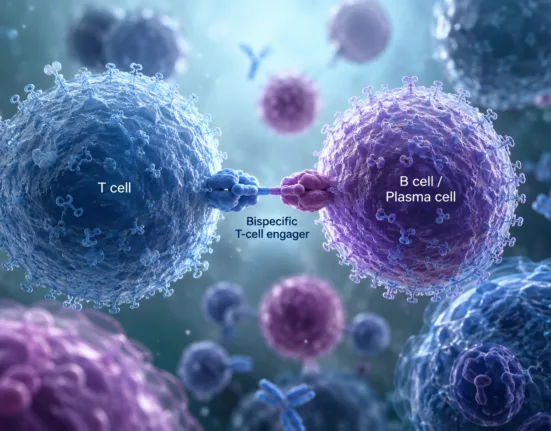
The msAb program offers a second innovation leg. CT-P72, a tetravalent bispecific antibody targeting HER2 and CD3, is emblematic of a strategy leaning into T-cell engager formats. Regulatory watchers note that Celltrion’s construct enters an increasingly crowded space where CD3-based bispecifics are under development by Amgen (tarlatamab), Roche (glofitamab), and Genmab/AbbVie (epcoritamab). The difference lies in the tetravalency and dual specificity, which suggest an attempt to increase tumor binding while mitigating T-cell overactivation.
Industry analysts following this space caution that successful msAb programs often require multi-year optimization to reduce cytokine release syndrome, minimize immune escape, and balance half-life with tumor penetration. As a relative newcomer to this field, Celltrion will need to prove its platform can produce clinically viable constructs with scalable manufacturability—a non-trivial bar.
Why Celltrion’s U.S. expansion strategy signals deeper global ambitions
While the pipeline drew attention for its scientific ambition, Celltrion’s acquisition of a 66,000-liter capacity facility in Branchburg, New Jersey, could prove more consequential over the long term. Acquired from Eli Lilly, the facility positions Celltrion to not only support its U.S. biologics push but to anchor global scale-up in a post-COVID supply chain environment where proximity to regulators and patients has become strategic.
The company has indicated that it will expand capacity at this site to 132,000 liters by 2030 and eventually build out drug product (DP) capabilities, effectively setting up an end-to-end manufacturing base on U.S. soil. Regulatory observers view this as a proactive move to mitigate international tariff exposure, reduce logistics complexity, and accelerate time-to-market for pipeline candidates that require local production to meet federal procurement standards or Medicaid rebate rules.
In the context of U.S. policy, the move aligns with a broader reshoring trend. As the Inflation Reduction Act and federal resilience mandates nudge the industry toward domestic sourcing, companies with physical infrastructure in the U.S. are increasingly favored in government contracts, value-based care models, and accelerated review frameworks.
Moreover, Celltrion’s biomanufacturing expansion comes at a time when contract development and manufacturing organization (CDMO) capacity is tightening for ADCs and cell-based therapies. By owning capacity, the company gains insulation from CDMO bottlenecks and retains flexibility to prioritize its internal programs—critical if multiple assets advance simultaneously into mid- or late-stage trials.
From an investor lens, this represents a capital-intensive bet, but one that adds durability to Celltrion’s pipeline execution. A key watchpoint will be how efficiently the company transitions the acquired site into current good manufacturing practice (cGMP) compliance for both clinical and commercial scale.
What this changes for ADC and msAb competition across global oncology
Should Celltrion execute on its innovation thesis, its entry into ADC and bispecific antibody segments could alter both pricing dynamics and regional access strategies in oncology. While most established ADCs carry six-figure price tags and depend on U.S.-centric reimbursement pathways, a Celltrion-led alternative, if clinically validated, could offer a cost-competitive biologic innovation model for international markets.
That said, the path from IND to product approval is fraught with attrition. ADC attrition in Phase 2 remains high due to dose-limiting toxicities, narrow therapeutic windows, and suboptimal pharmacokinetics. The regulatory environment has also evolved. The U.S. FDA has increased its scrutiny of surrogate endpoints and accelerated approvals, particularly after the withdrawal of indications for several immuno-oncology agents that failed confirmatory trials.
As for bispecifics, the market is evolving rapidly. First-generation CD3 bispecifics have shown promise in hematologic malignancies, but solid tumor applications remain largely unproven, with complex tumor microenvironments, immune exclusion, and rapid T-cell exhaustion as major barriers.
For Celltrion to gain traction, it must demonstrate not only clinical efficacy but also manufacturing sophistication, particularly in expressing complex bispecific constructs at commercial scale. Missteps in expression stability, aggregation, or purification could derail programs before pivotal trials begin.
What clinicians and regulators will be watching next
Looking forward, three near-term developments will likely serve as inflection points for Celltrion’s innovation trajectory:
First, the progress of CT-P70 in securing a clear registrational pathway under Fast Track. Analysts expect Celltrion to outline a Phase 2 design in NSCLC that either leverages a novel biomarker or compares favorably with existing standard-of-care regimens. A rapid enrollment strategy and early signals of response durability will be closely watched.
Second, the initiation and monitoring of first-in-human (FIH) trials for CT-P72, particularly with regard to immune-related adverse events, step-up dosing protocols, and cytokine modulation strategies. Any delays or protocol amendments during early phase trials could delay broader pipeline confidence.
Third, regulatory validation of the Branchburg site, including cGMP readiness audits, environmental controls, and successful batch releases. Timely execution here will affect Celltrion’s ability to meet its 2028 IND targets and mitigate future supply chain risks.
Clinicians, especially in the oncology community, will be evaluating whether Celltrion’s pipeline candidates offer incremental or transformative benefit, and how these agents compare with existing checkpoint inhibitor combinations or T-cell targeted agents. Payers and health technology assessment (HTA) bodies will be looking at cost-effectiveness modeling for any ADC or msAb programs that enter late-stage development.
Celltrion’s transition now hinges on execution, not intention
With its announcements at J.P. Morgan 2026, Celltrion has moved decisively from biosimilar maturity into biologic innovation. The scale and ambition of its ADC and msAb pipelines, paired with strategic U.S. manufacturing assets, could elevate its status within the global oncology landscape. But the innovation narrative now shifts from bold aspiration to scientific, clinical, and operational proof.
Investors may view the next 12–18 months as a period of validation: Can Celltrion bring its first ADC through mid-stage development with an approvable profile? Can it manage msAb complexity while building out domestic capacity in the United States? And can it translate biosimilar discipline into biologic risk-taking without compromising quality or focus?
The answers will shape not only Celltrion’s place in the oncology biologics arena—but potentially establish a new benchmark for how Asian biopharma companies build end-to-end innovation pipelines rooted in regional strength but scaled for global relevance.