Implantica AG has received US Food and Drug Administration Premarket Approval for RefluxStop, its implantable medical device for treating gastroesophageal reflux disease, giving the Swiss medtech company access to the US market after a regulatory programme built around five-year clinical follow-up, manufacturing review and pre-approval inspections. Unlike many recent device authorizations that move through the 510(k) substantial-equivalence process, RefluxStop underwent the more demanding PMA pathway used for Class III devices requiring evidence supporting safety and effectiveness. Implantica disclosed the approval on August 20, 2026 and said it can now begin US commercial launch activities.
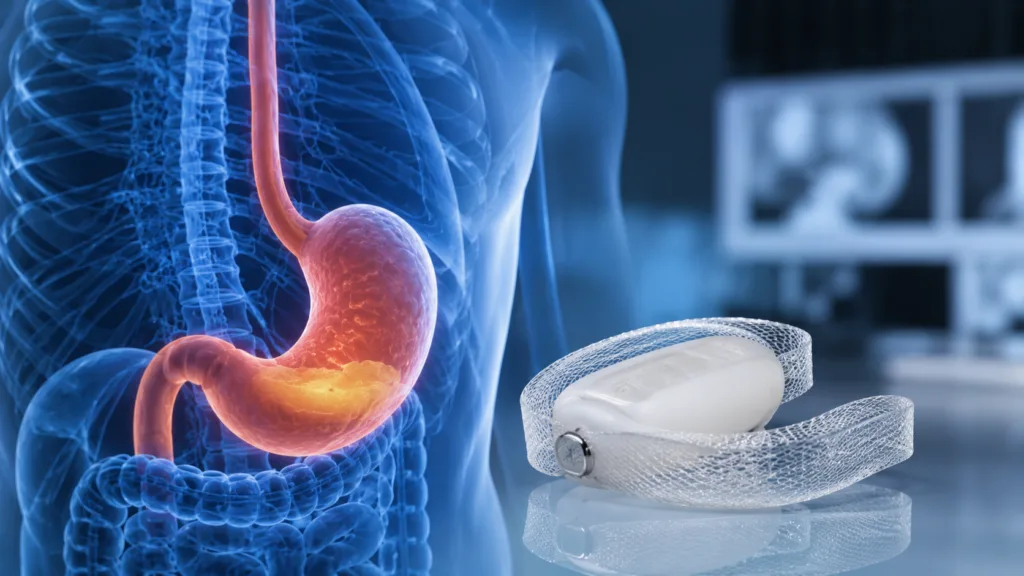
The approval is particularly important because RefluxStop does not use the same basic mechanical concept as several established anti-reflux surgical approaches. The implant is intended to maintain the gastroesophageal junction and lower esophageal sphincter in an anatomically appropriate position without encircling or applying pressure around the esophagus. Implantica is therefore betting that anatomical restoration can provide durable reflux control while limiting swallowing difficulty, gas bloating and inability to belch or vomit, complications that can influence patient and surgeon decisions around anti-reflux procedures.
The commercial opportunity will not materialize immediately simply because PMA has been granted. Implantica plans a targeted rollout through selected US reflux surgeons and medical centers, acknowledging that adoption will depend on training and individual site activation. That makes the next phase fundamentally different from the regulatory phase: the central question now becomes whether the company can translate European experience and relatively small pivotal-study evidence into reproducible outcomes across a much larger and more heterogeneous US surgical environment.
What exactly has FDA approval changed for RefluxStop?
Implantica describes the approved indication as treatment of acid and non-acid reflux in patients diagnosed with gastroesophageal reflux disease. The device is designed to maintain the gastroesophageal junction in a defined intra-abdominal position so the lower esophageal sphincter can continue functioning naturally, while an associated deployment tool is indicated for patients with GERD established through abnormal impedance-pH or pH testing and selected for implantation.
That is materially different from saying FDA has approved a new reflux medicine. RefluxStop is an implantable medical device placed surgically, meaning patient selection, procedural execution and surgeon experience will all affect real-world performance. The company’s commercial model will consequently depend on more than selling a physical implant; it must establish centers capable of identifying appropriate patients and reproducing the procedure consistently.
PMA is also an important regulatory distinction. FDA reserves premarket approval for devices requiring a higher level of regulatory scrutiny than products entering through substantial equivalence under 510(k). Implantica’s application was submitted in modules and included manufacturing and quality-system information, clinical data and product testing. Before approval, the company reported completion of six FDA pre-approval inspections involving manufacturing locations, quality systems and clinical-trial inspection activity.
Implantica submitted the third and final PMA module in June 2025 and spent much of the following year responding to regulatory questions and completing additional testing. The long process matters commercially because US entry had effectively become the single most important value-creation event for the company’s lead product.
What did the five-year RefluxStop clinical study actually show?
The pivotal evidence deserves careful interpretation because the results are encouraging but originate from a relatively small, non-randomized study. The prospective multicenter CE-mark trial enrolled 50 adults with chronic GERD, with 44 patients completing five-year follow-up. The study assessed measures including proton-pump inhibitor use, GERD-related quality of life, 24-hour pH monitoring, imaging and adverse events.
A peer-reviewed analysis published in Surgical Endoscopy reported that 97.9% of evaluable patients were not taking proton-pump inhibitors at five years. Median GERD-HRQL scores improved substantially from baseline, while five-year measurements showed sustained control of esophageal acid exposure. The accompanying analysis of food-passageway outcomes reported no ongoing adverse-event dysphagia at the five-year visit, no esophageal dilations during the study and no reported inability to belch or vomit among the evaluated participants.
Those numbers help explain why Implantica has emphasized the distinction between RefluxStop and procedures that manipulate or constrain the food passageway. However, the evidence should not be interpreted as a randomized demonstration that RefluxStop is superior to fundoplication, magnetic sphincter augmentation or other surgical alternatives. The pivotal study was single-arm, only 50 patients underwent the procedure, and 44 completed the five-year follow-up. Without a contemporaneous randomized control group, cross-procedure comparisons carry substantial limitations.
That does not make the durability signal unimportant. Five-year follow-up is valuable for an implanted therapy because short-term control would reveal little about whether reflux recurs, whether the implant migrates or whether late swallowing complications emerge. The long observation period therefore addresses a meaningful part of the clinical risk, even though comparative effectiveness remains less certain.
Does the larger European dataset reduce concerns about the small pivotal trial?
Evidence published in Scientific Reports during 2026 expands the safety dataset substantially. Investigators reported outcomes from 602 RefluxStop-treated patients across 22 centers in six European countries, with follow-up extending as long as 6.75 years and a mean follow-up of approximately two years. The study provides a broader real-world view of how the procedure performs beyond the tightly defined original clinical cohort.
That larger experience is commercially useful because new surgical technologies often face an important reproducibility question: outcomes achieved by a limited number of early expert operators may not necessarily persist when adoption spreads across more hospitals and surgeons. A multicenter dataset involving hundreds of procedures therefore gives Implantica more evidence to present during hospital evaluation and surgeon training.
It still does not eliminate the need for stronger comparative evidence. Observational real-world studies are valuable for identifying complications and confirming that performance is not confined to a single investigator group, but they generally cannot control confounding as effectively as randomized trials.
Implantica has been developing additional comparative programmes, including randomized studies intended to evaluate RefluxStop against established approaches. Those studies could become increasingly important in the United States because surgeon adoption, payer coverage and guideline placement may ultimately require more than evidence that the procedure works; decision-makers may want evidence defining when it works better, worse or differently than available alternatives.
Why could the US rollout be slower than the size of the GERD market suggests?
Implantica estimates that tens of millions of Americans experience acid reflux, but the clinically relevant market for an implantable surgical therapy is far smaller than the overall population experiencing GERD symptoms. Many patients are managed with lifestyle intervention and medication, while invasive treatment tends to be considered when symptoms remain inadequately controlled, medicines are unsuitable, complications develop or patients meet other surgical criteria.
The addressable market therefore depends on diagnosis, documented abnormal reflux, specialist referral and willingness to undergo intervention. RefluxStop also requires surgeons to learn a procedure involving reconstruction of the gastroesophageal junction and implantation of the device, creating a practical adoption bottleneck that does not exist to the same extent for conventional pharmaceutical launches.
Implantica has already acknowledged this reality by planning a controlled launch centered on selected US surgeons and institutions rather than immediate broad distribution. The company said nearly 1,800 patients had received RefluxStop in Europe and that more than 60 centers across nine European countries had accumulated experience by the time of US approval.
That installed expertise gives Implantica a useful training foundation, but healthcare systems will still want local evidence covering procedure times, complication management, repeat intervention, durability and patient selection. Reimbursement will represent another layer of the commercialization process, particularly as hospitals evaluate the economics of adopting a new implant and training programme.
What will determine whether RefluxStop becomes a meaningful US GERD device franchise?
The FDA decision changes the company’s immediate risk profile because regulatory uncertainty around market entry has been replaced by execution risk. Implantica can now build US demand, activate centers and generate post-commercial experience rather than operating entirely in pre-launch mode.
The most important indicators over the next several years will therefore be the number of trained centers, procedure volumes per center, repeat use by surgeons, real-world complication rates and the evolution of payer coverage. Strong early clinical interest can help open hospitals, but repeat utilization usually provides a better indication that a surgical technology is becoming embedded in practice.
Comparative clinical evidence could prove equally important. RefluxStop’s principal conceptual attraction is its attempt to restore the anti-reflux barrier without encircling the esophagus. If subsequent controlled studies show that this translates into durable reflux control with a favorable swallowing and gas-bloat profile, the device could occupy a differentiated position within anti-reflux surgery.
If results prove highly dependent on patient selection or specialist expertise, the product could instead remain concentrated within experienced reflux centers. FDA PMA approval resolves whether RefluxStop can enter the US market; it does not resolve how large that market will become.
For Implantica, that is still a major transition. RefluxStop has moved from an internationally marketed device awaiting access to the largest medtech market into an FDA-approved implant facing the much more practical test of adoption, reimbursement and surgical reproducibility.