Ionis Pharmaceuticals has secured United States Food and Drug Administration approval for Tryngolza, or olezarsen, as an adjunct to diet to reduce triglycerides and the risk of acute pancreatitis in adults with severe hypertriglyceridemia, defined as triglyceride levels of at least 500 mg/dL. The monthly self-administered therapy, available in 50 mg and 80 mg autoinjector doses, is expected to enter the expanded United States market in July 2026.
Why the pancreatitis-risk indication matters more than another triglyceride-lowering claim
The defining feature of the approval is not simply that Tryngolza lowers triglycerides. Fibrates, prescription omega-3 products and other lipid-modifying therapies have long been used alongside dietary changes and treatment of secondary causes such as poorly controlled diabetes, obesity and alcohol consumption. The more consequential difference is that Tryngolza now carries an indication covering reduction of acute pancreatitis risk.
That distinction addresses a persistent weakness in the severe hypertriglyceridemia treatment landscape. Earlier triglyceride-lowering medicines were approved primarily through changes in laboratory values. Their clinical programmes generally did not record enough pancreatitis events to establish whether the observed lipid reductions translated into fewer attacks. Clinicians therefore had a biologically plausible reason to lower triglycerides but limited randomised evidence connecting a medicine directly with prevention of the complication they feared most.
Tryngolza narrows that evidence gap. Acute pancreatitis can require hospitalisation, recur in patients who have already experienced an attack and lead to complications involving the pancreas and other organs. A therapy carrying a pancreatitis-risk indication gives prescribers and payers a more clinically tangible outcome than triglyceride reduction alone.

However, the approval does not make triglyceride concentration irrelevant. The drug remains an adjunct to diet, and the threshold for eligibility begins at 500 mg/dL. Lifestyle modification, management of underlying metabolic disease and conventional lipid-lowering therapy will continue to form the treatment foundation. Tryngolza adds a targeted option for patients whose triglycerides and pancreatitis risk remain inadequately controlled rather than replacing existing management.
How the CORE and CORE2 evidence strengthens the case while leaving important limits
The regulatory decision was supported by the Phase 3 CORE and CORE2 trials, which enrolled 1,061 adults with severe hypertriglyceridemia despite background treatment. Participants received 50 mg of olezarsen, 80 mg of olezarsen or placebo once monthly for 12 months in randomised, double-blind studies.
The study population was clinically relevant because the average baseline triglyceride level exceeded 1,100 mg/dL. These were not patients with mildly abnormal laboratory values. Many remained at substantial pancreatitis risk despite receiving standard lipid-lowering therapies and lifestyle interventions.
At six months, the placebo-adjusted reduction in fasting triglycerides reached 62.9 percentage points with the 50 mg dose and 72.2 percentage points with the 80 mg dose in CORE. Corresponding reductions in CORE2 were 49.2 percentage points and 54.5 percentage points. The consistency across two independent pivotal trials strengthens confidence that the effect was produced by APOC3 inhibition rather than by an unusually favourable result in a single study.
The integrated analysis produced an estimated acute pancreatitis rate ratio of 0.15, corresponding to an approximately 85 percent reduction relative to placebo. The estimated number needed to treat for one year to prevent one pancreatitis episode was 20 across the overall population. It fell to four among patients with triglyceride levels of at least 880 mg/dL and a previous pancreatitis episode, suggesting that the absolute clinical value may be greatest in those entering treatment with the highest baseline risk.
The pancreatitis result is compelling, but it requires disciplined interpretation. Acute pancreatitis remained less frequent than changes in laboratory endpoints, and the trials were not large cardiovascular outcome studies conducted over several years. The pooled analysis is therefore more informative than comparing the numerical pancreatitis reduction attached to each individual dose. The 50 mg group recorded a larger proportional reduction in pancreatitis events than the 80 mg group despite producing somewhat smaller triglyceride reductions, a pattern that may reflect limited event numbers rather than a genuine inverse dose relationship.
The trials also do not establish that olezarsen reduces heart attacks, strokes or cardiovascular mortality. Reductions in remnant cholesterol and non-high-density lipoprotein cholesterol are biologically interesting, but they cannot be converted into a cardiovascular claim without dedicated outcome evidence. The current therapeutic proposition is prevention of pancreatitis in severe hypertriglyceridemia, not broader cardiovascular risk reduction.
Why targeting APOC3 could shift treatment beyond fibrates and omega-3 products
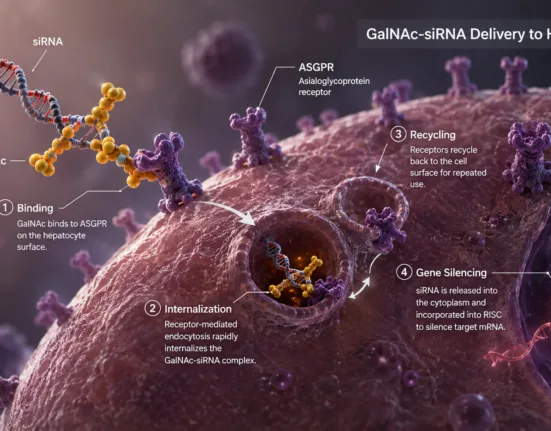
Olezarsen is an antisense oligonucleotide designed to reduce production of apolipoprotein C-III by targeting its messenger RNA in liver cells. Apolipoprotein C-III slows the clearance of triglyceride-rich particles and contributes to elevated circulating triglycerides. Reducing the protein allows the body to clear triglycerides and very-low-density lipoprotein particles more efficiently.
This mechanism differs from the broader metabolic effects of fibrates and omega-3 fatty acids. Rather than indirectly influencing lipid synthesis or oxidation, Tryngolza intervenes at a specific regulator of triglyceride metabolism. The approach may be especially relevant when severe hypertriglyceridemia persists despite multiple conventional interventions.
The approval also provides wider validation for APOC3 as a drug target. Tryngolza was originally approved in the United States in December 2024 for familial chylomicronemia syndrome, a rare inherited condition associated with extremely high triglycerides. Expanding from a genetically defined rare disease into the substantially broader severe hypertriglyceridemia population shows that APOC3 inhibition can potentially address both monogenic and multifactorial disease.
That expansion does not mean all adults with triglycerides above 500 mg/dL will immediately become candidates. Severe hypertriglyceridemia is heterogeneous. Some patients may respond strongly to improved diabetes control, weight loss, alcohol avoidance, dietary changes or established medicines. Others may have recurrent elevations despite intensive management. Clinicians will have to determine whether Tryngolza should be introduced immediately after the threshold is crossed or reserved for persistent disease and patients with additional pancreatitis-risk factors.
The mechanism also creates a competitive benchmark for other RNA-targeted treatments. Future APOC3 inhibitors will be judged not only by how far they lower triglycerides, but by whether they can reproduce pancreatitis prevention, offer less frequent dosing, simplify monitoring or improve affordability. Tryngolza has established the first clinically meaningful reference point in the broader severe hypertriglyceridemia market.
How dose selection and liver monitoring could shape real-world Tryngolza adoption
Offering both 50 mg and 80 mg monthly doses gives clinicians flexibility, but it also creates a more complicated benefit-risk decision than a fixed-dose product. The 80 mg dose generally produced the largest triglyceride reductions, yet higher exposure was also associated with more frequent liver-enzyme elevations, thrombocytopenia and a dose-dependent increase in hepatic fat during the clinical programme.
The approved safety information identifies injection-site reactions and liver-enzyme increases as the most common adverse reactions in severe hypertriglyceridemia. Liver testing should be considered before treatment begins, before increasing the dose and when clinically indicated during therapy. Persistent abnormalities may require treatment interruption or dose reduction.
These requirements are manageable within specialist lipid, cardiology and endocrinology practices, but they could create friction in primary care. Severe hypertriglyceridemia is frequently encountered outside specialist centres, particularly among adults with diabetes, metabolic dysfunction, obesity or other secondary causes. Broader use will depend on whether prescribing pathways and laboratory-monitoring expectations are simple enough for non-specialists to manage confidently.
Hepatic fat deserves particular attention because many potential recipients may already have metabolic dysfunction-associated steatotic liver disease. A treatment that lowers triglycerides while increasing hepatic fat in a dose-dependent manner creates a clinical trade-off that cannot be understood from short-term lipid results alone. Longer follow-up will be needed to determine whether the imaging changes stabilise, reverse after dose adjustment or translate into meaningful liver outcomes.
Hypersensitivity reactions are another recognised risk. These events are unlikely to determine uptake across the entire market, but clinicians will need to educate patients about relevant symptoms and discontinue treatment when a serious reaction occurs. Monthly self-administration improves convenience, although it shifts part of the safety and adherence burden from clinics to patients and caregivers.
Why reimbursement may concentrate first on patients with the highest pancreatitis risk
The FDA label covers adults with triglyceride levels of at least 500 mg/dL, creating a broad potential treatment population. Commercial access may initially be narrower. Insurers are likely to examine triglyceride history, prior use of conventional therapy, dietary intervention, secondary causes and previous pancreatitis before approving an RNA-targeted medicine.
Patients with triglyceride levels above 880 mg/dL, recurrent severe elevations or documented pancreatitis may present the clearest economic argument. The lower number needed to treat in the highest-risk subgroup suggests that preventing hospitalisation could offset a meaningful portion of treatment costs. In patients closer to the 500 mg/dL threshold with no previous pancreatitis, the immediate absolute benefit may be less pronounced, giving payers greater incentive to require step therapy.
Pricing will therefore influence whether the approval produces broad early adoption or a staged launch centred on specialist-managed patients. A high annual cost could reinforce restrictions even though the label is comparatively inclusive. Conversely, evidence showing fewer emergency admissions, intensive care episodes and recurrent pancreatitis attacks could support wider coverage once real-world data accumulate.
Patient identification will also be critical. Triglyceride levels can fluctuate substantially with diet, glycaemic control, medication adherence, alcohol use and acute illness. Health systems will need reliable methods to distinguish transient severe elevations from persistent disease that remains uncontrolled despite appropriate intervention.
What the approval means for Ionis Pharmaceuticals as it scales beyond rare disease
For Ionis Pharmaceuticals, the expanded indication is as much a commercial test as a regulatory milestone. The biotechnology firm has decades of experience developing antisense medicines, but much of its historical revenue has come through collaborations and royalties. Tryngolza represents an important independently commercialised product in the United States.
The earlier familial chylomicronemia syndrome launch provided experience in patient identification, specialist education, access support and distribution. Severe hypertriglyceridemia presents a different challenge. The potential population is far larger, more clinically diverse and spread across lipidologists, endocrinologists, cardiologists, gastroenterologists and primary care physicians.
Ionis Pharmaceuticals has increased its guidance for potential annual peak net sales from the severe hypertriglyceridemia opportunity to more than $3 billion. Reaching that level would require adoption extending well beyond patients with rare genetic lipid disorders. It would also require durable reimbursement, consistent long-term use and confidence that monitoring requirements do not outweigh the perceived benefits.
The July rollout should reveal whether the existing Tryngolza commercial infrastructure can be expanded efficiently. Early familial chylomicronemia syndrome sales demonstrate that Ionis Pharmaceuticals can execute in a concentrated rare-disease market. Severe hypertriglyceridemia will test whether the organisation can build a much larger prescriber base without allowing patient-support costs and commercial spending to grow faster than revenue.
What clinicians, regulators and competitors will watch after the United States launch
The first post-launch question will be which patients receive Tryngolza earliest. Uptake concentrated among adults with previous pancreatitis and triglycerides well above 880 mg/dL would support a risk-based treatment model. Broader prescribing near the 500 mg/dL eligibility threshold would indicate that clinicians view the therapy as an earlier preventive intervention.
The second question concerns dose selection. Real-world use may reveal whether clinicians generally begin with 50 mg and increase treatment selectively, or favour 80 mg when rapid triglyceride reduction is the overriding priority. Comparative persistence, laboratory abnormalities and dose modifications will provide important information that could not be fully resolved within the controlled trials.
Long-term hepatic safety, platelet effects and treatment adherence will remain central. Twelve months of randomised evidence is sufficient to support approval but not to characterise several years of continuous treatment in a metabolically complex population. Continued follow-up must establish whether the clinical benefits remain durable and whether hepatic fat changes have practical consequences.
Tryngolza has nevertheless crossed an important threshold. Severe hypertriglyceridemia treatment has moved from assuming that triglyceride reduction should prevent pancreatitis to having a therapy supported by randomised evidence and an explicit pancreatitis-risk indication. Whether that scientific advance becomes a widely used clinical standard will now depend on careful patient selection, manageable monitoring, convincing health-economic evidence and access beyond specialist lipid centres.