GSK plc has secured exclusive global rights outside Greater China to Suzhou Siran Biotechnology’s SA030, a long-acting small interfering RNA oligonucleotide targeting activin receptor-like kinase 7 for metabolic and vascular disease. The agreement gives GSK access to an early-stage, Phase 1 asset designed to reduce visceral adipose tissue while preserving lean mass, positioning the British pharmaceutical group in a fast-emerging cardiometabolic niche adjacent to, but distinct from, the crowded GLP-1 obesity market.
Why GSK’s SiranBio deal matters for cardiometabolic disease beyond conventional obesity drugs
The most important signal in the GSK and SiranBio agreement is not simply the headline value of up to about $1 billion. It is the strategic decision to pursue metabolic disease through visceral fat biology rather than appetite suppression, glucose control, or broad weight loss. That matters because obesity drug development is entering a more sophisticated phase. The next commercial battleground is unlikely to be only the number on a scale. It is increasingly about fat distribution, cardiometabolic risk, lean mass preservation, inflammation, organ-specific outcomes, and durability of response.

SA030 sits directly inside that shift. By targeting ALK7 through an siRNA approach, the candidate is intended to influence adipocyte biology, particularly visceral adipose tissue, the metabolically active abdominal fat depot associated with insulin resistance, dyslipidaemia, inflammation, kidney risk, liver disease progression, and cardiovascular complications. This gives GSK a potentially differentiated angle in metabolic and vascular disease, especially if the therapy can eventually show that reducing visceral fat delivers measurable clinical benefit in patients with chronic inflammatory diseases affecting the liver, lung, and kidney.
The unresolved question is whether this biology will translate cleanly in humans. Preclinical rationale can make an asset look elegant, but cardiometabolic drug development has repeatedly punished mechanisms that improved intermediate markers without producing enough clinical effect to justify reimbursement, chronic dosing, or large outcomes trials. For SA030, Phase 1 will need to do more than show tolerability. It will need to establish credible pharmacodynamic evidence that ALK7 silencing can affect the right tissue, in the right direction, with a safety profile suitable for long-term metabolic risk reduction.
How SA030 gives GSK an obesity-adjacent strategy without joining the GLP-1 crowd directly
GSK is not trying to outmuscle Eli Lilly and Novo Nordisk in the primary incretin obesity race with this transaction. That is precisely what makes the SiranBio deal interesting. The GLP-1 and incretin class has reset expectations for weight management, cardiometabolic outcomes, and payer scrutiny, but it has also created a brutally competitive market where late entrants need either dramatic efficacy, superior convenience, better tolerability, or clear combination logic.
SA030 offers a different thesis. Rather than competing head-on as another weight-loss drug, it could become a complementary metabolic-risk therapy if it can reduce visceral adipose tissue while preserving lean mass. That potential distinction matters because clinicians and industry observers are increasingly focused on the composition of weight loss. A patient who loses total body weight but also loses meaningful lean mass may not achieve the same long-term metabolic, functional, or frailty-related benefit as a patient who preferentially loses harmful visceral fat.
However, this positioning also creates a harder development burden. If SA030 is not primarily sold as a conventional obesity drug, GSK will need to define the most defensible clinical use case. That could be residual cardiometabolic risk in patients with chronic kidney disease, metabolic dysfunction-associated steatohepatitis, chronic liver disease, chronic inflammatory lung disease, or obesity with high visceral fat burden. Each of those pathways implies different endpoints, trial populations, payer expectations, and regulatory conversations. The commercial story becomes compelling only if the mechanism produces benefits that are both clinically meaningful and clearly separable from what incretin therapies already provide.
What the ALK7 mechanism reveals about the next phase of RNA therapeutics
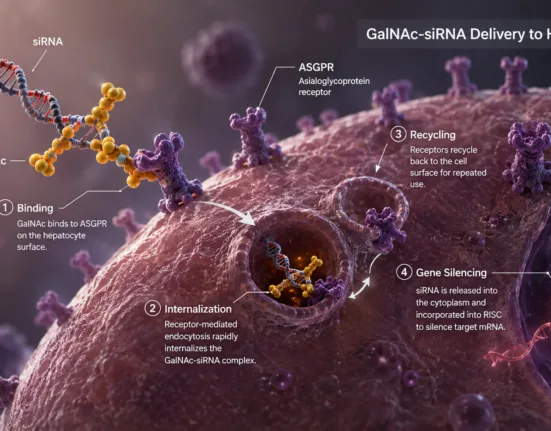
The GSK and SiranBio pact also highlights a broader shift in RNA therapeutics. For years, the commercial success of RNA interference medicines has been strongest in liver-directed targets, where delivery has been comparatively tractable. SA030 is more ambitious because its value proposition rests on adipocyte-directed delivery and extrahepatic activity. If successful, that would strengthen confidence in oligonucleotide platforms moving beyond traditional liver-centric use cases into metabolic, inflammatory, and tissue-specific disease biology.
For GSK, this is consistent with a wider effort to build an oligonucleotide pipeline across siRNA and antisense technologies. The pharmaceutical group already has exposure to RNA-based programs in areas such as hepatitis B, fatty liver disease, respiratory disease, and kidney-related inflammation. SA030 adds another node to that strategy, and it does so in a field where long-acting, low-frequency dosing could become commercially attractive if the clinical effect is durable.
The limitation is that extrahepatic delivery remains one of the most important technical risks in the field. A long-acting therapy can be an advantage when it works safely, but it can become a liability if tolerability issues emerge or if dose reversal is difficult. Regulators will likely pay close attention to off-target effects, immune activation, injection-site reactions, metabolic consequences, reproductive safety questions, and organ-specific signals. For a therapy aimed at chronic cardiometabolic risk, the safety bar will be high because patients may need prolonged treatment and may already be receiving multiple background therapies.
Why the deal structure reflects early promise but not yet late-stage confidence
The economics of the SiranBio deal appear designed to balance early conviction with development caution. A large milestone package signals that GSK sees meaningful optionality in SA030, while the early-stage status keeps the bulk of the value contingent on future progress. SiranBio will continue Phase 1 development before GSK assumes responsibility for later development, regulatory filings, and commercialization outside the excluded Greater China territories.
That sequencing is important. It allows GSK to secure global rights before the ALK7 and visceral fat field becomes more crowded, while still letting the first human safety and pharmacokinetic package mature before committing fully to larger and more expensive studies. For SiranBio, the transaction validates the platform, provides capital and external credibility, and preserves regional economics in mainland China, Hong Kong, Macau, and Taiwan.
The risk is that early partnering can sometimes amplify expectations before the data are ready to support them. SA030 is still a Phase 1 asset. Its current value is rooted in mechanism, delivery technology, preclinical promise, and strategic fit rather than demonstrated clinical outcomes. If the first human data show only modest biomarker movement, unclear tissue engagement, or tolerability concerns, the deal could quickly look more like an option on an intriguing mechanism than a direct route to a differentiated cardiometabolic product.
What clinicians, regulators, and payers will watch as SA030 enters the evidence-building phase
Clinicians tracking metabolic disease will likely watch whether SA030 can show a body-composition effect that matters clinically. The key issue is not only whether visceral fat declines, but whether that reduction links to insulin sensitivity, lipid profile, inflammatory markers, liver fat, kidney markers, functional outcomes, or broader cardiometabolic risk. A clean reduction in visceral adipose tissue would be scientifically interesting. A reduction that changes disease trajectory would be commercially powerful.
Regulators will focus on whether the development program can define a clear indication. Metabolic and vascular risk across liver, lung, and kidney disease is a broad ambition, but regulatory approvals require specific populations, endpoints, and benefit-risk frameworks. GSK may eventually need to choose whether SA030 is best developed as an obesity-adjacent body-composition therapy, a metabolic-risk modifier in chronic inflammatory disease, a combination partner for GLP-1 or SGLT2 therapy, or a targeted treatment for a narrower high-risk population.
Payers will ask an even sharper question. If incretin therapies continue to expand into cardiovascular, kidney, and liver-related outcomes, any new entrant must prove why it deserves reimbursement on top of, or instead of, existing standards of care. SA030’s most credible future may lie in patients with residual visceral fat-driven risk after standard therapy, or in groups where preserving lean mass and reducing abdominal fat create a differentiated clinical and economic argument. Without that payer logic, even a technically successful siRNA could face adoption friction.
What GSK’s stock reaction suggests about investor sentiment toward early RNA deals
GSK’s U.S.-listed shares showed little immediate movement around the latest trading session, suggesting that investors are treating the SiranBio agreement as a strategic pipeline option rather than a near-term valuation reset. That reaction is understandable. A Phase 1 oligonucleotide asset, even one with a large headline deal value, is unlikely to change near-term revenue expectations for a company with a market capitalization above $200 billion.
The more meaningful investor read-through is longer term. GSK is building a pattern of selective RNA and oligonucleotide dealmaking, including assets that target inflammation, fibrosis, kidney disease, respiratory disease, liver disease, and metabolic risk. That strategy may not deliver instant market excitement, but it could strengthen the group’s pipeline if several programs begin to show human proof-of-mechanism. In pharma, the market rarely pays heavily for early optionality until the data stop looking theoretical.
The caution is equally clear. Oligonucleotide enthusiasm has risen before, only to be tested by delivery constraints, safety questions, manufacturing complexity, and endpoint uncertainty. For GSK, SA030 becomes strategically important if it can help establish a broader platform logic in cardiometabolic and inflammatory disease. If it remains a single intriguing fat-biology asset without strong human differentiation, the market may view the agreement as disciplined but not transformative.
Why SA030 could become a test case for the future of visceral fat therapeutics
The SiranBio transaction lands at a moment when metabolic drug development is becoming more nuanced. The first wave of the modern obesity market rewarded visible weight loss. The next wave may reward therapies that explain why weight loss matters, which tissues are being changed, which risks are being reduced, and how patients can sustain benefit without trading one physiological problem for another.
SA030 could become a useful test case for that future. If GSK can show that ALK7 silencing reduces visceral adipose tissue, preserves lean mass, and improves risk markers in defined patient populations, the therapy could occupy a differentiated position alongside GLP-1 agonists, SGLT2 inhibitors, and future metabolic combination regimens. That would make the SiranBio deal more than a licensing transaction. It would make it a signal that visceral fat biology is becoming a serious pharmaceutical target.
For now, however, the story remains promising but early. The asset has strategic logic, a credible scientific rationale, and a partner with global development capacity. It also carries the familiar risks of early-stage metabolic drug development, including uncertain translation, unclear clinical endpoints, tough payer scrutiny, and the technical challenge of extrahepatic oligonucleotide delivery. GSK has bought a front-row seat in an emerging field. The next question is whether SA030 can turn a clever metabolic hypothesis into human data strong enough to matter.