Johnson & Johnson has secured United States Food and Drug Administration De Novo authorization for the OTTAVA robotic surgical system, formally clearing the healthcare group to enter a United States soft-tissue robotic surgery market dominated for decades by Intuitive Surgical’s da Vinci platform.
The authorization covers multiple general surgery procedures involving the upper abdomen, including Roux-en-Y gastric bypass, gastrectomy, cholecystectomy, splenectomy, sleeve gastrectomy, small-bowel resection, appendectomy, lysis of adhesions, fundoplication and hiatal hernia repair. Johnson & Johnson plans to begin a controlled commercial launch with selected United States hospitals while pursuing additional indications and regulatory authorizations in other markets.
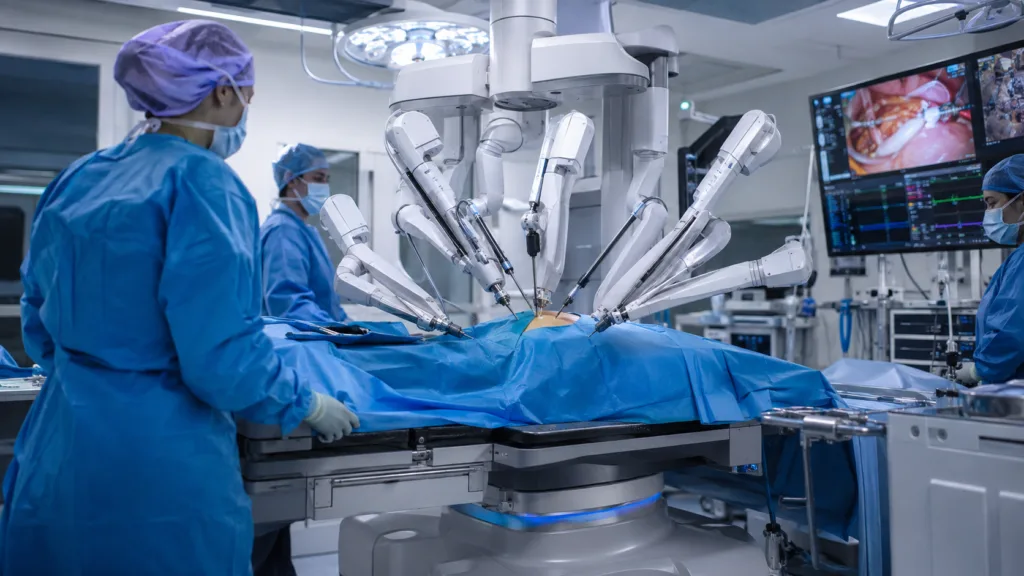
OTTAVA differs from established multiport robotic systems because its four robotic arms are integrated into the operating table rather than mounted on separate bedside carts or an overhead boom. Johnson & Johnson claims that this architecture gives the first-generation system a footprint approximately 30% to 50% smaller than traditional configurations, potentially allowing hospitals to introduce robotic surgery into operating rooms previously considered too constrained.
The regulatory milestone is commercially important, but it does not immediately place OTTAVA on equal terms with da Vinci. Intuitive Surgical has spent more than two decades building an installed system base, surgeon-training network, instrument portfolio, service infrastructure and clinical evidence across multiple specialties. OTTAVA must now prove that its physical design produces measurable workflow and economic benefits rather than merely giving hospitals another expensive capital-equipment option.
What procedures did the FDA authorize for the OTTAVA robotic surgical system?
The Food and Drug Administration granted De Novo authorization to the OTTAVA system on July 21, 2026, under an application submitted by Auris Health, part of Johnson & Johnson MedTech. Johnson & Johnson publicly announced the decision on July 22.
The authorized procedures are concentrated in general surgery within the upper abdomen. These include bariatric operations such as Roux-en-Y gastric bypass and sleeve gastrectomy, alongside gallbladder removal, appendectomy, stomach removal, spleen removal, small-bowel resection, adhesion removal, fundoplication and hiatal hernia repair.
That initial indication gives Johnson & Johnson access to a meaningful but still limited portion of the robotic surgery market. The authorization does not automatically cover prostatectomy, hysterectomy, thoracic surgery or other procedures that have contributed to the expansion of established robotic platforms.
Johnson & Johnson is conducting a separate United States clinical trial involving inguinal hernia procedures. Positive evidence from that study could support another regulatory submission and broaden the number of general surgeons able to use OTTAVA routinely. The company is also expected to pursue additional specialties and international markets over time.
The initial launch will involve selected customers rather than immediate nationwide placement. This controlled strategy should allow Johnson & Johnson to supervise training, observe hospital workflows, collect early commercial experience and address technical problems before attempting a larger rollout.
What does FDA De Novo authorization mean for Johnson & Johnson’s OTTAVA robot?
The De Novo pathway applies to certain novel medical devices for which no legally marketed predicate device adequately supports a conventional 510(k) submission. It allows the Food and Drug Administration to classify an eligible device as Class I or Class II when general controls, or general and special controls, can provide reasonable assurance of safety and effectiveness.
OTTAVA’s authorization should therefore be described as De Novo marketing authorization rather than conventional 510(k) clearance or premarket approval. The decision creates a new regulatory classification that could potentially be used as a predicate for future devices with sufficiently similar characteristics.
The De Novo decision also indicates that the regulator accepted the submitted clinical, engineering, usability and preclinical evidence for OTTAVA’s defined intended uses. It does not establish that robotic surgery is superior to conventional laparoscopy or open surgery for every authorized procedure.
The Food and Drug Administration describes robotically assisted surgical systems as computer-assisted technologies through which surgeons control instruments inserted through minimally invasive incisions. The agency continues to emphasise that appropriate patient selection, surgeon experience, training and post-market monitoring remain essential to safe use.
A robot does not independently perform the operation. The surgeon remains responsible for controlling the instruments and making clinical decisions, while the system translates the surgeon’s movements into actions inside the patient.
How does the table-integrated OTTAVA architecture differ from competing surgical robots?
OTTAVA incorporates four robotic arms into a standard-sized surgical table. This eliminates the need to position multiple independent arm carts around the patient or suspend the arms from a separate overhead structure.
Johnson & Johnson says predefined procedural poses can automate portions of system setup and breakdown. Its Twin Motion function synchronizes movement of the operating table and robotic arms, allowing the surgical team to reposition the patient and access different anatomical quadrants with fewer manual adjustments.
Patient repositioning has historically required careful coordination during robotic procedures because moving the operating table after instruments have been docked can create collision or tissue-injury risks. An integrated system capable of moving the patient and arms together could potentially reduce interruptions during complex operations involving several parts of the abdomen.
The smaller footprint may also improve access around the operating table for anaesthetists, nurses and assistants. Robotic systems can occupy substantial floor space, creating congestion and limiting the rooms in which hospitals can install them.
Johnson & Johnson reported that OTTAVA was used successfully in operating rooms ranging from approximately 243 to 694 square feet during its pivotal clinical study. Five of the six participating hospitals performed the procedures in rooms that had not previously been used for robotic surgery, including locations considered difficult because of space limitations.
These findings support the system’s spatial argument, but they do not yet prove that OTTAVA reduces total procedure time, increases the number of daily operations or lowers hospital costs. Those outcomes will require comparative evidence from routine clinical use.
What did the 30-patient FORTE clinical study show about OTTAVA’s performance?
The pivotal FORTE study was a prospective, multicentre, single-arm and open-label investigation involving 30 patients undergoing Roux-en-Y gastric bypass surgery at six United States hospitals.
Investigators completed every procedure robotically using OTTAVA, without converting any operation to a non-robotic approach. The study met its prespecified safety and performance endpoints through 30 days after surgery, while patients had lost an average of approximately 30 pounds by the 30-day assessment.
Roux-en-Y gastric bypass provided a demanding initial test because the operation requires restrictive and reconstructive steps, suturing, tissue dissection and access across multiple abdominal regions. Successful completion offered evidence that OTTAVA’s integrated-arm architecture could support a technically complex procedure.
The study was sufficient when combined with preclinical testing to support the De Novo application, but it has important limitations. Only 30 patients were treated, there was no control group and the central follow-up period lasted 30 days.
The research therefore cannot demonstrate that OTTAVA produces fewer complications, shorter hospital stays or better long-term weight loss than established robotic systems, conventional laparoscopic surgery or open surgery. It primarily establishes that trained investigators could use the system to complete the specified operations with an acceptable short-term safety and performance profile.
The patient population was also limited to Roux-en-Y gastric bypass despite the broader list of procedures included in the authorization. Preclinical, engineering and procedural-equivalence evidence helped support those additional uses, but post-market experience will be important for understanding performance across the full authorized range.
Can OTTAVA’s smaller footprint solve operating-room capacity problems for hospitals?
Operating-room space is only one component of robotic surgery capacity, but it can be an important barrier. Hospitals may have suitable surgical demand while lacking rooms large enough to accommodate an established robotic configuration without extensive renovation.
A table-integrated system could allow administrators to use existing rooms more efficiently and avoid some construction costs. It may also simplify transfers between conventional laparoscopic and robotic workflows if the table remains useful across different surgical approaches.
The commercial value will depend on the complete installation requirements. Hospitals will evaluate electrical infrastructure, room layout, sterilization, storage, instrument processing, service access, imaging compatibility and the space needed for the surgeon console and supporting equipment.
OTTAVA’s physical footprint should not be confused with its complete operational footprint. Even when the robotic arms occupy less space around the patient, hospitals still need somewhere to store instruments, accessories and replacement components.
Johnson & Johnson will also need to demonstrate whether automated poses and synchronized table movement shorten setup, docking and turnover times. A system that saves floor space but requires lengthy preparation may deliver limited improvement in daily operating-room throughput.
The earliest customers will probably be asked to generate workflow data addressing these questions. Evidence showing faster room turnover or the ability to perform additional cases could make OTTAVA’s economic argument more persuasive than the physical dimensions alone.
How strong is the OTTAVA challenge to Intuitive Surgical’s da Vinci system?
OTTAVA gives Johnson & Johnson a credible entry into robotic surgery, but Intuitive Surgical’s competitive advantage extends far beyond the design of the da Vinci machine.
Hospitals that already use da Vinci have trained surgeons, nurses and technicians around its operating model. They hold inventories of compatible instruments, maintain service agreements and may have invested in multiple generations of systems. Surgeons trained during residency and fellowship may also be reluctant to switch platforms without a clear clinical or operational benefit.
Intuitive Surgical continues to report strong procedure growth and a large global installed base. Its 2026 outlook anticipated worldwide da Vinci procedure growth of approximately 13.5% to 15.5%, even as investors assessed the potential impact of new competitors.
Johnson & Johnson brings different strengths. Its Ethicon business already supplies surgical staplers, energy devices, sutures, wound-closure products and other instruments to hospitals worldwide. The company can potentially integrate OTTAVA into existing surgical purchasing relationships and design robotic instruments around categories where it already has deep clinical experience.
The company’s two-in-one needle driver is intended to reduce accidental suture cutting, while its monopolar curved scissors were designed to produce more consistent cuts. OTTAVA also connects with the Polyphonic digital platform, which is intended to combine training, surgical media and procedure data.
The competitive battle may therefore involve entire surgical ecosystems rather than robots alone. Hospitals will compare capital costs, service contracts, disposable instruments, training, procedure coverage, reliability, clinical support and access to surgical data.
Could Medtronic’s Hugo and OTTAVA turn robotic surgery into a three-company market?
Medtronic’s Hugo system has already introduced another large medical-device company into United States robotic surgery, meaning OTTAVA is not challenging Intuitive Surgical in isolation.
A market containing da Vinci, Hugo and OTTAVA could give hospitals greater negotiating leverage and encourage more flexible pricing, service models and purchasing agreements. Competition may also accelerate innovation in system size, imaging, digital analytics, training and instrument design.
However, multiple authorized products do not guarantee equal adoption. Surgical robotics has strong network effects because surgeon familiarity and institutional experience accumulate around the most commonly used system.
Hospitals may prefer to standardize on one platform to simplify training and instrument inventory. Others may operate several systems to match different procedures, surgeon preferences and capacity needs.
Johnson & Johnson’s initial general-surgery authorization may appeal particularly to hospitals focused on bariatric and upper-abdominal procedures. Broader adoption may require additional indications in fields such as urology and gynaecology, where robotic surgery is already well established.
Industry estimates cited when OTTAVA was authorized suggested that robotic systems were used in only around 8% of surgical procedures globally. If that figure is directionally accurate, Johnson & Johnson may not need to win existing da Vinci customers immediately. It could instead pursue hospitals, operating rooms and surgical categories where robotic penetration remains limited.
What clinical evidence will hospitals require before adopting the OTTAVA system?
Regulatory authorization permits commercial use, but hospital technology committees will conduct their own assessments before purchasing and deploying the system.
They will want data covering complication rates, conversion to open or laparoscopic surgery, blood loss, operating time, length of hospital stay, readmission, instrument failures and the frequency of technical interruptions.
Hospitals will also examine the learning curve. A system may perform well in the hands of investigators who worked closely with the manufacturer while producing different results among surgeons and clinical teams encountering it for the first time.
Johnson & Johnson’s controlled launch provides an opportunity to study the number of cases required for proficiency and determine whether experienced robotic surgeons learn OTTAVA more quickly than surgeons without prior robotic experience.
Training will be a regulatory and clinical priority. The Food and Drug Administration has emphasised that manufacturers of robotically assisted surgical systems should operate adequate training programmes for new and experienced users.
The most persuasive evidence would come from comparative studies showing whether OTTAVA improves workflow or patient outcomes relative to other robotic and minimally invasive approaches. The FORTE study established feasibility, but it was not designed to prove commercial superiority.
What are the principal commercial and execution risks facing Johnson & Johnson?
The first risk is a slow launch. Hospitals have lengthy capital-budget and procurement cycles, particularly for equipment requiring substantial upfront spending and multiyear service commitments.
The second risk is reliability. Robotic systems must operate consistently because technical interruptions can delay surgery, disrupt operating-room schedules and damage surgeon confidence. Early malfunctions could significantly affect adoption even when they do not cause patient harm.
The third risk is instrument breadth. Surgeons need a complete range of graspers, scissors, energy devices, staplers and suturing tools appropriate for different operations. A system with attractive architecture but an incomplete instrument portfolio may struggle to support complex cases.
The fourth risk is limited indications. OTTAVA’s current authorization creates a meaningful entry point, but many hospitals may wait until the system supports additional high-volume procedures before committing capital and training resources.
The fifth risk is economics. Johnson & Johnson has not publicly disclosed OTTAVA’s acquisition price, instrument costs, service fees or expected procedure-level economics. Hospitals will compare those figures with existing contracts and expected utilisation.
The final risk is competitive response. Intuitive Surgical can continue developing its systems, instruments, digital capabilities and commercial terms while Johnson & Johnson scales its launch. The market leader does not need to remain technologically static while OTTAVA gains experience.
Expert view: OTTAVA creates credible competition, but the real contest begins after authorization
OTTAVA’s De Novo authorization represents one of Johnson & Johnson MedTech’s most consequential product milestones. The company has converted a delayed surgical-robotics programme into an authorized system with a distinctive architecture and a commercially relevant initial procedure range.
The integrated-table design addresses a genuine operational concern. Space limitations can restrict robotic surgery, and the FORTE trial showed that OTTAVA could function in rooms that had not previously accommodated robotic procedures.
The evidence does not yet establish that the system produces better patient outcomes or superior operating-room economics. A 30-patient, single-arm study with 30-day follow-up is an appropriate regulatory starting point, not the final clinical verdict.
Johnson & Johnson’s greatest advantage may be its existing position inside surgery departments. The company already understands surgical instruments, hospital purchasing and clinical education. It can potentially connect OTTAVA with products and relationships built over decades.
Intuitive Surgical’s advantage is equally formidable. Da Vinci is not merely a machine; it is an established clinical, educational and commercial ecosystem reinforced by thousands of trained surgeons and years of procedure data.
OTTAVA does not need to displace da Vinci immediately to succeed. Its near-term opportunity lies in proving that table integration expands operating-room access, simplifies workflows and allows hospitals to conduct more robotic procedures without compromising safety.
The Food and Drug Administration decision has opened the operating-room door. Whether surgeons and hospitals invite OTTAVA inside at scale will depend on evidence generated during the selective launch, the speed of indication expansion and the economic case Johnson & Johnson can build around each procedure.