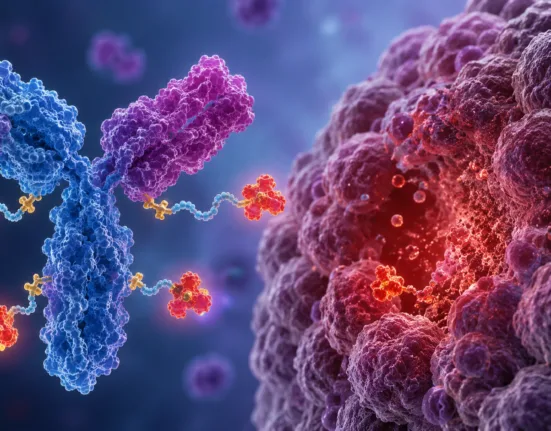
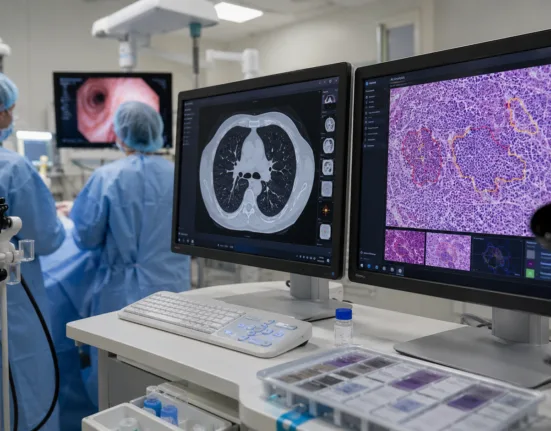
LabGenius Therapeutics and LG Chem have entered a multi-year research collaboration, option and licence agreement to develop an unnamed artificial intelligence and machine learning-designed, tumour-targeting multispecific antibody for difficult-to-treat solid cancers. LabGenius Therapeutics will use its EVA platform to engineer the candidate and conduct early preclinical research, while LG Chem will fund the programme, undertake later preclinical development and hold an option to license the asset. The economics include an undisclosed upfront payment, potential early milestones, possible triple-digit-million clinical, regulatory and commercial milestones following option exercise, and royalties on net sales.
Why tumour-selective multispecific antibodies could address a central solid-tumour limitation
The scientific importance of the programme lies less in the use of artificial intelligence itself and more in the biological problem the partners are attempting to solve. Many tumour-associated antigens are not exclusive to cancer cells. They may be expressed at high levels on malignant tissue but remain present at lower levels in healthy organs, creating the possibility that a potent antibody will attack both the tumour and normal tissue.
This on-target, off-tumour toxicity can sharply restrict dosing. A therapy may demonstrate strong cell-killing activity in laboratory models yet fail to achieve sufficient drug exposure in patients because normal-tissue toxicity emerges before an effective dose is reached. The development challenge is therefore not simply to create a molecule that binds tightly to a tumour antigen. It is to engineer a molecule that responds differently to high antigen density on cancer cells and lower antigen density on healthy cells.
Multispecific antibody formats offer several ways to create that distinction. Developers can adjust binding affinity, valency, molecular geometry and the number or arrangement of antigen-binding domains. A molecule may be engineered to bind weakly through one interaction but strongly when several binding events occur simultaneously on an antigen-rich tumour cell. This avidity-dependent behaviour can potentially establish a functional threshold below which healthy cells are spared.
The attraction is considerable because such a design could widen the therapeutic window without requiring the discovery of a completely tumour-exclusive antigen. That would expand the number of biologically relevant targets available for antibody development. However, antigen-density differences observed in controlled cell systems may not remain consistent across patients, tumour regions, disease stages or previously treated cancers. A successful laboratory threshold can become clinically unreliable when confronted with heterogeneous human tissue.

The identity of the antigen has not been disclosed, leaving several commercially important questions unanswered. Its normal-tissue distribution, internalisation behaviour, prevalence across cancer types and stability under treatment pressure will determine whether the programme addresses a broad opportunity or a narrower biomarker-defined population. Until those details emerge, the collaboration should be viewed as a sophisticated discovery effort rather than evidence of a clinically validated tumour-selectivity mechanism.
Why the EVA platform must prove that closed-loop optimisation improves real drug properties
LabGenius Therapeutics’ EVA platform combines machine learning, robotic experimentation and synthetic biology to explore antibody designs across multiple properties simultaneously. This matters because conventional antibody optimisation often proceeds through sequential trade-offs. Improving potency can worsen selectivity, increasing molecular complexity can reduce manufacturability, and strengthening binding can produce unacceptable activity against healthy tissue.
A closed-loop platform can theoretically test large libraries, measure several characteristics and use the resulting experimental data to propose a more informative second generation of molecules. Repeating that cycle may identify combinations that would be difficult to reach through intuition-led engineering alone. The practical advantage is not that an algorithm independently invents a medicine. It is that computational models can help prioritise which experiments should be performed next.
That distinction is important for assessing the growing number of AI drug discovery partnerships. The relevant measure is not how many virtual structures can be generated. It is whether the platform produces experimentally confirmed candidates with an improved balance of potency, selectivity, stability, solubility, expression yield and manufacturability. A molecule that performs exceptionally in a functional assay but aggregates during production or displays unpredictable pharmacokinetics is not a viable therapeutic candidate.
LabGenius Therapeutics has already used EVA to generate LGTX-101, a disclosed Nectin-4 x CD3 trivalent antibody programme. The biotech firm has also presented preclinical results for a tumour-selective T-cell engager showing strong tumour growth inhibition and a mechanism based on avidity. These data offer an early demonstration that the platform can produce biologically active molecules, but they do not establish clinical validation. The transition from engineered selectivity in models to reproducible selectivity in patients remains the decisive test.
The LG Chem programme creates another opportunity to demonstrate that the platform can work across targets and partnership settings. Success would strengthen the argument that EVA is transferable rather than dependent on one favourable antigen or molecular format. Failure could still generate useful platform data, but it would underline how difficult it is to model normal-tissue safety using preclinical systems.
How the option-based collaboration redistributes scientific and financial risk
The option structure gives LG Chem access to the programme without requiring an immediate commitment to full clinical development. LabGenius Therapeutics will perform the early design and in vitro research, after which LG Chem is expected to conduct additional preclinical work, including in vivo studies, before deciding whether to license the asset.
This arrangement allows LG Chem to evaluate the candidate at a more informative stage. By the time the option decision is made, the South Korean group should have greater visibility into efficacy, tissue selectivity, pharmacokinetics, manufacturability and potential safety liabilities. It can then compare the programme with internal pipeline candidates and competing external opportunities before allocating larger development capital.
For LabGenius Therapeutics, the agreement provides upfront funding, research support and possible milestone income while preserving participation in downstream value through royalties. It also reduces the financial burden of conducting the entire clinical programme independently. This supports the biotech firm’s hybrid model, which combines partnered research with an internally controlled pipeline.
The structure does, however, leave LabGenius exposed to option risk. A technically promising candidate may not be licensed if LG Chem’s portfolio priorities change, if another programme advances more quickly or if commercial assumptions deteriorate. Triple-digit-million milestone headlines also represent contingent value distributed across years of development and commercial execution. The more meaningful near-term indicators will be completion of the research plan, generation of a development candidate and exercise of the licensing option.
The undisclosed upfront payment makes it difficult to judge the immediate financial importance of the deal. Its strategic value is clearer. A second major pharmaceutical partnership after LabGenius Therapeutics’ work with Sanofi supports external interest in the platform, while LG Chem gains a relatively capital-efficient route into advanced multispecific antibody engineering.
How the deal strengthens LG Chem’s attempt to build a broader global oncology business
LG Chem has been expanding beyond its traditional pharmaceutical, vaccine and metabolic disease activities by adding commercial and clinical-stage oncology capabilities. Its acquisition of AVEO Oncology gave the group a U.S. oncology infrastructure and the marketed renal cancer drug tivozanib, while also adding clinical development programmes such as ficlatuzumab and rilogrotug.
The group’s oncology portfolio now includes a Phase 3 programme evaluating ficlatuzumab with cetuximab in HPV-negative recurrent or metastatic head and neck squamous cell carcinoma. LG Chem is also developing LB-LR1109, an investigational LILRB1-targeting antibody being studied in a Phase 1 trial across several advanced solid tumours. These programmes give the group experience in later-stage development and U.S. regulatory execution, but its early discovery pipeline still needs sufficient breadth to sustain a long-term oncology franchise.
LG Chem has indicated that it wants to increase its global oncology pipeline from six programmes in 2025 to ten by 2030. The LabGenius Therapeutics collaboration can contribute to that objective without requiring LG Chem to build every component of a specialised AI and automated antibody engineering platform internally. It also complements the company’s history of using partnerships to access immuno-oncology technologies and externally developed candidates.
The collaboration may therefore be as much about capability acquisition as it is about one antibody. Working with LabGenius Therapeutics can expose LG Chem’s research teams to high-dimensional antibody optimisation, automated experimentation and computational candidate selection. That knowledge may influence future internal programmes even if this specific asset does not reach clinical development.
For investors, however, the agreement is unlikely to alter LG Chem’s near-term earnings profile. The group’s valuation remains much more sensitive to its petrochemicals operations, advanced materials business, financial position and broader capital-allocation decisions. An undisclosed preclinical oncology collaboration is strategically constructive but financially immaterial until it produces an option exercise, clinical candidate or more visible milestone economics.
Why approved immune engagers show both the potential and the safety challenge
The clinical progress of immune-engaging therapies in solid tumours provides evidence that redirecting T cells can produce meaningful outcomes outside blood cancers. Tebentafusp demonstrated an overall survival benefit in HLA-A*02:01-positive metastatic uveal melanoma, while tarlatamab has achieved regulatory approval for previously treated extensive-stage small cell lung cancer.
These successes validate the broader therapeutic concept, but they also illustrate its limitations. Tebentafusp depends on a specific HLA genotype, restricting the eligible patient population. Tarlatamab carries serious warnings related to cytokine release syndrome and neurological toxicity, requiring carefully structured dosing and monitoring. Potent immune activation can therefore create clinical value while simultaneously increasing treatment complexity.
The new LabGenius Therapeutics and LG Chem candidate has not been identified as a T-cell engager, and its immune-effector mechanism remains undisclosed. Nevertheless, any highly active multispecific antibody intended to distinguish malignant from normal tissue will face a similar requirement to demonstrate a predictable therapeutic window. Regulators will want evidence that the molecule does not produce clinically unacceptable activity when exposed to healthy tissues expressing the target at lower levels.
Comparison with approved products will also raise the development bar. A future candidate will need to offer more than laboratory selectivity. It may need to demonstrate easier dosing, reduced monitoring requirements, broader patient eligibility, activity in resistant disease or compatibility with checkpoint inhibitors and other standard therapies. Clinical differentiation will depend on the total treatment profile, not simply on the use of AI during discovery.
What regulators will require before an AI-designed antibody can enter human trials
The artificial intelligence component is unlikely to change the fundamental regulatory standard applied to the candidate. Regulators will assess the final molecule’s pharmacology, toxicology, manufacturing controls and clinical risk regardless of how its sequence or format was selected.
Normal-tissue cross-reactivity testing will be particularly important because the programme is designed around differential antigen expression. Developers will need to show that the proposed selectivity threshold is maintained across relevant human tissues and experimental models. Selecting an appropriate toxicology species could also be difficult if the antibody does not bind the animal version of the target with comparable affinity or if tissue-expression patterns differ materially from humans.
The preclinical package will need to examine cytokine release, immune-cell activation, dose-response relationships, pharmacokinetics, biodistribution and potential immunogenicity. Regulators may also scrutinise whether small changes in antigen density, antibody concentration or binding geometry produce abrupt increases in normal-cell activity. A narrow transition between selective and non-selective behaviour could complicate initial dose selection.
The first clinical study would probably prioritise safety, tolerability, pharmacokinetics and identification of a recommended expansion dose. Depending on the molecular mechanism, investigators may need step-up dosing, prolonged observation or inpatient monitoring during early administrations. Tumour biopsies and blood-based pharmacodynamic measures could help establish whether the intended mechanism is active at doses that remain tolerable.
Patient selection may eventually require a quantitative companion diagnostic rather than a simple positive or negative antigen test. A tumour may technically express the target yet remain below the density required for effective binding. Conversely, normal tissue with unexpectedly high expression could increase toxicity. Defining clinically meaningful expression thresholds is likely to become one of the programme’s most demanding translational tasks.
Why manufacturing and biomarker strategy could determine commercial scalability
Multispecific antibodies can be more difficult to manufacture than conventional monoclonal antibodies. Their architecture may introduce challenges involving chain pairing, aggregation, stability, expression yield and product consistency. Computational optimisation can incorporate developability characteristics at an early stage, but commercial manufacturing requires robust processes that perform consistently at scale.
LG Chem’s willingness to fund the collaboration suggests that manufacturability will be evaluated alongside biological activity rather than postponed until a lead candidate has already been selected. This can reduce the risk of advancing a potent molecule that later proves impractical to produce. Even so, moving from research-scale expression to regulated manufacturing can reveal problems not captured by early screening assays.
The commercial opportunity will also depend on how broadly the target is expressed across tumour types. A shared antigen could support basket-style clinical development across several cancers, potentially increasing the addressable population. That approach would require evidence that antigen density, biological dependence and treatment response are sufficiently consistent across those diseases.
A broad target can become a liability when healthy-tissue expression is also widespread. The central commercial question is therefore not how many tumours express the antigen, but how many patients have tumours with a safe and therapeutically useful expression differential. The biomarker-defined opportunity may be smaller than the headline prevalence initially suggests.
What industry observers should watch as the programme moves towards candidate selection
The most important next disclosure will be the target antigen. That information will allow clinicians and industry observers to assess competitive intensity, normal-tissue expression, potential indications and whether the proposed selectivity mechanism addresses a recognised development bottleneck.
Preclinical data should then show a clear separation between activity against high-antigen tumour cells and lower-antigen healthy cells. Results from multiple patient-derived models would be more informative than performance in a narrow set of engineered cell lines. In vivo tolerability, pharmacokinetics and normal-tissue findings will determine whether the candidate has a credible path towards investigational testing.
The eventual format will also matter. The number of binding domains, valency, immune-effector mechanism and half-life engineering strategy will influence potency, safety, dosing frequency and manufacturing complexity. A molecule designed for maximum activity may not be commercially attractive if it requires intensive monitoring or produces a high rate of immune-mediated adverse events.
The collaboration represents a meaningful test of whether AI-guided, experimentally validated antibody optimisation can solve a clinically important problem rather than merely accelerate candidate generation. LabGenius Therapeutics brings the discovery engine, while LG Chem contributes funding, development infrastructure and an expanding oncology organisation. The partnership has strategic logic, but its ultimate significance will depend on a much harder achievement: showing that computationally engineered tumour selectivity survives contact with heterogeneous human cancer biology.