Novanta Inc. has completed its acquisition of Riverpoint Medical from Arlington Capital Partners, giving the Nasdaq-listed medical technology supplier a substantially larger position in minimally invasive surgical consumables, implantable materials and advanced surgical fibers. Novanta announced the completion on July 27, 2026, after originally agreeing to pay $1.2 billion in cash at closing, with an additional $250 million milestone payment scheduled to become payable by January 8, 2027.
Riverpoint Medical will operate within Novanta’s Medical Solutions segment and bring a portfolio that includes suture anchors, absorbable and non-absorbable sutures, implantable materials, surgical instruments and specialist coating technologies used primarily across sports medicine, trauma and cardiovascular procedures. Management expects the acquisition to double Novanta’s recurring medical consumables revenue to approximately $300 million and increase medical end-market exposure to about 60% of total company revenue.
The strategic logic is clearer than the headline purchase price might initially suggest. Novanta is not simply buying another device manufacturer. It is attempting to move more of its portfolio toward consumable products that are repeatedly purchased as procedures are performed, reducing reliance on equipment investment cycles that can be more exposed to hospital budgets, industrial demand and capital expenditure delays.
The commercial test, however, is demanding. Novanta paid a premium valuation for a private-label medical device platform whose future contribution will depend on customer retention, integration discipline, continued design wins, regulatory execution and the company’s ability to convert shared original equipment manufacturer relationships into sustainable revenue rather than optimistic cross-selling assumptions.
What capabilities does Riverpoint Medical add to Novanta’s medical technology portfolio?
Riverpoint Medical operates as an outsourced design, development, regulatory and manufacturing partner for medical device companies. Its capabilities extend from custom fibers, sutures and textile-based components to prototyping, device assembly, packaging, sterilisation support, private labelling and regulatory services. The company also manufactures finished devices and components using facilities in Portland, Oregon, and San José, Costa Rica.
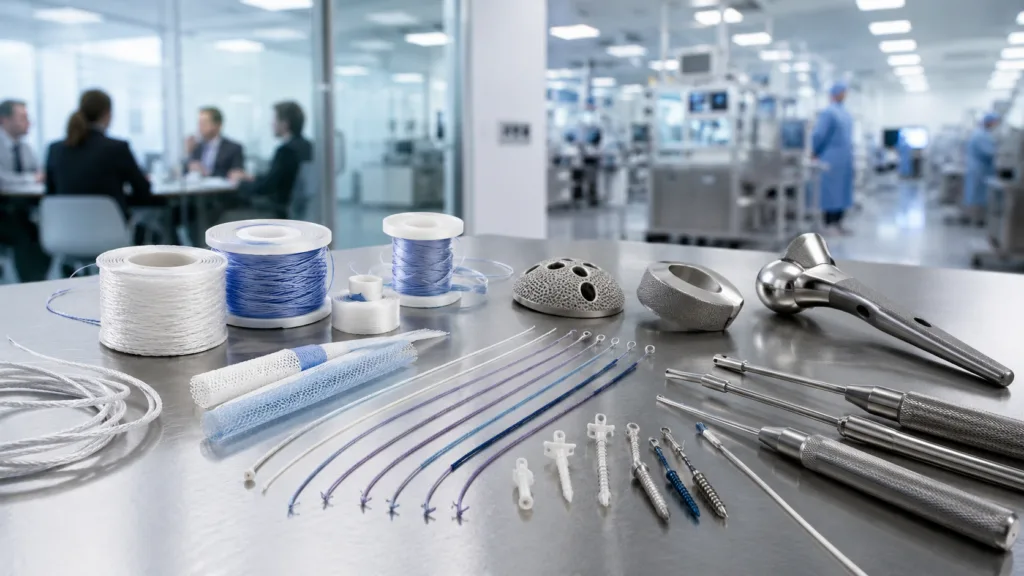
Its implantable materials portfolio includes multiple absorbable suture materials, including PGLA, PGA, PDO and PGCL, alongside non-absorbable materials such as PTFE, polyester and ultra-high-molecular-weight polyethylene. Riverpoint also offers titanium buttons, PEEK anchors and all-suture anchors, together with oncology products including gold markers, spacers and brachytherapy-related components.
Novanta’s June acquisition presentation characterised Riverpoint as a business with approximately $150 million in revenue, adjusted gross margins exceeding 50%, adjusted EBITDA margins of about 40%, more than 500 employees and over 80 owned or licensed patents. Management also projected a long-term organic growth rate of between 12% and 15%, although those figures represent company estimates and non-GAAP measures rather than independently guaranteed outcomes.
These economics help explain why Novanta was prepared to pay a substantial multiple. Riverpoint combines high-margin engineering and regulatory expertise with recurring revenue from implantable and procedure-linked consumables. Once an OEM customer has qualified a component or finished device for use within a regulated product, switching suppliers can be operationally difficult because changes may require validation, documentation, manufacturing review and, depending on the modification, additional regulatory work.
That embedded relationship can support durable revenue, but it also creates concentration risk. A supplier that is deeply integrated into a limited number of major OEM programmes can grow quickly when those programmes perform well, yet it may also be exposed to product redesigns, delayed launches, customer inventory adjustments or the loss of a significant account.
Why is recurring surgical consumables revenue central to Novanta’s acquisition strategy?
Novanta has historically supplied precision components, motion systems, photonics technologies, robotic solutions and advanced surgery equipment to medical, life-science and industrial manufacturers. Riverpoint moves the portfolio further downstream into products that are consumed during individual procedures rather than installed as durable equipment.
Before the acquisition, Novanta estimated that medical consumables represented about 15% of its sales. Management expects the combined portfolio to move that share toward 30%, while total medical end-market exposure rises from approximately 53% to 60%. Novanta also indicated that medical consumables could account for roughly one-third of total sales by 2030 if its internal forecasts are achieved.
The attraction is predictability. Demand for capital equipment can fluctuate when hospitals postpone installations or manufacturers reduce inventory. Consumables tend to follow procedure volumes, installed product usage and recurring customer orders. They are not immune to reimbursement pressure, elective procedure trends or purchasing negotiations, but they generally provide a more regular revenue stream than large equipment sales.
Riverpoint also serves many of the same medical OEMs already buying Novanta technologies. Management estimated that more than half of Riverpoint’s customer base overlaps with Novanta’s existing relationships. That creates an opportunity to offer customers a wider range of components, fluid-management products, surgical systems and implantable materials through a more integrated supplier relationship.
The overlap should not be confused with guaranteed cross-selling. Medical OEM procurement teams often qualify suppliers at a product, site and process level. Existing corporate relationships may open doors, but individual materials, manufacturing lines and finished-device programmes can still require engineering evaluation, quality audits, regulatory documentation and lengthy validation cycles.
Does the $1.2 billion valuation leave Novanta enough room for an attractive return?
The upfront purchase price represented approximately 19 times Riverpoint’s estimated 2026 adjusted EBITDA before synergies. Novanta calculated that the valuation would fall to about 17 times estimated 2026 adjusted EBITDA after including the full value of its expected fifth-year synergies. When the $250 million milestone payment is incorporated, the corresponding multiples become higher.
Novanta expects Riverpoint to generate approximately $80 million in adjusted EBITDA, including synergies, during 2027. The company has also projected more than $80 million in cumulative profit and cash-flow benefits over the first five years following the acquisition.
Those benefits are expected to come from several areas. Management identified avoided capital expenditure associated with establishing a new North American facility, faster access to qualified regional manufacturing capacity, integration of commercial and engineering teams, and cross-selling through shared OEM relationships. These are reasonable strategic opportunities, but they remain management forecasts and will need to be demonstrated through reported margins, cash flow and customer programme wins.
Novanta has said the transaction should produce a high single-digit return on invested capital by the third year and reach its internal return threshold by the fifth year. It also expects Riverpoint to contribute between $0.18 and $0.25 to adjusted diluted earnings per share in 2027, the first full calendar year after completion.
The valuation therefore places much of the burden on execution. Riverpoint must maintain its projected double-digit growth, preserve its strong margins and avoid material customer losses. Novanta must also prevent integration costs, purchase-accounting charges, interest expense or operational disruption from overwhelming the anticipated earnings contribution.
How important are Riverpoint’s regulatory and manufacturing capabilities to the deal?
Riverpoint’s value lies partly in its ability to support product development from concept through manufacturing and regulatory clearance. Novanta has highlighted Riverpoint’s experience managing the United States Food and Drug Administration 510(k) process for customers, as well as its manufacturing of private-label, intellectual property-protected devices.
This does not mean Riverpoint possesses a broad regulatory approval that automatically covers future devices. A 510(k) clearance applies to a specific device and its stated indication or intended use. New products, significant modifications and different clinical applications may still require separate regulatory analysis or submissions.
Riverpoint states that its quality system operates in accordance with United States Food and Drug Administration Quality System Regulations and the ISO 13485 quality-management standard. Its manufacturing capabilities include Class 7 cleanrooms, component manufacturing, finished-device assembly and high-volume production.
The Costa Rica facility adds another important dimension. Riverpoint invested $10 million in the site, which opened with approximately 4,000 square metres of manufacturing space and two certified cleanrooms. The facility was designed to manufacture absorbable, non-absorbable and orthopaedic fibers and had room for further expansion.
For Novanta, this established manufacturing network reduces the need to build and qualify a new facility from scratch. It also supports a regional manufacturing strategy under which production can be located closer to major medical device customers in the Americas.
The operational risks remain substantial. Medical device manufacturing integrations must preserve traceability, process controls, supplier management, complaint handling and change-control procedures. Cost reductions that appear straightforward in a financial model cannot compromise validated processes or product quality.
Will Novanta’s existing financial performance support the enlarged business?
Novanta entered the transaction from a position of underlying revenue and adjusted earnings growth. In the first quarter of 2026, the company reported revenue of $257.7 million, up 10.4% from the comparable period, while adjusted EBITDA rose 14% to $57.1 million. Adjusted diluted earnings per share increased to $0.81 from $0.74, although GAAP diluted earnings per share declined to $0.51 from $0.59.
Organic revenue growth was a more modest 3.1%, meaning acquisitions and currency movements contributed materially to reported expansion. That distinction matters because Riverpoint is intended to lift both Novanta’s reported size and its underlying organic growth profile.
The transaction was financed through a combination of cash, borrowing capacity and a completed $300 million private placement. The equity financing involved the sale of approximately 2.14 million Novanta common shares at $140 per share, providing capital for the acquisition but also increasing the share count against which future earnings will be measured.
Novanta previously projected net leverage of approximately 2.7 times after closing and said it intended to reduce that ratio below 2.3 times by the end of 2027. That target makes cash conversion and debt reduction important indicators of whether the acquisition is creating value beyond adjusted earnings accretion.
What does Novanta’s share-price performance indicate about investor sentiment?
Novanta shares closed at $140.80 on July 27, down 0.52% during the session in which the company announced completion of the Riverpoint acquisition. The stock had closed at $143.55 on July 20, producing a decline of approximately 1.9% over the five-session period.
The shares were also about 10.6% below their June 26 closing price of $157.55. Novanta’s 52-week trading range stood at $98.27 to $171.85, placing the stock well above its annual low but below the upper end reached earlier in the period.
The subdued completion-day reaction should not be interpreted as proof that investors rejected the deal. The acquisition had been announced in June, meaning much of the valuation, financing and strategic rationale had already been available to the market. The share performance is better read as cautious sentiment around the premium purchase multiple, increased financial commitments and the need for Novanta to demonstrate that Riverpoint can deliver its projected growth and margins.
The market is likely to focus less on the legal completion itself and more on measurable evidence. Investors will want to see updated 2026 guidance, Riverpoint’s initial revenue contribution, integration costs, interest expense, customer retention, consolidated margin trends and progress toward the 2027 adjusted earnings target.
What must Novanta demonstrate after completing the Riverpoint Medical acquisition?
Novanta is scheduled to release its second-quarter 2026 results after the United States market closes on August 5, followed by an earnings call on August 6. Management has said it will provide additional details on Riverpoint’s effect on the company’s 2026 financial outlook.
That update should establish the starting point for judging the acquisition. The most useful disclosures would include Riverpoint’s expected 2026 revenue contribution, acquisition-related costs, financing expense, amortisation assumptions, integration milestones and any changes to Novanta’s leverage expectations.
Longer term, the strategic thesis is credible. Riverpoint gives Novanta a larger foothold in implantable materials and minimally invasive surgical consumables, strengthens its regional manufacturing network and expands relationships with medical device OEMs already familiar with the company.
The price leaves limited space for complacency. Novanta has acquired a high-growth, high-margin asset, but it has also committed substantial capital and issued new shares to support the transaction. Riverpoint’s value will ultimately be determined not by the size of the addressable market or the promise of customer overlap, but by whether Novanta can retain programmes, win new device designs, protect quality systems and convert recurring surgical demand into durable cash flow.