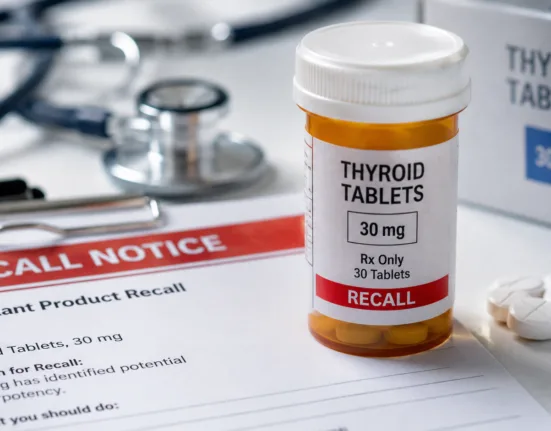
Oliva Therapeutics has announced the imminent U.S. commercial launch of Amerithroid Thyroid Tablets, USP, a porcine-derived desiccated thyroid extract containing levothyroxine, or T4, and liothyronine, or T3, for hypothyroidism and other labeled thyroid-hormone uses. The prescription product is manufactured in the United States by Jerome Stevens Pharmaceuticals and is entering the market while regulators reconsider how animal-derived thyroid medicines should be evaluated, manufactured and legally marketed.
Why Amerithroid represents a commercial expansion rather than a new therapeutic mechanism
Amerithroid does not introduce a new molecular mechanism, delivery route or clinically validated treatment strategy. Like established desiccated thyroid extract products, each 60 mg grain supplies approximately 38 micrograms of levothyroxine and 9 micrograms of liothyronine. Its therapeutic proposition is therefore familiar: provide both major thyroid hormones in a single animal-derived preparation rather than relying on levothyroxine alone and the body’s subsequent conversion of T4 into active T3.
The meaningful change is increased commercial choice within a relatively small but persistent segment of the hypothyroidism market. Amerithroid will be supplied in eight strengths ranging from 15 mg to 300 mg, potentially giving prescribers a broad titration ladder for patients already receiving desiccated thyroid extract. Domestic sourcing and manufacturing may also support Oliva Therapeutics’ attempt to compete on supply confidence, product availability and physician familiarity rather than on clinical novelty.
However, formulation familiarity should not be mistaken for demonstrated interchangeability. Amerithroid is not listed as an Orange Book product and has not undergone U.S. Food and Drug Administration therapeutic-equivalence or bioequivalence testing. The labeling therefore does not establish Amerithroid as a generic substitute for Armour Thyroid, NP Thyroid or another desiccated thyroid preparation, even when the nominal hormone content appears similar. Switching decisions may require active prescriber involvement, renewed laboratory monitoring and careful dose adjustment rather than routine pharmacy substitution.
What the launch reveals about persistent demand beyond levothyroxine monotherapy
Synthetic levothyroxine remains the dominant and guideline-preferred therapy for hypothyroidism. It is inexpensive, extensively studied, available in multiple formulations and supported by decades of clinical experience. Its longer half-life also permits relatively stable circulating T4 levels when dosing, absorption and adherence remain consistent.
That dominance has not eliminated dissatisfaction among every treated patient. A minority of people report continuing fatigue, cognitive complaints, weight concerns or reduced quality of life despite normalized thyroid-stimulating hormone levels on levothyroxine. The causes can be difficult to separate because such symptoms are nonspecific and may reflect other endocrine, cardiovascular, psychiatric, nutritional or lifestyle factors rather than inadequate thyroid replacement.
Even so, patient preference has helped sustain interest in treatments that provide T3 as well as T4. A recent meta-analysis of 11 randomized trials involving 1,135 participants found that 52% preferred either combination levothyroxine-liothyronine therapy or desiccated thyroid extract, compared with 24% who preferred levothyroxine alone. Another 24% reported no preference. That finding indicates a genuine experience gap for some patients, but it does not establish that desiccated thyroid extract produces superior long-term clinical outcomes.
Preference studies are vulnerable to expectations, treatment familiarity, crossover effects and differences in dosing schedules. Trials have also generally been too small or too short to establish whether desiccated thyroid extract meaningfully changes cardiovascular outcomes, fracture risk, cognitive decline or other long-term endpoints. Amerithroid can therefore address a recognized preference segment, but Oliva Therapeutics cannot rely on patient enthusiasm alone to resolve the broader evidence debate.
Why the FDA position creates both an opening and a major strategic risk
The most consequential issue surrounding Amerithroid is not its hormone composition. It is the product’s regulatory status. Amerithroid’s DailyMed listing states that the medicine has not been found by the U.S. Food and Drug Administration to be safe and effective and that its labeling has not been approved by the agency. It is categorized as an unapproved prescription drug rather than as an approved new drug or licensed biologic.
Animal-derived thyroid products have remained available largely because their use predates the modern drug-approval framework. That historical position is becoming less secure. The U.S. Food and Drug Administration has raised concerns about potency consistency, impurities and the presence of biologically derived components that have not been fully characterized for safety and effectiveness.
In March 2026, the regulator said it planned to issue guidance on compliance priorities by August 2026 and separate development guidance intended to support future marketing applications. The agency is currently applying a risk-based enforcement approach, meaning continued availability does not amount to formal approval or permanent regulatory acceptance.
This creates a difficult commercial equation for Oliva Therapeutics. Launching before the guidance is published may allow Amerithroid to establish prescriber relationships and distribution while the market remains open. However, the future requirements could impose substantial clinical, analytical, manufacturing and regulatory costs. A company entering the category now must be prepared for the possibility that potency controls, source-material characterization, process validation, stability testing and clinical evidence standards will become considerably more demanding.

The unresolved question is whether Oliva Therapeutics and Jerome Stevens Pharmaceuticals intend to pursue a formal marketing application. Without a credible approval strategy, Amerithroid could remain vulnerable to changing enforcement priorities. With one, the firms may face a lengthy and expensive development programme for a product competing in a mature market with widely available low-cost levothyroxine.
How Amerithroid compares clinically with levothyroxine and synthetic combination therapy
The central clinical distinction is Amerithroid’s direct delivery of both T4 and T3. Levothyroxine supplies T4, which peripheral tissues convert into T3 according to physiological demand. Desiccated thyroid extract bypasses part of that conversion process by introducing T3 directly, creating a pharmacological profile that some patients may perceive as more effective or noticeable.
That same feature creates a monitoring challenge. Liothyronine acts more rapidly and is more potent on a microgram basis than levothyroxine. Direct T3 administration can produce more pronounced fluctuations in circulating hormone levels, particularly after dosing. Excess exposure may contribute to palpitations, tachycardia, nervousness, heat intolerance or other manifestations of thyroid-hormone over-replacement.
The porcine T4-to-T3 balance also contains proportionally more T3 than normal human thyroid physiology. A tablet may meet compendial hormone-content specifications while still generating a biochemical pattern different from levothyroxine monotherapy. Studies comparing the approaches have commonly reported higher T3 and lower T4 levels with desiccated thyroid extract or T3-containing therapy, even when thyroid-stimulating hormone remains within the target range.
That does not automatically make the treatment inappropriate, but it increases the importance of patient selection and laboratory interpretation. Older adults and people with coronary artery disease, arrhythmia risk or other cardiovascular vulnerabilities may be particularly sensitive to excessive thyroid-hormone exposure. Amerithroid’s availability broadens choice, but it also shifts more responsibility onto clinicians to distinguish persistent hypothyroid symptoms from unrelated conditions and to avoid treating subjective complaints with progressively higher hormone doses.
Why manufacturing consistency will determine whether the U.S.-made positioning matters
Oliva Therapeutics is emphasizing that Amerithroid is sourced and manufactured in the United States by Jerome Stevens Pharmaceuticals. Domestic production may carry commercial value at a time when pharmaceutical supply resilience, quality oversight and dependence on overseas manufacturing remain prominent industry concerns.
Jerome Stevens Pharmaceuticals also brings established experience in thyroid medicines, including the manufacture of Unithroid levothyroxine sodium tablets. That manufacturing history may help Oliva Therapeutics build familiarity among endocrinologists, pharmacies and wholesalers. It may also support a broader narrative around specialist focus and operational continuity within thyroid care.
However, experience with an approved synthetic levothyroxine medicine cannot substitute for product-specific evidence supporting an animal-derived preparation. Desiccated thyroid extract begins with biologically variable porcine tissue and contains more components than its declared T4 and T3 content. Regulators are therefore likely to focus on source controls, viral and microbial safety, purification, hormone potency, batch consistency and impurity characterization.
The commercial value of domestic manufacturing will depend on whether Oliva Therapeutics can demonstrate reliable performance across production lots. In a narrow-therapeutic-index treatment area, even modest potency variation may alter laboratory values or symptom control. Supply reliability is important, but consistent supply of a variable product would not answer the underlying regulatory concern.
What could limit adoption across prescribers, pharmacies and health plans
Amerithroid enters a market where physician behaviour is deeply established. Most primary-care clinicians and endocrinologists begin with levothyroxine because professional guidance, regulatory approval, cost and long-term experience all support that choice. Desiccated thyroid extract is more likely to be considered for selected patients who remain dissatisfied or who strongly prefer a T3-containing approach.
Changing that prescribing pattern will require more than a sales message about natural origin or U.S. manufacturing. Oliva Therapeutics will need to explain the product’s dosing, titration, hormone content, quality controls and regulatory status clearly. Any suggestion that animal-derived therapy is inherently safer, more physiological or universally more effective than synthetic treatment could weaken credibility with clinicians already cautious about the category.
Pharmacy adoption may present a second obstacle. Because Amerithroid lacks an established therapeutic-equivalence rating, pharmacists cannot necessarily treat it as an automatic substitute for another desiccated thyroid brand. Pharmacies must also decide whether demand justifies stocking eight strengths, while wholesalers will assess expected prescription volumes and inventory turnover.
Coverage and patient cost will add another layer. Health plans may favour inexpensive generic levothyroxine and require additional justification for a branded desiccated product. Amerithroid’s commercial progress could therefore vary significantly by payer, pharmacy network and prescriber concentration. Strong interest in patient communities may generate initial inquiries, but sustainable uptake will depend on routine availability and predictable reimbursement.
How Amerithroid changes the strategic shape of Oliva Therapeutics’ thyroid portfolio
Amerithroid gives Oliva Therapeutics a more diversified thyroid-hormone portfolio. The U.S.-based healthcare firm already markets Thyquidity, an FDA-approved ready-to-use levothyroxine oral solution designed for patients who may have difficulty swallowing tablets, including some paediatric patients. Amerithroid now adds a tablet-based T4 and T3 option aimed at a different clinical and preference segment.
The portfolio logic is commercially sound. Both products target thyroid replacement, involve overlapping prescriber groups and can be promoted through a specialist endocrine sales infrastructure. Thyquidity addresses dosage-form accessibility within conventional levothyroxine therapy, while Amerithroid addresses demand for animal-derived combination hormone replacement.
The regulatory contrast between the products is equally important. Thyquidity is FDA approved, whereas Amerithroid is not. Oliva Therapeutics will need to maintain a clear distinction in promotional materials, medical communications and sales training so that the credibility of the approved product is not inadvertently used to imply approval or equivalence for Amerithroid.
The broader opportunity is to become a focused thyroid-care commercial platform rather than a single-product marketer. The risk is that Amerithroid may consume disproportionate regulatory and medical-affairs resources if the U.S. Food and Drug Administration requires a formal development programme. Portfolio expansion can create operating leverage, but it can also concentrate exposure to a single therapeutic area undergoing regulatory change.
What clinicians, regulators and industry observers are likely to watch next
The first commercial test will be whether Amerithroid becomes consistently available through major wholesalers and retail or mail-order pharmacies. Announcing a launch creates awareness, but prescription fulfilment, inventory depth and the availability of multiple strengths will determine whether clinicians can use the product without exposing patients to interruptions.
The second test will involve regulatory clarity. Guidance expected from the U.S. Food and Drug Administration could define compliance timelines, manufacturing expectations and the evidence required for approval. Any requirement for a biologics licence application or similarly demanding pathway would materially change the economics of the category.
Product-specific data will also matter. Amerithroid currently enters the market without publicly established head-to-head evidence showing clinical superiority, noninferiority, bioequivalence or improved treatment satisfaction compared with existing products. Analytical potency data, stability performance, lot-release standards and real-world safety monitoring could help Oliva Therapeutics differentiate the product more credibly than broad claims about natural origin.
Amerithroid therefore represents a calculated commercial entry rather than a therapeutic breakthrough. It gives prescribers and patients another desiccated thyroid option and gives Oliva Therapeutics a broader endocrine portfolio built around multiple formulations of thyroid replacement. Its durability, however, will depend less on initial demand than on manufacturing consistency, regulatory execution, evidence generation and the ability to earn clinician trust in a treatment category where preference and scientific consensus remain imperfectly aligned.