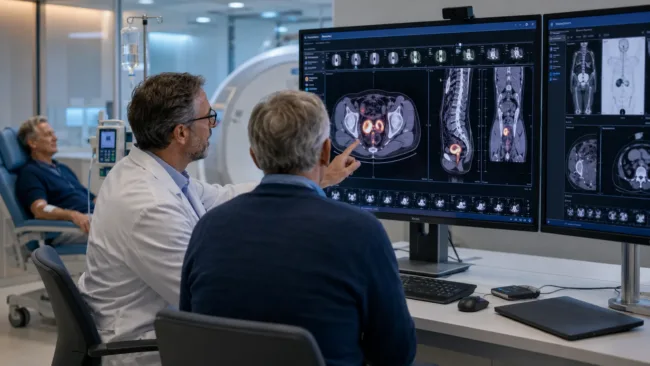
Radnostix, Inc. (OTCQB: INIS) has completed the acquisition of key Lucerno Dynamics, LLC assets, including the Lara System technology platform, Ellexa Explorer software, associated medical device hardware, regulatory assets and intellectual property. The platform monitors intravenously administered radiopharmaceuticals and can help identify extravasation, a leakage of radioactive material from a blood vessel into surrounding tissue, during diagnostic imaging and radioligand therapy procedures. The acquisition gives Radnostix an established administration-monitoring product while creating a foundation for future dosimetry, drug uptake and automated infusion applications.
The strategic significance lies in where Radnostix is moving within the nuclear medicine value chain. The Idaho-based radioisotope and medical device manufacturer already supplies sodium iodide I-131 products, radiopharmaceutical manufacturing services, isotope materials, calibration standards and equipment used by nuclear pharmacies and imaging centres. Adding the Lara System extends that presence from radiopharmaceutical production and equipment calibration into the clinical administration process, where treatment quality, workflow documentation and patient-specific monitoring are becoming increasingly important.
Why the Lucerno Dynamics assets move Radnostix deeper into the radiopharmaceutical workflow
The acquisition is not simply an expansion of Radnostix’s device catalogue. It adds a platform positioned at the point where a radiopharmaceutical is physically delivered to a patient, creating a potential connection between isotope supply, administration equipment, quality assurance and post-administration analysis. This could allow Radnostix to offer nuclear medicine centres a more integrated package than suppliers focused only on radioactive materials or calibration products.
That distinction matters as radioligand therapy expands beyond a relatively small number of specialist centres. New treatment sites require more than access to radioactive drugs. They also need shielding, calibration equipment, trained personnel, administration protocols, contamination controls, monitoring systems and reliable documentation. A supplier capable of addressing several of these requirements may gain greater influence over purchasing decisions and longer customer relationships.
The Lara System could also introduce a different commercial model into the Radnostix portfolio. Hardware placements may generate revenue from sensors, accessories, replacement components, service agreements and software support. However, the acquisition will create meaningful value only if Radnostix can maintain the existing installed base, convert clinical interest into new placements and demonstrate that administration monitoring delivers benefits that justify its cost.
How real-time extravasation monitoring could change radioligand therapy administration
The Lara System uses skin-mounted radiation sensors to monitor activity around the injection site and compare it with activity detected at a control location. The accompanying software can produce time-activity curves showing whether the radiopharmaceutical is leaving the administration site and entering systemic circulation as expected. Its Real-Time Visualization capability is intended to give clinicians feedback during administration rather than revealing a potential problem only after the procedure has been completed.
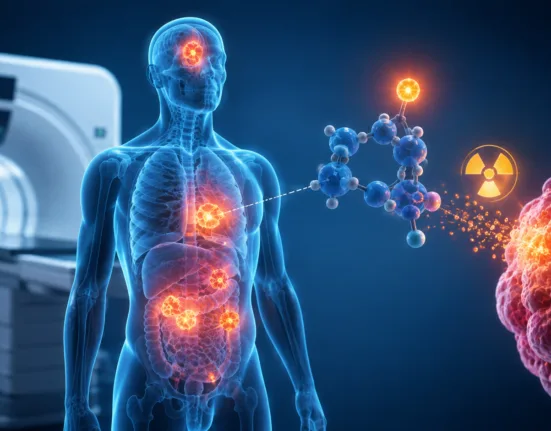
This is particularly relevant for therapeutic radiopharmaceuticals. An extravasation may leave radioactive material concentrated in local tissue while reducing the amount reaching the intended tumour target. The resulting concern is therefore two-sided. Local tissue may receive an unintended radiation dose, while the tumour may receive less activity than planned. Early recognition could allow a clinical team to stop or modify an administration and begin appropriate mitigation procedures before the full activity has been delivered.
The clinical opportunity nevertheless depends on the system’s sensitivity, specificity and usability under real-world conditions. A monitoring platform must distinguish meaningful extravasation from normal variations in venous access, patient movement, detector placement and radiopharmaceutical kinetics. Excessive alerts could disrupt treatment and reduce confidence, while missed events would weaken the safety argument. Radnostix will need to show that real-time monitoring produces consistent and clinically actionable information across different isotopes, administration techniques and patient populations.
Why the clinical evidence base still leaves important questions for hospitals and regulators
The Lara System has accumulated experience across nearly 50,000 radiopharmaceutical administrations in the United States, Europe, Australia and parts of Asia. Published research has also demonstrated that topical radiation sensors can detect and characterise radiopharmaceutical activity near an injection site, supporting the technical feasibility of prospective administration monitoring.
However, procedural experience is not the same as evidence that routine monitoring improves patient outcomes. Much of the available literature concerns detection rates, injection quality, time-activity curves or estimates of retained activity. There is less high-quality evidence demonstrating that monitoring reduces tissue injury, improves tumour response, prevents repeat imaging or produces measurable cost savings across broad clinical populations.
The risk associated with extravasation also varies considerably. Diagnostic radiopharmaceuticals are generally administered at lower radiation burdens than therapeutic agents, and many diagnostic extravasations do not result in documented clinical injury. Therapeutic radiopharmaceuticals can present a different risk because higher activities or particle-emitting isotopes may remain concentrated in tissue. A commercially successful monitoring strategy may therefore need to prioritise higher-risk therapeutic procedures rather than treating every nuclear medicine injection as an identical use case.
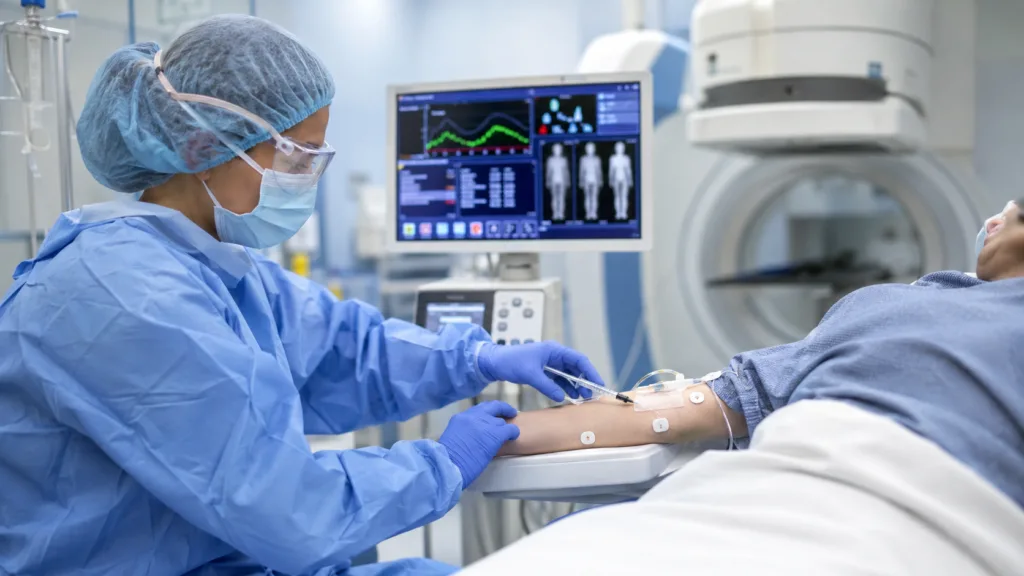
Hospitals will also need clearer protocols for responding to an alert. Detection has limited clinical value unless staff know when to stop an injection, when to reposition vascular access, how to measure retained activity, which mitigation methods to use and how long to follow the patient. Technology can expose an administration problem, but it cannot by itself resolve the uncertainty surrounding clinical thresholds and follow-up responsibilities.
What FDA listing does and does not establish for the Lara System’s commercial expansion
The Lara System is listed with the U.S. Food and Drug Administration for dynamically measuring the presence of radiopharmaceutical activity in an organ or body region during nuclear medicine uptake periods. Its stated uses include assessing whether activity remains near the administration site, evaluating biological clearance and supporting quality control and quality assurance around radiopharmaceutical administration.
FDA listing should not be confused with a broad FDA clearance or approval for every application Radnostix may pursue. Product registration and listing establish regulatory visibility, but the permissible commercial claims remain connected to the device’s intended use and classification. Applications involving treatment intervention, automated drug delivery, advanced patient-specific dosimetry or new diagnostic claims may require additional validation and regulatory engagement.
This creates an important boundary between the assets Radnostix acquired and the future products it hopes to develop. The existing system provides a commercial starting point, but integration with infusion equipment or the development of software that recommends clinical action could change the device’s risk profile. New algorithms, therapeutic applications or automated controls may require additional design verification, clinical evidence, human-factors testing and cybersecurity controls.
The regulatory challenge is therefore manageable but not trivial. Radnostix must preserve compliance for the current platform while deciding which future claims justify the cost and time of expanded regulatory submissions. Moving too slowly could allow competing administration technologies to emerge. Moving too aggressively could create regulatory delays or claims that are not sufficiently supported by clinical evidence.
How Ellexa Explorer could turn administration monitoring into a broader data platform
Ellexa Explorer may become as strategically important as the physical sensors. The software converts sensor recordings into visual information that can help clinicians evaluate administration quality and biological clearance. Over time, a sufficiently large and standardised dataset could support comparisons among treatment centres, injection methods, vascular access techniques, radiopharmaceuticals and patient groups.
This could shift the value proposition from event detection toward workflow intelligence. Nuclear medicine departments may use administration data to identify repeated problems, train technologists, compare performance and document quality-improvement initiatives. Radiopharmaceutical developers may also be interested in understanding how administration variability affects dosimetry, pharmacokinetics and treatment consistency.
The limitation is that such a platform must integrate with existing clinical systems without creating another isolated data repository. Nuclear medicine centres already manage imaging workstations, electronic health records, radiopharmacy systems, radiation safety records and treatment-planning tools. Ellexa Explorer will become more valuable if its data can be securely incorporated into those workflows, but interoperability increases development complexity.
Radnostix will also need to define ownership, retention and secondary use of administration data. Any move toward cloud analytics or cross-centre benchmarking would introduce privacy, cybersecurity and governance requirements. A software platform can create scalable revenue and valuable clinical insight, but it also carries obligations that differ substantially from manufacturing calibration sources or passive medical equipment.
Why regulatory policy could materially influence the commercial value of the acquisition
The timing of the transaction is notable because U.S. regulators and policymakers continue to debate how clinically significant radiopharmaceutical extravasations should be reported. The U.S. Nuclear Regulatory Commission has been developing a rule that could require certain extravasations involving suspected radiation injury and medical attention to be reported as medical events. Final rule language and implementation guidance remained unresolved when Radnostix completed the acquisition.
The transaction economics reveal that regulatory developments are part of the commercial thesis. Lucerno Dynamics may receive an additional stock payment tied to a regulatory milestone involving the Nuclear Medicine Clarification Act within seven years. This aligns part of the consideration with a policy outcome that could increase attention on administration quality, documentation and extravasation monitoring.
A reporting requirement would not necessarily mandate use of the Lara System. Nuclear medicine centres could respond through staff training, vascular access protocols, imaging-based checks or alternative monitoring methods. However, stronger reporting expectations could make prospective detection and documented administration quality more commercially attractive.
The policy debate also creates reputational risk. Stakeholders disagree over how frequently clinically significant extravasations occur, which events should be reportable and whether new reporting requirements would improve safety or impose unnecessary operational burdens. Radnostix will need to position the platform as a practical quality tool rather than allowing its commercial strategy to depend entirely on one legislative or regulatory outcome.
What the acquisition economics reveal about Radnostix’s execution priorities and risks
Radnostix agreed to an initial purchase price of $900,000, consisting of $150,000 in cash and $750,000 in common stock. Lucerno Dynamics may receive additional stock valued at up to $750,000 through regulatory and sales-placement milestones, as well as capped cash earn-out payments linked to future Lara System and Ellexa Explorer sales.
The structure limits the buyer’s immediate cash requirement and shifts part of the consideration toward future performance. It also indicates that the ultimate value of the assets remains uncertain. A substantial portion of the potential payment depends on regulatory progress, system placements and commercial sales rather than being guaranteed at closing.
Radnostix also raised $500,000 through a convertible promissory note carrying a 5% annual interest rate and a 2031 maturity. This gives the manufacturer additional capital, but it introduces potential dilution and future cash-interest obligations. For a relatively small public company, product development, manufacturing transfer, regulatory work and commercial expansion must be carefully prioritised.
The central execution question is whether Radnostix can transform a specialised monitoring product into a scalable platform without stretching its financial and organisational resources. The medical device manufacturer must preserve customer support, secure component supply, maintain regulatory compliance and continue software development while integrating the acquired intellectual property. A low upfront purchase price reduces acquisition risk, but it does not remove the cost of commercialisation.
What clinicians, nuclear medicine centres, and industry observers should watch next
The first indicator will be continuity. Existing users will want assurance that sensors, accessories, software support and technical service remain available during the transition. Any interruption could weaken confidence among specialist centres and make new customer acquisition more difficult.
The second indicator will be product strategy. Radnostix has identified possibilities in uptake monitoring, dosimetry, quantification and integration with automated infusion systems. The most important question is which of these opportunities receives investment first. Developing several applications simultaneously could dilute resources, while a focused programme centred on therapeutic administration monitoring may create a clearer clinical and commercial pathway.
Clinical validation will remain decisive. Hospitals will look for evidence that the platform changes treatment decisions, improves administration consistency or reduces avoidable costs. Regulators will focus on intended use, software performance and the consequences of incorrect readings. Radiopharmaceutical developers may assess whether monitoring data can support more accurate dosimetry or improve confidence in multicentre clinical trials.
The acquisition gives Radnostix an entry point into a growing but operationally demanding segment of nuclear medicine. Its value will not be determined by the number of intellectual property assets transferred at closing. It will be determined by whether Radnostix can turn administration monitoring into a dependable clinical workflow, a defensible medical device franchise and a scalable data platform for radiopharmaceutical delivery.
![Representative image: A PET/CT imaging suite illustrates how Pentixapharm’s [68Ga]Ga-PentixaFor Phase 3 PANDA study could reshape primary aldosteronism diagnostics and cardiovascular precision medicine.](https://pharmadevicenews.com/wp-content/uploads/2026/06/Pentixapharms-FDA-clearance-puts-CXCR4-PET-CT-into-a-higher-stakes-diagnostic-race-e1780989931457.webp)