Orum Therapeutics (KRX: 475830) has received US Food and Drug Administration clearance to begin clinical testing of ORM-1153, moving a new type of antibody conjugate that carries a targeted protein degrader rather than a conventional cytotoxic chemotherapy payload into patients with relapsed or refractory acute myeloid leukemia and other hematologic malignancies. The company plans to initiate a first-in-human Phase 1 study by the end of 2026, initially enrolling approximately 42 patients at US clinical sites and evaluating safety, tolerability, pharmacokinetics, pharmacodynamics and preliminary antitumor activity. The August 22 IND clearance is notable because ORM-1153 combines two drug-development fields that have largely advanced separately: antibody-directed cellular delivery and targeted protein degradation.
Orum calls the resulting architecture a degrader-antibody conjugate, or DAC. ORM-1153 uses an antibody against CD123 to identify selected hematologic cancer cells and a cleavable linker to carry SMol006, Orum’s proprietary molecular-glue payload designed to degrade the intracellular protein GSPT1. The objective is to concentrate a highly potent degradation mechanism inside CD123-expressing malignant cells while reducing the systemic exposure that can constrain small-molecule degraders administered without cell-specific targeting. The concept is scientifically attractive, but the IND clearance marks permission to test that proposition in humans rather than evidence that the preclinical therapeutic window will translate clinically.
Why is CD123 an attractive delivery address in acute myeloid leukemia?
CD123 is the alpha chain of the interleukin-3 receptor and is expressed on many AML blasts and leukemia stem-cell populations, making it an appealing surface marker for therapies attempting to discriminate malignant hematopoietic cells from normal progenitors. Orum’s development strategy does not require CD123 itself to be the principal oncogenic driver. Instead, the antibody uses the surface antigen as an address that enables internalization of the conjugate, after which the degrader payload is released and acts against the intracellular GSPT1 target. This is conceptually similar to an antibody-drug conjugate using HER2 or TROP2 as a delivery mechanism, except the molecular event after payload release is targeted protein degradation rather than direct DNA or microtubule damage.
AML is also a disease in which targeted treatment remains difficult because malignant clones can be genetically heterogeneous and can evolve under treatment pressure. Gemtuzumab ozogamicin demonstrates that an antibody-conjugate approach can work in AML, but its CD33-directed cytotoxic mechanism comes with clinically meaningful safety constraints. Orum is attempting to determine whether cell-selective delivery of a protein degrader can preserve strong antileukemic activity while producing a more manageable therapeutic index, particularly in populations with adverse molecular biology such as TP53-mutant disease. That possibility remains preclinical until ORM-1153 establishes a tolerable dose and shows tumor activity in the upcoming Phase 1 study.
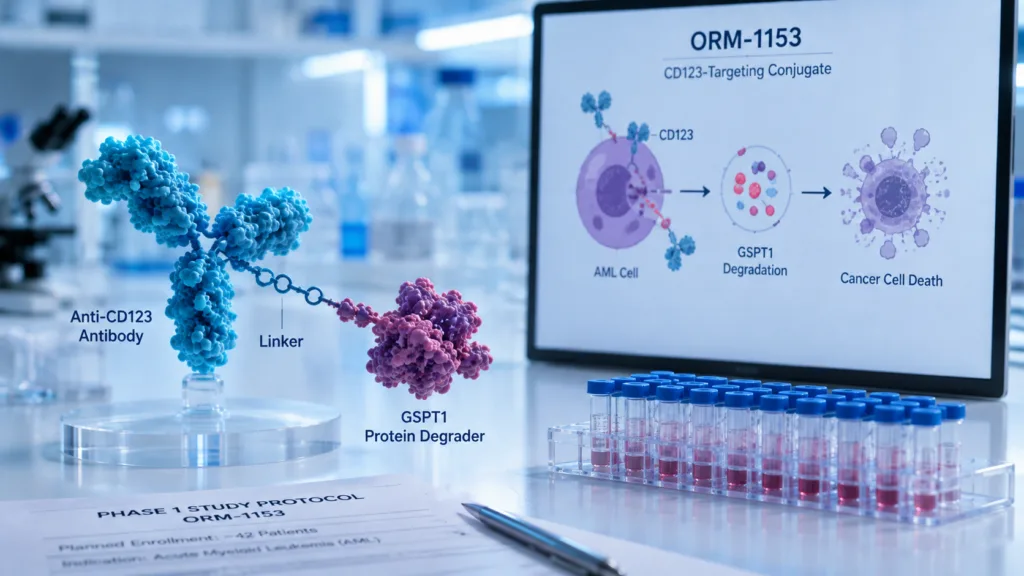
What happens after ORM-1153 enters a CD123-positive cancer cell?
The payload is designed to degrade GSPT1, also known as eRF3a, a protein involved in translation termination and cellular protein synthesis. Molecular-glue degraders can induce interactions between a target protein and an E3 ubiquitin ligase complex, resulting in ubiquitination and subsequent destruction through the proteasome. Small-molecule GSPT1 degraders have previously demonstrated antileukemic activity, but systemic exposure can narrow their therapeutic window because GSPT1 is not a cancer-exclusive protein.
ORM-1153 attempts to solve that exposure problem through antibody delivery. Orum has conjugated SMol006 to a high-affinity CD123 antibody through a beta-glucuronide-cleavable linker and engineered the antibody to reduce Fc-gamma-receptor interactions that might otherwise increase off-target engagement. The company’s AACR 2026 data described strong activity against CD123-positive AML models, including primary AML samples, while preclinical studies suggested retained activity in TP53-relevant models. Those experiments are useful for establishing biological rationale but cannot determine the human dose at which tumor degradation becomes meaningful without unacceptable effects on normal hematopoiesis.
What did Orum’s preclinical work reveal about the safety problem?
The company’s preclinical programme specifically tried to examine whether engineering the antibody and linker could widen the separation between antitumor activity and normal-tissue toxicity. Orum reported lower cytotoxicity than Mylotarg in healthy hematopoietic progenitor colony assays and said repeat-dose nonclinical studies showed normal hepatic biomarkers, although transient and reversible reductions in platelet levels occurred. The company has interpreted those results as evidence of a potentially improved therapeutic index, but platelet effects are an important reminder that targeted delivery does not completely prevent biologically active payload from affecting healthy tissues.
The first Phase 1 cohorts will therefore matter disproportionately. Investigators will need to establish whether the degradation mechanism produces cytopenias, liver abnormalities, infections or other toxicities at exposures capable of suppressing AML, while pharmacodynamic testing should indicate whether GSPT1 is actually being degraded in the intended cellular populations. Unlike an ordinary ADC where early development can sometimes focus heavily on response rate, a first-in-class DAC also needs to validate that its engineered sequence of delivery, release and degradation behaves in patients the way it did in laboratory models.
Why could degrader-antibody conjugates matter beyond ORM-1153?
The broader attraction is that conventional ADCs have historically relied on a relatively narrow collection of extremely potent cytotoxic payload classes. A degrader payload potentially allows the antibody to deliver pharmacology against an intracellular protein rather than simply carrying another form of chemotherapy. That could expand antibody conjugates into disease mechanisms that are biologically important but inaccessible to antibodies themselves because the relevant target sits inside the cell.
Orum’s earlier programmes have explored the same general concept against other surface targets, including HER2 and CD33. The platform therefore separates two questions that conventional targeted protein degradation has often been forced to solve simultaneously: which intracellular protein should be removed, and how can the degrader be exposed preferentially to the disease cell? Antibody targeting potentially provides an answer to the second question.
The clinical challenge is that combining two sophisticated drug modalities can combine their failure modes as well. Antibody expression can be heterogeneous, linker release can vary, payload metabolism can create systemic exposure, resistance to degradation can emerge and manufacturing becomes more complicated than for a straightforward small molecule. The first ORM-1153 study will consequently be less about proving that the company has another active AML drug and more about establishing whether the DAC architecture functions as a controllable human pharmacology platform.
FDA’s IND clearance moves that question into the clinic. If ORM-1153 can demonstrate target-dependent GSPT1 degradation and antileukemic activity at a tolerable exposure, Orum would have evidence that an antibody can carry a molecular degrader into selected cells and generate a clinically usable therapeutic window. If toxicity appears before meaningful activity, the same trial will expose how difficult it is to convert elegant delivery engineering into a practical medicine.