Avricore Health Inc. (TSXV: AVCR) has signed a multi-year collaboration with Abbott Laboratories through its HealthTab subsidiary to supply and distribute Abbott point-of-care diagnostic products across the United Kingdom, beginning with deployment of the Afinion 2 Analyzer in NHS-linked community pharmacies for HbA1c and lipid testing. The August 20 agreement creates a formal framework for expanding point-of-care testing through pharmacies rather than limiting chronic-disease screening and monitoring to laboratories, GP surgeries or hospitals, while financial terms were not disclosed.
The partnership is commercially interesting because HealthTab supplies more than a testing instrument. Its platform is designed to connect near-patient testing with digital result management, giving pharmacies a workflow for collecting biomarkers, presenting results to patients and potentially feeding structured information into broader care programmes. Abbott, meanwhile, brings an established point-of-care analyzer that can perform HbA1c, lipid, albumin-to-creatinine ratio and C-reactive protein testing depending on the market and assay configuration.
Why is HbA1c testing in a pharmacy different from simply offering another health check?
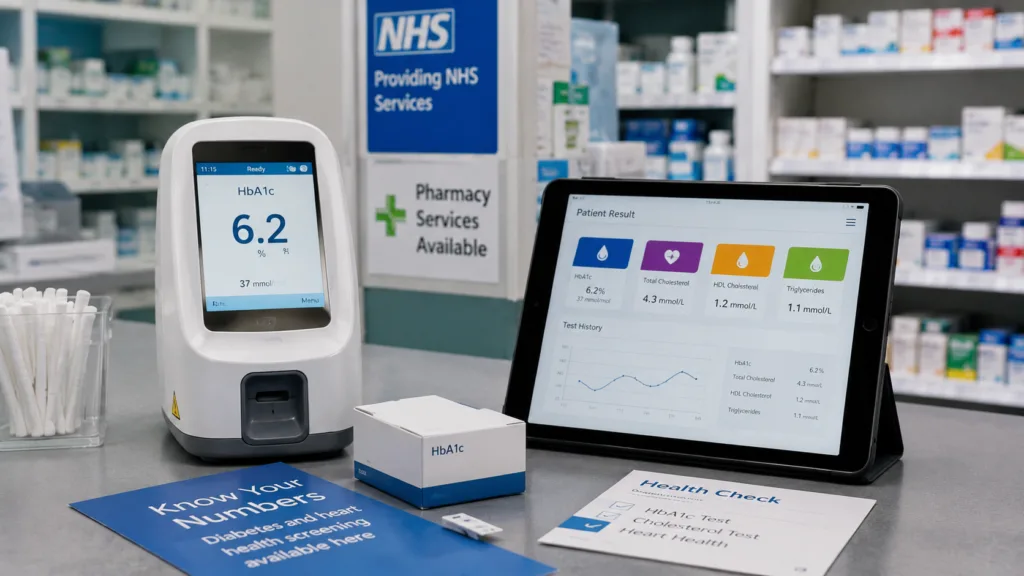
HbA1c reflects average glycemic exposure over a period of roughly two to three months and is widely used to diagnose or monitor diabetes. Moving the test into a community pharmacy can shorten the gap between identifying a person at risk and initiating a clinical conversation because patients already visit pharmacies frequently for medicines, vaccinations and other services. Abbott says the Afinion platform can produce HbA1c results in about three minutes, potentially allowing the result to be discussed during the same encounter rather than sending a specimen to a central laboratory and waiting for reporting.
That speed matters most when it changes the care pathway. A rapid result with no route for follow-up simply relocates testing; a system that identifies abnormal HbA1c, connects the result with a structured referral pathway and allows subsequent monitoring could help pharmacies become more active participants in chronic-disease management. HealthTab’s UK strategy is explicitly being developed around NHS-linked programmes rather than treating point-of-care testing as a stand-alone consumer wellness service.
The same logic applies to lipids. Abbott’s Afinion Lipid Panel quantitatively reports total cholesterol, HDL, LDL, triglycerides, non-HDL cholesterol and the cholesterol-to-HDL ratio from a small blood sample, with results available within minutes. Cardiovascular screening increasingly depends on bringing together several risk variables rather than one isolated cholesterol number, making a connected pharmacy testing model potentially useful for identifying people who need further clinical assessment or treatment optimization.
What has HealthTab already learned from its UK pharmacy pilots?
Avricore said in April 2026 that HealthTab had screened more than 3,500 patients through community pharmacies across North East and North Central London. During an initial one-month HbA1c pilot, 2,295 tests were completed across 57 locations, with the company reporting average monthly testing per pharmacy approximately 10 times higher than it had previously experienced in Canada.
Those figures help explain why the Abbott collaboration matters strategically. The challenge in point-of-care diagnostics is often less about whether the instrument can produce an accurate result and more about whether enough patients can move through the service for the economics and clinical impact to justify deployment. Thousands of screenings across dozens of pharmacies provide HealthTab with evidence that the UK pharmacy environment can generate materially higher utilization than a low-volume demonstration project.
The unanswered question is how rapidly that activity can scale beyond defined NHS-linked programmes while preserving testing quality, clinical escalation and data integration. A high-volume service requires training, quality-control procedures, consumable supply, instrument maintenance and clearly defined pathways for abnormal results. Pharmacies can become decentralized diagnostic sites only if the infrastructure surrounding the device remains as reliable as the analyzer itself.
Why does Abbott’s Afinion 2 fit a pharmacy-based model?
The analyzer is compact and designed for near-patient testing rather than a conventional high-throughput laboratory. Abbott lists four test categories on the platform: HbA1c, lipid panel, ACR and CRP, while the system can transfer information through standard healthcare connectivity protocols such as HL7 and POCT1-A. Individual test cartridges contain sample-collection and reagent components, reducing the laboratory preparation required at the point of care.
This matters because community pharmacies generally do not possess the staffing or physical workflow of hospital laboratories. Successful pharmacy diagnostics need instruments that can operate with limited sample preparation while still maintaining quality safeguards and providing results quickly enough that testing does not disrupt dispensing and consultation services.
Abbott has already positioned Afinion for physician offices, community health centers, nursing homes, mobile units and similar near-patient environments. The HealthTab partnership adds an important commercial layer by embedding the analyzer into a digital pharmacy network rather than selling devices to individual locations one by one.
Could community pharmacy testing reduce pressure elsewhere in the NHS?
Potentially, but the value depends on what happens after testing. Diabetes and cardiovascular disease generate substantial healthcare demand partly because many high-risk individuals are identified late or remain inadequately monitored. Pharmacies are geographically widespread and already interact with patients receiving medicines for blood pressure, cholesterol and glucose control, giving them access to populations that could benefit from structured screening.
A pharmacy can potentially identify elevated HbA1c during a routine visit, counsel the patient and route the result into an appropriate NHS follow-up pathway without requiring a separate GP appointment solely to obtain the initial blood test. Similarly, lipid monitoring can help identify patients whose treatment may need review.
The risk is fragmentation. If pharmacy results are not available to other clinicians, patients can end up with another isolated dataset rather than a more efficient health system. HealthTab’s emphasis on a secure connected platform is therefore important because interoperability may determine whether decentralized diagnostics reduce workload or create another place from which clinicians have to retrieve information manually.
What is commercially unresolved in the Abbott-HealthTab partnership?
No transaction value, minimum purchase volume or nationwide rollout target was disclosed. The announcement establishes a multi-year supply and distribution framework and allows HealthTab to distribute Afinion 2 in NHS-linked pharmacies, but it does not guarantee that every pharmacy chain or NHS region will adopt the service.
For Avricore, the potential upside comes from turning successful London pilots into a repeatable UK network with higher testing density and broader assay menus. For Abbott, the partnership extends an existing point-of-care franchise into a distribution channel where chronic-disease testing could become more frequent and more decentralized.
The strategic tension is therefore not whether the analyzer can measure HbA1c or lipids. Those capabilities are established. The question is whether pharmacy-based diagnostics can move from pilot programmes into routine NHS-linked care without losing the clinical governance and data continuity traditionally provided by centralized laboratory pathways.