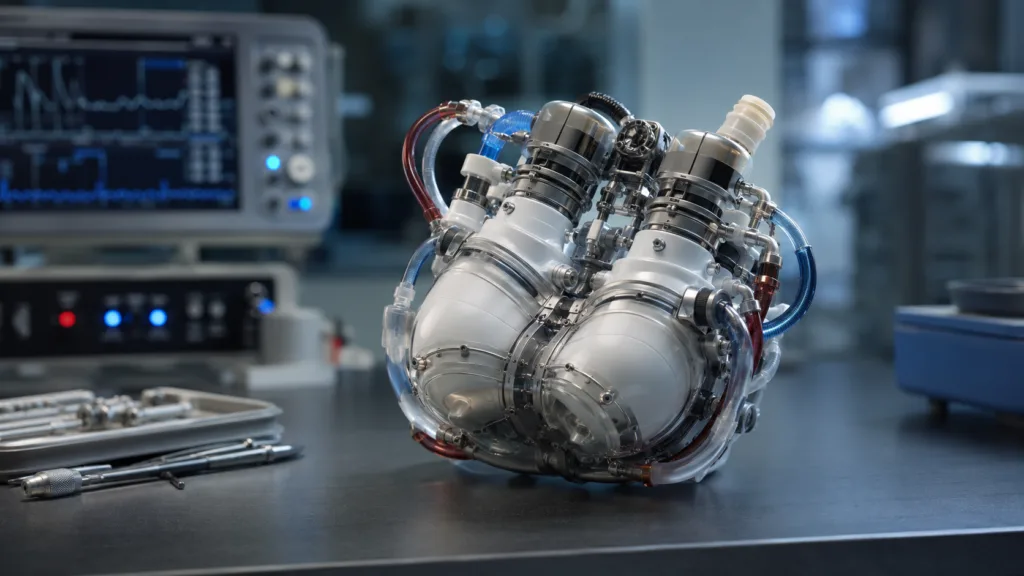
Picard Medical has publicly presented the integrated architecture of its Emperor Total Artificial Heart for the first time, revealing how a compact electromechanical drive system could eventually replace the external pneumatic equipment used to power the existing SynCardia Total Artificial Heart.
The preliminary architecture was presented at the 48th Annual International Conference of the IEEE Engineering in Medicine and Biology Society, held from July 26 to July 30 in Toronto. The system combines established SynCardia artificial ventricles with the patent-pending Emperor Drive System, an independent dual-motor platform intended to provide full pulmonary and systemic circulation.
The disclosure represents an engineering milestone, not a clinical or regulatory approval. Emperor remains in preclinical development, has not been implanted in a human and is not commercially available. Picard Medical’s latest stated roadmap calls for a possible Investigational Device Exemption submission in 2028 and the beginning of clinical study activity in 2029.
The programme could nevertheless address one of the largest limitations of the current SynCardia system. Patients depend on an external pneumatic driver connected to the implanted ventricles by tubes passing through the chest wall, creating practical limitations involving mobility, equipment burden, infection risk and long-term independence.
Picard Medical is taking a staged approach. Its initial Emperor configuration is expected to retain an external controller and battery while eliminating the external pneumatic driver. A later version is intended to incorporate internal control and wireless power transfer, potentially removing the need for permanently exposed power or air connections.
What did Picard Medical disclose about the integrated Emperor heart architecture?
The IEEE presentation described how the Emperor Drive System connects with the left and right SynCardia artificial ventricles to create an electromechanically actuated total artificial heart.
The current SynCardia system uses controlled pulses of compressed air to move flexible diaphragms inside two artificial ventricles. As each diaphragm moves, blood is drawn into the corresponding chamber and then ejected toward either the lungs or the rest of the body.
Emperor is intended to preserve this displacement-based pumping principle while changing how the diaphragms are actuated. Compact mechanical drivers would generate the movement currently produced by external pneumatic equipment.
The latest architecture uses an independent motor for each artificial ventricle. This separation is important because the right and left sides of the circulation operate under different pressures. The right ventricle pumps blood through the relatively low-pressure pulmonary circulation, while the left side must overcome substantially higher systemic resistance.
Independent control could allow the system to adjust the output of each ventricle rather than relying on a single mechanical action for both sides. This may help maintain balance between pulmonary and systemic blood flow under changing physiological conditions.
Picard Medical has not published complete technical specifications covering the size, weight, power consumption, motor life, internal temperature or control algorithms of the integrated device. The conference disclosure therefore establishes the architecture without yet showing that it is sufficiently compact, durable and energy-efficient for chronic human implantation.
Why is Picard Medical preserving the existing SynCardia ventricles and valves?
The Emperor strategy is based on separating the relatively established blood-pumping components from the less convenient external drive technology.
Picard Medical is retaining the SynCardia ventricular chambers, flexible diaphragm assemblies, chamber geometry and mechanical valve interfaces. These components have accumulated clinical experience through more than 2,100 total artificial heart implants across 27 countries.
Preserving blood-contacting components could reduce some development uncertainty. The materials, diaphragm movement, valve function and blood-flow pathways of the SynCardia ventricles are already understood more extensively than those of a completely new artificial heart design.
The existing system is available in 70 cubic centimetre and 50 cubic centimetre ventricular sizes. The larger model can generate cardiac output of up to approximately 10.5 litres per minute, while the smaller version can produce up to approximately 7.5 litres per minute under its approved pneumatic configuration.
Reusing an established ventricular platform does not mean Emperor can rely automatically on the existing regulatory approval. Changing from pneumatic pressure to electromechanical actuation could alter diaphragm stress, filling characteristics, valve timing, blood damage, heat generation and failure behaviour.
The FDA would therefore need evidence that the new drive system does not introduce harmful changes to components that previously performed safely under a different source of power. Bench testing must examine the entire integrated system rather than assuming that each familiar component will behave identically after the change.
There is also a strategic trade-off. Preserving the displacement-pump design allows Picard Medical to build on decades of experience, but it retains several flexible and mechanical components exposed to billions of repetitive cycles. Competing rotary systems are pursuing fewer moving parts as a possible route to longer durability.
What has preclinical testing shown about the Emperor Total Artificial Heart so far?
Picard Medical has reported bench testing in a Donovan mock circulation system, a laboratory arrangement designed to reproduce clinically relevant pressure, resistance and blood-flow conditions.
The company said Emperor demonstrated preload-dependent output, meaning that its pumping volume changed in response to the amount of fluid returning to the artificial ventricles. This resembles the autoregulatory behaviour of the existing SynCardia heart and is important for balancing the two sides of the circulation.
The system also reportedly maintained stable performance across clinically relevant afterload ranges. Afterload represents the resistance against which a ventricle must pump, and it can change with blood pressure, pulmonary vascular resistance, activity, medication and illness.
Earlier prototypes produced pulsatile flow exceeding a minimum target of 3.5 litres per minute and met or exceeded an average cardiac output benchmark of approximately 5.6 litres per minute. These laboratory findings suggest that electromechanical actuation can move sufficient blood under controlled test conditions.
Picard Medical subsequently completed three acute large-animal implant procedures at the University of Arizona and Banner University Medical Center. The second-generation system maintained full circulatory support during the procedures, and the company reported no device-related intraoperative failure.
The animal studies also supported anatomical compatibility and short-duration haemodynamic stability. Those findings establish that the architecture can fit within a large-animal chest and operate under real biological loading, at least for the duration of an acute experiment.
They do not demonstrate chronic durability, long-term survival or acceptable complication rates. An implant that functions for several hours during surgery has not yet shown that its motors, bearings, diaphragms, valves, control electronics and power system can operate continuously for months or years.
The number of procedures is also small. Three acute studies can identify obvious design problems, but they cannot characterize infrequent failure modes or biological complications that emerge only after prolonged exposure.
Does the Emperor design already qualify as a fully implantable artificial heart?
The latest disclosure requires careful interpretation because “fully implantable” describes Picard Medical’s long-term development objective rather than the complete functionality of the first planned clinical configuration.
The current SynCardia Total Artificial Heart requires an external pneumatic driver. Patients initially use the hospital-based Companion 2 Driver and may later transition to the portable Freedom Driver if they are clinically stable and satisfy discharge requirements.
The Freedom Driver weighs approximately 13 pounds and can be carried in a shoulder bag or backpack. Although it permits greater mobility outside the hospital, two air tubes continue to pass through the patient’s chest wall to connect the driver with the implanted ventricles.
Emperor’s electromechanical drive is designed to remove the external pneumatic machine. Picard Medical has described the new driver as smaller and self-contained, with its mechanical actuation positioned close to the ventricles.
The initial configuration is still expected to use an external controller and battery. That means patients could remain connected to power and monitoring equipment even if they no longer need to carry a pneumatic pump.
Picard Medical’s longer-term roadmap envisions wireless energy transfer and internal control. Such a system could recharge an implanted battery across intact skin and reduce or eliminate permanent transcutaneous connections.
Achieving that configuration would be a much larger engineering step than replacing compressed air with motors. The company must solve power-transfer efficiency, battery capacity, heat, electromagnetic compatibility, redundant control and emergency backup while ensuring that a failure does not abruptly stop both sides of the circulation.
Calling Emperor driverless is therefore accurate only in relation to the current external pneumatic driver. It should not be interpreted as meaning that the system requires no motor, controller, battery or external energy source.
Could removing pneumatic drivelines reduce infection and improve patient mobility?
External drivelines create a route between the body and the surrounding environment. Even with careful wound care, a permanent skin exit site can become infected and may require antibiotics, hospitalization, surgical intervention or device exchange.
Total artificial heart recipients already face substantial infection risk because they are critically ill, undergo extensive surgery and frequently experience prolonged intensive-care exposure. Removing transcutaneous pneumatic tubes could eliminate one particular route of microbial entry.
A fully closed system could also simplify bathing, dressing, sleeping and rehabilitation. Patients might move without managing air hoses and a backpack-sized driver, potentially making daily activities feel less dominated by the mechanical support system.
The benefit will depend on how much external equipment remains. If the first Emperor model uses a cable connected to an external controller and battery, it may reduce bulk without completely eliminating exit-site care or power-management demands.
Mobility also involves more than device size. A total artificial heart recipient must manage anticoagulation, rehabilitation, neurological monitoring, infection surveillance and frequent clinical follow-up. Severe illness and the consequences of major surgery can restrict independence even when the pump performs properly.
Wireless power would offer the clearest opportunity to remove the exposed connection. The system would still require an implanted battery capable of sustaining circulation if the external charging unit were disconnected or failed.
Backup duration will be clinically critical. An ordinary consumer device can shut down when its battery is exhausted. A total artificial heart cannot tolerate a similar interruption, making power redundancy and failure alarms central elements of the safety case.
Which engineering risks must Emperor overcome before chronic implantation?
Durability is the most obvious hurdle. An artificial heart operating at 100 cycles per minute would complete more than 52 million pumping cycles in one year. A durable replacement intended for several years would require components to survive hundreds of millions of repetitions without losing performance.
The dual-motor design offers independent ventricular control but also introduces two electromechanical systems that can wear, overheat or fail. Engineers must demonstrate that failure on one side can be detected immediately and managed without causing rapid pulmonary congestion or loss of systemic circulation.
Temperature control is another concern. Motors, batteries and power electronics generate heat, and implanted tissue cannot dissipate heat as effectively as an open laboratory environment. Chronic heating could damage surrounding tissue or reduce electronic reliability.
Blood compatibility remains essential even though the blood-contacting ventricular design is established. Changes in filling and ejection speed could alter shear stress, stagnant-flow regions and valve closure patterns, potentially influencing clot formation or blood-cell damage.
Sensors and control software must respond correctly as posture, activity and vascular resistance change. Standing, walking, coughing, sleeping, dehydration and infection can all alter venous return and pressure. The system must adapt without overfilling one circuit or depriving the other.
Reliability testing will also need to examine uncommon combinations of events. A low battery, sensor error, motor degradation and abnormal vascular resistance may each be manageable alone but dangerous when they occur together.
A clinically viable design will require redundant sensors, protected software, audible and remote alarms, emergency power and procedures allowing clinicians to diagnose faults without immediately replacing the implanted system.
What regulatory pathway separates Emperor’s conference presentation from human testing?
The existing SynCardia Total Artificial Heart received FDA premarket approval in 2004 for use as a bridge to transplantation in eligible patients at risk of imminent death from biventricular failure. The smaller 50 cubic centimetre model subsequently received approval through a premarket approval supplement.
Emperor is likely to require extensive premarket review because it is a life-sustaining, permanently implanted, high-risk cardiovascular device. Reuse of approved ventricular components may assist the review, but the new actuation, control and power systems create substantial new questions.
Before beginning a United States clinical study, Picard Medical must obtain an Investigational Device Exemption. The submission would normally include design controls, manufacturing information, bench durability findings, biocompatibility evidence, electrical safety testing, software validation, animal results, risk analysis and a proposed clinical protocol.
The company’s July regulatory roadmap identifies 2028 as the target for an Investigational Device Exemption submission and 2029 for initial clinical activity. An earlier corporate update referred to a possible 2028 study start, indicating that the timeline has since been refined or moved.
Picard Medical also intends to pursue FDA Breakthrough Device designation. Such a designation could provide more frequent interaction with the agency and prioritized review if the device meets the statutory criteria.
Breakthrough designation would not establish that Emperor is safe or effective. It would not authorize implantation outside an approved study and would not remove the need for sufficient clinical evidence.
The first human investigation would probably be small and highly controlled. Initial participants would likely have end-stage biventricular failure, face an immediate risk of death and have limited suitability for other mechanical support options.
How could Emperor change the purpose of SynCardia support beyond waiting for a transplant?
The current United States indication is bridge to transplantation. SynCardia is used to keep eligible patients alive until a donor heart becomes available rather than as a permanent replacement.
That indication shapes patient selection. A person who is not eligible for transplantation generally cannot receive the approved system as destination therapy, even if both ventricles are failing and no suitable donor organ is expected.
A more mobile and durable electromechanical system could support broader ambitions. Picard Medical has discussed bridge-to-candidacy and longer-duration support, in which a patient receives mechanical circulation while clinicians determine whether organ function, infection, body weight or another potentially reversible issue can improve enough to permit transplantation.
Destination therapy would require a much higher evidentiary standard. A device intended to remain for life must demonstrate dependable long-term performance, acceptable neurological and bleeding outcomes, manageable infection risk and a quality of life that justifies irreversible removal of the native ventricles.
Total artificial heart implantation is not equivalent to adding a temporary pump. Surgeons remove the failing native ventricles and connect the artificial chambers to the atria, pulmonary artery and aorta. Once implanted, the patient remains dependent on the mechanical system until transplantation or another surgical replacement.
For this reason, confidence in reliability must be exceptionally high. Device failure cannot be managed by simply switching the heart back on or allowing the native ventricles to resume circulation.
How does Emperor compare with BiVACOR and ventricular assist devices?
Emperor is entering a renewed total artificial heart development landscape. BiVACOR has already moved its investigational rotary total artificial heart into an FDA-authorized early feasibility study.
The BiVACOR system uses one magnetically levitated rotor to pump blood through both the pulmonary and systemic circulations. Its design is valveless and has fewer moving components than a displacement-based artificial heart.
Emperor follows a different philosophy. It retains two pulsatile artificial ventricles, flexible diaphragms and mechanical valve interfaces while changing the drive technology. Picard Medical is relying on an established blood-contacting architecture rather than introducing an entirely new pumping mechanism.
BiVACOR is further ahead clinically because it has been implanted in humans. Early participants were bridged to donor transplants, and an Australian recipient remained on the investigational device for more than 100 days before transplantation.
Those experiences do not establish long-term superiority or commercial approval. BiVACOR remains investigational, and comparisons with Emperor would be premature because Emperor has not entered human testing.
Left ventricular assist devices represent another alternative but usually support the left side of the heart without removing and replacing both ventricles. They are widely used for bridge-to-transplantation and destination therapy, but they may be unsuitable when severe failure affects both sides of the circulation.
Some centres have used two ventricular assist devices to provide biventricular support. This approach can be technically complex, and a paired left ventricular assist device configuration is not an FDA-approved total artificial heart.
Emperor’s eventual position will depend on whether retaining pulsatile displacement ventricles delivers clinical advantages worth the added mechanical complexity. The answer will require comparative outcomes, not engineering arguments alone.
What evidence would make the first Emperor clinical programme credible?
The preclinical programme must first demonstrate chronic survival rather than only acute haemodynamic support. Animals should remain supported long enough to evaluate motor wear, blood damage, thrombosis, tissue response, infection, organ function and control-system stability.
Bench testing must accelerate millions of cycles to estimate component life and identify how the system fails. A convincing safety case should show that predictable wear produces warnings before catastrophic loss of circulation.
The first human study must establish whether surgeons can implant the electromechanical architecture without creating unacceptable operative complexity. Device fit will matter, particularly for smaller adults and adolescents who may not have enough chest space for the ventricles, motors and internal electronics.
Early endpoints will likely include survival to transplantation, successful continued support, serious device-related adverse events and the frequency of motor, controller, battery or sensor failures. Stroke, bleeding, infection, kidney injury and neurological dysfunction will require close monitoring.
Mobility and quality-of-life measurements should be included from the beginning. Replacing a pneumatic driver has limited clinical value if the new system introduces a different external burden or does not help patients leave the hospital and participate in rehabilitation.
The programme should also report energy use, external battery requirements, charging interruptions and the consequences of component failure. These may sound like engineering details, but for a patient entirely dependent on the device, power management is part of the clinical outcome.
Can Emperor realistically become a permanent mechanical replacement for the human heart?
The IEEE presentation gives Picard Medical a defined architecture for advancing beyond the existing pneumatic system. Preserving clinically used ventricles while introducing independent electromechanical control is a credible development strategy.
It is also an incomplete one. The latest disclosed design has demonstrated laboratory performance and short-duration support in three acute animal procedures. It has not shown chronic animal survival, human implantability, long-term motor durability, reliable wireless power or acceptable multi-year complication rates.
The programme’s value will depend on whether Picard Medical can progress from a hybrid system with external power and control to a genuinely closed implant without creating new points of failure. That transition may require several device generations rather than a single regulatory submission.
The Emperor architecture could reduce equipment burden and eventually remove transcutaneous pneumatic drivelines while retaining the pulsatile circulation associated with SynCardia’s established ventricles. These would be meaningful advances for patients whose survival currently depends on a large external driver.
For now, Emperor should be viewed as a promising preclinical redesign of how a proven artificial heart is powered, not as a fully implantable human heart ready for clinical use. The decisive milestones will be chronic survival testing, an accepted Investigational Device Exemption and the first carefully monitored human implantation.
If those stages succeed, Picard Medical may convert the only commercially available total artificial heart platform in the United States into a system intended for longer and more independent support. If they fail, the familiar ventricles will not compensate for insufficient motor durability, inadequate power redundancy or unacceptable surgical complexity.
The first architecture disclosure has shown how Picard Medical intends to cut the pneumatic cord. The clinical programme must now prove that the replacement can keep pumping when a patient’s life depends on it.