
Salus Scientific Corp. has welcomed a multi-society expert consensus statement calling for the urgent adoption of enhanced radiation protection devices in fluoroscopy laboratories. Announced by the company on July 18, 2026, the development places occupational radiation safety, heavy protective apparel and the long-term health of interventional teams more firmly within the hospital technology and workforce agenda.
The consensus statement was published on July 14 and backed by six medical societies. It was led by the Society for Cardiovascular Angiography & Interventions, the American Society of Echocardiography, the Heart Rhythm Society, the Society of Interventional Radiology and the Society for Vascular Surgery, with endorsement from the American College of Cardiology.
The document is strategically relevant to Salus Scientific because its portfolio spans several of the problems the statement identifies. AeroShield is an enhanced radiation protection system designed to reduce scatter exposure through room-integrated barriers, GLiFT redistributes the weight of protective apparel, and PeRM provides real-time personal radiation monitoring.
However, the consensus is an endorsement of a broader technology category and safety strategy, not an endorsement of Salus Scientific or any specific product. The commercial opportunity will therefore depend on whether the privately held company can demonstrate that its systems meet the evidence, workflow, compatibility and economic standards hospitals will apply as the market becomes more visible.
What does the new consensus actually change for occupational radiation safety in fluoroscopy laboratories?
The statement calls for hospitals, manufacturers, regulators and professional societies to move occupational radiation protection beyond heavy wearable apparel and operator-dependent precautions. Its recommendations include adopting enhanced radiation protection devices, incorporating protection into fluoroscopy rooms and imaging equipment, strengthening real-time dosimetry, introducing standardised safety metrics and expanding training.
That represents a meaningful change in emphasis. Traditional radiation protection has relied on the ALARA principle, under which exposure should be kept as low as reasonably achievable through reduced exposure time, greater distance from the radiation source and appropriate shielding. In practice, protection for people remaining close to the patient has often depended heavily on lead or lead-equivalent aprons, thyroid collars, eyewear and manually positioned barriers.
Enhanced radiation protection devices move more of the responsibility toward engineering controls. Instead of asking every team member to maintain ideal positioning and correctly use multiple pieces of protective equipment throughout a complex procedure, these systems attempt to block scatter radiation closer to its source or create a larger protective zone around the procedural team.
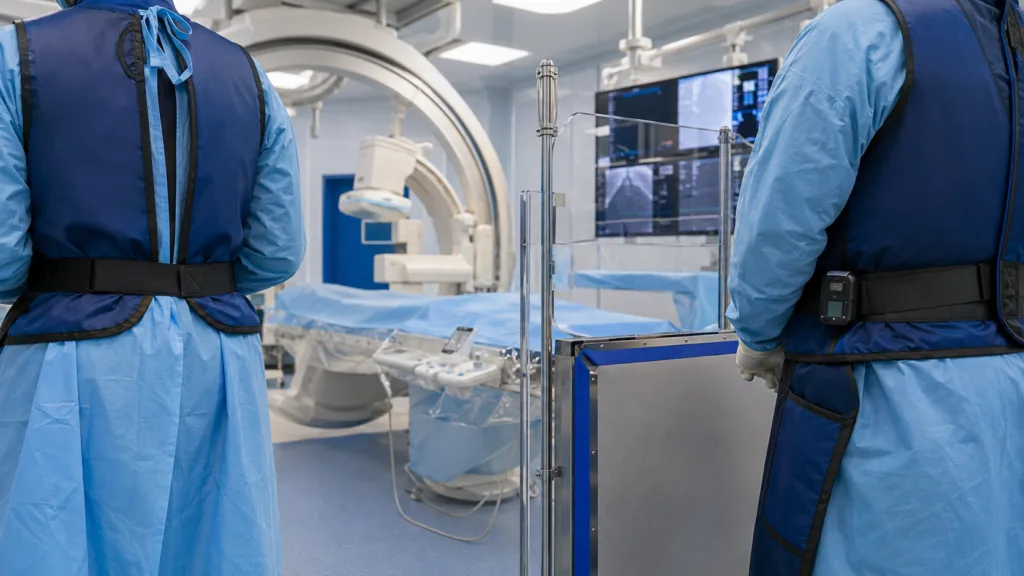
The consensus nevertheless does not independently change federal or state law, establish reimbursement or require every hospital to purchase a particular system. Its use of urgent and mandatory language expresses the authors’ clinical and ethical position. Converting that position into enforceable standards will require action by regulators, health systems, accreditation bodies, manufacturers and individual fluoroscopy laboratories.
For vendors, the immediate benefit is therefore greater institutional legitimacy rather than guaranteed sales. Hospital administrators who previously regarded enhanced shielding as an optional equipment upgrade now have a multi-society document that can be incorporated into occupational health reviews, capital requests and laboratory redesign discussions.
Why are radiation exposure and the weight of protective apparel becoming a workforce issue?
The occupational case extends beyond radiation dose alone. Fluoroscopy-guided procedures require physicians, nurses and technologists to work close to the patient while imaging equipment produces ionising radiation. Scatter from the patient becomes the principal source of occupational exposure for personnel in the room.
Protective apparel reduces exposure but introduces a second hazard. Lead and lead-equivalent garments can place sustained weight on the neck, shoulders and spine during lengthy procedures. The burden becomes particularly important for clinicians performing a high volume of coronary, electrophysiology, structural heart, vascular or interventional radiology cases over many years.
A 2023 survey of Society for Cardiovascular Angiography & Interventions members, subsequently published in 2025, found that 59.8% of respondents reported orthopedic injuries and 17% said they had limited their catheterisation laboratory time to reduce radiation exposure. Among female respondents, 28% reported being discouraged from working in the laboratory because of pregnancy or consideration of pregnancy, while 71% wanted the option to step away during pregnancy.
Those results explain why the new statement treats radiation protection as a workforce sustainability issue. Occupational injuries can affect clinician availability, career duration, recruitment and the capacity of hospitals to maintain experienced procedural teams as demand for minimally invasive interventions grows.
The evidence still requires careful interpretation. The survey received 296 responses and had an 8% response rate, while injuries and lifetime cancer diagnoses were self-reported. It identifies a substantial perceived and reported burden within the responding population, but it does not by itself establish the incidence of disease across all interventional specialists or prove that occupational exposure caused every reported condition.
That limitation does not eliminate the need for prevention. It means hospitals should combine epidemiological evidence with local dosimetry, ergonomic assessments, injury records, procedure volumes and staff feedback when evaluating new protection systems.
How closely do AeroShield, GLiFT and PeRM align with the society recommendations?
Salus Scientific has developed a portfolio that addresses radiation control, ergonomic burden and exposure measurement through separate but potentially complementary products.
AeroShield combines an inflatable table-mounted lower shield with an above-table barrier. The company says the configuration is intended to provide passive protection across different imaging angles while preserving access to the patient and avoiding repeated shield repositioning. Its current product information describes compatibility with coronary catheterisation, electrophysiology, structural and peripheral procedures, while additional versions for other specialties remain under development.
GLiFT addresses the physical burden of protective apparel rather than eliminating the garment. Its endoskeleton is designed to transfer apron weight away from the neck, shoulders and spine toward the pelvic rim. That gives Salus Scientific a product for laboratories that continue using wearable shielding, including sites that are not ready to move toward substantially lead-apron-free workflows.
PeRM adds real-time dosimetry through a system developed with Polimaster and ChartHouse. It is intended to provide live individual exposure data, zone-based alerts and information that can help teams identify patterns associated with higher doses.
This three-part positioning is commercially useful because hospitals are unlikely to modernise radiation safety through a single purchase. A facility may need room-level shielding, wearable protection, dosimetry, garment management, training and ongoing performance review. Salus Scientific can consequently present itself as an occupational safety platform rather than a single-device supplier.
The consensus strengthens that portfolio narrative, but it does not certify that every Salus Scientific product satisfies every recommendation. Hospitals will still need product-specific testing, instructions for use, medical physics review and compatibility assessments for each room and procedure type.
Is the supporting clinical evidence for AeroShield mature enough to drive broad hospital procurement?
Salus Scientific has begun generating clinical and workflow evidence for AeroShield, including its first reported clinical implementation at Tallahassee Memorial HealthCare in February 2026. That deployment moved the technology beyond bench testing and into a functioning catheterisation laboratory.
The company describes a prospective observational comparison involving 31 procedures using traditional protection and 30 procedures using AeroShield. It reports that case mix and radiation output were comparable between the groups and that average occupational dose per case was reduced across several staff positions. Salus Scientific also reports favourable responses from a 19-person staff survey concerning continued use, room turnover and patient access.
These findings are encouraging because a radiation protection device must do more than attenuate scatter under controlled conditions. It must function across clinically relevant imaging angles without delaying patient preparation, restricting access during an emergency or interfering with the movement of imaging equipment.
The evidence is still formative. The comparison was small, observational and conducted at a single centre. The staff survey involved only three physicians alongside nurses and technical personnel. Such results can support feasibility and inform larger studies, but they are not equivalent to a large multicentre evaluation across different imaging platforms, laboratory configurations, operators and procedural specialties.
Salus Scientific will need to demonstrate whether the reported dose reductions remain consistent during complex and lengthy interventions, whether staff use the system correctly after initial training and whether benefits persist as procedural teams and room configurations change. Hospitals may also seek data covering cleaning, infection-control procedures, maintenance requirements, emergency access and long-term equipment durability.
The societies’ statement cites evidence that enhanced radiation protection devices can reduce occupational exposure by as much as 99%. That figure reflects the wider evidence base for the category and should not automatically be applied to every system, procedure or person in the laboratory. Product-level purchasing decisions will depend on reproducible performance under the conditions in which each device will be used.
Why could procurement and laboratory integration determine the commercial outcome for Salus Scientific?
The strongest consensus statement cannot remove the operational friction associated with changing a procedural laboratory. Fluoroscopy rooms vary by imaging manufacturer, table design, rail configuration, ceiling equipment, patient-access requirements and the types of procedures performed.
A hospital considering AeroShield would likely involve interventional physicians, nurses, radiation safety officers, medical physicists, infection-prevention teams, biomedical engineers, facilities personnel and procurement managers. Each group may evaluate a different risk. Physicians will focus on access and movement, medical physicists on dose performance, nurses on preparation and emergency response, and administrators on cost and measurable workforce benefits.
Unlike a procedure-generating therapeutic device, radiation protection equipment generally functions as safety infrastructure. The financial case is therefore likely to sit within capital expenditure, occupational health and workforce-retention planning rather than depend on separate reimbursement for each use.
That creates both an obstacle and an opportunity. Capital committees may delay purchases when the benefit is expressed only as avoided future harm. However, a hospital that can connect improved protection with reduced injuries, fewer staff absences, better recruitment and longer clinical careers may see a broader economic rationale.
Real-time dosimetry could help make that rationale more measurable. If PeRM or another monitoring system records exposure before and after installation, hospitals can build local evidence instead of relying exclusively on vendor testing. Those data could also identify whether workflow changes, training or additional shielding are needed.
The new consensus specifically supports measurement and reporting, which could favour suppliers capable of combining hardware with exposure data and implementation support. Salus Scientific’s challenge will be proving that its portfolio produces a coherent safety programme rather than several products that must be purchased and managed separately.
Does category-level validation give Salus Scientific an advantage over competing radiation protection suppliers?
Recognition of enhanced radiation protection devices should expand awareness across the entire supplier category. Salus Scientific is not the only company developing room-integrated barriers, suspended shielding, wearable alternatives or real-time dosimetry.
The consensus could therefore intensify competition as well as increase demand. Hospitals may compare attenuation performance, room compatibility, installation time, clinical evidence, service coverage, total cost and the ability to protect personnel beyond the primary operator.
Salus Scientific’s potential differentiation lies in addressing multiple layers of occupational safety. AeroShield targets scatter radiation through engineering controls, GLiFT addresses the orthopedic burden of protective garments, and PeRM measures exposure as it occurs. This aligns closely with the consensus statement’s combined focus on radiation, musculoskeletal strain and safety monitoring.
The company’s commercial maturity must still be distinguished from the maturity of the problem it is addressing. Salus Scientific began commercialising GLiFT in 2024, expanded its radiation protection and monitoring portfolio in 2025, and reported the first clinical use of AeroShield in February 2026. Its July 18 response to the consensus is consequently a positioning event, not a new regulatory clearance, large hospital contract or revenue disclosure.
As a privately held company, Salus Scientific does not provide the continuous revenue, order-book and market valuation information available for listed medical-device manufacturers. Adoption will need to be assessed through hospital installations, repeat purchases, multicentre evidence, commercial partnerships and expansion into additional fluoroscopy specialties.
What milestones would show that the radiation safety consensus is producing real adoption?
The most meaningful next evidence will come from hospital behaviour. New installations, expansion from one laboratory to multiple rooms, continued use after pilot periods and adoption across coronary, electrophysiology, structural and peripheral procedures would demonstrate that the technology is moving beyond early advocates.
Clinical validation should progress in parallel. Larger multicentre studies would help establish how dose reduction varies by procedure, operator position, imaging angle and laboratory configuration. Longer follow-up could also clarify equipment reliability, staff compliance and whether reduced dependence on heavy apparel produces measurable ergonomic benefits.
Salus Scientific will additionally need to show that hospitals can implement AeroShield without compromising patient access, imaging flexibility or room turnover. The company’s reported Tallahassee Memorial HealthCare experience provides a useful starting point, but health systems purchasing equipment at scale will want reproducibility across diverse facilities.
The six-society consensus gives Salus Scientific a credible strategic tailwind because it shifts the discussion from whether occupational radiation safety deserves investment toward how modern protection should be implemented. It does not hand the company a commercial victory. That will depend on whether AeroShield, GLiFT and PeRM can convert a powerful category-wide recommendation into durable evidence, routine laboratory use and repeatable health-system procurement.
