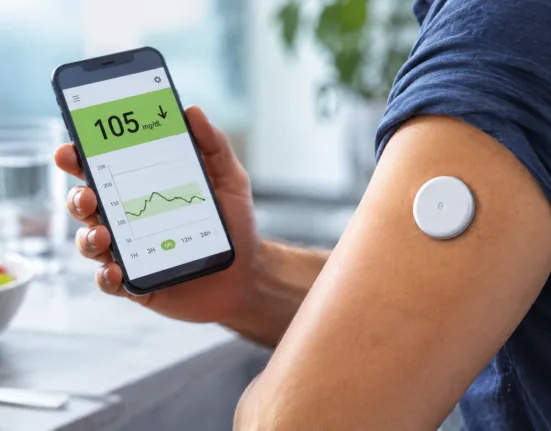
MultiDimension Technology Co., Ltd. introduced the TMR1370 ultra-low-power magnetic switch integrated circuit on July 17, 2026, positioning the component for magnetic wake-up functions in battery-powered continuous glucose monitoring devices. The company reported a maximum supply current of 50 nanoamperes and approximately 30 nanoamperes at a 3-volt supply, which it said could support more than two years of standby operation when incorporated into a suitable CGM architecture.
Samples are available through DigiKey and MultiDimension Technology’s online store. However, the announcement did not identify a continuous glucose monitoring manufacturer, regulatory submission, qualified production programme or commercial design win involving the TMR1370.
The distinction matters because the TMR1370 is not a glucose sensor and does not measure, analyse or transmit glucose readings. It is a supporting semiconductor component designed to detect a magnetic field and help wake dormant electronics when a CGM device is activated.
That narrow function could still have meaningful operational value. A disposable wearable may spend months inside its packaging, move through multiple distributors and remain in pharmacy or hospital inventory before reaching a patient. Power consumed during that period is power unavailable for sensing, processing and wireless communication after activation.
The technical specifications represent a measurable improvement over MultiDimension Technology’s earlier magnetic switches. The central test, however, is whether the lower current translates into longer validated shelf life or more usable battery capacity once the TMR1370 is integrated with every other power-consuming component inside a finished CGM device.
What is genuinely new in TMR1370 compared with MultiDimension Technology’s earlier CGM switches?
The TMR1370 uses tunnelling magnetoresistance technology, in which changes in a magnetic field alter the electrical resistance of a sensor structure. The integrated circuit converts that response into a digital switching signal that can be used by the wider device electronics.
MultiDimension Technology specifies a maximum current of 50 nanoamperes for the new component and a typical current of approximately 30 nanoamperes at 3 volts. It operates across a supply-voltage range of 1.8 volts to 4 volts, senses magnetic fields along the X-axis and has a maximum operating point below 40 gauss.
The company’s existing catalogue lists the TMR1367, TMR1368 and TMR1369 at 100 nanoamperes. The TMR1367 provides Z-axis sensing across 1.2 volts to 3.5 volts, while the X-axis TMR1368 and TMR1369 divide their coverage between 1.2 volts to 2 volts and 2 volts to 3.5 volts respectively.
On the published numbers, the TMR1370 therefore reduces the stated current requirement while combining broader voltage compatibility in a single X-axis component. That may allow developers to use the same switch across more than one battery or power-management architecture instead of maintaining separate low-voltage and higher-voltage configurations.
The comparison should not be treated as a fully independent, like-for-like benchmark until a detailed TMR1370 datasheet establishes the test conditions behind the maximum and typical values. Supply current can vary with voltage, temperature, measurement mode and manufacturing tolerance, all of which matter when engineers are working with nanoampere-level power budgets.
The packaging improvement also requires nuance. The TMR1370 is supplied in a five-lead DFN package measuring 1.6 millimetres by 1.6 millimetres by 0.5 millimetres. This is smaller than the 2-millimetre by 1.5-millimetre LGA package used by the TMR1367, but its outer dimensions are similar to the DFN option already available for the TMR1368 and TMR1369. The principal advance is therefore the combination of power efficiency, voltage coverage and compact packaging, rather than an unprecedented reduction in package dimensions across the entire portfolio.

Why does magnetic wake-up current matter long before a CGM sensor reaches the patient?
A magnetic wake-up architecture can keep higher-power parts of a CGM device inactive during manufacturing, shipping and storage. A magnet incorporated into the product packaging or applicator maintains the required switch state, with removal or repositioning of the magnetic field initiating device activation.
This approach avoids the need for a conventional mechanical power switch and can support sealed, compact wearable designs. It also prevents radios, processors and other circuits from drawing their normal operating current while the product is sitting in inventory.
At the TMR1370’s typical 30-nanoampere specification, the switch alone would consume approximately 0.53 milliampere-hours over two years. At the maximum 50-nanoampere figure, consumption would be approximately 0.88 milliampere-hours. The actual effect depends on the battery capacity and the contribution from every other leakage path in the system.
Those numbers illustrate why even a tiny reduction can matter in a disposable medical wearable. Battery capacity must cover manufacturing delays, distribution time, labelled shelf life, activation, sensor operation, wireless transmission and an engineering reserve for variations in temperature, component performance and battery ageing.
However, two years of switch standby capability is not the same as two years of validated CGM shelf life. Shelf life also depends on battery self-discharge, sensor chemistry, sterile-barrier or protective packaging, adhesives, applicator performance, calibration stability and the ageing of other electronic components.
The claim also does not mean that a CGM incorporating TMR1370 could be worn for two years. Wear duration is governed by the finished system’s authorised indication, sensor stability, skin interface, clinical performance and battery design after activation. The TMR1370 addresses the period before use, not the duration for which a glucose sensor may remain on or inside the body.
For context, United States Food and Drug Administration review records for the Dexcom, Inc. G7 15 Day Continuous Glucose Monitoring System reported real-time shelf-life testing supporting an 18-month useful life. A magnetic switch capable of remaining dormant for more than two years could provide useful design headroom, but it would not independently extend the labelled shelf life of a finished product.
How could wider voltage support and X-axis sensing simplify future CGM hardware layouts?
The 1.8-volt to 4-volt operating range gives developers more flexibility around battery selection, power rails and voltage variation during storage. It may also reduce the need to qualify different switch models when manufacturers develop several CGM platforms around related electronics.
X-axis sensing means the component responds to a magnetic field running parallel to the relevant plane of the package. This affects where the magnet can be positioned in an applicator or product package and how the switch must be oriented on the printed circuit board.
MultiDimension Technology already offers both X-axis and Z-axis devices, giving manufacturers options when internal space, applicator geometry or assembly processes constrain magnet placement. The TMR1370 expands the X-axis side of that portfolio while retaining a small package suitable for thin wearable devices.
Compactness is not merely cosmetic. Every fraction of a millimetre can influence circuit-board routing, battery size, antenna placement, enclosure thickness and the mechanical design of a disposable applicator. Saving space in one area may give engineers more freedom elsewhere, although the benefit will differ between CGM architectures.
Migration from an earlier component will not necessarily be automatic. Designers must confirm pin compatibility, magnetic thresholds, output behaviour, switching frequency, start-up characteristics and performance across the expected temperature range. A five-lead package may also require board-level changes even when its external dimensions resemble an existing four-lead component.
Magnet strength, placement tolerance and surrounding materials must be evaluated as part of the mechanical design. A switch that is too difficult to activate could prevent the device from starting, while unintended activation during shipping could consume battery capacity before the CGM reaches the user.
Why does the two-year standby claim require full-device validation instead of component arithmetic alone?
The TMR1370’s supply current is only one part of the total standby budget. Battery self-discharge, protection circuitry, regulators, capacitors, microcontroller sleep current, radio leakage and printed-circuit-board contamination can collectively consume more power than the magnetic switch.
Temperature is another important variable. CGM products may move through warehouses, delivery vehicles, pharmacies and homes with different environmental conditions. Battery discharge and semiconductor leakage can change across those conditions, meaning that a room-temperature calculation cannot establish finished-device shelf life.
The announcement did not disclose the battery chemistry, battery capacity, storage-temperature profile, number of samples tested or whether the two-year estimate was supported by accelerated ageing, real-time testing or an integrated CGM prototype. The figure should therefore be understood as a supplier-reported, design-enabling capability rather than a validated outcome for a commercial continuous glucose monitoring system.
Manufacturers evaluating the TMR1370 will need current measurements across voltage and temperature, statistical data covering production variation, magnetic operating and release thresholds, output leakage, electrostatic-discharge robustness and long-term reliability information. They will also need confidence that the device does not activate prematurely under foreseeable magnetic or mechanical conditions.
This does not diminish the importance of the lower-current specification. It defines the proper evidence category. The TMR1370 appears capable of reducing one source of standby drain, but only system-level testing can establish whether that improvement extends shelf life, permits a smaller battery or creates more post-activation energy reserve.
What regulatory and quality work follows when a new switch enters a regulated CGM design?
The TMR1370 is an electronic component rather than an independently authorised continuous glucose monitoring system. Its introduction does not represent United States Food and Drug Administration clearance, European certification or clinical validation of a finished medical device.
Responsibility for the completed CGM remains with the legal manufacturer integrating the component. That manufacturer must determine whether the switch meets defined design inputs and whether its use affects device safety, performance, shelf life or the information included in an existing regulatory submission.
In the United States, the Quality Management System Regulation became effective on February 2, 2026 and incorporates ISO 13485:2016 requirements into the federal medical-device quality framework. CGM manufacturers evaluating TMR1370 must therefore address supplier controls, design and development documentation, risk management, verification, validation and change control within their quality systems.
Relevant failure modes include premature activation, failure to wake, intermittent switching and unexpected current consumption. Testing may need to cover temperature, humidity, shock, vibration, package tolerances, magnet alignment, component ageing and manufacturing variability.
Whether replacing an existing switch would require a new regulatory submission depends on the finished device, jurisdiction and effect of the change. A component substitution cannot be assumed to be either regulatory-neutral or submission-triggering without a documented assessment by the CGM manufacturer.
What does sample availability reveal about the commercial maturity of TMR1370?
Availability through DigiKey and MultiDimension Technology’s online store allows engineering teams to begin evaluation without waiting for a negotiated volume contract. This can shorten early prototyping and give smaller medical-device developers access to the same component considered by larger manufacturers.
Sample availability does not establish production qualification, regulatory inclusion or broad adoption. MultiDimension Technology did not disclose volume pricing, delivery commitments, qualified CGM customers or expected production quantities.
Medical-device design-ins can take considerable time because changing even a small electronic component may require electrical testing, mechanical redesign, reliability work, supplier audits and updated risk documentation. The commercial opportunity may ultimately involve high component volumes, but that opportunity becomes visible only when prototypes progress into qualified production programmes.
MultiDimension Technology said its proprietary wafer processes and manufacturing facilities support volume production of TMR sensors. Prospective customers will still need product-specific information on process controls, lot consistency, capacity, traceability, change-notification procedures and continuity of supply.
Which milestones would show that TMR1370 is moving from an attractive specification to CGM adoption?
The next meaningful milestone would be publication of a complete datasheet covering current consumption, magnetic thresholds, switching behaviour, operating temperature, output characteristics, package reliability and qualification status. Evaluation-board or reference-design data demonstrating performance within a realistic CGM standby architecture would add further confidence.
Customer qualification, production orders or a named design win would move the product beyond the sample stage. The strongest confirmation would come from a finished CGM manufacturer reporting validated shelf-life or battery improvements after integrating the TMR1370.
For now, the TMR1370 represents a focused component improvement with a credible role in the increasingly constrained power budgets of disposable medical wearables. If its 50-nanoampere ceiling holds across production and environmental conditions, it could preserve more battery capacity before activation and give CGM manufacturers additional design flexibility.
The important number is not simply two years. It is the amount of usable battery capacity remaining when an individual continuous glucose monitoring device finally leaves its packaging, activates reliably and begins the regulated job for which it was designed.