
One of the most dangerous complications after a large ischemic stroke can develop partly out of sight. Damaged brain tissue begins swelling, intracranial pressure rises and healthy structures can be displaced, yet the patient may not initially display neurological deterioration dramatic enough to reveal how serious the process will become. By the time malignant cerebral edema becomes unmistakable, the window for the most effective intervention can be narrowing rapidly.
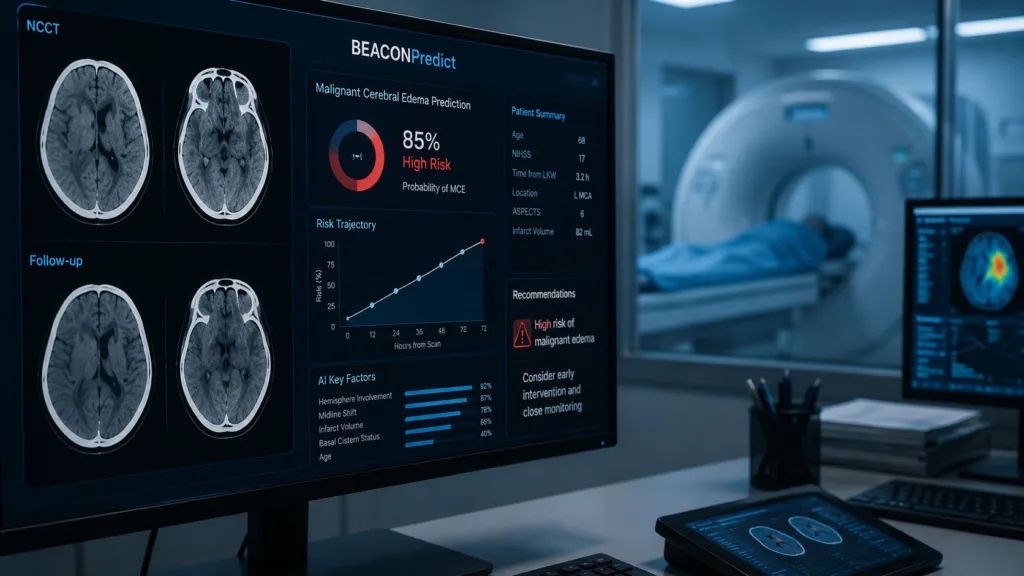
Artificial intelligence may provide a way to identify that risk earlier. BEACON-Neuro.AI, a startup originating from Washington University in St. Louis research, is developing BEACONPredict, software that analyzes routine computed-tomography imaging and clinical information to estimate whether an acute ischemic-stroke patient is likely to develop malignant cerebral edema. The system has received U.S. Food and Drug Administration Breakthrough Device designation, and an August 28 partnership with medical-software specialist Innolitics is now advancing it through a planned De Novo regulatory pathway. BEACONPredict is not yet FDA-cleared or commercially authorized.
Why is malignant cerebral edema so dangerous after a major ischemic stroke?
An ischemic stroke deprives part of the brain of adequate blood flow. Injured cells begin losing their ability to regulate water and ions, and tissue can progressively swell during the hours and days after the initial event.
The skull creates the fundamental problem. Unlike swelling in an arm or leg, brain tissue cannot expand freely because it is enclosed within rigid bone. As swelling increases, pressure can shift brain structures and ultimately produce herniation, a life-threatening state in which critical neurological structures become compressed.
For selected patients, decompressive hemicraniectomy can save lives by surgically removing a portion of the skull and giving the swollen brain room to expand. The decision is consequential because the operation is major and permanently alters the immediate anatomy of the skull, while waiting until severe deterioration occurs can reduce the benefit of intervention.
The clinical challenge is therefore predictive rather than merely diagnostic: physicians need to know which patients are going to develop dangerous swelling before the full complication is visible.
What can artificial intelligence see in an ordinary CT scan that humans may miss?
Computed tomography is already routine in acute stroke care. Clinicians use it to exclude hemorrhage, evaluate early ischemic changes and guide treatment decisions, meaning an AI system capable of extracting additional prognostic information from the same scan does not necessarily require a completely new imaging procedure.
Research underlying BEACONPredict focuses partly on changes in cerebrospinal-fluid spaces. As brain tissue swells, the amount and distribution of visible cerebrospinal fluid can decrease before dramatic midline shift develops.
An automated system can segment those spaces, measure changes and combine imaging-derived features with clinical information such as neurological severity. BEACON-Neuro.AI says its platform processes routine noncontrast CT scans using cerebrospinal-fluid segmentation and feeds those data into a neural network that produces an individualized edema-risk estimate.
This is an important form of medical artificial intelligence because the algorithm is not simply reproducing something a radiologist already reports. It is attempting to infer a future event from quantitative patterns that may be too subtle, distributed or time-dependent for conventional visual assessment.
How strong is the research behind AI prediction of malignant cerebral edema?
Early Washington University research examined 598 stroke patients, 20 of whom developed malignant cerebral edema severe enough to require decompressive surgery or result in death with midline shift. A long short-term memory neural network incorporating serial clinical and computed-tomography features achieved 100% recall and 87% precision in the research cohort, substantially outperforming conventional regression and a validated clinical edema score.
Those numbers are striking, but they should not be mistaken for prospective commercial-device performance. The work was retrospective and the investigators themselves emphasized the need for prospective validation before the approach could be relied upon clinically.
The broader scientific literature nevertheless points in the same direction. A 2025 systematic review and meta-analysis covering ten studies and 1,594 stroke patients estimated pooled sensitivity of 81.1%, specificity of 92.6% and an area under the receiver-operating-characteristic curve of 0.939 for artificial-intelligence models predicting malignant cerebral edema. The analysis also warned that methodological variability, reporting differences and limited external validation remain obstacles to adoption.
A separate multicenter radiomics study found that combining features from the infarct, affected hemisphere and whole brain improved prediction compared with focusing on the infarct lesion alone, suggesting that the future of stroke prediction may involve measuring how the entire intracranial system responds to injury rather than simply quantifying the damaged tissue.
Could AI change when surgeons perform decompressive hemicraniectomy?
This is where predictive software could become clinically consequential.
Current practice requires physicians to balance two serious risks. Operating too readily could expose patients who might never develop malignant edema to unnecessary major neurosurgery. Waiting for unmistakable neurological deterioration, however, can allow irreversible injury to progress before decompression occurs.
A validated risk score could create a middle ground. High-risk patients could be transferred earlier to neurocritical-care centers, monitored more intensively, evaluated by neurosurgery before deterioration and discussed with family members while there is still time for deliberate decision-making.
BEACON-Neuro.AI says its system is designed to generate a risk estimate at approximately 24 hours, before most severe edema develops.
The software would not need to make the surgical decision itself to be valuable. Even a reliable notification identifying the small group most likely to deteriorate could change hospital logistics, staffing and escalation pathways.
Why is predicting a complication harder to regulate than detecting one?
A diagnostic algorithm can often be evaluated against something that is already present: a tumor on an image, an abnormal rhythm on an electrocardiogram or a pathogen in a specimen.
Predictive devices make a different claim. They estimate an event that has not happened yet.
Regulators therefore need evidence not only that an algorithm correlates with future malignant cerebral edema but that the risk estimate performs consistently across scanners, hospitals, demographic groups, stroke types and changing standards of care.
False positives and false negatives also have asymmetric consequences. A false-negative result could delay escalation in a patient who later develops catastrophic swelling, while an excessive false-positive rate could send large numbers of patients toward unnecessary intensive monitoring, transfers or surgical consultations.
That is why prospective multicenter validation will be central to moving this technology from promising research into routine medicine.
What does FDA Breakthrough Device designation mean for BEACONPredict?
Breakthrough Device designation does not mean FDA approval or clearance. It provides enhanced regulatory interaction for technologies intended to address serious conditions when they may offer significant advantages over existing alternatives.
BEACONPredict is pursuing a De Novo pathway as clinical decision-support software and has also been accepted into the FDA’s Total Product Life Cycle Advisory Program pilot, according to the companies.
The August 28 Innolitics partnership is focused on converting the academic research platform into a regulated software medical device, including the engineering, quality and submission work needed to support eventual authorization.
BEACON-Neuro.AI is also raising $500,000 in pre-seed funding followed by a planned $2.7 million seed round to advance the system through FDA clearance and commercialization.
That funding requirement illustrates an often-overlooked gap in medical innovation. A strong academic algorithm is not a finished device. Developers must build validated software, cybersecurity controls, quality systems, user interfaces, workflow integration, clinical evidence and postmarket monitoring around the underlying model.
Could predictive AI create a new category of medical device?
Possibly, and malignant cerebral edema provides a useful example.
Most first-generation medical AI has concentrated on detection: find the lung nodule, identify atrial fibrillation, quantify an imaging abnormality or highlight suspicious pathology.
The next generation is moving toward prediction. Instead of asking what is wrong with the patient now, algorithms increasingly ask what is likely to happen next.
That shift could produce tools forecasting acute kidney injury, sepsis, cardiac decompensation, neurological decline, respiratory failure or drug toxicity hours before conventional thresholds are crossed.
The commercial value of such systems will depend on actionability. Predicting a bad outcome has limited clinical value if there is nothing physicians can do differently after seeing the warning.
Malignant cerebral edema is attractive precisely because an actionable pathway exists: intensify monitoring, transfer the patient, involve neurosurgery and potentially decompress the brain before catastrophic deterioration.
Could future intensive-care units become prediction centers rather than monitoring centers?
Modern intensive-care units generate extraordinary amounts of data, but most monitoring remains reactive. An alarm sounds because oxygen saturation has already fallen, blood pressure has already crossed a threshold or heart rhythm has already changed.
Predictive AI could invert that relationship. Instead of waiting for physiology to deteriorate visibly, software could combine trends in imaging, laboratory data, vital signs and clinical observations to identify trajectories toward failure.
The challenge will be preventing alarm fatigue on a much larger scale. If every algorithm continuously forecasts dozens of possible complications, clinicians could receive so many risk notifications that the most important warnings disappear into noise.
The strongest future systems will therefore need to answer three questions simultaneously: how likely is the complication, how soon could it occur and what action should the clinician consider now?
BEACONPredict represents an early attempt to apply that framework to a particularly unforgiving neurological emergency.
What must happen before AI-predicted brain swelling becomes standard stroke care?
Prospective validation comes first. Researchers must demonstrate that the system performs reliably in new patients rather than only in historical datasets used during development.
Clinical-utility studies are equally important. A technically accurate prediction model does not automatically improve outcomes unless hospitals act on its findings in ways that change treatment timing or resource allocation.
Health systems will then need to determine where the software sits in the stroke workflow. Should every eligible CT automatically run through the algorithm? Who receives the alert? How quickly must it be acknowledged? What risk threshold triggers neurosurgical consultation?
Finally, developers will need evidence that predictive performance remains stable as scanners, reconstruction algorithms, stroke therapies and patient populations evolve.
The long-term potential is larger than this single complication. Medicine has historically become very good at responding once deterioration is measurable. Predictive artificial intelligence proposes something more ambitious: use information already hidden inside routine clinical data to identify the patient who is still stable but may not remain that way.
If that promise can survive prospective trials, regulatory scrutiny and real-world deployment, the future stroke unit may not wait for the brain to swell before acting. It may know which patient is most likely to deteriorate while there is still time to prevent the emergency from becoming irreversible.
