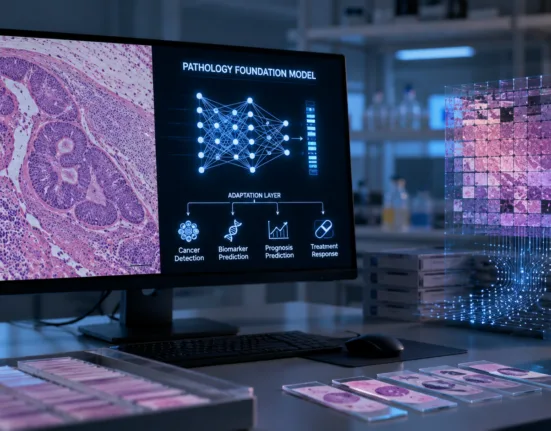
Acupath Laboratories has integrated the ArteraAI Prostate Test into its digital pathology diagnostic pathway, adding an artificial intelligence-powered risk stratification tool for patients with localized prostate cancer. The move enables the Plainview, New York-based pathology services provider to send digitized prostate biopsy images to Artera for analysis, with results typically returned within 24 hours after a completed validation process.
The significance of the integration lies less in the availability of another diagnostic add-on and more in where the prostate cancer testing workflow is moving. For years, digital pathology has been discussed mainly as an efficiency tool for slide management, remote review, archival access, and subspecialty consultation. Acupath Laboratories’ adoption of the ArteraAI Prostate Test shows how the same infrastructure is increasingly becoming a clinical decision-support channel, particularly in oncology indications where treatment intensity must be matched carefully to disease biology.
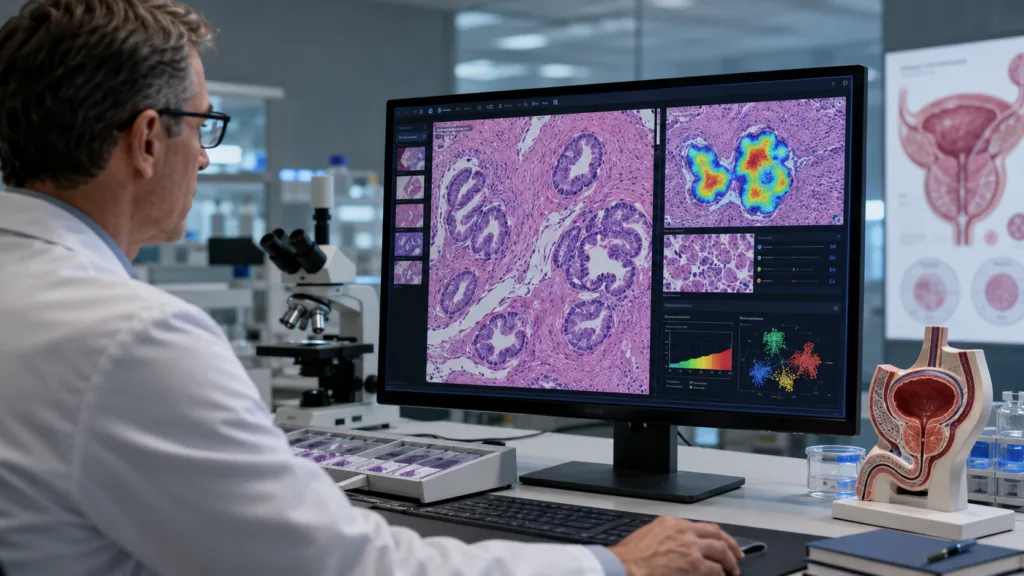
Prostate cancer is an especially relevant proving ground because the disease spans a wide biological spectrum. Some localized tumors may remain indolent for long periods, while others carry a higher risk of progression, metastasis, or treatment failure. That creates a persistent clinical dilemma: aggressive therapy may expose some patients to unnecessary toxicity, while conservative management may be inadequate for those with higher-risk disease. A tool that can use digital pathology images and clinical data to clarify prognosis or treatment benefit therefore addresses a real decision gap, although it still enters a field where physician judgment, established clinical factors, pathology grading, imaging findings, and patient preference remain central.
Why AI-based prostate cancer risk stratification matters in treatment selection
The core promise of the ArteraAI Prostate Test is that it adds a predictive and prognostic layer to localized prostate cancer assessment. Prognostic information can help estimate long-term outcomes, while predictive information is more commercially and clinically powerful because it aims to indicate whether a patient is likely to benefit from a specific treatment approach. That distinction matters because oncology diagnostics are most valuable when they do more than classify risk. They must influence a treatment decision that clinicians are already struggling to make.
For localized prostate cancer, treatment selection can involve active surveillance, surgery, radiotherapy, androgen deprivation therapy, or combinations of these options depending on disease features and patient factors. Existing decision-making often draws on prostate-specific antigen levels, Gleason grading, tumor stage, imaging, biopsy findings, genomic classifiers, and multidisciplinary review. An AI pathology tool must therefore fit into a crowded but still imperfect diagnostic environment. Its value depends on whether it can provide incremental clarity without adding friction, cost, or interpretive confusion.
Acupath Laboratories’ integration suggests that laboratory adoption may depend heavily on operational simplicity. The announcement emphasizes the ability to transmit biopsy slide images and receive results quickly, which matters because prostate cancer care pathways can already involve multiple appointments, consultations, and diagnostic steps. A risk tool that requires additional tissue handling, prolonged turnaround time, or complex clinician onboarding may struggle despite strong science. By contrast, a digital-image-based pathway can be more scalable if pathology laboratories already have the scanning, validation, and quality-control systems needed to support it.
What this reveals about the commercial pathway for AI in oncology diagnostics
The commercial story here is not only about Acupath Laboratories or Artera. It reflects a broader shift in how artificial intelligence may enter clinical practice through laboratory workflows rather than direct-to-physician software adoption. Pathology laboratories already sit at a key decision point in cancer diagnosis. If AI-based tools can be embedded into existing diagnostic pathways, they may achieve adoption through laboratory service models that feel familiar to urologists, oncologists, and hospital systems.
That matters because many healthcare AI products face the same adoption trap: they are scientifically interesting but operationally awkward. Clinicians may not have time to use standalone platforms, integrate new dashboards, interpret unfamiliar outputs, or justify reimbursement for tools that do not clearly change management. Laboratory-integrated AI has a cleaner route if the result appears within an existing diagnostic reporting workflow and arrives in time to support treatment planning.
However, this route also raises important limitations. Laboratories adopting AI-powered pathology tools must ensure validation is robust, reproducibility is monitored, image quality is sufficient, and digital pathology systems are aligned with regulatory and quality requirements. If scan variability, tissue processing differences, or data-transfer workflows affect performance, the promise of scalable AI could run into the same quality-control realities that shape every clinical laboratory test. The technology may be digital, but the operational burden remains very physical.
How Acupath’s move compares with conventional prostate cancer testing models
Conventional prostate cancer risk assessment has long relied on clinicopathologic factors and, in some cases, molecular or genomic tests that examine tumor biology through tissue-based assays. Those tools can help stratify recurrence risk or guide decisions around active surveillance, radiotherapy, and systemic intensification. The ArteraAI Prostate Test is different because it analyzes digitized histopathology images along with clinical data, positioning digital pathology itself as the analytical substrate.
That distinction could become important for laboratories and health systems. Image-based AI may reduce dependence on some wet-lab processes if the validated workflow can extract clinically meaningful signals from standard pathology images. It may also allow faster scaling across sites already investing in whole-slide imaging. For providers, the attraction is not simply that the technology uses artificial intelligence. The attraction is that it may convert routine biopsy material into a richer risk assessment without requiring the same operational model as some molecular assays.
The competitive challenge is that clinicians do not adopt new diagnostics because they are technologically elegant. They adopt them when the output is trusted, actionable, reimbursed, and aligned with guidelines or institutional pathways. The announcement’s reference to inclusion in National Comprehensive Cancer Network Clinical Practice Guidelines in Oncology is therefore commercially meaningful. Guideline recognition can support physician confidence, payer discussions, and institutional review, although it does not remove the need for local validation, clinician education, and proof that real-world use improves decision quality.
Why pathology laboratories could become central to AI cancer diagnostics
Acupath Laboratories processes a large volume of specimens and serves a broad client base across urology, gastroenterology, hematology and oncology, dermatology, breast, gynecology, otolaryngology, podiatry, and oral pathology. That background gives the integration broader relevance because high-throughput pathology providers are natural test beds for AI-enabled diagnostics. They have specimen flow, subspecialty expertise, reporting infrastructure, and established relationships with clinicians who depend on pathology results to make treatment decisions.
For AI developers, partnerships with such laboratories can accelerate market reach without requiring every hospital or practice to build its own AI pathology capability from scratch. For laboratories, offering AI-enabled tests can help differentiate their diagnostic menu at a time when anatomic pathology is under pressure to modernize, digitize, and demonstrate greater clinical value. The strategic logic is clear: pathology providers want to move from diagnosis alone toward integrated risk intelligence.
The risk is that the market could become fragmented if each laboratory integrates different AI tools, reporting formats, or interpretation frameworks. Clinicians may face inconsistent outputs across institutions, while payers may scrutinize whether multiple risk stratification products are duplicative or genuinely differentiated. The next phase of adoption will likely depend on standardization, evidence transparency, reimbursement consistency, and whether AI-generated outputs can be incorporated into tumor boards and treatment algorithms without adding confusion.
What clinicians and regulators are likely to watch as AI pathology scales
The regulatory context around AI-powered diagnostics is evolving quickly, especially as software products move from research environments into routine clinical pathways. Artera’s broader platform includes FDA-authorized software products in prostate and breast cancer, while the ArteraAI Prostate Test is commercially available as a laboratory-developed test in the United States. That distinction matters because clinicians, laboratories, and regulators will continue to examine how different versions of AI-enabled diagnostics are validated, updated, governed, and monitored after deployment.
In oncology, performance evidence must be more than technically impressive. Clinicians will want to know whether the test changes treatment recommendations, reduces uncertainty, identifies patients who can avoid unnecessary intensification, or flags patients who may benefit from more aggressive therapy. Regulators and payers will also focus on whether evidence is generalizable across patient populations, biopsy quality, scanner systems, and care settings. Bias, dataset diversity, and real-world drift remain central concerns for any AI system that influences clinical interpretation.
The 24-hour result window is commercially attractive, but turnaround speed is only one part of clinical utility. A fast result that lacks clear actionability will not transform care. A result that is interpretable, validated, and delivered quickly enough to shape treatment discussions has a stronger pathway. The burden now shifts toward demonstrating that operational integration can translate into consistent physician use and measurable clinical impact.
What could limit adoption of AI prostate cancer risk tools despite strong demand
The strongest near-term barrier may be reimbursement and workflow economics. Laboratories can integrate AI tools, but sustained adoption depends on whether clinicians order them, payers cover them, and patients are not left facing unclear out-of-pocket exposure. In prostate cancer, where multiple established risk assessment tools already exist, any new test must show not just validity but comparative usefulness. It must answer a question that clinicians cannot answer confidently through existing clinical and pathology inputs.
Another constraint is trust. Pathologists and urologists may welcome AI-generated insights, but they are unlikely to treat them as standalone decision-makers. The test’s output must be understandable enough to support clinical discussion and defensible enough to withstand scrutiny when treatment decisions are complex. This is especially important in localized prostate cancer, where choices may involve trade-offs around survival, recurrence risk, urinary function, sexual function, bowel toxicity, and quality of life.
There is also the broader question of how AI risk stratification fits into shared decision-making. Patients facing prostate cancer treatment often receive competing recommendations from different specialists. A risk score or therapy-benefit estimate may help clarify the picture, but it could also complicate conversations if the output conflicts with conventional risk categories or prior genomic testing. Adoption will therefore depend on education, reporting clarity, and the ability of clinicians to explain the test without overstating certainty.
Why this integration may be incremental today but strategically important for precision oncology
Acupath Laboratories’ integration of the ArteraAI Prostate Test is not a sweeping reinvention of prostate cancer care on its own. It is an incremental operational step by a pathology provider adding a validated AI-enabled risk stratification tool into an existing diagnostic pathway. However, strategically, it points to a larger direction of travel for precision oncology: digital pathology is becoming a platform for treatment intelligence, not just a digitized version of the microscope.
That shift could reshape the diagnostics market if laboratories can use routine digital slides to support prognosis, therapy selection, and longitudinal decision-making across multiple cancer types. Artera’s broader focus on multimodal artificial intelligence in prostate and breast cancer suggests that developers see a pathway beyond single-disease applications. If the model works commercially, pathology laboratories may increasingly become distribution partners for AI-powered oncology tools that blend histology, clinical data, and disease-specific treatment prediction.
The unresolved question is whether this becomes a durable clinical layer or another crowded diagnostics category fighting for attention. The answer will depend on evidence, reimbursement, physician trust, integration quality, and whether tools like the ArteraAI Prostate Test consistently help clinicians make better treatment decisions for localized prostate cancer. Acupath Laboratories’ move brings that question closer to everyday pathology practice, which is exactly where healthcare AI must prove itself.