Transpire Bio Inc. has received U.S. Food and Drug Administration acceptance for filing of its abbreviated new drug application for fluticasone furoate, umeclidinium, and vilanterol inhalation powder, a proposed substitutable generic version of the high-strength Trelegy Ellipta 200 mcg/62.5 mcg/25 mcg product. The filing places the U.S.-based biotech firm deeper into the complex respiratory generics market, where regulatory execution, device equivalence, manufacturing quality, and patent timing matter as much as active pharmaceutical ingredients.
Why Transpire Bio’s high-strength Trelegy ANDA matters beyond a routine generic filing
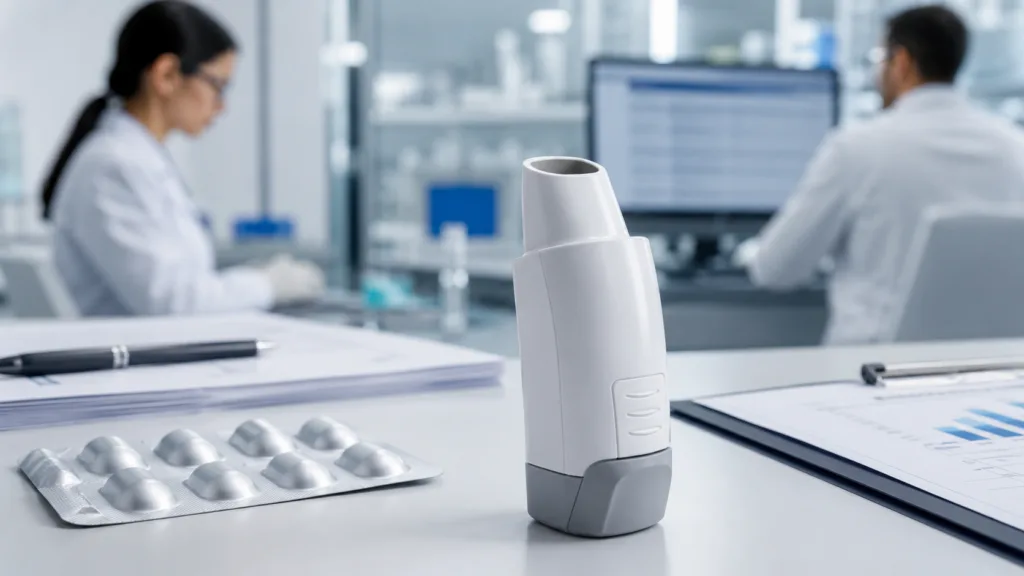
The significance of Transpire Bio’s filing lies less in the existence of another generic application and more in the type of product being targeted. Trelegy Ellipta is not a simple oral solid dose medicine where bioequivalence can often be demonstrated through more standardized pathways. It is a dry-powder inhaler that combines an inhaled corticosteroid, a long-acting muscarinic antagonist, and a long-acting beta agonist in a device-dependent format. For generic developers, that means the scientific bar is not only about matching the molecules. It is also about showing that patients receive a therapeutically equivalent product through an inhaler that regulators can consider substitutable.
That is why the high-strength Trelegy Ellipta generic opportunity is strategically important. The 200 mcg/62.5 mcg/25 mcg strength is used in adult asthma maintenance therapy, while the 100 mcg/62.5 mcg/25 mcg strength is the only Trelegy strength approved for chronic obstructive pulmonary disease in the United States. By moving on the higher-strength product, Transpire Bio is not merely chasing a broad respiratory brand. It is targeting a specific segment where asthma patients, prescribers, payers, and pharmacy benefit managers are closely watching whether single-inhaler triple therapy can become more affordable over time.
The risk is equally clear. FDA acceptance for filing is not approval. It means the agency has determined that the application is sufficiently complete for substantive review, not that the generic product has cleared the scientific, device, patent, or manufacturing hurdles needed for market entry. In complex inhalation generics, that distinction is crucial. A product can be accepted for review and still face extended regulatory questions around device performance, emitted dose, particle-size distribution, user interface, labeling, and commercial-scale reproducibility.
How the first-to-file claim could shape the commercial stakes for generic Trelegy
Transpire Bio believes it was the first company to file an ANDA for the high-strength Trelegy Ellipta product with a Paragraph IV certification. If that position is confirmed and the application is eventually approved, the U.S.-based biotech firm believes it could be eligible for 180 days of market exclusivity. In Hatch-Waxman strategy, that exclusivity window can be the difference between an ordinary generic launch and a materially valuable commercial opening, especially when the reference product remains a high-revenue brand.
The competitive logic is straightforward. A first generic entrant in a large respiratory category can attract payer attention quickly because inhaler affordability remains politically and commercially sensitive in the United States. For pharmacy benefit managers, a substitutable generic for a widely used triple-therapy inhaler could create leverage in formulary negotiations. For patients, the practical benefit would depend on insurance design, copay structures, pharmacy substitution rules, and the final pricing strategy. For Transpire Bio, the larger prize would be proof that its inhalation development platform can repeatedly tackle branded products that are difficult for conventional generic manufacturers to copy.
However, the first-to-file claim also brings uncertainty. Paragraph IV filings often trigger patent litigation, and any market entry timeline can be shaped by court outcomes, settlements, patent expiry dates, regulatory review cycles, and potential exclusivity forfeiture conditions. Transpire Bio’s filing therefore signals commercial intent, but it does not yet establish launch timing. The sharper industry question is whether the company can convert a technical filing position into an approved, manufacturable, and legally launchable product before larger generic competitors narrow the gap.
Why Trelegy remains one of the most closely watched respiratory assets for GSK plc
For GSK plc, Trelegy Ellipta remains one of the most important respiratory products in its General Medicines portfolio. GSK plc reported Trelegy sales of about £3.0 billion in 2025, with double-digit constant-exchange-rate growth, while Transpire Bio cited IQVIA data indicating U.S. annual market sales of $8 billion in 2025. The difference between reported company sales and IQVIA market sales likely reflects different measurement bases, including net manufacturer sales versus broader market-level prescription sales metrics. Either way, the signal is the same: Trelegy is a major commercial asset.
That creates a classic innovator-versus-generic tension. GSK plc has benefited from the growth of single-inhaler triple therapy, particularly as clinicians and payers have looked for simplified maintenance regimens in asthma and chronic obstructive pulmonary disease. A once-daily triple-combination inhaler can be attractive because it reduces the complexity of managing multiple inhalers, although clinical suitability depends on the patient, indication, severity, and prior treatment response. Trelegy’s commercial strength has therefore been built on both clinical utility and device familiarity.
The challenge for GSK plc is that respiratory franchises eventually face generic erosion, and inhalers are no exception, even if they tend to be harder to copy than tablets. Investors are already accustomed to seeing older respiratory brands face pressure from generic competition. Trelegy has been a growth offset inside GSK plc’s broader respiratory business, where some mature products have faced erosion. A credible generic threat does not immediately collapse the brand’s outlook, but it introduces a future margin and volume risk that will become more visible as regulatory and legal milestones develop.
What complex inhaler generics reveal about the next phase of respiratory competition
The Transpire Bio filing underscores a broader shift in the generics industry. The easiest generic opportunities have already been heavily competed, while value is increasingly migrating toward complex products that require device engineering, formulation expertise, analytical sophistication, and manufacturing discipline. Dry-powder inhalers sit squarely in that category because the device is part of the therapeutic experience. For regulators, the question is not only whether the active ingredients match. It is whether the generic product performs closely enough that substitution does not compromise treatment.
This is where Transpire Bio’s broader strategy becomes relevant. The U.S.-based biotech firm is positioning itself around inhaled therapeutics, including complex generics and a pipeline of inhalation medicines for idiopathic pulmonary fibrosis, progressive pulmonary fibrosis, pulmonary arterial hypertension, diabetes, obesity, Parkinson’s disease psychosis, and glioblastoma. That pipeline is ambitious and still carries substantial development risk, but the generic inhaler franchise could provide a nearer-term validation path if the company can secure approvals in difficult device-linked categories.
The limitation is that inhalation expertise does not automatically translate into commercial success. Manufacturing consistency is a major issue for inhaled powders because dose delivery can be affected by formulation behavior, device resistance, moisture protection, patient inhalation flow, and packaging integrity. Even after approval, scaling production while maintaining quality standards can be difficult. Transpire Bio’s South Florida manufacturing footprint gives it a degree of integration, but investors and industry observers will still watch whether that infrastructure can support reliable commercial supply if approval arrives.
How payers and clinicians may view a substitutable generic Trelegy product
For payers, the appeal of generic Trelegy would be direct. Respiratory medicines have drawn intense attention in the United States because inhaler costs can create barriers to adherence, particularly for patients with chronic conditions who require long-term therapy. A substitutable generic could create competition in a category where branded inhalers have historically remained expensive and technologically protected. If approved, Transpire Bio’s product could become a useful negotiating tool even before it captures substantial share, because its existence would alter payer leverage.
Clinicians, however, may approach substitution with more caution than payers. Inhaler technique is a real-world variable, and device familiarity can influence adherence. Even when a generic product is deemed therapeutically equivalent, some prescribers may want reassurance that patients can use the device properly, especially in asthma and chronic obstructive pulmonary disease populations where incorrect inhaler technique is common. A generic that is substitutable on paper still has to work in the practical world of pharmacy counters, physician offices, patient education, and refill behavior.
That creates a nuanced adoption path. A lower-cost generic could be welcomed by payers and many patients, but uptake may depend on how closely the device experience matches the reference product and how smoothly pharmacies, prescribers, and insurers handle substitution. The most important question will not be whether the generic is cheaper in theory. It will be whether the product is trusted enough across the respiratory care chain to shift prescribing and dispensing behavior at scale.
What GSK plc investors are likely to watch as the generic Trelegy timeline develops
GSK plc’s U.S.-listed shares recently traded around $49.81, with the company carrying a market capitalization of about $206.5 billion. The stock context matters because Trelegy is not GSK plc’s only growth driver, but it remains a meaningful respiratory asset at a time when investors are evaluating the group’s specialty medicines momentum, vaccine performance, pipeline execution, and exposure to patent cliffs. Generic pressure on Trelegy would not be a one-day thesis-breaker, but it could become part of the longer-term debate over how durable GSK plc’s post-consumer-healthcare growth profile really is.
Market sentiment toward GSK plc has been supported by stronger specialty medicines performance, especially in oncology, HIV, and respiratory immunology. Trelegy’s growth inside General Medicines has also helped soften declines elsewhere in mature respiratory products. That makes any credible generic challenge relevant because it could reduce one of the more dependable contributors within an otherwise mixed legacy medicines portfolio. Investors are likely to focus on timing, legal outcomes, and whether GSK plc can continue shifting the growth narrative toward newer specialty assets before Trelegy faces deeper erosion.
For Transpire Bio, the investor read-through is different because the company is privately held. The accepted ANDA gives the U.S.-based biotech firm a stronger story around execution in complex generics, especially after prior first-to-file claims around generic Breo and Trelegy filings. Yet the company still has to prove that it can move from application acceptance to approval and then from approval to commercial uptake. In complex generics, the victory lap comes much later than the filing milestone.
Why the next test is regulatory execution rather than market size alone
The commercial prize around generic Trelegy is obvious, but the next phase will be less glamorous and more decisive. The FDA review process will test whether Transpire Bio’s formulation, device performance, comparative data, labeling, and manufacturing controls meet the standards for approval. Patent disputes may test whether the company can launch within a commercially meaningful timeframe. Payer behavior will test whether a generic triple-therapy inhaler can rapidly convert theoretical substitution into real market share.
That is why this filing should be read as an important inflection point, not a finished disruption story. Transpire Bio has stepped into one of the most attractive and technically demanding areas of the respiratory generics market. GSK plc still controls a major branded franchise with entrenched physician familiarity, payer relationships, and patient usage. The eventual outcome will depend on whether regulatory approval, legal clearance, manufacturing readiness, and market acceptance line up.
The broader takeaway is that respiratory medicine is entering a more competitive phase where the old assumption that complex inhalers are protected by technical difficulty alone is becoming less secure. If Transpire Bio succeeds, the high-strength Trelegy generic pathway could become a case study in how smaller inhalation-focused developers can challenge blockbuster respiratory brands. If the process stalls, it will reinforce why dry-powder inhaler generics remain one of the toughest corners of the U.S. generic drug market.