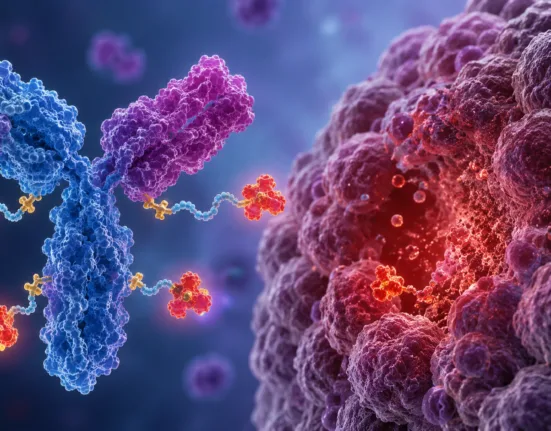
Cartography Biosciences has secured a strategic investment from Samsung Ventures to support its antibody-based oncology pipeline and expand its proprietary drug discovery platform. The investment comes as the U.S.-based biotech firm advances CBI-1214, a T-cell engager for colorectal cancer that entered a Phase 1 clinical trial in early 2026, placing its tumor antigen discovery approach into its first major clinical validation window.
Why Samsung Ventures’ investment in Cartography Biosciences matters for oncology drug discovery platforms
The strategic importance of the Samsung Ventures investment lies less in the undisclosed financing amount and more in the type of validation it provides. Cartography Biosciences is not simply presenting another early-stage oncology asset. It is positioning itself as a platform-driven biotech attempting to identify tumor-restricted antigens and antigen combinations with enough precision to support antibody therapeutics that may avoid some of the toxicity and selectivity problems that have slowed parts of the targeted oncology field.
That distinction matters because oncology drug discovery is moving through a difficult reset. Investors and biopharmaceutical companies have become more selective after years of enthusiasm around broad platform claims, especially in artificial intelligence-enabled biology, immune oncology, and antibody engineering. A platform now needs more than attractive computational language. It needs a credible route from data generation to target identification, target validation, drug design, manufacturability, and clinical differentiation. Samsung Ventures’ decision to invest through the Samsung Life Science Fund suggests that Cartography Biosciences has moved far enough along that its platform can no longer be viewed only as a discovery-stage concept.
The unresolved question is whether the platform can produce clinical outcomes that justify the confidence. Many oncology platforms have shown impressive preclinical selectivity but faced difficulty once human tumor heterogeneity, immune biology, dosing limitations, and safety thresholds entered the picture. For Cartography Biosciences, the move from mapping tumor biology to treating patients is the moment when its thesis begins to face clinical pressure. The Phase 1 development of CBI-1214 is therefore not just a trial of one T-cell engager. It is also an early test of whether Cartography’s antigen discovery system can identify targets with practical therapeutic value.
How CBI-1214 could test the clinical value of tumor-restricted antigen discovery in colorectal cancer
CBI-1214 is central to the investment story because it gives Cartography Biosciences a clinical-stage anchor in colorectal cancer, a disease area where targeted therapeutic innovation remains uneven. Colorectal cancer has a large treatment population, but the biology is fragmented across molecular subgroups, prior treatment histories, immune sensitivity, and resistance patterns. That creates room for new approaches, but it also raises the bar for proving meaningful benefit.
T-cell engagers are attractive because they are designed to redirect immune cells toward tumor cells, but that mechanism also carries a familiar challenge. The more powerful the immune engagement, the more carefully developers must manage safety, target expression, cytokine-related effects, and damage to healthy tissue. In solid tumors, the challenge can be even greater because target antigens may not be exclusively expressed on malignant cells, and the tumor microenvironment can suppress immune activity. Cartography’s emphasis on tumor-restricted antigens is therefore clinically relevant, because improved selectivity could theoretically support a better therapeutic index.
However, early-stage trials rarely answer that question quickly. A Phase 1 trial is primarily expected to assess safety, tolerability, dose escalation, pharmacokinetics, pharmacodynamics, and early signals of antitumor activity. Even if CBI-1214 shows encouraging early responses, industry observers will want to see whether those responses are durable, reproducible across patient subsets, and supported by biomarker logic. The clinical relevance of Cartography’s platform will depend not only on whether CBI-1214 can be dosed safely, but whether the selected antigen biology translates into patient-level benefit that looks different from conventional targeted approaches.
Why ATLAS and SUMMIT may be the real strategic assets behind the oncology pipeline
Cartography Biosciences’ ATLAS and SUMMIT platforms appear to be the deeper reason Samsung Ventures is engaging with the biotech firm. The platforms integrate proprietary single-cell datasets, computational biology, target validation, and drug development capabilities to identify tumor-restricted antigens and antigen combinations. This puts Cartography within a growing class of companies trying to make oncology discovery more systematic by combining large-scale biological maps with engineered therapeutic design.
The potential advantage is clear. Single-cell data can reveal patterns that bulk tissue analysis may obscure, particularly when tumors contain mixed cell populations, rare subclones, immune cells, stromal elements, and healthy tissue contamination. If Cartography can distinguish cancer-associated expression from healthy tissue expression with high resolution, it may be able to nominate targets that reduce off-tumor toxicity. The mention of logic-gated target combinations also points toward a more selective therapeutic design philosophy, where drugs may require more than one biological signal before engaging a malignant cell.
The limitation is equally important. More data does not automatically mean better drug candidates. Platform developers must show that computationally selected targets are not only biologically specific, but also druggable, accessible, stable across patients, and relevant after therapy pressure. Tumors evolve. Antigen expression can vary between primary and metastatic disease, between patients, and across treatment lines. For Cartography, the critical challenge will be proving that its mapping approach identifies targets that remain clinically actionable when confronted by real-world tumor variability.
What Samsung’s life sciences strategy gains from a platform oncology investment
For Samsung Ventures, the investment fits a broader strategic pattern in life sciences. The Samsung Life Science Fund was established by Samsung Biologics, Samsung Bioepis, and Samsung C&T, and its stated focus includes next-generation technologies across biologics, gene editing, and AI-enabled therapeutics. Cartography Biosciences sits neatly within that mandate because it combines biologics, computational biology, and oncology therapeutic design.
The investment also gives Samsung’s life sciences ecosystem exposure to a part of biotech innovation that sits upstream from manufacturing. Samsung Biologics is already a major force in contract biologics manufacturing, but future value in biologics will increasingly be shaped by the quality of therapeutic design, target selection, and platform-enabled pipelines. Investing in companies such as Cartography Biosciences allows Samsung-linked entities to track emerging therapeutic architectures before they become late-stage manufacturing or commercialization opportunities.
Still, strategic investment should not be confused with clinical endorsement. It signals interest and alignment, not proof of efficacy. Cartography Biosciences will still need to generate clinical data, manage trial execution, and demonstrate that its antibody-based oncology programs can be differentiated in a crowded therapeutic landscape. The Samsung connection may strengthen credibility and optionality, but it does not remove the biological and regulatory uncertainty that defines early oncology development.
How this deal reflects the changing standard for AI-enabled and data-driven biotech companies
The Cartography Biosciences announcement also reflects a wider shift in how the market is evaluating data-driven biotech firms. A few years ago, the phrase “AI-enabled therapeutics” could attract attention largely on the promise of faster discovery. Today, the industry is more demanding. Investors want to know whether computational approaches can produce better targets, cleaner mechanisms, stronger translational packages, and more efficient clinical programs.
Cartography’s pitch is stronger than a generic AI discovery story because it is tied to a specific biological problem in oncology: identifying antigens and antigen combinations that are sufficiently tumor-selective for antibody-based therapies. That gives the platform a clear use case. Instead of claiming to transform drug discovery broadly, Cartography is trying to solve a specific bottleneck in precision oncology.
The risk is that platform narratives can still outrun evidence. If CBI-1214 struggles in Phase 1 because of safety, weak pharmacodynamic activity, limited patient selection, or inadequate response durability, the market may reassess not only the asset but the platform’s translational assumptions. Conversely, even modest early clinical validation could strengthen the credibility of Cartography’s broader pipeline. That makes the next phase of patient enrollment and early data generation unusually important.
What regulators and clinicians may watch as Cartography Biosciences advances CBI-1214
Regulators and clinicians are likely to focus on whether CBI-1214 can demonstrate a manageable safety profile while producing signs of meaningful biological activity. For T-cell engagers, tolerability is not a secondary issue. It shapes dosing, patient eligibility, clinical setting, monitoring requirements, and eventual adoption. A therapy that looks potent but requires complex management may face a narrower commercial path, particularly in solid tumors where multiple competing treatment options may already exist.
Patient selection will also matter. If Cartography’s antigen discovery platform identifies a target with variable expression across colorectal cancer patients, the development strategy may require a companion diagnostic or biomarker-led enrichment approach. That could improve response probability, but it could also narrow the addressable population and complicate trial design. The strongest outcome for Cartography would be a target profile that is selective enough to protect safety, prevalent enough to support commercial scale, and biologically stable enough to deliver durable benefit.
The manufacturing dimension should not be ignored either. Antibody-based therapies, including T-cell engagers, must be scalable, consistent, and economically viable if they progress beyond early trials. Samsung’s broader life sciences expertise may be strategically relevant here, particularly if Cartography’s programs mature into more complex biologics development. However, manufacturing strength cannot compensate for uncertain clinical differentiation. The first question remains whether the biology works.
Why the next readout phase could define Cartography Biosciences’ credibility beyond the funding headline
The strategic investment gives Cartography Biosciences additional momentum, but the more consequential milestone will be clinical evidence from CBI-1214 and follow-on oncology programs. The biotech firm now has a clearer story for industry watchers: a proprietary tumor mapping platform, a lead T-cell engager in Phase 1, and a strategic investor linked to one of Asia’s most important life sciences ecosystems. That combination is meaningful, but it is still a starting point rather than a conclusion.
What is genuinely new is the strengthening of Cartography’s external validation at the same time its first clinical program is entering human testing. What remains unresolved is whether the platform can deliver the central promise of precision oncology: therapies that hit cancer hard while sparing healthy tissue. That is the difference between a compelling discovery engine and a clinically valuable pipeline.
For the oncology sector, the announcement is another sign that investors remain interested in platforms capable of improving target selectivity, particularly for antibody-based and immune-engaging therapies. For Cartography Biosciences, the pressure now shifts from platform explanation to clinical demonstration. Samsung Ventures has placed a strategic marker. The next verdict will come from patients, biomarkers, dose-escalation data, and the unforgiving biology of solid tumors.