NRx Pharmaceuticals, Inc. subsidiary HOPE Therapeutics has treated its first patients using Zeta Surgical’s FDA-cleared Zeta TMS Navigation System at outpatient clinics in West Palm Beach and Sarasota, Florida. The deployment brings AI-powered, sub-millimetric image guidance into transcranial magnetic stimulation workflows for patients with major depressive disorder and other neurological conditions. The milestone is clinically relevant because TMS is already used in treatment-resistant depression, but more precise and repeatable targeting may help improve confidence in delivery, protocol consistency and future combination strategies involving pharmacologic and device-based interventions.
Why does Zeta-guided TMS matter for treatment-resistant depression care?
Treatment-resistant depression remains a major clinical challenge because a substantial proportion of patients with major depressive disorder do not achieve adequate remission with standard antidepressant therapy. TMS has become an important non-invasive option for patients who have not responded well to medication, but the effectiveness of treatment can depend on accurate targeting of brain regions involved in mood regulation and neural circuit dysfunction.
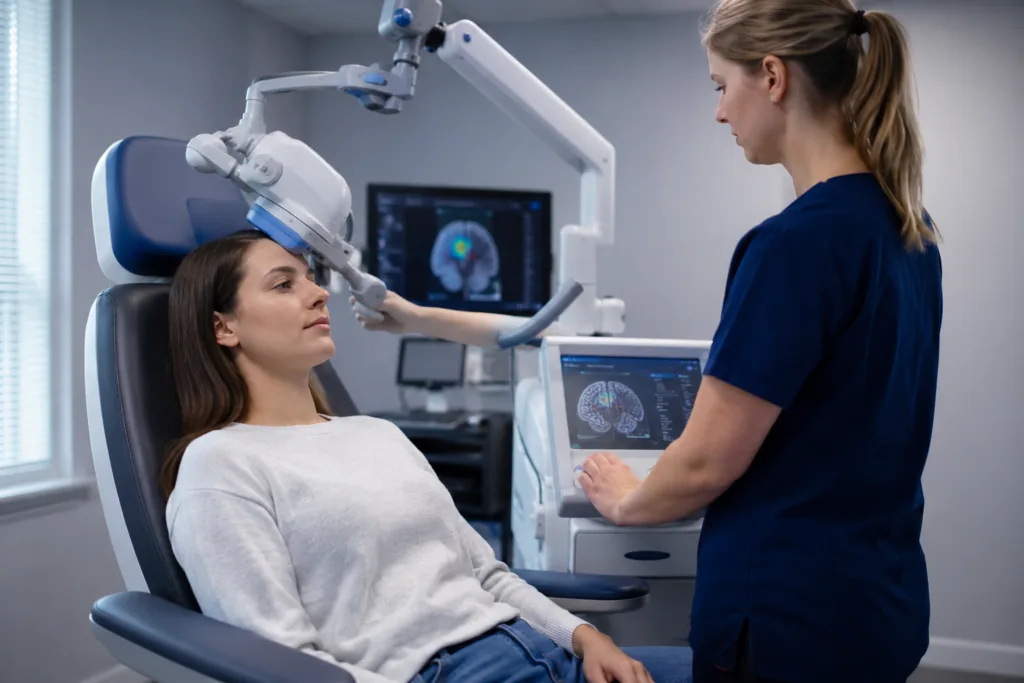
The Zeta TMS Navigation System is intended to address that delivery challenge by adding image-guided precision to outpatient TMS. The system uses artificial intelligence and computer vision to register a patient’s MRI or CT imaging to facial anatomy and track the position of the TMS coil relative to the planned brain target. For a therapy that depends on stimulating specific cortical regions, targeting accuracy and repeatability are not minor operational details. They are part of the treatment’s clinical logic.
HOPE Therapeutics’ first patient treatments mark a move from technology deployment to active clinical use. That transition matters because device-based psychiatry is increasingly being evaluated not only by whether a technology exists, but by whether it can be integrated into real care settings. Outpatient clinics need systems that are accurate, practical, fast enough for routine workflows and usable across patients with different anatomy and clinical histories.
The milestone also reflects a broader shift in psychiatry toward more precise, circuit-informed care. Depression is not treated only as a broad symptom cluster in advanced interventional settings. Clinicians are increasingly interested in how brain circuits, stimulation targets, biomarkers and patient-specific treatment planning can improve outcomes. Zeta-guided TMS fits into that evolution by attempting to make delivery more individualized and reproducible.
How does the Zeta TMS Navigation System change the outpatient workflow?
The Zeta system uses proprietary RealTrack technology to provide real-time, markerless image guidance for TMS procedures. According to the company, the system can register MRI or CT imaging to a patient’s facial anatomy in under two minutes and continuously track the TMS coil relative to the planned brain target with sub-millimetric accuracy. This is designed to reduce reliance on less precise positioning methods and support more consistent treatment delivery across sessions.
That workflow could be important in outpatient psychiatry because TMS usually involves repeated treatment sessions over a course of care. If coil positioning varies from session to session, clinicians may have less confidence that the same neural target is being stimulated consistently. Image guidance may help reduce variability, especially in clinics treating complex patients or using more advanced stimulation protocols.
The markerless design is also clinically practical. Systems that require cumbersome patient markers, lengthy setup or complicated calibration can slow clinic throughput. A navigation tool that can integrate into routine treatment without adding excessive burden may be more likely to be adopted in community and specialty outpatient settings. The value of precision technology often depends on whether clinicians can actually use it repeatedly in busy clinics.
The deployment at HOPE clinics may therefore provide a real-world test of whether AI-guided navigation can become part of standard interventional psychiatry operations. If the system improves workflow confidence and supports more reproducible TMS delivery, it could become relevant beyond these first Florida sites.
Why is this milestone important for HOPE Therapeutics’ interventional psychiatry model?
HOPE Therapeutics is building an interventional psychiatry platform that includes ketamine, Spravato, TMS, hyperbaric oxygen therapy and other neuroplastic therapies. The addition of Zeta-guided TMS supports the company’s strategy of combining advanced treatment modalities with more precise delivery infrastructure. In psychiatric care, where many patients cycle through several medication options without remission, an integrated model may help clinicians match patients to multiple evidence-based interventions.
The Zeta deployment also gives HOPE a technology differentiator in outpatient care. TMS is available in many clinics, but image-guided targeting may help distinguish centers focused on more advanced precision delivery. That could matter as interventional psychiatry becomes more competitive and patients, referring physicians and payers look for treatment settings that offer higher-quality workflows.
For NRx Pharmaceuticals, the milestone connects to its broader central nervous system strategy. The company is developing NRX-100, preservative-free intravenous ketamine, and NRX-101, an oral D-cycloserine and lurasidone combination. Its interventional psychiatry platform gives the company a potential clinical infrastructure layer around device-based and pharmacologic treatment strategies.
The clinical significance will depend on outcomes, not only deployment. Treating first patients with an FDA-cleared navigation system is an operational milestone, but future evidence will need to show whether precision-guided TMS improves remission, durability, tolerability or workflow efficiency compared with less targeted approaches. The strongest case for the platform will come if guided delivery translates into measurable patient benefit.
How does this support the planned NRX-101 and robotic-enabled TMS study?
The Zeta-guided TMS deployment aligns with NRx’s planned SPARC-TMS trial evaluating NRX-101 in combination with robotic-enabled TMS for patients with depression and suicidality. The company expects that study to include a leading U.S. academic teaching hospital, three HOPE Therapeutics clinics and two military treatment facilities. The Zeta system’s precision-guidance capabilities may support the type of repeatable targeting needed in a study combining drug therapy with device-based neuromodulation.
This is clinically important because combination strategies in depression require careful control of both pharmacologic and procedural variables. If a study aims to evaluate whether NRX-101 can augment TMS effects, then the consistency of TMS targeting becomes part of the integrity of the trial. More precise navigation may help reduce variability that could otherwise complicate interpretation.
The military treatment facility component is also relevant because depression, suicidality and trauma-related disorders remain major areas of concern in military and veteran populations. If robotic-enabled or image-guided TMS can be paired with pharmacologic augmentation in a clinically meaningful way, it could support development of more structured care pathways for high-risk patients.
The trial remains planned, and the Zeta deployment does not establish that the combination approach will succeed. It does, however, show that HOPE is building the clinical operations needed to support a more advanced interventional psychiatry study. The move from system installation to active patient treatment is one step toward that broader development strategy.
Why does FDA-cleared Zeta TMS navigation still need outcomes evidence in depression care?
The Zeta TMS Navigation System is FDA-cleared and commercially available in the United States, which means it has met the regulatory requirements for its cleared use. Clinicians should still distinguish between clearance of the navigation technology and clinical evidence for any specific treatment protocol or combination strategy. A navigation system can support targeting, but it does not by itself prove improved antidepressant outcomes.
TMS is a non-invasive therapy used primarily in treatment-resistant depression and also in other neuropsychiatric conditions such as obsessive-compulsive disorder. It is generally considered an established treatment modality in appropriate patients, but like any intervention, it requires screening, protocol selection and monitoring. Accurate targeting may improve procedural confidence, but clinical judgment remains essential.
The introduction of AI-powered image guidance also raises practical considerations. Clinics will need to ensure staff training, data handling, imaging workflow, device calibration and quality control. In neuromodulation, accuracy depends on both technology and human execution. A sophisticated system still requires disciplined clinical operations.
For patients, the main message is that guided TMS may support more precise delivery, but it should be understood as part of a broader care plan. Patients with treatment-resistant depression often need comprehensive evaluation, medication review, psychotherapy, safety planning and follow-up care. Precision TMS may become an important tool, but it is not a standalone answer for every patient.
Could AI-guided TMS reshape precision psychiatry for treatment-resistant depression?
HOPE Therapeutics’ first Zeta-guided treatments point toward a future in which psychiatric interventions may become more personalized, measurable and technology-enabled. For decades, many psychiatric treatments have relied heavily on symptom-based diagnosis and trial-and-error medication sequencing. Interventional psychiatry is gradually adding tools that target brain circuits more directly, and image-guided neuromodulation fits that direction.
The use of AI and computer vision in TMS targeting could also support more standardized treatment delivery across clinics. If systems can help clinicians identify, track and reproduce stimulation targets more accurately, multi-site treatment programs and clinical trials may become easier to conduct. That could be particularly important for companies developing combination strategies that require consistent procedural execution.
The broader field will need outcomes evidence. Precision tools are valuable when they improve clinical results, reduce variability, increase safety or make care more scalable. The deployment at HOPE clinics is an early operational step, not a final clinical validation. Still, it provides a practical example of how advanced navigation technology is beginning to enter routine outpatient psychiatry.
For patients with treatment-resistant depression and other complex neuropsychiatric conditions, the promise is a treatment model that is less generic and more targeted. The next stage will determine whether that promise can be measured in remission rates, durability, patient experience and real-world access.