AIDS Healthcare Foundation and the Pan American Health Organization have announced a regional collaboration intended to expand early HIV diagnosis, bring testing closer to underserved communities and improve the connection between a positive diagnosis and sustained treatment. The agreement, unveiled on July 27, 2026, during the AIDS 2026 conference in Rio de Janeiro, will cover Latin America and the Caribbean, where late diagnosis and interruptions in care continue to undermine the benefits of effective antiretroviral therapy.
The collaboration will support HIV self-testing, community-based service models, improved linkage to care, earlier initiation of antiretroviral therapy and stronger retention of people already enrolled in treatment programmes. AIDS Healthcare Foundation and the Pan American Health Organization also plan to help countries exchange operational experience and generate evidence that can identify which interventions should be expanded across different national health systems.
The agreement addresses a persistent contradiction in the regional HIV response. Latin America and the Caribbean have access to increasingly effective testing, prevention and treatment technologies, yet a substantial share of people are still diagnosed only after the infection has reached an advanced stage. The central question is therefore no longer whether appropriate tools exist, but whether governments and implementing organisations can deliver them earlier, consistently and in formats that people are willing and able to use.
PAHO estimated that approximately 34% of new HIV diagnoses in Latin America and the Caribbean during 2025 were made at an advanced stage of infection. The organisation also estimated that around 32,000 people died from AIDS-related causes during the year, despite the availability of treatment capable of suppressing the virus and substantially reducing HIV-related illness and mortality.
Why is late HIV diagnosis still driving preventable mortality across the region?
Late diagnosis reduces the time available to begin antiretroviral therapy before a person becomes vulnerable to severe opportunistic infections and other complications associated with advanced HIV disease. It can also indicate that routine health services have failed to reach people who face stigma, geographical isolation, migration-related barriers, unstable employment, discrimination or limited access to confidential healthcare.
These obstacles cannot be solved simply by distributing more conventional test kits through hospitals and clinics. Facility-based services remain essential, but they may not reach individuals who are reluctant to enter formal health settings or who live far from testing centres. Community-based testing, self-testing and network-based approaches are intended to create additional entry points, particularly for populations that have historically experienced gaps in diagnosis and prevention services.
The World Health Organization’s differentiated HIV testing guidance highlights the expanding role of self-testing and network-based testing, as well as the integration of HIV services with testing for sexually transmitted infections. The guidance supports moving away from a single delivery model and designing testing strategies around the needs of different populations and local epidemics.
A self-test, however, is an entry point rather than the completion of a diagnostic pathway. Reactive results generally require confirmation through an approved national testing algorithm. Individuals also need counselling, clinical assessment and rapid connection to treatment or prevention services. A programme that expands self-testing without establishing clear referral and follow-up systems could increase testing volumes while producing only limited improvement in treatment coverage.
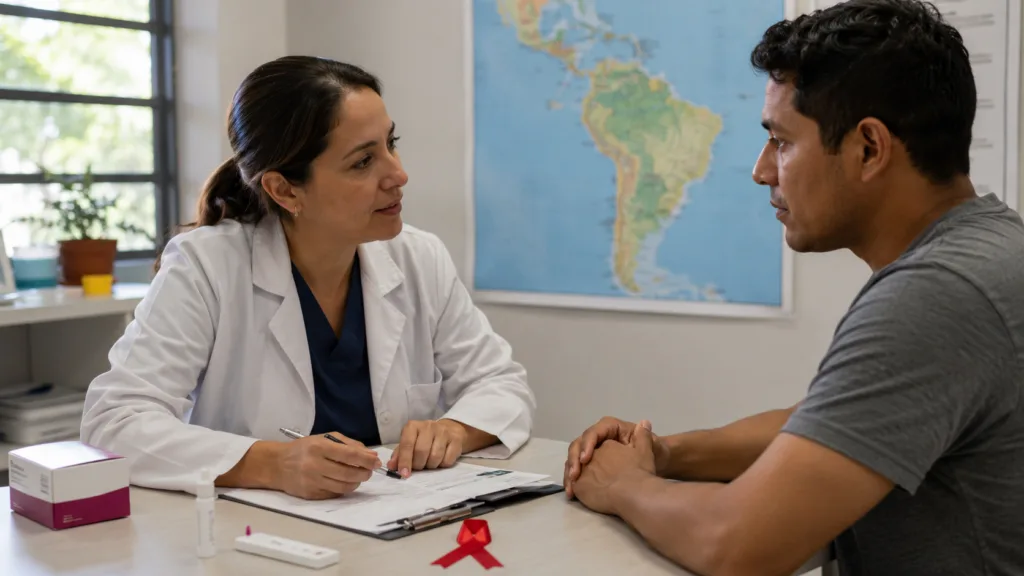
What will the AIDS Healthcare Foundation and PAHO collaboration actually deliver?
The agreement combines AIDS Healthcare Foundation’s implementation experience with the Pan American Health Organization’s relationships with governments, public-health agencies and national health systems. AIDS Healthcare Foundation said it operates in 11 countries across Latin America and the Caribbean and provides HIV-related services in 50 countries globally. PAHO, as the World Health Organization’s regional office for the Americas, can support policy development, technical cooperation and the adaptation of interventions across multiple jurisdictions.
The planned work includes differentiated diagnostic models, HIV self-testing, services delivered through community networks, stronger linkage to treatment, improved retention in care and closer integration between HIV prevention and services for other sexually transmitted infections. The partners also intend to collect evidence and identify interventions capable of being expanded beyond individual projects or countries.
Important implementation details have not yet been disclosed. The announcement did not identify the initial participating countries, the financial value of the collaboration, the number of people expected to be reached or a timetable for launching the first interventions. It also did not provide numerical targets for new diagnoses, treatment initiation, retention, viral suppression or reductions in advanced-stage presentation.
Those omissions do not diminish the need for the initiative, but they limit the ability to assess its likely scale. Regional agreements can provide an effective framework for coordination, although their impact ultimately depends on national budgets, procurement systems, regulatory policies, trained personnel and the participation of local community organisations.
The first meaningful evidence of progress will therefore come from country-level implementation plans. These should reveal whether the collaboration is primarily a technical-assistance programme or whether it will also finance testing, workforce expansion, digital follow-up systems, transportation support and community-led outreach.
Why must the partnership connect diagnosis directly with treatment and retention?
Testing coverage receives considerable attention because it is visible and comparatively easy to count. Yet the clinical value of diagnosis depends on what happens immediately afterwards. A person who receives a positive result must be connected to confirmatory testing, clinical assessment and treatment without unnecessary delays.
Rapid initiation of antiretroviral therapy is especially important because treatment can suppress HIV, protect immune function and reduce the likelihood of onward transmission when viral suppression is maintained. However, initiation alone is not sufficient. People must remain in care, receive a reliable supply of medicine, attend appropriate monitoring and be supported when social or economic pressures threaten treatment continuity.
PAHO estimated that approximately 2.1 million people living with HIV in Latin America and the Caribbean received antiretroviral therapy in 2025, equivalent to regional treatment coverage of about 72%. An estimated 900,000 people were not receiving treatment, while loss to follow-up remained a significant obstacle to achieving regional HIV targets.
This gap explains why the AHF and PAHO initiative places retention and re-engagement alongside early diagnosis. Some people may have been diagnosed but never started treatment. Others may have initiated therapy and later stopped attending services because of mobility, stigma, medicine shortages, clinic waiting times, administrative requirements or changes in personal circumstances.
WHO describes retention as the continued use of HIV care according to an individual’s clinical needs. Recommended service-delivery approaches can include community-based interventions, longer medicine refills and less frequent facility visits for people who are clinically stable, while those with advanced disease may require more intensive support.
Can community-based HIV services overcome the region’s access barriers?
Community delivery may be one of the partnership’s most consequential components because trusted local organisations can reach populations that are poorly served by conventional facilities. They may also offer testing in locations and at times that are more compatible with work, family and transportation constraints.
Community programmes can reduce some barriers, but they require formal integration with national health systems. Test quality, confirmatory pathways, patient consent, confidentiality, data protection, referral procedures and medicine access must remain consistent. The objective should not be to create parallel systems that identify people but cannot reliably connect them to clinical services.
Countries will also have to decide how information from self-testing and community programmes is incorporated into surveillance systems. Inadequate data integration can make it difficult to determine whether people who receive reactive results are confirmed, enrolled in treatment and retained in care. Excessive data collection, on the other hand, could undermine trust among populations concerned about privacy or discrimination.
The partnership’s plan to exchange experience across countries could help address these challenges. Latin American and Caribbean health systems vary considerably in financing, geography, laboratory capacity, digital infrastructure and relationships with civil-society organisations. A model that succeeds in a large urban area may need significant adaptation for rural communities, islands, border populations or mobile workers.
What could the collaboration mean for diagnostics and healthcare technology providers?
Although the agreement is a public-health collaboration rather than a commercial procurement announcement, its implementation could influence demand for rapid diagnostic tests, self-testing products, laboratory confirmation services and digital tools supporting patient referral and follow-up.
Any commercial opportunity will depend on national procurement decisions and product eligibility requirements. The announcement did not name diagnostic manufacturers, technology partners or suppliers, and it should not be interpreted as confirmation of new purchasing contracts.
For test developers, the relevant opportunity may extend beyond the sale of individual kits. Programmes increasingly require packaging, user instructions, distribution networks, multilingual support, quality assurance and mechanisms that help users connect with confirmatory testing. Digital platforms could support appointment scheduling, reminders and re-engagement, but they must be designed around privacy, connectivity and the risk of excluding people without reliable internet access.
Integration with sexually transmitted infection services may also encourage the use of combined or coordinated testing models. WHO’s guidance has highlighted dual HIV and syphilis testing and the broader integration of testing services where supported by national programmes.
The industry implication is therefore less about a sudden increase in test volumes and more about a gradual shift toward decentralised, connected and differentiated diagnostic pathways. Providers that can demonstrate quality, ease of use and compatibility with public-health workflows may be better positioned than suppliers focused only on unit sales.
How should the impact of the AHF and PAHO agreement be measured?
The agreement should eventually be assessed using outcomes that extend beyond the number of tests distributed or community events organised. Useful measures would include the proportion of reactive self-tests receiving confirmatory testing, the time between diagnosis and treatment initiation, retention at defined intervals, viral suppression and the share of people presenting with advanced disease.
Country-level reporting will also be needed to show whether the initiative reaches populations currently outside routine services. Aggregate regional figures can conceal wide differences between countries and within individual countries, particularly between urban centres and remote or underserved areas.
Evidence generation is therefore a necessary part of the collaboration rather than an academic addition. Programmes need to identify which distribution channels generate completed testing, which referral methods result in treatment initiation and which retention interventions remain effective after pilot funding ends.
The partners will also have to distinguish between interventions that are scalable and those that depend on unusually intensive staffing or external support. A model may perform well in a limited demonstration but prove difficult to sustain through routine health budgets.
Why will execution determine whether this regional HIV partnership matters?
The AIDS Healthcare Foundation and Pan American Health Organization agreement arrives when the region possesses more prevention, diagnostic and treatment options than at any previous stage of the HIV response. PAHO has reported that access to pre-exposure prophylaxis increased from approximately 35,000 people in 2020 to more than 326,000 in 2025, while AIDS-related deaths across Latin America and the Caribbean declined by 46% between 2010 and 2025. Nevertheless, almost one-third of diagnoses continue to occur late and hundreds of thousands of people remain outside treatment.
That combination of progress and persistent exclusion defines the partnership’s opportunity. The tools are available, but the systems connecting them to people remain uneven.
The collaboration could add value by linking PAHO’s regional policy and technical role with AIDS Healthcare Foundation’s community and service-delivery experience. Its credibility, however, will depend on whether broad commitments are converted into funded programmes with defined countries, measurable targets and transparent implementation results.
The decisive indicator will not be how many HIV tests the partners distribute. It will be whether more people receive a timely diagnosis, begin appropriate care, remain on treatment and achieve sustained viral suppression before preventable complications develop. That is the operational gap the agreement has been designed to close, and it is the standard against which its regional impact should ultimately be judged.