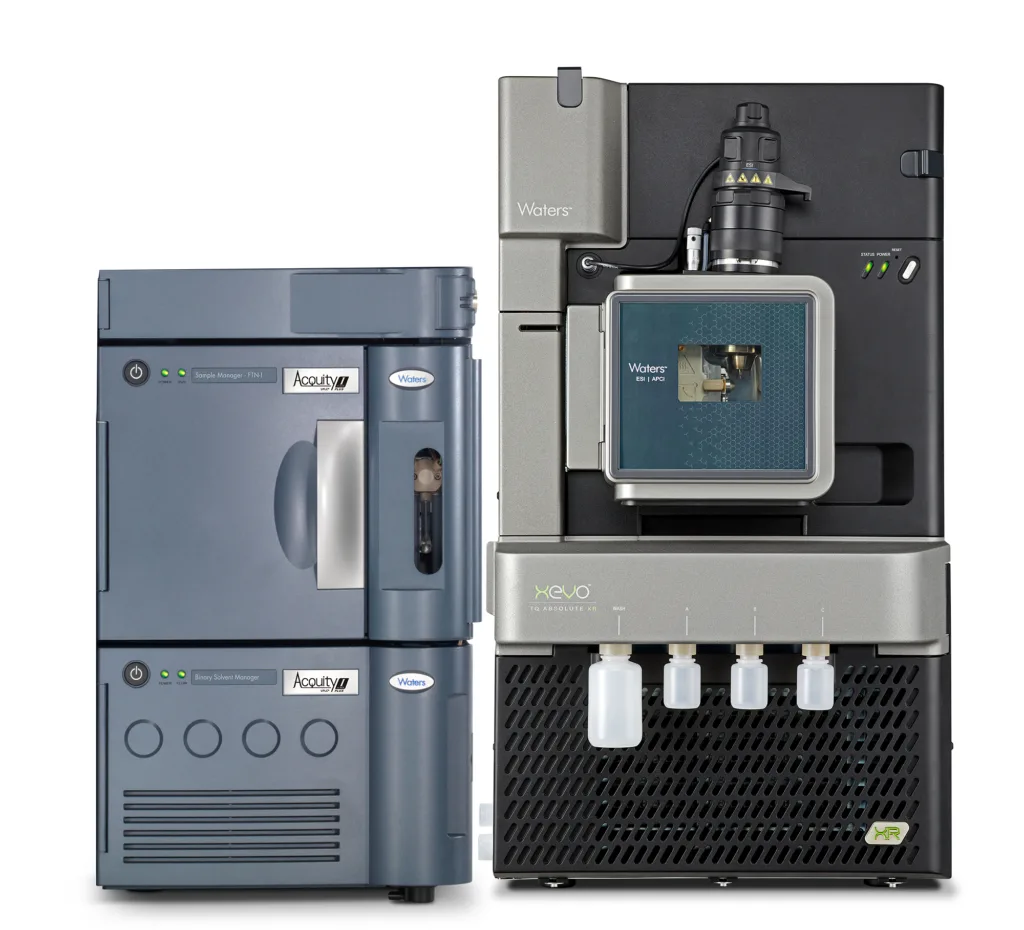
Waters Corporation has launched the Xevo TQ Absolute XR IVD Mass Spectrometer, adding a higher-sensitivity and more contamination-resistant instrument to its MassTrak portfolio of liquid chromatography tandem mass spectrometry systems for clinical laboratories. Unveiled on July 27, 2026, during the Association for Diagnostics and Laboratory Medicine Annual Meeting, the system is available to order and is being positioned for trace-level measurements in women’s health, hormone-related cancer assessment and toxicology.
The central proposition is not simply that the new instrument can detect smaller quantities of an analyte. Waters is attempting to combine lower detection limits with longer periods of stable operation when laboratories process biological samples containing phospholipids, salts and other substances that can gradually contaminate an instrument’s ion path. That combination could be commercially important because analytical sensitivity loses much of its operational value when frequent cleaning, recalibration or maintenance interrupts laboratory throughput.
The launch nevertheless requires careful interpretation. Waters’ sensitivity and robustness figures are company-generated comparisons and application data, rather than evidence from an independent multicentre clinical evaluation. The announcement also describes the system as an IVD platform but does not identify a specific United States Food and Drug Administration clearance, a universally applicable indication or a single regulatory authorization covering every geography and assay that laboratories may develop on the instrument.
What is genuinely new in Waters’ Xevo TQ Absolute XR IVD clinical mass spectrometry system?
The system combines Waters’ ACQUITY UPLC I-Class PLUS platform with the Xevo TQ Absolute XR IVD tandem quadrupole mass spectrometer. Its most important hardware addition is the StepWave XR Ion Guide, which is designed to reduce the impact of contamination as ions move from the sample interface into the mass analyser. Waters says this design allows laboratories to preserve sensitivity and ion-ratio consistency for longer periods when analysing complex matrices.
Waters reports that the instrument can provide up to five times greater sensitivity than other IVD-compliant systems in its comparison set. The company’s supporting note identifies the Waters Xevo TQ-XS IVD and SCIEX 6500 IVD as the two comparison instruments used for that claim. This is an important qualification because “five times greater sensitivity” is not a universal comparison with every clinical mass spectrometer, every ionisation mode or every possible analyte.
The product page presents another performance comparison, stating that the XR system may deliver up to 15 times the sensitivity of the previous Waters product for certain difficult compounds analysed using negative ionisation. These figures can coexist because they use different comparators and analytical conditions, but laboratories will need analyte-specific performance data rather than relying on the largest headline multiple.
The practical change is therefore best understood as an upgraded analytical platform rather than a ready-made clinical answer. The instrument may give laboratories more technical headroom to establish lower quantification limits, reduce sample requirements or develop assays for difficult compounds. Whether those capabilities become clinically useful will depend on the complete method, including sample preparation, chromatographic separation, calibrators, internal standards, quality controls and result interpretation.
How strong is the supporting evidence for the sensitivity and robustness claims?
Waters has published an application note assessing serum estradiol and estrone measurements using the Xevo TQ Absolute XR for clinical research. The method used 250 microlitres of sample, liquid-liquid extraction and chromatographic separation before tandem mass spectrometry analysis. Waters reported lower limits of quantification of 3 picograms per millilitre for estradiol and 1 picogram per millilitre for estrone, with within-run and total precision of no more than 3.2% coefficient of variation across the disclosed quality-control concentrations.
The company also compared estradiol measurements from 39 United Kingdom National External Quality Assessment Service samples with mass spectrometry laboratory trimmed means. The application note reported close agreement, although the analytical work was conducted by Waters and was explicitly presented for clinical research. It should not automatically be interpreted as an independently validated diagnostic assay, evidence of improved patient outcomes or authorization for every proposed clinical use.
Waters’ sixfold robustness claim also needs context. The launch announcement cites a controlled experiment involving more than 12,000 pesticide analyses in a fish-feed matrix, in which the XR instrument reportedly maintained performance for up to six times longer than the earlier Xevo TQ Absolute. This supports the engineering rationale for improved contamination resistance, but the matrix and analytical application are different from routine human clinical testing.
The product page provides a more clinically relevant company example involving more than 30,000 injections of naltrexone and its metabolite in human plasma. Waters reported that the calculated concentrations remained within plus or minus 20% during that study. This adds useful evidence that the design can operate over extended sequences involving a biological matrix, although independent laboratories will still need to establish maintenance intervals and performance stability under their own workloads, sample-preparation methods and assay acceptance criteria.
Why could lower detection limits matter for estradiol and hormone-related cancer assessment?
Estradiol can be challenging to quantify at very low concentrations because some immunoassays may lack the analytical sensitivity or selectivity required for particular research and laboratory applications. Liquid chromatography tandem mass spectrometry can improve molecular selectivity, but the workflow may demand complex extraction, derivatisation or larger sample volumes when the instrument lacks sufficient sensitivity.
Waters’ application work suggests that the XR platform can distinguish very low estradiol and estrone concentrations using a relatively limited serum volume and without derivatisation. That could support laboratories developing methods for populations in which hormone concentrations are expected to be low, including certain women’s health investigations and the monitoring or assessment of hormone-related cancers.
However, analytical sensitivity alone does not establish clinical utility. Laboratories must demonstrate that their method remains accurate across relevant patient populations, medications, endogenous interferences and concentration ranges. They must also ensure that the lower limit of quantification is appropriate for the clinical decision being made, rather than simply being technically achievable.
The distinction is particularly important near clinical decision thresholds. A stronger signal may make a low-concentration result easier to measure, but laboratories still require controlled calibration, traceability, proficiency testing and appropriate reference intervals. The value of the Xevo TQ Absolute XR will therefore be determined by reproducible assay performance, not by sensitivity specifications in isolation.
Can the StepWave XR Ion Guide materially reduce clinical laboratory downtime?
Biological matrices create a persistent operational problem for LC-MS/MS laboratories. Even well-prepared serum, plasma, urine or hair extracts may contain matrix components that accumulate within the ion source and ion-transfer path. As contamination increases, signal intensity, ion ratios, peak shape or quantitative consistency can deteriorate, eventually forcing laboratories to pause testing for cleaning and maintenance.
The StepWave XR Ion Guide is intended to slow that deterioration. Waters says the design resists contamination and maintains optimum sensitivity for longer operating periods, potentially reducing interventions and increasing instrument availability. Cansford Laboratories, an early user cited by Waters, indicated that the system had improved signal stability and analytical confidence when measuring substances near decision cut-offs in human hair.
The commercial significance could be substantial for high-volume laboratories. Unplanned instrument downtime can delay results, require samples to be transferred to another analyser or force testing to be sent to an external laboratory. A system that extends the interval between maintenance events may therefore improve capacity without requiring an immediate increase in instrument numbers.
Those benefits remain laboratory-dependent. Throughput will also be influenced by extraction time, chromatography duration, sample loading, reruns, quality-control failures and staffing. A sixfold improvement in a controlled robustness experiment does not mean every clinical laboratory will achieve six times more usable operating hours. Real-world service records and independently reported injection counts will be more informative after the installed base expands.
What must laboratories validate before using the system for routine clinical testing?
The new Waters system is an analytical platform, not a universal menu of finished assays. Clinical laboratories will need to confirm the intended-use status of the instrument, software, reagents and individual methods in their jurisdiction. The launch announcement does not disclose a specific FDA clearance or claim that every potential estradiol, cancer-assessment or toxicology application is authorized as a complete diagnostic assay.
Method verification will be particularly important when laboratories transfer existing assays from another instrument. Waters’ 2025 hair-toxicology application note was developed using the earlier Xevo TQ Absolute, was labelled for forensic toxicology use only and specifically advised users to perform appropriate method-verification work when moving the application to the XR or another LC-MS system.
That application note demonstrated both the potential and complexity of toxicology testing. Waters reported a rapid four-minute chromatographic cycle and quantification across a broad panel, but some compounds did not satisfy every validation target. Phentermine and metadesnitazine presented accuracy or precision limitations, while several external quality-control results fell outside the stated reference windows.
This is not an argument against the system. It illustrates why laboratories buy complete workflows rather than sensitivity numbers. Sample preparation, extraction recovery, matrix effects, internal-standard availability, chromatography and compound-specific interference can determine whether an assay succeeds, even when the mass spectrometer has sufficient raw sensitivity.
Laboratories will also need to examine operator training, software controls, data-review requirements, laboratory information system connectivity, service coverage and the availability of validated calibrators and quality-control materials. Capital-equipment adoption often depends as much on implementation and support as it does on technical performance.
How does the Xevo TQ Absolute XR launch fit Waters Corporation’s diagnostics expansion?
The product arrives during a major change in Waters Corporation’s scale and portfolio. Waters completed its acquisition of the Biosciences and Diagnostic Solutions businesses previously owned by Becton, Dickinson and Company on February 9, 2026, creating a larger organisation with approximately 16,000 employees and a much broader presence in regulated diagnostic environments.
In the first quarter of 2026, the acquired Biosciences and Diagnostic Solutions businesses contributed $520 million of reported revenue from the closing date through the end of the quarter. The acquired Diagnostic Solutions operation generated $288 million on an owned-period basis, while Waters’ existing Clinical Business Unit reported $61 million. Waters has grouped these activities within its Advanced Diagnostics Division.
The Xevo TQ Absolute XR is therefore more strategically relevant than a routine instrument refresh. It gives Waters another platform around which it can combine analytical instruments, clinical diagnostics expertise, informatics, service and customer relationships from the enlarged company. The potential commercial advantage lies in cross-selling and workflow integration, particularly if Waters can introduce mass spectrometry into laboratories already using other products from its diagnostics portfolio.
Management raised its 2026 organic constant-currency revenue growth guidance to between 6.5% and 8%, while projecting total reported revenue of $6.405 billion to $6.455 billion. The company also increased adjusted earnings-per-share guidance to between $14.40 and $14.60. New products such as the Xevo TQ Absolute XR will be judged partly on whether they help sustain that growth after the initial contribution from acquired businesses is separated from organic performance.
What does Waters Corporation’s share price indicate about investor sentiment?
Waters Corporation shares closed at $371.20 on July 27, 2026, down 0.93% during the session in which the Xevo launch was announced. The movement does not establish that investors reacted negatively to the product, particularly because a single instrument launch is unlikely to dominate the valuation of a company with a market capitalisation of approximately $36.45 billion.
The stock was approximately 3.8% higher than its July 20 close, but about 0.9% below its June 26 level. It was also around 2.3% lower for 2026 and remained between its 52-week low of $275.05 and high of $414.15. This suggests broadly constructive but not euphoric sentiment, with investors appearing more focused on integration, margins, organic growth and execution across the enlarged company than on one product announcement.
The next significant financial checkpoint is Waters Corporation’s second-quarter results, scheduled for August 4, 2026. Management commentary on the Advanced Diagnostics Division, product-launch traction and integration synergies may provide a clearer indication of how quickly the expanded clinical portfolio is influencing orders and revenue.
What will determine whether the Xevo TQ Absolute XR becomes a meaningful clinical platform?
The initial commercial test will be whether laboratories order the system for routine regulated environments rather than primarily for specialist research or early evaluation. Waters will need to demonstrate that the instrument’s performance advantages can be translated into validated assays, longer maintenance intervals, fewer reruns and economically meaningful increases in laboratory capacity.
Independent application data will be particularly valuable. Laboratories will want to see performance across multiple sites, operators, patient matrices and assay types, including results close to medical decision thresholds. They will also examine whether analytical stability is maintained when an instrument runs mixed workloads rather than a single controlled application over thousands of injections.
Waters has presented a technically credible case that greater sensitivity and a more contamination-resistant ion path can address genuine clinical laboratory problems. The launch is also well aligned with the company’s effort to build a larger Advanced Diagnostics business following the Becton, Dickinson and Company transaction.
The harder phase begins after the launch event. Xevo TQ Absolute XR will need to prove that improved analytical specifications can consistently reduce operational friction in real laboratories, while supporting methods that meet local regulatory, quality and clinical requirements. That evidence, rather than the largest sensitivity multiple, will determine whether the system becomes an important recurring contributor to Waters Corporation’s diagnostics growth.