
Auxilium Biotechnologies has used its AMP-1 orbital bioprinter to manufacture kidney, liver and cartilage tissue constructs aboard the International Space Station, alongside 28 nerve repair implants produced during the same mission. The kidney and liver work represents the first reported manufacturing of those tissue types in orbit, giving the San Diego biotechnology company a significant technical milestone in microgravity-based biofabrication.
The biological samples and implants returned to Earth following the SpaceX CRS-34 mission, which completed its Pacific Ocean splashdown on June 17, 2026. The returned tissues are now entering the stage that will determine the scientific value of the mission, including examination of cell survival, distribution, structural integrity, biological activity and differences from comparable materials manufactured under normal gravity.
The distinction between printing a tissue construct and producing a clinically usable organ is essential. Auxilium has demonstrated that its hardware can manufacture multiple biological and medical product types during one orbital mission, but it has not produced transplantable kidneys or livers. The immediate significance lies in manufacturing control, platform versatility and the possibility that microgravity may help researchers organize cells and embedded materials more precisely than conventional Earth-based processes.
The mission may therefore prove more important as an industrial platform demonstration than as an organ replacement breakthrough. A system that can switch between tissue designs and implantable products, operate with limited astronaut intervention and return several product classes from one flight offers a more credible starting point for orbital manufacturing than an isolated laboratory experiment.
Why does producing three tissue types and 28 implants in one mission matter for orbital manufacturing?
Many microgravity biotechnology experiments are designed around one material, one tissue type or one narrowly defined research question. Auxilium’s latest mission instead tested whether a single manufacturing platform could handle kidney, liver and cartilage bio-inks while also producing nerve repair implants during the same flight.
That breadth matters because access to orbit remains expensive, logistically constrained and dependent on tightly scheduled launch and return missions. Commercial customers are unlikely to build sustainable orbital manufacturing programmes around hardware that performs only one specialised experiment at a time. A platform capable of supporting different research groups, materials and product configurations could spread mission costs across several programmes and improve utilisation of limited orbital laboratory capacity.
The production of 28 implants also introduces an early throughput signal. It suggests that AMP-1 is moving beyond printing a single showcase object and towards repeated manufacturing within one operational cycle. For commercial partners, repeat output is more meaningful than novelty alone because it begins to address whether orbital production can eventually support batches, process validation and predictable scheduling.
However, manufacturing multiple items does not establish commercial scalability by itself. Auxilium will need to show that products made at different points in the mission were consistent, that printing performance did not deteriorate between runs and that the system maintained control over temperature, sterility, material handling and print accuracy.
Future missions will also need to demonstrate reproducibility across cartridges, flights, operators and space platforms. Twenty-eight implants made during one mission may be an encouraging engineering result, but regulated manufacturing requires evidence that every unit falls within clearly defined specifications.
What advantage does microgravity offer when cells and drug particles must remain evenly distributed?
Gravity can complicate tissue fabrication because cells, particles and other suspended materials may settle, separate or accumulate unevenly before a structure has stabilised. In engineered tissues, location matters. Different cell populations may need to be placed in specific arrangements, while nutrients, signalling molecules and structural materials must be distributed in ways that support survival and function.
Microgravity can reduce sedimentation during printing and curing. This may allow cells and therapeutic particles to remain suspended more uniformly within a bio-ink, giving manufacturers greater control over the internal composition of a printed construct. For Auxilium, the same principle is relevant to both tissue engineering and nerve repair implants containing biologically active materials.
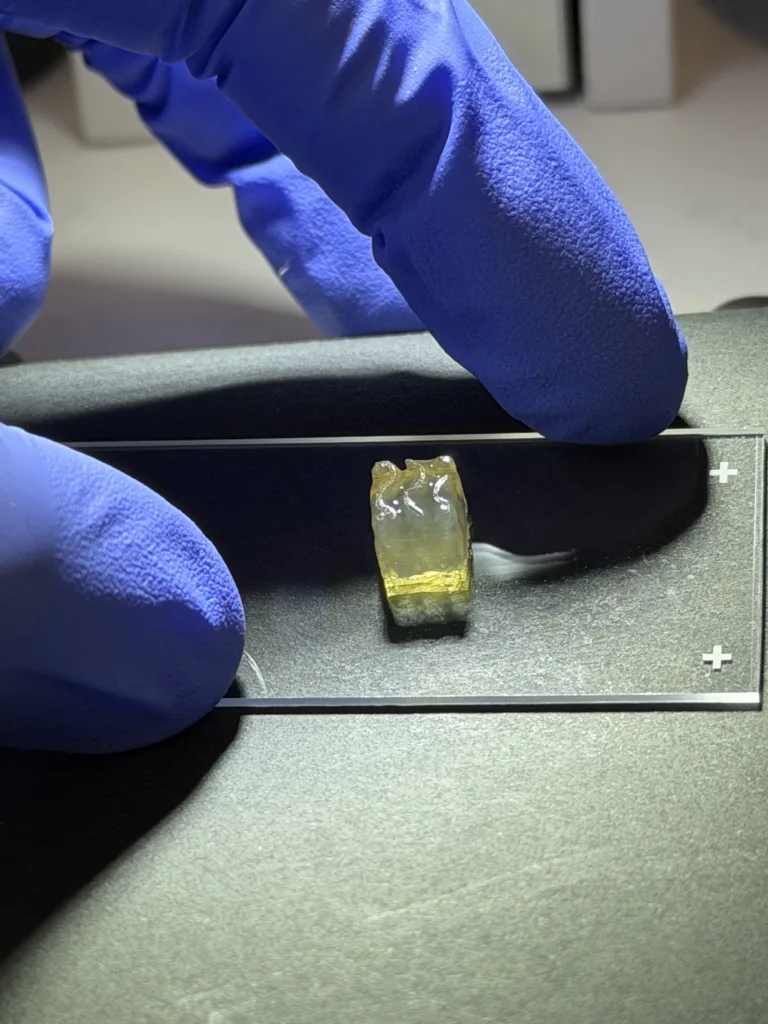
Uniformity is nevertheless only one component of tissue performance. The returned kidney and liver constructs will need to be examined for cell viability, tissue organisation, gene expression and organ-specific functions. Researchers will also need to determine whether the constructs retained their intended properties during re-entry, splashdown, transportation and laboratory processing.
A visually uniform sample could still lack important biological characteristics. Liver tissue models, for example, may be evaluated for functions such as albumin production, metabolic activity and response to toxic compounds. Kidney constructs may require evidence that relevant cell types maintain their identity, organisation and transport functions.
Comparison with matched Earth-manufactured controls will be especially important. Without strong ground controls, researchers cannot determine whether any observed improvement resulted from microgravity, changes in the printing protocol, differences in materials or other mission-specific factors.
The next meaningful disclosure will therefore be a detailed dataset rather than another successful-print announcement. Peer-reviewed results describing tissue architecture, viability and functional performance would allow the wider regenerative medicine field to judge whether orbital production delivers a scientifically material advantage.
Why are tissue patches and organoids more realistic near-term products than replacement organs?
The idea of printing an entire replacement kidney or liver in space is compelling, but it remains far beyond the evidence produced by this mission. Full-sized organs require extensive vascular networks capable of delivering oxygen and nutrients throughout thick tissue. They must also reproduce complex architecture, withstand surgical implantation and integrate safely with the recipient’s blood supply, immune system and surrounding anatomy.
Smaller tissue patches present a more plausible translational pathway. A liver patch, for example, would not need to replace the entire organ. It might instead be designed to support damaged tissue, deliver therapeutic cells or restore a limited biological function. Smaller constructs are easier to nourish, test and manufacture consistently than complete organs.
Organoids and laboratory tissue models could offer an even nearer commercial opportunity. These three-dimensional models are increasingly used to study diseases, assess drug toxicity and examine how human cells respond to experimental therapies. Kidney and liver tissues are particularly relevant because both organs play central roles in drug clearance, metabolism and safety assessment.
Regulatory interest in new approach methodologies is strengthening the potential market for more human-relevant tissue models. The United States Food and Drug Administration has been developing frameworks for validating alternatives that may supplement or reduce certain forms of animal testing, while the National Institutes of Health has expanded its focus on human-based research technologies.
That policy direction does not mean every organoid or printed tissue will automatically be accepted for regulatory decision-making. Developers must establish a clearly defined context of use and show that their models are reliable, reproducible and predictive of human outcomes. A model designed to identify liver toxicity may require different validation from one intended to study disease progression or select treatments.
Orbital manufacturing adds another variable to that validation process. Researchers would need to demonstrate that tissues produced in space are sufficiently consistent, stable after return and meaningfully better than Earth-produced models. The scientific gain must justify the additional cost and operational complexity.
Can AMP-1 become a commercial platform rather than remain an International Space Station experiment?
Auxilium is positioning AMP-1 as a reusable orbital manufacturing capability that could serve biotechnology companies, academic laboratories and medical device developers. Its partnership with Starlab Space provides a potential route beyond the International Space Station as commercial low Earth orbit infrastructure develops.
The timing is strategically relevant because NASA is preparing for a transition from the International Space Station to commercially operated orbital destinations. Biotechnology companies that establish flight heritage, validated hardware and customer relationships before that transition may be better placed to secure laboratory capacity on future stations.
Auxilium’s multi-product mission supports that positioning. A commercial space station operator would benefit from compact equipment capable of serving several customers rather than a dedicated system used occasionally by one research programme. Remote operation and the ability to update manufacturing instructions from Earth could further reduce the burden placed on astronauts.
Yet a sustainable business model will require more than technical access to a station. Auxilium must identify products for which microgravity creates enough additional value to offset launch, integration, astronaut time, orbital storage, sample return and insurance costs.
High-value research models, personalised tissues, advanced implants and products that cannot be manufactured reliably under normal gravity may be stronger candidates than routine biomedical materials. The economics become less convincing when an equivalent product can be made cheaply in a terrestrial cleanroom.
Quality control will also become more demanding as the platform moves closer to regulated products. Orbital manufacturing systems may need real-time process monitoring, digital batch records, contamination detection and methods for rejecting a product before it returns to Earth. Regulators and manufacturers will need confidence that events during launch, orbit and re-entry are fully documented.
How does the orbital bioprinting programme connect with Auxilium’s nerve repair strategy?
Auxilium’s original therapeutic focus is traumatic peripheral nerve injury. Its NeuroSpan Bridge is an investigational implant designed with microchannels that seek to guide regenerating nerve fibres across an injury while preserving their organisation.
The orbital manufacturing programme emerged partly from the challenge of distributing drug-containing particles and other components uniformly within nerve repair implants. If therapeutic materials settle during Earth-based manufacturing, different regions of an implant may contain different concentrations, potentially affecting how regenerative signals are delivered.
Microgravity may provide a way to keep those materials suspended while the implant is formed. The 28 units produced during the latest mission therefore connect the space programme with a defined medical device development strategy rather than an entirely separate research venture.
The link must still be evaluated carefully. Printing an implant successfully in orbit does not establish that it performs better in patients, improves nerve regeneration or provides a commercially viable alternative to terrestrial production. Those questions require material testing, preclinical comparisons and appropriately designed clinical studies.
NeuroSpan Bridge is already described as an investigational device in clinical evaluation, but results from that programme should not be conflated with the performance of the space-manufactured implants. Auxilium will need to show whether orbital production changes the implant’s physical properties, drug distribution or biological performance in a clinically meaningful way.
If no meaningful difference emerges, space manufacturing may remain an engineering accomplishment without a strong medical rationale. If the orbital devices show superior consistency or therapeutic delivery, the company would have a more defensible case for incorporating microgravity into its long-term manufacturing strategy.
What evidence would turn Auxilium’s space bioprinting milestone into a medical breakthrough?
The first priority is a transparent comparison between orbital samples and matched ground controls. Researchers will need data on cell viability, distribution, tissue-specific markers, structural organisation and functional activity. Any claimed improvement should be consistent across several samples rather than driven by one unusually successful construct.
The second requirement is durability. The tissues must retain useful properties after return to Earth, because most near-term products would still be used in terrestrial research or medicine. A construct that performs well in orbit but deteriorates during return would have limited commercial value.
The third requirement is repeatability across missions. Orbital biotechnology cannot depend on one successful flight. Auxilium must demonstrate that AMP-1 can manufacture comparable products under different mission conditions and eventually on different space stations.
Commercial partners will also look for evidence that manufacturing time, cartridge capacity and sample yields are improving. A platform that can reliably serve several customers per mission would be more attractive than one requiring extensive customisation for each experiment.
The July 2026 achievement gives Auxilium a credible technical story at the intersection of regenerative medicine and commercial space infrastructure. It demonstrates that kidney, liver and cartilage constructs can be printed alongside implantable products using one orbital system.
The harder work begins with the returned samples. Their biological performance, manufacturing consistency and economic value will decide whether AMP-1 becomes a useful biomedical factory in orbit or remains an impressive demonstration of what can be printed when gravity is temporarily removed from the equation.


