The United States Food and Drug Administration (FDA) has approved Sanofi’s Sarclisa Escena for subcutaneous administration through the CirCLIQ on-body injector, creating the first FDA-authorised anticancer treatment that can be delivered using a wearable injector. The regulator approved the fixed 1,400-milligram dose on July 9, 2026 for several multiple myeloma treatment combinations already supported by the intravenous Sarclisa franchise.
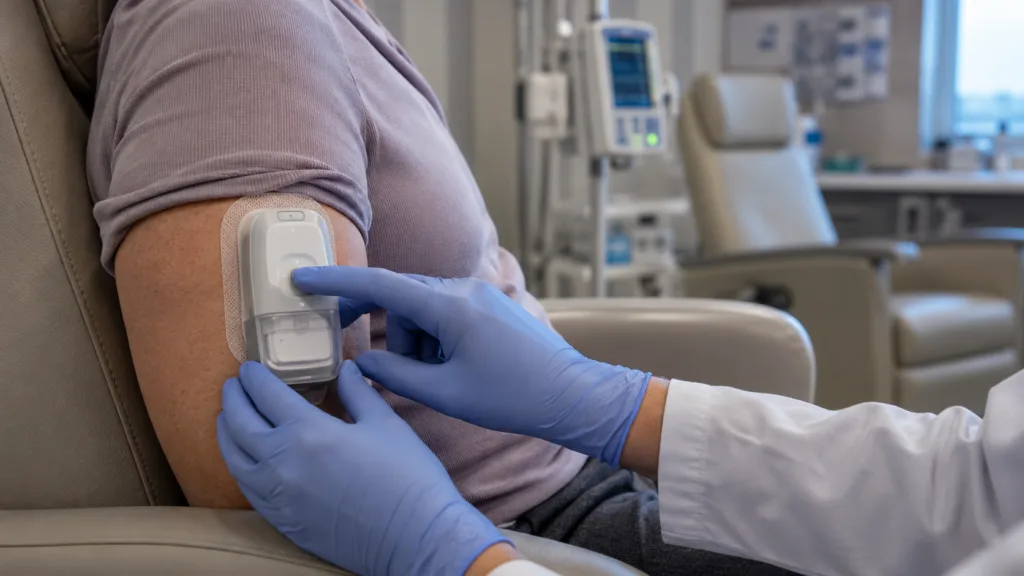
The approval turns Enable Injections’ enFuse drug-delivery platform into a commercial oncology technology rather than merely an experimental device used in clinical trials. CirCLIQ is designed to deliver the high-volume biologic beneath the skin after a healthcare professional activates the device, allowing administration to proceed hands-free in approximately 13 minutes instead of requiring a prolonged intravenous infusion or several minutes of forceful manual injection.
The regulatory milestone has consequences beyond a single multiple myeloma product. It provides a closely watched test of whether on-body injectors can move complex biologic treatments out of infusion chairs, reduce nursing workload and support more flexible cancer-care models without sacrificing dose reliability, safety or clinical efficacy.
Why is the Sarclisa Escena wearable injector approval important for oncology drug delivery?
On-body injectors are not new to healthcare, but oncology has been a more difficult environment for adoption because anticancer biologics can require large doses, close clinical monitoring and rigorous control of administration reactions. The approval of Sarclisa Escena shows that a wearable system can meet regulatory standards for delivering a high-volume monoclonal antibody used repeatedly across different stages of multiple myeloma.
The CirCLIQ device is based on Enable Injections’ enFuse platform and uses an automated delivery mechanism with a concealed, retractable 30-gauge needle. Sanofi said the needle is shorter and thinner than needles commonly used for large-volume subcutaneous injections, while the hands-free design is intended to reduce the physical effort required from nurses.
That distinction matters because manual delivery of a large-volume subcutaneous biologic can involve pushing a high-resistance syringe for several minutes. An automated device can free the clinician to observe the patient, prepare other medicines, document treatment or support additional patients instead of maintaining constant pressure on a syringe.
The approval does not make Sarclisa Escena a patient-operated consumer wearable. The medicine is administered by a healthcare provider, and the product’s warnings include systemic administration reactions, injection-site reactions, neutropenia, infections, secondary malignancies, laboratory-test interference and embryo-fetal toxicity.
Its immediate value is therefore likely to emerge inside oncology centres and other supervised treatment settings. The longer-term opportunity is whether experience with the device can eventually support broader decentralisation, including home administration where regulations, clinical protocols and reimbursement permit.
How does CirCLIQ reduce the burden of repeated multiple myeloma treatment?
Multiple myeloma is generally managed as a long-term disease requiring combinations of medicines delivered over repeated treatment cycles. Even when therapy controls the cancer, patients may spend substantial time travelling to clinics, waiting for preparation, receiving infusions and undergoing post-treatment monitoring.
Traditional intravenous Sarclisa administration can take considerably longer than the approximately 13-minute median injection time reported with the wearable system. The shorter administration window does not eliminate the need for clinical assessment, accompanying medicines or safety observation, but it can reduce the time during which a patient occupies an infusion chair.
The difference becomes more significant when multiplied across months of treatment and hundreds of patients. Infusion capacity is a constrained resource in many cancer centres. A therapy that can be delivered without a long infusion may allow hospitals to treat additional patients using the same physical space and workforce.
Sanofi has also positioned the on-body injector as a way to make the treatment experience less intrusive. In the Phase 3 IRAKLIA trial, 70% of patients using the wearable injector reported being satisfied or very satisfied with administration, compared with 53.4% of patients receiving intravenous Sarclisa. In the Phase 2 IZALCO study, 74.5% of patients who experienced both delivery methods preferred the on-body injector, while 17% preferred manual injection.
Patient preference will not determine prescribing by itself. Physicians must still choose the most appropriate anti-CD38 therapy and accompanying regimen based on disease stage, prior treatment, risk, tolerability and access. The satisfaction findings nevertheless suggest that delivery design can influence how patients experience a medicine even when the active antibody remains unchanged.
What clinical evidence convinced the FDA that subcutaneous Sarclisa could match intravenous treatment?
The central evidence came from IRAKLIA, an open-label Phase 3 non-inferiority trial involving 531 patients with relapsed or refractory multiple myeloma. Participants received Sarclisa with pomalidomide and dexamethasone, delivered either as a fixed subcutaneous dose through the wearable system or as the conventional weight-based intravenous formulation.
The subcutaneous arm produced an independently reviewed objective response rate of 71.1%, compared with 70.5% in the intravenous arm. The study also met its pharmacokinetic objective, showing that drug exposure at steady state was sufficient relative to the intravenous formulation.
The approval was supported by additional studies covering other Sarclisa combinations. In the Phase 2 IZALCO study, the objective response rate was 79.7% among 74 patients receiving subcutaneous Sarclisa with carfilzomib and dexamethasone. In the IsaSocut study involving transplant-ineligible patients with newly diagnosed multiple myeloma, the objective response rate reached 97.3% with the bortezomib, lenalidomide and dexamethasone combination.
These trials were designed primarily to demonstrate that changing the delivery route did not compromise the established activity of isatuximab. They were not intended to prove that the wearable version treats the cancer more effectively than intravenous Sarclisa.
The clinical argument is instead that similar efficacy and pharmacokinetics can be preserved while changing the administration experience. That can still carry substantial commercial and healthcare value when patients require frequent, long-duration therapy.
Does the wearable formulation improve safety as well as convenience?
The most visible safety difference involved administration-related reactions. In IRAKLIA, systemic reactions occurred in 1.5% of patients receiving Sarclisa through the wearable injector, compared with infusion reactions in 25% of patients receiving the intravenous formulation. Local injection-site reactions occurred in only 0.4% of more than 5,100 wearable-device injections and were almost entirely mild.
The reduction may make administration easier to manage, but it does not mean the subcutaneous formulation is free of serious toxicity. Multiple myeloma regimens combine several active medicines, and substantial rates of haematological abnormalities remained visible in the trial.
Grade 3 or higher neutropenia occurred in 84.7% of patients in the wearable-injector arm and 74.3% in the intravenous arm. Severe thrombocytopenia occurred in 26.1% and 23%, respectively, while severe anaemia was reported in 17.6% and 19.5%. Pneumonia remained one of the most common serious non-haematological adverse events in both groups.
The device therefore changes how the antibody enters the body, but it does not remove the clinical risks associated with isatuximab or the wider treatment combination. Patients will continue to require blood-count monitoring, infection management and assessment for systemic reactions.
The safety profile also highlights why oncology wearable delivery is more complicated than attaching a patch and allowing a patient to leave immediately. Clinics must develop protocols governing device placement, confirmation of successful dosing, reaction monitoring and management of any interrupted administration.
How does Sarclisa Escena change Sanofi’s competition with Darzalex Faspro?
Sanofi’s anti-CD38 franchise competes most directly with Johnson & Johnson’s daratumumab franchise. Darzalex Faspro is already widely used as a subcutaneous multiple myeloma treatment and is available across a broad set of treatment combinations and disease stages. It contains daratumumab with recombinant hyaluronidase and is administered as a manual subcutaneous injection.
Sarclisa Escena does not enter the market as the first subcutaneous anti-CD38 antibody. Its differentiation lies in the availability of both automated wearable administration and manual injection without relying on a hyaluronidase component.
That delivery flexibility could help Sanofi compete for treatment centres seeking to reduce hands-on administration time. However, device convenience will be only one factor in a market shaped by established prescribing habits, clinical guidelines, treatment combinations, contracting and the strength of long-term efficacy evidence.
Darzalex has a substantial first-mover advantage, broader physician familiarity and an extensive set of approved uses. Sanofi must persuade clinicians that Sarclisa’s clinical profile and wearable delivery justify changing or expanding their anti-CD38 treatment choices.
The wearable system could be particularly relevant where clinic capacity is under pressure. A hospital may value a therapy that reduces infusion-chair occupation and manual nursing work even when drug efficacy appears broadly comparable across competing options.
Commercial success will depend on whether those operational savings are meaningful enough to influence formulary decisions and whether reimbursement adequately covers the medicine, device and associated administration.
Why does the approval validate Enable Injections’ business model?
Enable Injections has spent years developing enFuse as a platform for delivering large-volume medicines that would otherwise require intravenous infusion or difficult manual injection. Sarclisa Escena gives the privately held company a prominent commercial validation in one of the most demanding therapeutic settings.
Sanofi’s relationship with Enable Injections extends beyond a standard supplier contract. The pharmaceutical company invested $30 million in Enable Injections in January 2026 to expand manufacturing, strengthen the supply chain and support commercial growth. Enable Injections had previously raised $50 million in a Sanofi-led Series B financing and completed a $215 million Series C round in 2022.
The investment suggested that Sanofi viewed manufacturing capacity as a strategic part of the product launch. Drug-device combinations require dependable production of both components. A shortage of injector units could constrain medicine sales even when Sanofi has sufficient antibody supply.
Enable Injections has also built a 90,000-square-foot manufacturing centre in Ohio to support larger-scale production. The challenge now is to demonstrate high yields, consistent device performance and the ability to meet demand across multiple regions.
A successful rollout could make enFuse more attractive to other pharmaceutical companies developing high-volume biologics. Platform technologies gain value when they can be used with several medicines rather than one partner’s product.
The opposite risk is concentration. If early commercial adoption of Sarclisa Escena is slower than expected or manufacturing problems emerge, perceptions of the wider platform could be affected. The first oncology launch will become an operating test for Enable Injections as much as a clinical milestone.
Could on-body injectors eventually move cancer therapy into patients’ homes?
European approval of subcutaneous Sarclisa permits administration in outpatient or home settings where local rules allow it. In the IRAKLIA programme, home administration took a median of 13 minutes, all injections were completed and no new safety signals emerged among patients treated in countries where at-home use was permitted.
The United States approval should not automatically be interpreted as permission for unsupervised self-administration. Sarclisa Escena is given by a healthcare provider, and decisions about home delivery would require appropriate clinical oversight, payer coverage and local operating protocols.
A realistic near-term model may involve nurse-supported home administration or specialised outpatient centres rather than patients independently applying the device. That could still reduce travel and hospital congestion, especially for people who live far from major cancer centres.
Several barriers remain. Providers must determine which patients are medically stable enough for decentralised dosing, how reactions will be handled and how the device will be stored, transported and documented. Insurers must decide whether home-based delivery produces sufficient savings to justify reimbursement.
The commercial opportunity extends beyond convenience. Moving selected maintenance treatments into lower-cost settings could change healthcare economics, particularly as cancer becomes a longer-term condition for many patients.
The first FDA approval creates a regulatory precedent, but broader adoption will depend on real-world evidence showing that decentralised administration is safe, reliable and financially sustainable.
What manufacturing and device-performance risks could affect the commercial rollout?
Wearable injectors add another layer of complexity to an already demanding biologic supply chain. Sanofi must manufacture the antibody formulation, while Enable Injections must produce a device that activates correctly, inserts the needle, delivers the full dose and retracts safely.
Device failures may take several forms, including incomplete delivery, leakage, adhesion problems, premature activation or user error. Even infrequent failures can become commercially important when a device is paired with an expensive cancer medicine.
Training will therefore be central. Nurses and other healthcare professionals must understand placement, activation, monitoring and confirmation that dosing has finished. Hospitals may need procedures for managing incomplete injections and deciding whether any replacement dose is required.
Sanofi and Enable Injections must also maintain adequate production capacity as use expands across the United States, European Union and United Kingdom. Japan has approved manual subcutaneous Sarclisa, while the wearable injector remains under regulatory review there.
Global expansion means the device and drug must satisfy different regulatory, labelling and pharmacovigilance requirements. Any significant manufacturing change may require additional validation or regulatory notification.
The companies have secured an important approval, but the commercial reputation of the platform will be built dose by dose. Reliable execution may receive less publicity than the regulatory milestone, yet it will determine whether treatment centres trust the device sufficiently to change established workflows.
How did investors respond to Sanofi’s wearable oncology milestone?
Sanofi’s American depositary receipts closed at approximately $43.50 on July 10, declining about 0.9% during the session. The muted response suggests investors viewed the approval as strategically positive but not large enough on its own to materially change the valuation of a pharmaceutical group with a market capitalisation above $50 billion.
Sarclisa is nevertheless becoming more important within Sanofi’s oncology strategy. The company said Sarclisa-based regimens had been prescribed to more than 70,000 patients globally and that the medicine was approved in almost 60 countries before the latest United States expansion.
The wearable formulation could support revenue growth by strengthening competition against Darzalex, increasing treatment-centre acceptance and extending the commercial life of the franchise. The financial effect will depend on pricing, reimbursement and whether patients shift from intravenous Sarclisa rather than representing new users of the medicine.
For Enable Injections, the strategic effect may be proportionally larger. Commercial use in oncology gives the company a reference product that could help attract additional pharmaceutical partnerships, investment and manufacturing demand.
What should hospitals, patients and medtech companies watch after the FDA approval?
The first signal will be how quickly United States cancer centres add Sarclisa Escena to formularies and establish workflows for the CirCLIQ injector. Uptake may vary depending on existing anti-CD38 prescribing, nursing capacity and agreements with payers.
Real-world administration times will also matter. Clinical trials reported a median duration of approximately 13 minutes, but hospitals will evaluate the complete process, including preparation, device placement, observation and documentation.
Patient preference should be assessed outside controlled trials, particularly among older people, patients with fragile skin and those receiving complicated multi-drug regimens. A wearable device can simplify one part of care while the broader treatment schedule remains demanding.
Enable Injections’ manufacturing performance will receive close attention as commercial volumes rise. Consistent supply and low device-failure rates could validate enFuse for additional oncology and immunology biologics.
The approval gives Sanofi a differentiated delivery option in a fiercely competitive multiple myeloma market. It also gives the medical-device sector a milestone that has been discussed for years but rarely achieved: a high-volume wearable injector becoming part of routine cancer treatment.
The most meaningful change may not be visible in response rates or survival curves because the active medicine remains isatuximab. It may appear in quieter measures such as fewer hours spent in infusion chairs, less manual work for nurses and greater flexibility in where repeated treatment can be delivered.