
Quoin Pharmaceuticals Ltd. has received U.S. Food and Drug Administration clearance for an investigational new drug application covering QRX003 in generalized inflammatory peeling skin syndrome, allowing the Nasdaq-listed rare-disease developer to initiate a Phase 2 trial in the second half of 2026. The study will enroll six to eight pediatric and adult participants in the United States and Europe, with QRX003 applied twice daily to more than 80% of the body surface for 52 weeks.
The clearance moves peeling skin syndrome from isolated clinical observation into formal company-sponsored development. That distinction matters because QRX003 has so far generated encouraging evidence in only one pediatric patient with the disorder, while the proposed Phase 2 study must determine whether those findings can be reproduced across a genetically and clinically diverse group.
Quoin Pharmaceuticals is seeking to develop QRX003 as a topical treatment platform for rare disorders involving abnormal skin shedding and impaired barrier function. Peeling skin syndrome becomes the second indication with a cleared U.S. investigational new drug application for QRX003, joining the more advanced Netherton syndrome programme.
The regulatory milestone therefore carries two different meanings. It creates the first structured clinical pathway for an overlooked disorder with no approved treatment, while simultaneously testing whether Quoin can extend QRX003 beyond the biological setting in which most of its clinical development has occurred.
Why does FDA clearance matter when peeling skin syndrome has no approved therapy?
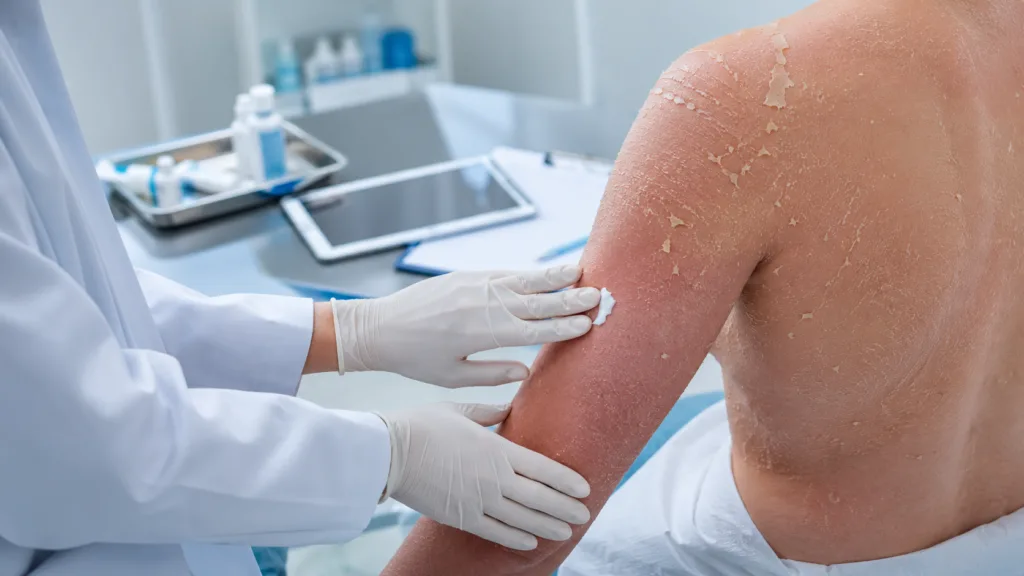
Generalized inflammatory peeling skin syndrome is an exceptionally rare inherited skin disorder associated with loss-of-function variants in the CDSN gene. The gene produces corneodesmosin, a protein involved in maintaining adhesion between cells in the outer layers of the epidermis. When that adhesion is impaired, superficial skin layers separate too easily, producing continuous peeling, inflammation, pain and chronic itching.
The burden extends beyond a visible dermatological condition. A persistently defective skin barrier can expose patients to infection, discomfort, disturbed sleep and substantial limitations on ordinary activities. The rarity of the disorder also creates diagnostic difficulties and leaves clinicians with little disease-specific evidence to guide long-term management.
Treatment has largely centred on symptom control and supportive skin care. Emollients, topical anti-inflammatory approaches and other measures may ease particular manifestations, but they do not restore the underlying structural defect. Scattered case reports have explored immune-modulating treatments, yet those observations cannot establish a standard of care or provide the regulatory evidence required for an approved therapy.
Against that background, the significance of the FDA decision is not that QRX003 has been validated as effective. An investigational new drug clearance means the proposed clinical programme may proceed after the regulator has reviewed the available preclinical, manufacturing and safety information. It is permission to test the treatment, not a preliminary approval of its benefits.
Even so, entering a formal Phase 2 programme represents a meaningful change for an indication that has historically attracted little commercial drug development. Potential sites, investigators and participants have already been identified, which could reduce some of the recruitment uncertainty commonly associated with ultra-rare disease trials.
The difficult part begins after activation. When the addressable population is extremely small, each enrolled patient carries unusual statistical and clinical weight. A single atypical response, discontinuation or safety event can materially alter the interpretation of the entire dataset.
Can a mechanism developed for Netherton syndrome translate into CDSN-driven disease?
QRX003 is a topical lotion containing a broad-spectrum serine protease inhibitor. It is designed to reduce excessive protease activity involved in uncontrolled skin shedding, with the aim of supporting a more stable and functional epidermal barrier.
That mechanism was initially developed around Netherton syndrome, another rare genetic skin disorder. Netherton syndrome is caused by variants in the SPINK5 gene that result in deficient production of LEKTI, a protein that normally regulates epidermal kallikrein activity. Without sufficient regulation, excessive protease activity contributes to abnormal desquamation, inflammation and severe barrier dysfunction.
Peeling skin syndrome is not biologically identical. The inflammatory generalized form targeted by Quoin is associated with deficient corneodesmosin and weakened cellular cohesion rather than the same SPINK5 and LEKTI pathway. QRX003 is therefore not replacing the missing corneodesmosin protein or correcting the underlying CDSN variant.
The development argument rests on a shared downstream problem. Both disorders involve abnormal shedding and a compromised skin barrier, creating the possibility that controlling protease activity could improve epidermal stability even when the initiating genetic defects differ.
That is a scientifically plausible bridge, but it remains a bridge that must be clinically demonstrated. A mechanism capable of moderating kallikrein hyperactivity in Netherton syndrome may not deliver the same magnitude or consistency of benefit when structural adhesion is impaired by corneodesmosin deficiency.
Quoin’s existing pediatric observation provides the first human signal supporting the expansion. One patient reportedly experienced clinically meaningful improvement by week 12 across the Modified Ichthyosis Area Severity Index, Investigator’s Global Assessment and a pediatric dermatology quality-of-life measure. Treatment has continued for more than 15 months without a reported adverse event.
The duration is encouraging because whole-body therapies for chronic genetic skin disorders must remain tolerable over prolonged use. Nevertheless, one uncontrolled patient cannot separate a treatment effect from natural fluctuation, supportive care, observer expectations or changes in disease severity over time.
The Phase 2 trial must show that the initial response was reproducible rather than exceptional. It will also need to clarify whether improvement reflects temporary symptom control, stronger barrier function or a more durable modification of the disease process while treatment continues.
What can a six-to-eight-patient, 52-week Phase 2 study realistically establish?
A trial enrolling six to eight participants would appear almost vanishingly small in a common dermatological indication. In peeling skin syndrome, however, conventional recruitment expectations are unrealistic because the diagnosed population is limited, geographically dispersed and likely heterogeneous.
Small enrollment does not make the study uninformative. Repeated measurements over 52 weeks could generate substantial within-patient data on skin severity, itching, pain, quality of life, treatment adherence and safety. A long observation period could also help distinguish sustained improvement from a brief response.
The more important question is whether the trial design can produce an interpretable treatment effect. Without a large control group, baseline documentation and the natural history of each participant become critical. Investigators will need to demonstrate that changes exceed normal variability and are consistent across clinical assessments, patient-reported outcomes and potentially photographic or objective barrier measurements.
Mixing pediatric and adult participants may broaden the safety dataset, but it could also increase variability. Disease duration, baseline severity, skin surface involvement, prior treatment and age-related differences in barrier function may influence response. With only six to eight patients, subgroup analysis will be extremely limited.
Endpoint selection will carry unusual regulatory importance. Measures such as the Modified Ichthyosis Area Severity Index and Investigator’s Global Assessment can quantify visible changes, while quality-of-life instruments can capture effects that matter directly to patients. However, instruments developed or adapted for related skin disorders may require careful justification when used in peeling skin syndrome.
The 52-week duration should provide information that a short proof-of-concept study could not. It may reveal whether the response plateaus, continues to improve, varies seasonally or disappears despite ongoing treatment. It will also expose participants to a much larger cumulative dose, making the study an important safety evaluation rather than a simple efficacy experiment.
Quoin is targeting a potential approval in 2028. That schedule could be achievable only if enrollment begins without significant delay, the dataset is compelling and the FDA accepts a development programme designed around the practical limitations of an ultra-rare disease. Additional studies, manufacturing work or longer follow-up could move the timeline.
Why will whole-body twice-daily dosing test more than QRX003’s clinical efficacy?
Applying QRX003 twice daily to more than 80% of the body for an entire year is an ambitious regimen. It is intended to test a treatment designed for widespread disease, but it also introduces adherence and usability challenges that may be as important as pharmacological activity.
Whole-body topical treatment can be time-consuming, particularly for children who depend on caregivers. The amount of lotion required, ease of spreading, drying time, interaction with clothing and impact on everyday routines could determine whether participants consistently receive the intended exposure.
A therapy can demonstrate biological activity under supervised conditions yet struggle in commercial use if the regimen is burdensome. The Phase 2 programme must therefore produce practical evidence about application behaviour, treatment interruptions and the amount of product used over time.
Extensive skin coverage also raises systemic exposure questions. Topical administration is often associated with lower systemic exposure than oral treatment, but a damaged skin barrier and application across most of the body can change absorption. Pediatric participants may require particularly careful monitoring because the ratio of skin surface area to body mass is higher than in adults.
The FDA’s decision to allow the 52-week study to proceed indicates that the submitted package was sufficient to support clinical testing under the proposed conditions. It should not be interpreted as proof that chronic whole-body dosing is risk-free. That conclusion can emerge only from accumulated clinical experience.
Manufacturing scalability will eventually enter the equation. A treatment applied to most of the body twice daily could require materially more product per patient than a cream used on a localised lesion. Commercial planning would need to account for batch consistency, container design, supply requirements, storage and the cost of supporting chronic use.
These issues could influence reimbursement as well. Payers evaluating a rare-disease topical therapy are likely to consider not only the annual price but also documented improvements in pain, itching, sleep, infection risk, caregiver burden and daily functioning.
Does a second QRX003 indication strengthen Quoin’s platform or stretch its resources?
The peeling skin syndrome clearance gives Quoin a broader clinical narrative for QRX003. Instead of relying exclusively on Netherton syndrome, the developer can investigate whether the formulation has utility across multiple rare disorders characterised by abnormal desquamation and skin-barrier failure.
Indication expansion can improve the economics of an orphan-drug platform. Manufacturing knowledge, formulation development, safety monitoring and parts of the regulatory package may be leveraged across programmes. Evidence generated in one disorder can also improve understanding of chronic exposure in another, although efficacy must still be established independently.
The strategy creates scientific diversification but not necessarily financial diversification. Quoin remains a pre-revenue biotechnology developer whose spending is tied to clinical execution and external financing. At March 31, 2026, it held approximately $3.1 million in cash and $10.9 million in investments, while its first-quarter net loss reached roughly $5 million and operating cash outflow was approximately $4.9 million.
Management has indicated that available capital is expected to support operations into 2027. The regulatory filing, however, also included a going-concern warning and acknowledged that additional funding would be required to complete development and support longer-term operations.
That financial backdrop matters because the planned peeling skin syndrome study overlaps with a pivotal Phase 3 programme in Netherton syndrome expected to begin in the second half of 2026. Running a year-long international study while advancing the lead indication could increase clinical, manufacturing and administrative expenditure.
For a micro-cap biotechnology firm, positive regulatory progress can improve access to capital. It can also create dilution risk if fundraising occurs before the programmes deliver decisive efficacy data. The value of a broader pipeline therefore depends on whether Quoin can sequence spending without slowing its most important clinical milestones.
What does the muted QNRX share-price response reveal about investor sentiment?
Quoin Pharmaceuticals shares closed at $4.72 on July 8, before the FDA clearance announcement, and slipped to $4.67 on July 9. They fell again to $4.45 on July 10, leaving the American depositary shares about 3.3% below their July 6 close despite the regulatory progress.
The subdued response suggests that investors viewed the clearance as constructive but insufficient to resolve the central risks. An investigational new drug clearance was broadly anticipated after the June submission, while the programme remains dependent on a very small uncontrolled study and a single-patient clinical signal.
The stock’s 52-week range of $3.25 to $41.80 illustrates the extreme volatility surrounding the micro-cap developer. At $4.45, the shares remained roughly 89% below the range high but about 37% above the June low.
That positioning reflects cautious sentiment rather than a rejection of the programme. Investors appear to be waiting for trial activation, broader clinical evidence and greater clarity on financing. In a company of this size, capital structure considerations can easily overshadow an early regulatory catalyst.
The next valuation change is more likely to come from execution than from another procedural milestone. First-patient dosing, enrollment progress, credible multidimensional efficacy data and evidence that cash resources can support the development schedule would provide more substantial information than IND clearance alone.
Which results will determine whether Quoin’s 2028 approval ambition remains credible?
The first operational test is whether Quoin can initiate the Phase 2 study in the second half of 2026 as planned. Identifying potential participants in advance is helpful, but international site activation, genetic confirmation and eligibility screening can still delay rare-disease enrollment.
The second test is consistency. Regulators and clinicians will want to see improvement across several participants, multiple assessments and repeated time points. A result driven by one unusually strong responder would leave the programme exposed to the same uncertainty that surrounds the current pediatric observation.
Safety and adherence must remain credible through a full year of whole-body treatment. Even modest application-site reactions, systemic absorption concerns or declining compliance could change the risk-benefit assessment when the therapy is intended for lifelong use.
Quoin must also explain how the Phase 2 evidence connects to an approvable regulatory package. The rarity of peeling skin syndrome could justify a flexible programme, but flexibility does not eliminate the need for persuasive evidence, validated measurements and a clinically meaningful treatment effect.
The FDA clearance is therefore best understood as the beginning of a consequential experiment. QRX003 has crossed from a compelling single-patient signal into a formal test of mechanism, durability, usability and commercial feasibility.
If the treatment produces consistent improvements across a small but representative group while remaining tolerable over 52 weeks, the study could establish a development precedent in a disease that has never had an approved therapy. If responses vary widely or the whole-body regimen proves difficult to sustain, the same trial could expose the limits of extending a Netherton-focused mechanism into a genetically distinct disorder.