QIAGEN N.V. (NYSE: QGEN; Frankfurt Prime Standard: QIA) highlighted its molecular testing portfolio on July 15, 2026, as U.S. public-health agencies investigated a sharp seasonal increase in infections caused by Cyclospora cayetanensis. The company’s central clinical offering is the FDA-cleared QIAstat-Dx Gastrointestinal Panel 2, a multiplex molecular test that includes Cyclospora among 16 bacterial, viral and parasitic targets and can return results in about one hour.
The Centers for Disease Control and Prevention reported 1,645 laboratory-confirmed domestically acquired cases from 34 states as of July 13. The agency recorded 141 hospitalisations and no deaths, while more than 5,100 additional cases required further analysis to determine whether they met the criteria for domestically acquired cyclosporiasis.
QIAGEN’s announcement does not represent a new regulatory clearance, a new clinical study or a disclosed supply contract. Its importance lies in showing how an already cleared syndromic diagnostic, supported by separate research-use digital PCR and sequencing products, could address different stages of the response to a difficult-to-detect foodborne parasite.
Why does the 2026 U.S. Cyclospora surge create a diagnostic problem that routine stool culture cannot solve?
Cyclospora cayetanensis is a microscopic parasite that causes cyclosporiasis, a gastrointestinal illness frequently associated with watery diarrhoea, appetite loss, abdominal discomfort, fatigue and weight loss. Symptoms may persist or recur, making timely identification important for clinical management and case reporting.
The diagnostic challenge is that Cyclospora is not detected through routine bacterial stool culture. Laboratories need to use specialised approaches, which can include molecular assays, microscopy with specific staining techniques or other parasite-directed procedures. If Cyclospora testing is not specifically ordered or incorporated into a broader gastrointestinal panel, infections can be missed or identified only after additional testing.
The epidemiological picture also remains unsettled. The Centers for Disease Control and Prevention has identified a large multistate outbreak involving more than 400 reported cases across Michigan, Ohio, West Virginia and Kentucky, with illnesses beginning on or after June 22. A specific food source had not been confirmed when the latest investigation update was released.
That cluster sits within a broader national increase involving several outbreaks and additional cases under investigation. The number of confirmed infections is also likely to understate the true burden because some people recover without seeking medical care, some are not tested and recent cases can take several weeks to enter national surveillance data.
This uncertainty makes laboratory detection relevant beyond individual diagnosis. Confirmed cases provide the starting material for public-health interviews, geographic clustering, food-exposure analysis and molecular investigations intended to identify connections between illnesses.
What can the FDA-cleared QIAstat-Dx gastrointestinal test do, and where does its intended use stop?
The QIAstat-Dx Gastrointestinal Panel 2 is a Class II in vitro diagnostic device cleared through the U.S. Food and Drug Administration’s 510(k) pathway. It is a qualitative multiplex nucleic-acid test intended to detect and identify genetic material from multiple gastrointestinal pathogens in preserved stool samples collected from individuals with signs or symptoms of gastrointestinal infection.
Its 16-target menu includes Cyclospora cayetanensis alongside three other parasitic targets, Cryptosporidium, Entamoeba histolytica and Giardia lamblia. The panel also tests for selected bacterial and viral causes of gastrointestinal illness, including Salmonella, Campylobacter, Shigella or enteroinvasive Escherichia coli, norovirus and rotavirus.
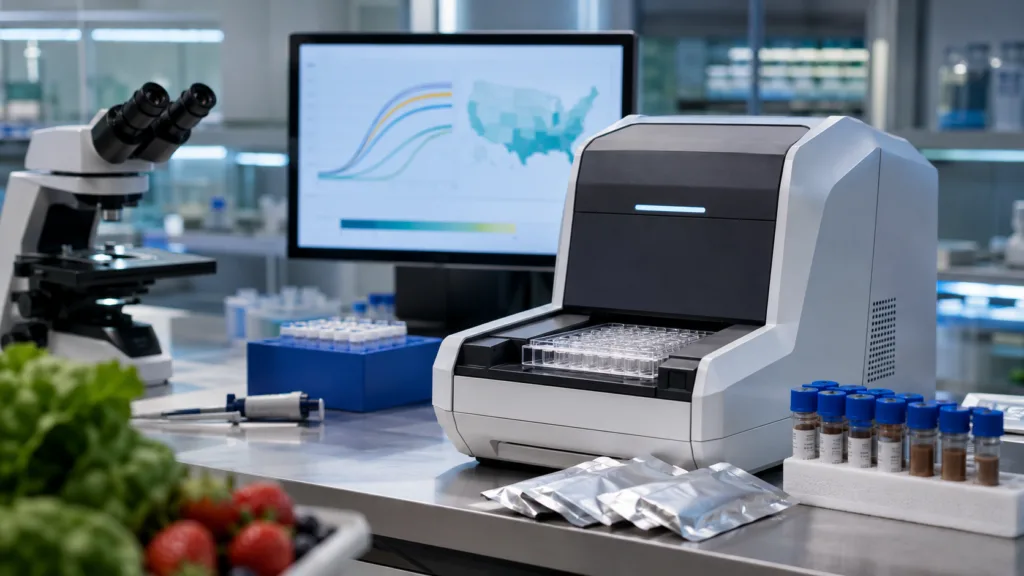
The assay is available for use with the QIAstat-Dx Analyzer 2.0 and the higher-throughput QIAstat-Dx Rise. The workflow integrates sample preparation, nucleic-acid amplification and real-time PCR detection in a closed, single-use cartridge. QIAGEN says laboratories can obtain results in approximately one hour with limited hands-on preparation.
The regulatory wording remains important. The panel is an aid in identifying specific agents of gastrointestinal illness and must be interpreted alongside clinical, laboratory and epidemiological information. A positive molecular result does not establish that the detected organism is the sole cause of a patient’s symptoms, while a negative result cannot exclude pathogens outside the panel, sampling problems or non-infectious gastrointestinal conditions.
The original clearance evidence also requires measured interpretation. Cyclospora was uncommon among the naturally positive specimens included in the clinical performance studies, meaning the corresponding agreement estimates were based on very small clinical sample numbers and were supplemented by contrived specimens. The clearance supports the assay’s intended use, but QIAGEN has not presented new outbreak-specific performance data in this announcement.
How could one-hour syndromic testing change laboratory workflow during a multistate outbreak?
The practical advantage of syndromic testing is its ability to evaluate several plausible causes of gastrointestinal illness from the initial patient sample. That can be useful when symptoms overlap and clinicians do not have enough information to confidently select a single pathogen-specific test.
A multiplex result may reduce the time spent moving through sequential tests, particularly when routine culture is unable to detect the suspected organism. Faster recognition could also support earlier reporting to public-health authorities, although the diagnostic result alone does not establish that a patient belongs to a specific outbreak.
The QIAstat-Dx platform offers different capacity configurations. A modular QIAstat-Dx Analyzer can process up to four samples simultaneously and, in its largest configuration, up to 84 samples per day. QIAstat-Dx Rise can use eight analytical modules to process as many as 160 samples daily, with random-access and batch-testing capabilities.
Those specifications make the system potentially relevant to both routine hospital laboratories and higher-volume facilities facing a seasonal testing increase. Nevertheless, theoretical capacity should not be confused with real-world utilisation. Throughput depends on staffing, sample arrival patterns, instrument configuration, cartridge availability and the laboratory’s testing criteria.
Procurement teams will also consider whether a broad 16-target panel is appropriate for each patient population. QIAGEN describes the extended panel as suitable for higher-risk and inpatient testing, while its smaller gastrointestinal panels are positioned for more targeted use. The narrower panels do not include Cyclospora, which means laboratories seeking Cyclospora detection would need the full Gastrointestinal Panel 2 or another appropriate testing method.
Cost, reimbursement, existing instrumentation, competing multiplex panels and laboratory information-system integration will therefore influence adoption. The outbreak can make the clinical need more visible, but it does not automatically remove the economic and workflow barriers associated with broad syndromic testing.
Why must QIAGEN’s QIAcuity and QIAseq tools be separated from its clinical diagnostic claim?
QIAGEN is presenting three different technology layers, but only the QIAstat-Dx Gastrointestinal Panel 2 carries the relevant FDA-cleared clinical diagnostic status described in the announcement.
The company also offers a Microbial DNA Detection Assay targeting Cyclospora cayetanensis for use with the QIAcuity digital PCR system. That assay is labelled for research use only. It can support sensitive detection in research and public-health applications, but it is not cleared as a substitute for the QIAstat-Dx clinical test and should not be portrayed as an authorised patient diagnostic.
Digital PCR divides a sample across numerous individual reactions, allowing researchers to detect and quantify small amounts of target genetic material. In an outbreak investigation, that capability may support assay development, environmental research, analytical confirmation or other specialised laboratory work. Its value depends on validated protocols, appropriate sample preparation and the specific questions being investigated.
The QIAseq FX DNA Library Prep Kit occupies another part of the workflow. QIAGEN says the research-use-only kit has been approved for use within PulseNet, the U.S. public-health laboratory network for detecting and investigating foodborne disease outbreaks. The kit can prepare samples for shotgun sequencing workflows that analyse the DNA present in a sample and help characterise foodborne pathogens.
“PulseNet-approved” describes acceptance within a public-health laboratory workflow. It is not equivalent to FDA clearance for clinical diagnosis. Sequencing data must also be combined with epidemiological interviews, food-distribution records, environmental sampling and regulatory investigations before officials can attribute an outbreak to a particular product or source.
That distinction is especially relevant for Cyclospora. The Centers for Disease Control and Prevention has said that agencies are continuing to develop and validate molecular tools capable of linking cyclosporiasis cases. The technology is advancing, but molecular similarity alone does not solve every source-tracing problem.
What could the outbreak mean commercially for QIAGEN after mixed first-quarter sales?
QIAGEN’s first-quarter 2026 results show why the outbreak announcement is strategically useful but not yet a quantifiable financial catalyst. QIAstat-Dx generated approximately $36 million in quarterly sales, an increase of 4% on a reported basis but a decline of 1% at constant exchange rates.
Within that result, QIAstat-Dx consumables sales increased as the recently introduced U.S. gastrointestinal and meningitis panels delivered double-digit constant-exchange-rate growth. Instrument placements also continued, although the broader QIAstat-Dx franchise faced a difficult comparison with the previous year.
QIAcuity digital PCR performed more strongly, recording double-digit constant-exchange-rate sales growth as both instrument and consumables demand increased. The outbreak therefore connects two areas where QIAGEN already has commercial or strategic momentum, even though the Cyclospora-specific digital PCR assay remains a research product.
QIAGEN reported total first-quarter net sales of $492 million, up 2% as reported but down 1% at constant exchange rates. The company reduced its full-year outlook to approximately 1% to 2% constant-exchange-rate sales growth, citing lower immigration-related QuantiFERON demand, cautious U.S. life-sciences spending and geopolitical uncertainty.
No order value, government contract, laboratory commitment or expected revenue contribution was disclosed with the Cyclospora announcement. Any near-term benefit would most likely appear through higher gastrointestinal cartridge consumption at laboratories that already operate QIAstat-Dx systems. Instrument demand could follow if customers expect sustained testing requirements, but a seasonal outbreak is a less predictable basis for capital-equipment purchasing.
What does QGEN’s recent share performance reveal about investor sentiment toward the announcement?
QIAGEN shares closed at $41.24 on July 15, down 0.77% for the session but 8.53% higher over five trading days. The stock had gained approximately 11.4% from its June 15 closing price of $37.01, although it remained within a wide 52-week range of $32.53 to $57.82. The company’s U.S. market capitalisation stood at roughly $8.6 billion.
The outbreak release was published at 4:05 p.m. Eastern Time, shortly after the regular U.S. market session ended. Consequently, the July 15 closing move cannot be treated as a reaction to QIAGEN’s Cyclospora portfolio announcement.
The improving short-term share trend also sits against more cautious underlying sentiment. QGEN remained down approximately 12.9% for 2026, while Berenberg downgraded the shares to Hold on July 15 and lowered its price target to $45.50 from $59, citing competition and growth concerns.
Investors are therefore unlikely to value the Cyclospora update as a standalone earnings event without evidence of additional cartridge demand, customer placements or public-health orders. Its greater importance is as a demonstration that QIAGEN’s existing menu can respond to emerging infectious-disease testing needs without waiting for a new assay-development cycle.
What will determine whether outbreak visibility becomes durable diagnostic adoption for QIAGEN?
The first test will be whether U.S. case numbers continue to rise through the May-to-August Cyclospora season and whether clinicians increase molecular testing for persistent gastrointestinal symptoms. Laboratory utilisation, not the headline case count alone, will determine the immediate consumables opportunity.
The second test concerns installed capacity. Laboratories already operating QIAstat-Dx can potentially increase cartridge use more quickly than new customers can complete procurement, validation, staff training and system integration. QIAGEN will need to show whether demand is concentrated among existing users or is producing new instrument placements.
The third test will be the public-health investigation itself. Identification of a common food source could narrow the outbreak and reduce testing demand, while multiple unresolved clusters could sustain attention for longer. Public-health funding and access to specialised molecular workflows will shape the use of QIAcuity and QIAseq products.
QIAGEN is scheduled to report second-quarter 2026 results on August 5. Because much of the current case acceleration occurred late in the quarter and during July, any clearer commercial effect may emerge through later consumables trends rather than an immediate material revenue contribution.
For now, QIAGEN has demonstrated portfolio relevance rather than a financial breakthrough. The QIAstat-Dx Gastrointestinal Panel 2 offers an already cleared clinical route for detecting Cyclospora alongside other gastrointestinal pathogens, while QIAcuity and QIAseq support separate research and surveillance functions. Whether that technical breadth becomes durable growth will depend on cartridge utilisation, laboratory adoption and the still-unresolved course of the 2026 outbreaks.