Camurus AB (Nasdaq Stockholm: CAMX) said on July 17, 2026 that the United States Food and Drug Administration had accepted its resubmitted New Drug Application for CAM2029, an investigational extended-release octreotide injection for patients with acromegaly. The regulator assigned a Prescription Drug User Fee Act target action date of December 18, 2026, returning the programme to formal review after a Complete Response Letter was issued on June 10.
The acceptance is an important procedural advance, but it is not an approval and does not establish that the manufacturing concerns behind the June decision have been resolved to the regulator’s satisfaction. Camurus reported that the Complete Response Letter did not raise concerns about CAM2029’s clinical efficacy or safety and instead related to observations from a current Good Manufacturing Practice inspection at a third-party manufacturing facility.
That distinction shapes the entire investment and industry interpretation. CAM2029 already has a substantial clinical package and is authorised in the European Union and United Kingdom as Oczyesa, but its United States path has now been delayed twice by issues connected to the same external manufacturing operation. The December decision will therefore be less a referendum on octreotide’s therapeutic rationale than a test of whether the contract manufacturer’s corrective actions, inspection readiness and associated documentation meet FDA expectations.
What does FDA acceptance change after two manufacturing-related Complete Response Letters?
The immediate benefit is certainty of process. Camurus once again has a defined FDA decision date, allowing the company to coordinate manufacturing, distribution, market access and commercial planning around a December regulatory event rather than an open-ended resubmission timetable.
The history nevertheless warrants caution. The original CAM2029 application reached its October 21, 2024 action date without approval after the FDA issued a Complete Response Letter connected to observations from a September 2024 inspection of the third-party manufacturer. Camurus resubmitted the application in December 2025, and the FDA accepted it as a Class 2 resubmission with a June 10, 2026 decision date.
The regulator then issued another Complete Response Letter on that date. Camurus said the second letter again concerned the September 2024 inspection observations and indicated that satisfactory resolution, potentially including a reinspection, would be required before approval. The FDA also recommended a labeling change involving an oxygen absorber used in the product packaging.
Camurus subsequently said that outstanding FDA comments had been addressed, while the contract manufacturer had completed its remediation actions and confirmed that it was ready for inspection. Acceptance of the latest resubmission shows that the agency considers the application sufficiently complete to review, but it does not pre-judge whether those corrective actions will pass regulatory scrutiny.
Why is the December 18 deadline primarily a manufacturing and inspection event?
A manufacturing-related Complete Response Letter can be frustrating because the clinical asset may remain scientifically viable while approval depends on systems outside the sponsor’s direct facilities. The regulator must be satisfied that the commercial product can be manufactured consistently, that quality controls are reliable and that corrective and preventive actions adequately address inspection findings.
The current announcement does not confirm that the FDA has reinspected the facility or closed the underlying observations. Camurus has reported that the manufacturer is inspection-ready, leaving open the possibility that facility access, inspection timing, documentary review or follow-up questions could influence the December outcome.
This makes operational execution more important than another clinical analysis. The company and manufacturer must demonstrate not only that individual observations were answered, but that the quality system can sustain compliance. That may require evidence covering procedures, training, validation, deviation management, documentation and packaging controls, depending on the nature of the regulator’s findings.
The repeated delay also illustrates the strategic risk of third-party manufacturing in pharmaceutical development. Outsourcing can reduce fixed investment and provide specialised expertise, but a sponsor remains exposed to the contractor’s compliance performance. For Camurus, the central question is whether the latest remediation package converts inspection readiness into an FDA assessment that the facility is acceptable for CAM2029 production.
How strong is the clinical evidence supporting CAM2029 for acromegaly treatment?
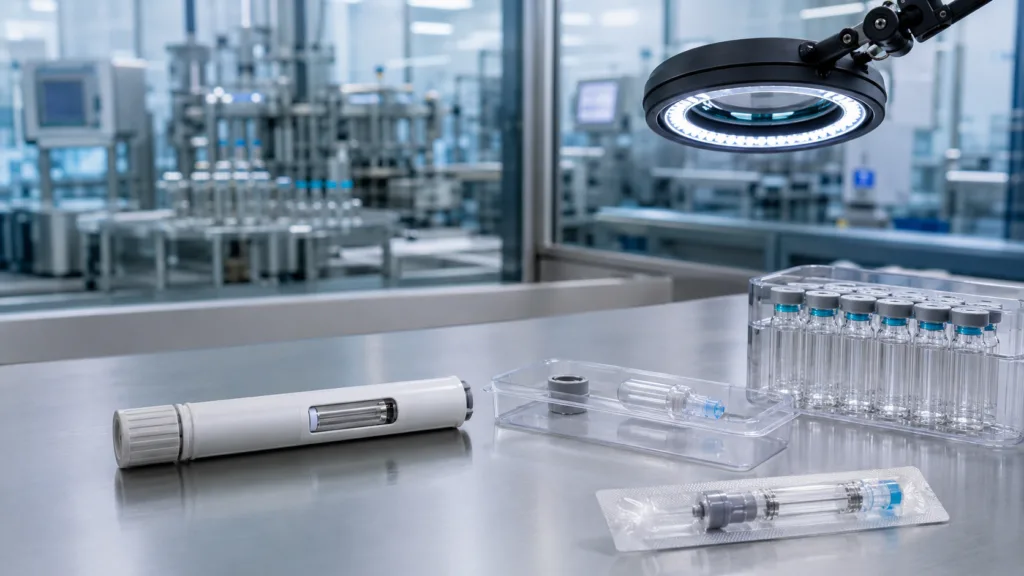
CAM2029 is a long-acting subcutaneous formulation of octreotide built on Camurus’ FluidCrystal drug-delivery technology. It is designed for administration once every four weeks using a ready-to-use autoinjector pen, potentially allowing suitable patients to administer treatment themselves rather than attending a clinic for a conventional intramuscular or deep subcutaneous injection.
The New Drug Application is supported by seven clinical studies, including the two Phase 3 ACROINNOVA trials. The peer-reviewed ACROINNOVA 1 study enrolled 72 adults whose acromegaly was biochemically controlled while receiving stable treatment with octreotide or lanreotide. Participants were randomised two to one to receive monthly CAM2029 or placebo for 24 weeks.
At weeks 22 and 24, 72.2% of CAM2029-treated participants met the primary biochemical-control endpoint, defined through insulin-like growth factor-1 levels at or below the upper limit of normal, compared with 37.5% of participants receiving placebo. The estimated difference was 34.6 percentage points, and the result was statistically significant. A combined endpoint incorporating insulin-like growth factor-1 and growth hormone control was achieved by 70% of CAM2029 recipients and 37.5% of placebo recipients.
The design provides strong evidence that CAM2029 can maintain biochemical control when patients switch from established injectable somatostatin receptor ligands. It does not, however, demonstrate superiority over active treatment with octreotide, lanreotide or newer oral alternatives because the comparator was placebo after withdrawal of standard therapy.
The safety population included 71 participants. Adverse events were reported in 78.7% of CAM2029 recipients and 79.2% of placebo recipients, with most described as mild. Serious adverse events occurred in 8.5% of each group, and none in the CAM2029 group was considered treatment-related. Four CAM2029 recipients discontinued treatment because of adverse events, including injection-site reactions and migraine. These findings support the application, although the approved United States label, warnings and intended patient population remain subject to the FDA’s final decision.
ACROINNOVA 2 added longer-term, open-label evidence from 135 patients. Camurus reported sustained biochemical control, continued symptom improvement and greater treatment satisfaction during the 52-week study. The open-label design and absence of an active comparator mean those results should be interpreted as supportive evidence rather than proof that CAM2029 performs better than established therapies.
Where could once-monthly self-injection fit after Palsonify entered the US market?
The competitive position has changed while CAM2029 has remained in regulatory limbo. Crinetics Pharmaceuticals, Inc. secured FDA approval for Palsonify, or paltusotine, in September 2025, making it the first once-daily oral treatment approved for adults with acromegaly who had an inadequate response to surgery or for whom surgery is not an option.
Palsonify’s arrival means CAM2029 would no longer enter a market defined mainly by clinic-administered depot injections and Chiesi USA, Inc.’s oral octreotide product Mycapssa. Camurus would need to differentiate monthly self-injection against a once-daily oral medicine, while also competing with familiar injectable products such as Novartis AG’s Sandostatin LAR and Ipsen S.A.’s Somatuline Depot.
The comparison is not simply injection versus tablet. Daily oral treatments require consistent adherence and may include fasting or food-timing instructions. CAM2029 offers a four-week dosing interval, room-temperature storage and an autoinjector with a concealed needle, but it remains an injectable therapy and may not appeal to every patient.
Clinician familiarity with octreotide could help adoption because CAM2029 reformulates an established somatostatin analogue rather than introducing an entirely new therapeutic target. Its commercial opportunity may be strongest among patients who are controlled on injectable octreotide or lanreotide but want fewer clinic visits without accepting a daily oral routine.
The final United States label will be critical. The European indication covers maintenance treatment in adults who have responded to and tolerated somatostatin analogues. Until the FDA approves a label, Camurus cannot assume that the United States indication, eligible population or dosing language will mirror Europe.
What does early Oczyesa adoption reveal about CAM2029’s commercial opportunity?
European experience provides an early, if still limited, indication of how adoption may develop. Camurus launched Oczyesa in Germany in November 2025 and reported SEK 4 million in second-quarter 2026 product sales, broadly in line with the first quarter. The company said adoption was building as patients moved through scheduled specialist-clinic visits.
The first patients had also started treatment in Sweden, while formulary decisions were progressing in the United Kingdom. Camurus is targeting a double-digit share of German acromegaly patients treated with somatostatin receptor agonists by the end of 2026, but the early revenue contribution shows that even an authorised rare-disease product does not instantly convert into meaningful sales.
Specialist prescribing cycles, reimbursement, formulary access, clinician education and patient willingness to switch can slow uptake. United States approval would open a larger commercial opportunity, but Camurus would still need payer coverage, specialty distribution and evidence that its convenience claims translate into sustained real-world use.
Why can Camurus absorb another review cycle without making CAM2029 a financial emergency?
Camurus enters the new review period with an established commercial business and a strong balance sheet. Second-quarter revenue increased 4% to SEK 702 million, while product sales rose 13% to a record SEK 528 million. Brixadi royalty revenue increased 42% to SEK 127 million, and the operating result was broadly unchanged at SEK 293 million.
Cash and cash equivalents reached approximately SEK 4.1 billion at the end of June. Management reiterated its 2026 outlook for revenue of SEK 2.6 billion to SEK 2.9 billion and an operating result of SEK 0.9 billion to SEK 1.2 billion despite the June Complete Response Letter.
The financial position means Camurus does not need to raise capital simply to keep CAM2029 moving through the latest review. Buvidal sales and Brixadi royalties provide operating support, while the company can maintain United States launch preparations without becoming wholly dependent on a December approval.
The delay still has an opportunity cost. Commercial infrastructure must be kept ready without generating CAM2029 revenue, while competitors gain prescribing experience and payer relationships. Financial resilience reduces existential risk, but it does not recover the market time lost since the original October 2024 decision date.
How should investors interpret the Camurus share recovery before the new FDA deadline?
Camurus shares traded around SEK 639 on July 17, giving the company a market capitalisation of approximately SEK 38.7 billion. That price was about 15% above the July 10 close and nearly 20% above the June 17 close, although much of the recent advance followed the company’s stronger second-quarter results rather than the FDA announcement alone.
The shares remained roughly 15% below their 52-week high of SEK 754.50 but stood well above the 52-week low of SEK 430.80. The pattern suggests improving sentiment following the earnings update and restoration of the CAM2029 timeline, while a meaningful regulatory discount remains.
Acceptance is best viewed as a near-term catalyst and a partial recovery of lost visibility, not full regulatory de-risking. Approval could unlock a new United States product launch and strengthen confidence in the wider CAM2029 platform. Another delay would raise more difficult questions about the manufacturer, the durability of launch readiness and whether Camurus should consider additional supply-chain safeguards.
What must happen before FDA acceptance can become a commercial CAM2029 launch?
The next measurable milestone is the December 18 action date. Before then, the FDA must complete its assessment of the resubmission, determine whether the third-party facility’s remediation is satisfactory and conduct any follow-up inspection it considers necessary.
Camurus must also complete agreement on final labeling, including any packaging language connected to the oxygen absorber previously identified by the regulator. Even if the application is approved, commercial execution will depend on manufacturing release, inventory availability, payer negotiations, specialty distribution and the pace at which endocrinologists consider switching controlled patients.
CAM2029 is therefore closer to another decision, but not yet across the regulatory line. The clinical evidence has survived two Complete Response Letters without a disclosed efficacy or safety objection. The December outcome now rests on whether Camurus and its manufacturing partner can demonstrate that a scientifically supported product can also be produced, packaged and controlled to the standard required for the United States market.