
Nova Biomedical announced on July 24, 2026, that it had completed a transaction involving certain assets of NanoCellect Biomedical, bringing NanoCellect’s microfluidic cell sorting technology into Nova Biomedical’s expanding cell line development portfolio. The company highlighted the WOLF G2 cell sorting platform as an upstream addition that could connect cell selection and isolation with Nova Biomedical’s existing Solentim systems for clone generation, clonality verification and productivity analysis.
The transaction is strategically more significant than a conventional laboratory instrument portfolio extension. Nova Biomedical is attempting to assemble a connected workflow that begins with identifying and isolating individual cells, continues through evidence of single-cell origin and clonal outgrowth, and extends into productivity screening, cell culture monitoring and manufacturing process development.
That ambition is commercially attractive because cell line development frequently involves instruments, software and consumables from several suppliers. A broader Nova Biomedical platform could reduce the number of separate vendor relationships managed by biopharmaceutical laboratories, although the company has not yet demonstrated that the newly combined technologies operate as a technically unified system rather than a collection of complementary products.
Why does the NanoCellect transaction extend Nova Biomedical beyond its existing clone development tools?
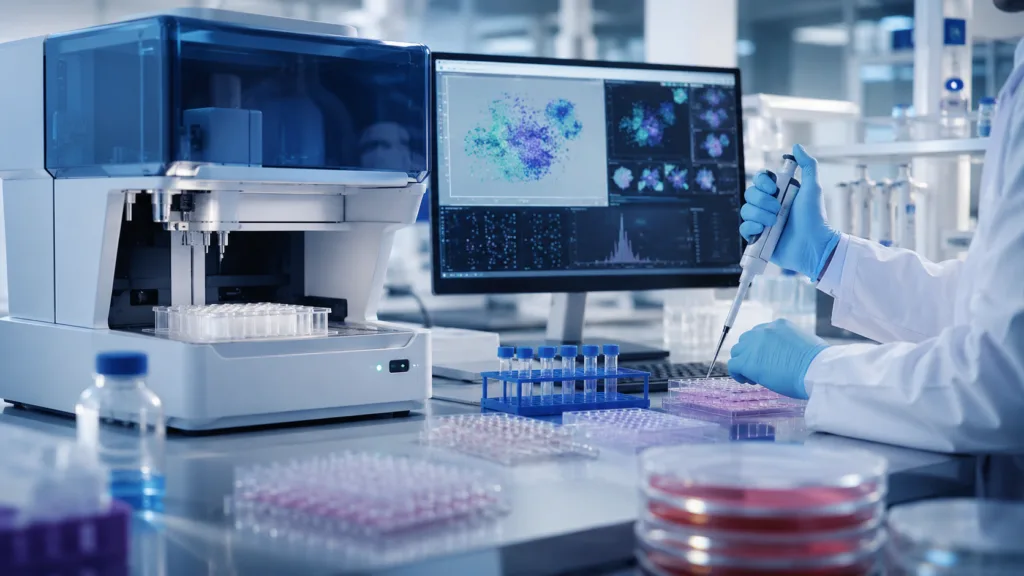
NanoCellect’s principal contribution is an earlier cell selection and sorting capability. The WOLF G2 is a benchtop microfluidic cell sorter with two-laser configurations and support for as many as nine fluorescent channels. When combined with NanoCellect’s N1 Single-Cell Dispenser, the system can sort individual cells into 96-well or 384-well plates for applications including cell line engineering, antibody discovery, gene editing, stem cell research and single-cell genomics.
The platform uses disposable microfluidic cartridges and a piezoacoustic mechanism to direct cells into collection channels. NanoCellect says the WOLF G2 operates at pressures below 2 pounds per square inch and is designed to reduce the mechanical stress placed on sensitive cells during sorting. The company also describes the cartridge architecture as aerosol-free and capable of reducing sample carryover between experiments. These are product claims rather than independent evidence that the system will improve development success rates across every cell type or workflow.
Nova Biomedical’s existing Solentim portfolio is concentrated further along the clone development pathway. The VIPS PRO system seeds cells into plates while capturing images intended to support evidence of single-cell origin. Cell Metric X follows colony growth through whole-well imaging, while the ICON platform combines imaging with measurements such as viable cell density, protein titer and selected critical quality attributes. STUDIUS provides the data-management layer that links information from these instruments and supports clone tracking and reporting.
Adding NanoCellect therefore gives Nova Biomedical a potential entry point before conventional clone imaging and productivity screening. Scientists could use cell sorting to enrich or isolate a defined population, dispense selected cells, verify their origin and outgrowth, evaluate protein production and then move the strongest candidates into process development.
The strategic logic is clear. The operational integration is less certain. WOLF G2 with the N1 dispenser and Solentim VIPS PRO can both participate in single-cell deposition workflows, creating some functional overlap. Nova Biomedical will need to explain when customers should use one system, when the systems should be combined and whether data can move automatically between NanoCellect software and the STUDIUS environment.
Can a connected workflow materially shorten cell line development timelines?
Nova Biomedical said the expanded portfolio could accelerate cell line development and improve clone selection outcomes. The proposition is plausible, but the announcement did not include comparative workflow data, customer validation studies or quantified evidence showing how much time could be removed from a typical development programme.
Cell line development is not delayed by a single instrument step. Development teams must identify suitable parental cells, introduce the required expression construct, isolate individual candidates, establish confidence in clonality, monitor outgrowth, screen productivity, evaluate product quality and assess stability before selecting cells for banking and manufacturing development.
International Council for Harmonisation guidance emphasises that the source, history, manipulation and selection of production cell substrates should be documented. It also treats the characterisation and testing of master and working cell banks as critical to confirming identity, purity, stability and suitability for manufacturing. A faster sorting step can improve laboratory efficiency, but it does not replace the broader characterisation package required for a production cell line.
The most credible efficiency opportunity may come from reducing manual transfers, duplicated measurements and disconnected data reviews. A workflow that links cell selection with plate-level imaging and productivity results could help scientists eliminate weak candidates earlier and focus resources on clones with the most promising combination of growth, viability, productivity and product-quality characteristics.
However, achieving that benefit requires more than placing the products in one catalogue. Customers will expect validated interfaces, consistent sample identifiers, secure data transfer, audit trails and common reporting formats. Without this integration, laboratories may still need to reconcile records manually, limiting the practical value of the broader portfolio.
Why could clonality evidence become an important commercial differentiator for Nova Biomedical?
For biologic manufacturing, a production clone is not selected solely because it generates a high protein titer. Developers must understand its origin, identity, growth characteristics, stability and ability to produce a consistent product over the intended manufacturing lifespan.
Solentim’s commercial proposition has been built partly around image-based clonality evidence. VIPS PRO captures images during initial deposition and subsequent colony development, while STUDIUS maintains associated records and audit trails. Nova Biomedical markets the system as suitable for Good Manufacturing Practice-compatible workflows and for generating documentation that can support regulatory submissions.
NanoCellect’s technology could strengthen the front end of that evidence chain by providing fluorescence-based cell selection before single-cell deposition. This may be useful when researchers need to isolate a population carrying a particular marker, expression profile or engineered characteristic before beginning clonal expansion.
The combined approach should not be interpreted as an automatic regulatory endorsement of any clone created with the instruments. Regulators review the sponsor’s complete process, controls, validation and cell-bank characterisation. Instrument-generated images and sorting records can support the documentation package, but they do not independently prove genetic stability, product consistency or manufacturing suitability.
Nova Biomedical’s opportunity is therefore to become the supplier of a more traceable workflow rather than merely promising faster cloning. Biopharmaceutical developers may value a platform that preserves a continuous record from selected cell through clonal outgrowth and productivity screening, particularly when that record reduces ambiguity during internal quality review or regulatory preparation.
How does the acquisition fit Nova Biomedical’s broader bioprocessing platform strategy?
The NanoCellect transaction follows a larger transformation of Nova Biomedical. Advanced Instruments completed its $2.2 billion acquisition of Nova Biomedical in July 2025, after which the combined company adopted the Nova Biomedical name. The business now operates under Patricia Industries, part of Investor AB, and combines instruments and consumables used across biopharmaceutical development, manufacturing and clinical testing.
Advanced Instruments had previously acquired Solentim in 2021, adding single-cell seeding, clonal imaging and clone-characterisation technologies to its osmolality portfolio. The subsequent combination with Nova Biomedical brought in cell culture analytics, including the BioProfile product family. NanoCellect now extends this acquisition-led strategy into microfluidic cell sorting.
The result is a portfolio spanning several control points. BioProfile FLEX2 can measure chemistries, gases, cell density, viability and osmolality, while BioProfile FAST CDV focuses on automated cell density and viability measurement. These systems are positioned for process development and manufacturing monitoring rather than the initial isolation of individual clones.
Bringing sorting, imaging, clone analysis and culture monitoring under one organisation creates cross-selling opportunities. A customer purchasing a WOLF G2 system may also become a candidate for Solentim imaging tools, BioProfile analysers, service agreements and recurring consumables.
Disposable sorting cartridges, seeding kits, assay plates and analytical consumables may be particularly important commercially because they can generate revenue after the initial instrument sale. The size of that opportunity will depend on the installed base transferred through the transaction, instrument utilisation, customer retention and Nova Biomedical’s ability to maintain continuity of supply.
What remains unclear about the NanoCellect asset transaction and product integration?
Nova Biomedical described the deal as a transaction involving certain NanoCellect assets rather than an acquisition of NanoCellect Biomedical as an entire corporate entity. The announcement did not disclose the purchase price, financing structure, detailed asset perimeter, employee transfers or whether all NanoCellect products and development programmes were included.
The distinction matters for customers. Instrument owners need clarity on warranties, service contracts, software updates, replacement parts, consumable availability and technical support. Distributors will require information about whether existing agreements remain active, while laboratories considering purchases will want confidence that the acquired products have a stable development and support roadmap.
It is also unclear how Nova Biomedical will handle NanoCellect’s broader product portfolio beyond WOLF G2. NanoCellect had developed products and applications extending into image-guided cell analysis, genomics, stem-cell research and cell therapy research. Nova Biomedical’s announcement concentrated on cell line development, suggesting that the immediate commercial priority may be the fit between WOLF G2 and the Solentim ecosystem rather than every historical NanoCellect application.
Nova Biomedical will also need to determine whether to preserve NanoCellect as a product brand or gradually migrate the technology under the Nova Biomedical identity. The company retained Advanced Instruments as a portfolio brand for its osmolality products after the 2025 combination, indicating that a multi-brand approach is possible.
What milestones will show whether Nova Biomedical has created a genuinely integrated platform?
The first measurable test will be customer continuity. Nova Biomedical must demonstrate that existing NanoCellect users can obtain cartridges, service, software support and application assistance without disruption.
The second will be technical integration. Shared sample tracking, compatible plate formats, automated transfer of sorting data into STUDIUS and combined workflow protocols would provide stronger evidence of a connected platform than portfolio marketing alone.
The third will be independent customer evidence. Case studies showing reduced manual handling, faster clone triage, improved recovery of sensitive cells or more efficient progression from sorting to clone selection would help substantiate Nova Biomedical’s acceleration claims. Comparisons will need to account for cell type, expression system, screening strategy and the laboratory’s existing level of automation.
The transaction gives Nova Biomedical a credible opportunity to occupy more of the cell line development workflow, particularly at the point where scientists move from a heterogeneous cell population toward isolated, documented and productive clones. Its commercial success will ultimately depend on whether Nova Biomedical can convert acquired instruments into a coherent workflow with reliable consumables, interoperable data and demonstrable laboratory efficiency.