Beckman Coulter Diagnostics has launched the DxU 1800 System in the United States, introducing a fully automated urinalysis platform that connects its new DxU 1800c urine chemistry analyzer with the company’s established DxU Iris digital microscopy technology. The system was unveiled at the Association for Diagnostics and Laboratory Medicine’s 2026 scientific meeting as laboratories face pressure to process larger urine-testing volumes with fewer manual handoffs and more consistent result-review processes.
The product launch is commercially significant because Beckman Coulter is not merely replacing an individual analyzer. It is attempting to consolidate urine chemistry, particle imaging, result verification and laboratory information system connectivity into a more unified workflow. That distinction matters in core laboratories, where delays frequently arise not from the speed of a single instrument but from specimen transfers, manual microscopy, result reconciliation and staff intervention between different testing stages.
The DxU 1800 therefore enters the market as an operational automation proposition rather than as evidence of a new clinical diagnostic capability. Its success will depend on whether hospitals and reference laboratories can reproduce the company’s efficiency claims in their own sample populations, staffing models and result-release protocols.
What exactly has Beckman Coulter changed in the DxU 1800 urinalysis workflow?
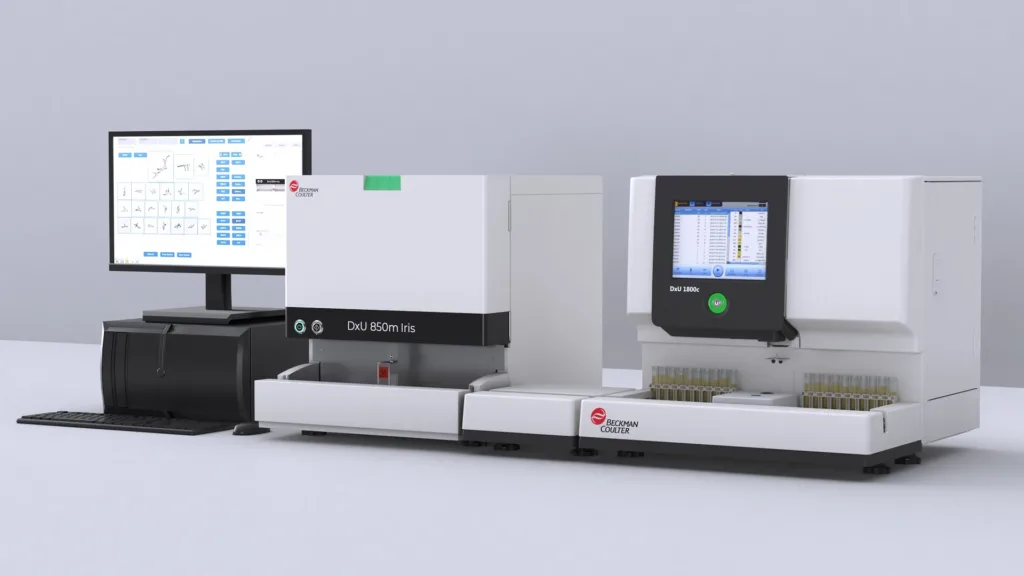
The DxU 1800 combines the new DxU 1800c chemistry module with either the DxU 840m Iris or DxU 850m Iris microscopy analyzer. The chemistry analyzer automates test-strip handling and imaging, while the microscopy component uses Digital Flow Morphology and Auto Particle Recognition software to capture, identify and classify images of urine particles.
Beckman Coulter says the DxU 1800c can process up to 300 samples per hour, accommodate as many as 500 test strips and store up to two million sample results and 100,000 strip images. The broader system also incorporates Edit-Free Release technology, which can automatically transmit qualifying results to a laboratory information system according to parameters established by the laboratory.
The 300-sample figure should not, however, be interpreted as the guaranteed end-to-end throughput of every DxU 1800 configuration. Beckman Coulter lists the DxU 840m Iris microscopy analyzer at up to 70 samples per hour and the DxU 850m Iris at up to 101 samples per hour. Actual system capacity will therefore depend on the proportion of specimens requiring microscopy, the laboratory’s reflex-testing rules, the selected microscopy model and the frequency of operator review.
This is an important distinction for procurement teams. A high chemistry-module throughput can prevent strip analysis from becoming a bottleneck, but a laboratory assessing the complete system will need to model its own chemistry-to-microscopy referral rate rather than rely on the highest component specification.
Beckman Coulter’s product information also states that the DxU 1800c is not currently available as a standalone analyzer. The immediate commercial proposition is consequently centred on the integrated DxU 1800 configuration, even though the chemistry module has its own performance specifications.
How strong is the evidence behind the claim of less than 3% manual microscopy review?
One of the most commercially attractive claims surrounding the DxU 1800 is that its microscopy workflow can reduce manual microscopic review rates to below 3%. For laboratories dealing with large volumes, even a modest reduction in manual reviews can affect turnaround time, staffing allocation and the predictability of daily operations.
The qualification attached to that figure is equally important. Beckman Coulter states that the DxU 840m and DxU 850m use proprietary technology also present in the earlier iQ200 series and considers the underlying study results transferable. However, the performance data supporting the manual-review claim were collected using the iQ200 rather than through a newly disclosed multicentre evaluation of the complete DxU 1800 system.
The claim therefore represents a technology-transfer argument, not direct evidence that every DxU 1800 installation will achieve a sub-3% review rate. Local review rates can be influenced by specimen complexity, patient mix, abnormal-result prevalence, autoverification thresholds, institutional policies and the confidence of laboratory directors in automatically releasing particular result categories.
Clinical laboratories will probably conduct verification studies before changing established microscopy-review practices. They will need to determine whether the system correctly identifies samples that require human intervention while allowing sufficiently routine specimens to progress without unnecessary review.
The critical adoption metric may consequently be the percentage of results safely released under a laboratory’s actual validation rules, rather than the manufacturer’s maximum theoretical throughput.
Why are testing volumes and laboratory staffing pressures strengthening the automation case?
Urinalysis remains one of the most frequently ordered laboratory tests because it contributes information relevant to urinary tract infections, kidney disorders, diabetes and other metabolic or systemic conditions. Beckman Coulter cited evidence indicating that urine testing is used in a substantial proportion of emergency, inpatient and primary-care encounters.
The chronic-disease backdrop supports the company’s volume argument. The United States Centers for Disease Control and Prevention estimates that about 12% of the US population has diagnosed or undiagnosed diabetes, while more than one in seven American adults is estimated to have chronic kidney disease. These figures do not automatically translate into DxU 1800 demand, but they reinforce the underlying requirement for scalable laboratory testing and longitudinal disease monitoring.
Staff availability is another part of the commercial equation. The United States Bureau of Labor Statistics projects only 2% employment growth for clinical laboratory technologists and technicians between 2024 and 2034, while expecting approximately 22,600 openings each year, largely because existing workers will leave the profession or retire. The agency also expects increased laboratory automation to moderate employment demand.
Automation should not be interpreted simply as replacing laboratory professionals. In practice, the more immediate objective is often to move trained staff away from repetitive specimen handling and routine image confirmation towards quality assurance, exception management, instrument oversight and complex testing.
For Beckman Coulter, the strongest sales case may be found in laboratories whose test volumes are growing faster than their ability to recruit and retain personnel. Facilities with relatively low volumes or established, efficient instrumentation may face a less urgent replacement decision.
How does the DxU 1800 compare with other integrated automated urinalysis platforms?
Beckman Coulter is entering an established competitive field rather than creating a new equipment category. Sysmex America markets the UN-3000 as an integrated platform combining chemistry testing, particle counting and digital imaging. Siemens Healthineers offers the Atellica 1500, which combines the CLINITEK Novus chemistry analyzer with the Atellica UAS 800 sediment analyzer. Roche Diagnostics offers the modular cobas 6500 series, which integrates urine strip analysis with digital microscopy.
Published manufacturer specifications are not directly comparable without examining how each company defines throughput. Siemens Healthineers lists the Atellica 1500 at up to 240 samples per hour. Roche states that its chemistry analyzer can process higher volumes independently, while the integrated sample-transport workflow operates at up to 116 samples per hour. Sysmex says UN-3000 throughput varies according to the test-order mix and laboratory-defined settings.
Beckman Coulter’s competitive argument is therefore unlikely to be settled by the DxU 1800c’s 300-sample chemistry rating alone. Laboratories will compare the platforms according to abnormal-sample classification, manual-review rates, image quality, autoverification flexibility, reagent and consumable costs, maintenance requirements, system uptime and compatibility with existing information systems.
Installed-base considerations may be particularly influential. A laboratory already using DxU Iris microscopy equipment could view the new chemistry module as a lower-disruption pathway towards a more integrated workflow. A facility standardized around Siemens Healthineers, Sysmex or Roche Diagnostics products may place greater value on continuity with its existing service agreements, consumables and staff training.
The commercial contest is consequently about switching costs and operational confidence as much as analytical performance.
Why could creatinine and microalbumin expansion strengthen the DxU 1800 proposition?
Beckman Coulter said it plans to expand the DxU 1800 chemistry menu to include creatinine and microalbumin assays. The company presented these planned additions as a way of generating further kidney-function information within the routine urinalysis workflow without requiring major changes to laboratory processes.
The wording remains prospective. Creatinine and microalbumin should not be treated as part of the currently established menu solely because the company intends to add them. Their eventual value will depend on analytical performance, regulatory status, calibration requirements, reporting configuration and how the assays are integrated into existing kidney-screening protocols.
A broader menu could nevertheless improve the system’s economics by increasing the number of clinically relevant results produced from the same specimen and workflow. It could also strengthen Beckman Coulter’s recurring consumables opportunity if laboratories adopt the additional assays at scale.
The timing and scope of the menu expansion will therefore be an important next milestone. Procurement teams will want precise information about availability, applicable markets, validation data and whether additional consumables or software configurations are required.
What will hospital laboratories examine before adopting the DxU 1800 system?
The initial purchase decision will involve more than analyzer speed. Laboratories will need to examine footprint, specimen-routing requirements, laboratory information system interfaces, cybersecurity controls, service response times, quality-control procedures, scheduled maintenance and the availability of trained support personnel.
Autoverification governance will be especially important. The DxU 1800 can automatically release results according to user-defined parameters, but each laboratory remains responsible for validating those rules and establishing appropriate exception pathways. A system that technically supports automated release may still require extensive manual review if local thresholds are conservative or the patient population produces a high proportion of complex specimens.
Total cost of ownership will also shape adoption. Beckman Coulter has not publicly disclosed system pricing, service-contract terms, expected reagent revenue or the financial value of its initial order pipeline. Laboratories will therefore need to compare capital expenditure and recurring consumable costs with measurable reductions in hands-on time, repeat processing and turnaround-time variability.
Post-installation performance will provide the most meaningful evidence. Multi-site data describing manual-review rates, uptime, error handling and staff-time savings would make the commercial case more persuasive than isolated component specifications.
What does the DxU 1800 launch mean for Danaher Corporation’s diagnostics strategy?
Beckman Coulter Diagnostics operates within Danaher Corporation, whose diagnostics segment recorded 7% reported sales growth in the second quarter of 2026. Core diagnostics sales increased 2%, or 5% when respiratory-testing revenue was excluded, according to Danaher’s latest quarterly results.
The DxU 1800 fits Danaher’s broader strategy of building connected diagnostic platforms that combine instruments, software, assays, consumables and service relationships. Urinalysis is unlikely to transform Danaher’s financial performance on its own, but a successful platform launch can strengthen customer retention and produce recurring revenue beyond the original equipment sale.
The announcement should therefore be viewed as an incremental commercial execution test rather than a major standalone stock-market catalyst. Beckman Coulter must now convert technical integration into validated laboratory productivity, installations and repeat consumables demand.
The DxU 1800 addresses a credible operational problem: laboratories are being asked to process more routine testing while controlling manual workloads and result variability. Its chemistry capacity and established digital microscopy platform give Beckman Coulter a credible offering, but the decisive evidence will come from real laboratories demonstrating how frequently the system avoids manual review, how reliably it integrates with existing workflows and whether the resulting efficiency justifies the complete cost of adoption.