Precision Diabetes, Inc. and Nagase Diagnostics Co., Ltd. have entered an exclusive U.S. commercialization partnership for Lucica Glycated Albumin-L, an in vitro diagnostic assay cleared by the United States Food and Drug Administration for the intermediate-term monitoring of glycemic control in patients with diabetes. Under the agreement announced on July 23, 2026, Precision Diabetes will lead U.S. market development, laboratory partnerships, customer engagement, physician education and other commercial activities for the assay.
The partnership is not a new regulatory clearance. Lucica received 510(k) clearance in October 2017, making the latest development primarily a test of commercial execution, clinical education and laboratory adoption nearly nine years after the original regulatory decision. Financial terms, sales targets, launch volumes and customer commitments were not disclosed.
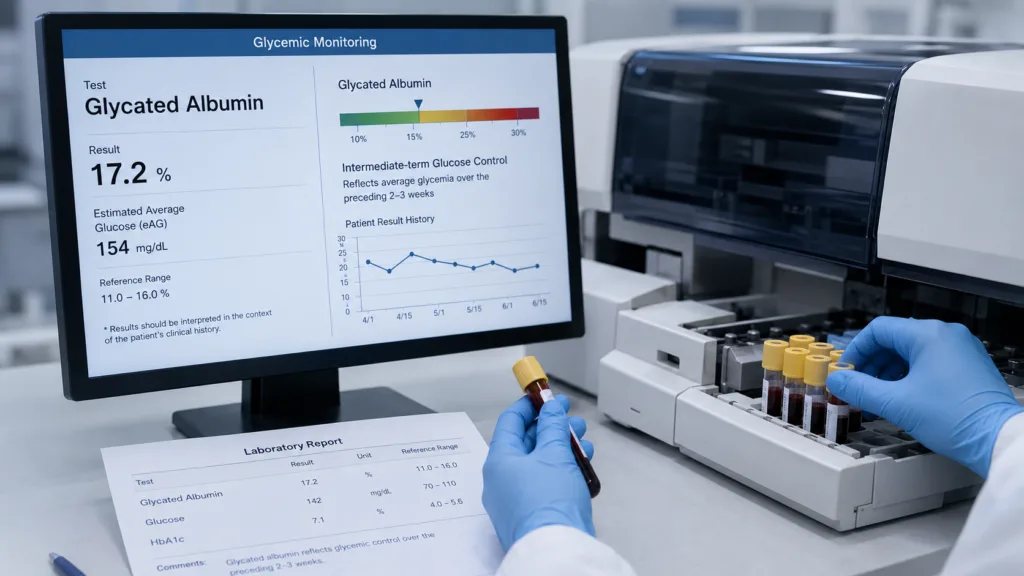
Lucica measures glycated albumin, a serum biomarker that reflects glycemic exposure over roughly the preceding two to three weeks. That shorter window places it between immediate glucose measurements and glycated hemoglobin, commonly known as HbA1c, which generally reflects average glucose exposure over a substantially longer period. The commercial proposition is therefore not that glycated albumin should displace every established monitoring method, but that it could provide additional information when clinicians need a faster laboratory-based assessment or when HbA1c interpretation is complicated.
Why is the Lucica partnership a commercialization event rather than a new FDA milestone?
The FDA cleared Lucica Glycated Albumin-L through the 510(k) pathway under submission K170147 after determining that the Class II device was substantially equivalent to a legally marketed predicate. The original applicant was Asahi Kasei Pharma Corporation, whose diagnostics operations were subsequently transferred to the NAGASE Group and began operating as Nagase Diagnostics in July 2025.
This corporate history helps explain why the 2026 announcement matters despite the age of the clearance. Nagase Diagnostics possesses the assay technology, reagent-development experience and manufacturing background, while Precision Diabetes is being positioned as the specialist U.S. commercialization organisation responsible for building clinical awareness and laboratory demand.
Precision Diabetes already works with diabetes biomarkers, including the GlycoMark test, and describes its business as focused on precision diagnostic technologies and algorithms spanning diabetes risk, monitoring and complications. That portfolio may offer relevant relationships with endocrinologists, clinical laboratories and researchers, although the Lucica partnership will require a distinct adoption strategy because glycated albumin is not yet ordered with the routine familiarity of HbA1c.
The agreement gives Precision Diabetes an exclusive role in the United States, but exclusivity alone does not establish market penetration. The company must translate a technically differentiated biomarker into defined ordering pathways, laboratory menus, clinician interpretation protocols and economically sustainable testing volumes.
What does the FDA-cleared intended use establish for Lucica Glycated Albumin-L?
The cleared indication is specific. Lucica is intended for the quantitative measurement of glycated albumin in human serum on compatible clinical chemistry analysers, with the measurement described as useful for monitoring glycemic control over the preceding two to three weeks in patients with diabetes. It is an in vitro diagnostic intended for prescription use.
The clearance does not establish Lucica as a standalone test for diagnosing diabetes. It also does not authorise autonomous treatment decisions or claim that glycated albumin universally provides a more accurate assessment than HbA1c or continuous glucose monitoring. The appropriate interpretation is that the assay supplies an additional laboratory measurement that clinicians can evaluate alongside the patient’s wider glucose data, treatment history and clinical condition.
Lucica uses an enzymatic method to quantify glycated albumin and a colorimetric method to measure total albumin. The final result is calculated as the ratio of glycated albumin to total albumin, helping reduce the influence of differences in absolute albumin concentration. The kit uses liquid reagents, and Nagase Diagnostics says it can be applied to general-purpose biochemical analysers using a small serum sample.
However, the FDA performance package was based on the Roche/Hitachi Modular P Chemistry System. Laboratories considering other analysers will still need to confirm that the proposed platform is compatible and that the method can meet applicable validation, calibration, quality-control and reporting requirements in their own environment.
The FDA review reported a glycated albumin analytical range of 173 to 979 mmol/mol. Precision and multisite reproducibility results were strong within the submitted testing programme, while a U.S. reference-range study involving 262 people without diabetes produced a range of 183 to 259 mmol/mol. The FDA decision summary did not establish a clinical cutoff, an important distinction between demonstrating reliable analytical measurement and defining universally applicable treatment targets.
How could glycated albumin complement HbA1c and continuous glucose monitoring?
HbA1c remains deeply embedded in diabetes care because it is standardised, widely available and supported by decades of outcomes evidence. Its interpretation can nevertheless be affected when red blood cell survival or haemoglobin characteristics do not reflect the assumptions underlying the measurement.
Laboratory guidance developed with input from the American Diabetes Association states that glycated albumin or fructosamine may be considered when abnormal red blood cell turnover, haemoglobin variants or other factors compromise HbA1c interpretation. The American Diabetes Association’s 2026 Standards of Care also recognises glycated albumin and fructosamine as alternative measures for monitoring glycemic status.
That recognition creates a more supportive clinical backdrop for Lucica than existed when it first received clearance. Potentially relevant settings include anaemia, haemoglobinopathies, erythropoiesis-stimulating therapy and some forms of advanced kidney disease, although the biomarker must still be interpreted according to the patient’s underlying physiology.
The shorter measurement window may also prove useful after a treatment has been initiated or modified. A glycated albumin result obtained several weeks after a change could indicate whether average glycemia is moving in the intended direction before enough time has elapsed for HbA1c to fully reflect the new regimen.
This does not make Lucica a laboratory substitute for the detailed glucose profiles generated by continuous glucose monitoring. Continuous glucose monitoring can reveal time in range, time below range, time above range, overnight patterns and glucose variability. A glycated albumin result compresses intermediate-term exposure into a single laboratory measurement and cannot show when hypoglycemia or hyperglycemia occurred.
The commercial opportunity is therefore likely to be strongest where continuous glucose monitoring is unavailable, unaffordable, poorly tolerated or unnecessary for continuous use, and where clinicians still want more recent information than HbA1c can provide. Lucica may also serve as a complementary measurement when laboratory findings appear inconsistent with self-monitored or sensor-derived glucose data.
How mature is the evidence connecting Lucica with glucose control and time in range?
The evidence supporting glycated albumin extends beyond analytical validation, but it remains less mature than the outcomes framework surrounding HbA1c. The pivotal Lucica programme included a 24-week prospective study conducted across eight U.S. clinics involving 150 adults with type 1 or type 2 diabetes. Ninety-eight participants were undergoing treatment changes intended to improve glycemic control, while 52 remained on stable regimens.
A later exploratory analysis examined continuous glucose monitoring data from only 34 of those participants. Within that subgroup, glycated albumin showed stronger correlations with time in range than HbA1c at weeks four and eight, and stronger correlations than fructosamine during the early part of follow-up. The analysis reported that glycated albumin values predicted time in range above 70% across weeks two to 24 with an area under the receiver operating characteristic curve greater than 0.80.
These findings strengthen the rationale for using glycated albumin as an intermediate-term marker. They do not demonstrate that using Lucica to direct treatment improves clinical outcomes, reduces hypoglycemia, prevents diabetes complications or lowers healthcare costs.
The continuous glucose monitoring analysis was post hoc and involved a small subset of the original study population. The authors acknowledged that limitation, and the work was supported and conducted by Asahi Kasei Pharma Corporation, which developed the assay. Independent prospective studies examining clinician decision-making and patient outcomes would therefore add materially to the commercial evidence package.
Laboratories and healthcare systems may be willing to adopt a test based on analytical performance and established biomarker associations, but broader protocol-driven use usually becomes easier when evidence shows that testing changes management in a reproducible and economically meaningful way.
Why do kidney disease and albumin metabolism remain important interpretation issues?
Patients receiving dialysis are frequently presented as a potentially important population for glycated albumin because anaemia, shortened red blood cell survival and erythropoiesis-stimulating therapy can complicate HbA1c interpretation. Lucica is independent of red blood cell lifespan, giving it a plausible role when HbA1c appears discordant with other glucose measurements.
Yet glycated albumin is not physiologically neutral. Conditions that alter albumin synthesis, distribution or turnover can influence the relationship between glycated albumin and actual glucose exposure. Nagase Diagnostics identifies altered albumin metabolism in conditions including thyroid disease, liver cirrhosis, nephrotic states, glucocorticoid treatment and advanced obesity as factors requiring attention during interpretation.
Recent evidence reinforces the need for that caution. A 2026 prospective study involving 251 people receiving maintenance dialysis compared HbA1c, glycated albumin and fructosamine with mean glucose measured by a Dexcom G6 Pro sensor over ten days. HbA1c and glycated albumin were both strongly correlated with sensor-derived mean glucose, but each biomarker showed bias associated with clinically relevant characteristics. Glycated albumin and fructosamine were affected by factors including dialysis modality, dialysis duration, residual kidney function and body mass index.
The practical lesson is not that glycated albumin lacks value in dialysis. It is that no single laboratory marker completely resolves the complexity of glycemic assessment in this population. Lucica’s strongest positioning may be as part of a triangulated approach involving glucose measurements, clinical context and other laboratory findings, rather than as an uncomplicated replacement for HbA1c.
What must Precision Diabetes and Nagase Diagnostics prove to win laboratory adoption?
The first commercial challenge is operational. Precision Diabetes must identify laboratories with sufficient diabetes, endocrinology, nephrology, obstetric or dialysis-related testing volumes to justify adding the assay, validating it, training staff and maintaining inventory, calibration and quality-control materials.
The second challenge is clinical interpretation. Physicians need to understand when glycated albumin provides useful additional information, what conditions may distort the result, how frequently it should be ordered and how changes should be interpreted alongside HbA1c, continuous glucose monitoring and self-monitored glucose.
The third challenge is access and payment. The partnership announcement did not disclose reimbursement arrangements, payer coverage, test pricing or the economics offered to laboratories. Even a test that runs on existing chemistry infrastructure must produce enough reimbursed or self-sustaining volume to compete for space on laboratory menus.
Standardisation will also influence confidence. Nagase Diagnostics has developed glycated albumin reagents traceable to the Japan Society of Clinical Chemistry reference material JCCRM611, and the FDA-cleared assay demonstrated analytical traceability and reproducibility. Wider adoption will nevertheless require consistent reporting conventions, reference intervals and clinician familiarity across different institutions.
Precision Diabetes can contribute through targeted clinical education and laboratory relationships, but promotional awareness will not be enough. The company will need to show where the test changes decisions, where it avoids misleading interpretation and where it adds sufficient value beyond existing glucose-monitoring options.
What will determine whether Lucica becomes a routine U.S. diabetes monitoring tool?
The timing of the partnership is favourable in one respect. Clinical guidance now gives alternative glycemic biomarkers greater visibility, continuous glucose monitoring has made metrics beyond HbA1c more familiar, and the limitations of relying on one marker are increasingly recognised.
Lucica also arrives with an established FDA clearance, an automated enzymatic method and a meaningful international history rather than an early-stage research concept. Nagase Diagnostics says the underlying liquid-reagent assay has been marketed in Japan since 2004, giving the product a longer operating history than its U.S. commercial footprint might suggest.
The unresolved question is whether that technical maturity can be converted into routine American ordering behaviour. The answer will depend on laboratory placements, validated analyser configurations, payer treatment, clinician education and evidence that the assay improves decisions in clearly defined patient groups.
For Precision Diabetes and Nagase Diagnostics, the next meaningful milestone will not be another description of glycated albumin’s biological advantages. It will be evidence that U.S. laboratories are adopting Lucica, clinicians are ordering it for appropriate patients and the resulting information is being integrated into care without overstating what a two-to-three-week biomarker can establish.